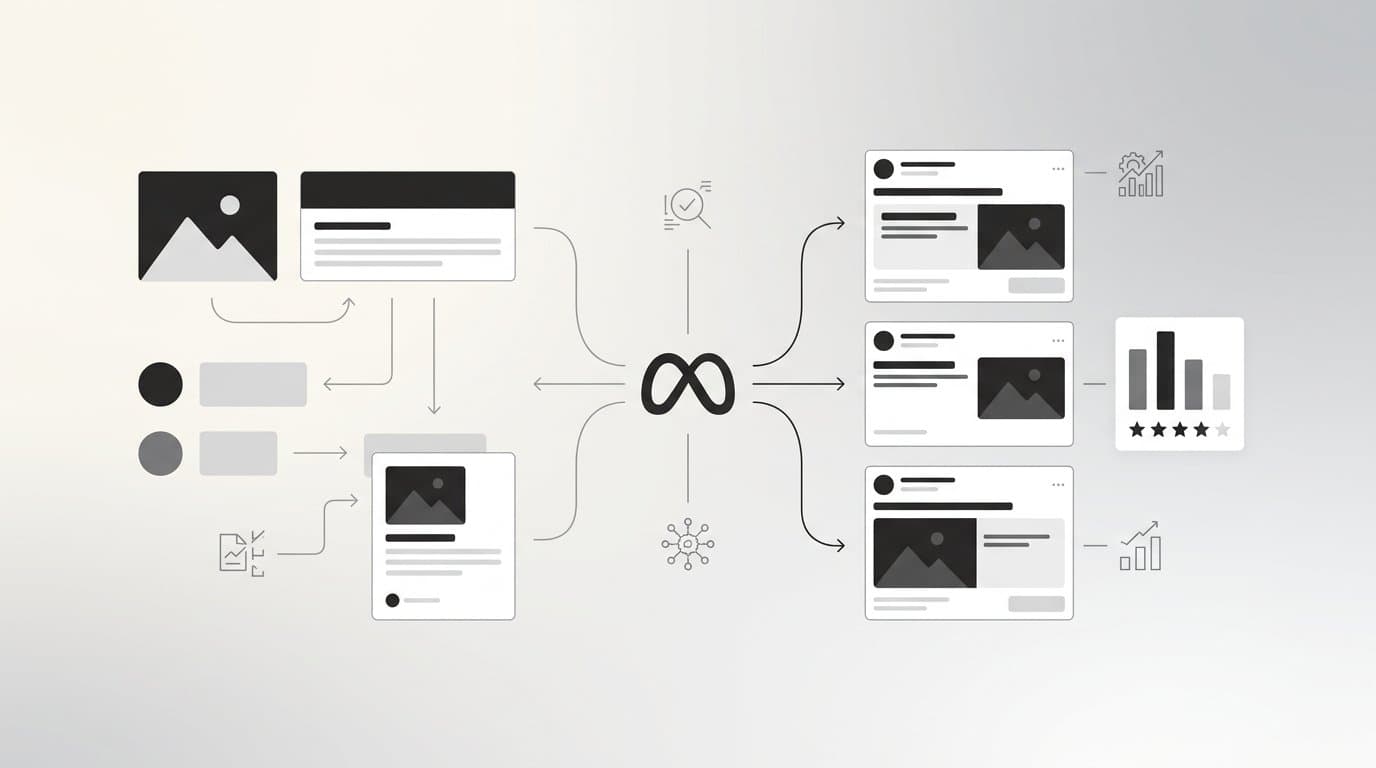
Video ads consistently outperform static creatives across Meta platforms. That is not an opinion; it is something every performance marketer learns quickly once they start running campaigns at scale. The problem has never been whether video works. The problem has been everything that goes into making it.
Hiring videographers, coordinating actors, editing footage, and resizing assets for every placement can take weeks and cost thousands of dollars per creative. By the time your ad is live, the trend you were chasing has moved on. The audience has seen something shinier. And your competitors have already tested three new angles while you were waiting on revisions.
Automated video ad creation changes this equation entirely. With AI-powered tools, marketers can generate scroll-stopping video ads, UGC-style content, and motion creatives in minutes rather than weeks. No video editors. No production crews. No waiting.
But automation alone is not a strategy. The marketers who get the best results are the ones who pair the right workflows with smart creative decisions. They know which formats to prioritize, how to structure hooks that stop the scroll, when to clone what is already working, and how to let performance data guide the next iteration.
This guide covers eight actionable strategies to help you get more from automated video ad creation on Meta. Whether you are a solo performance marketer, a growing agency, or an in-house team managing large budgets, these approaches will help you produce more creative volume, test faster, and scale what works.
1. Start With a Product URL, Not a Brief
The Challenge It Solves
The traditional creative briefing process is one of the biggest time sinks in advertising. Writing a brief, aligning stakeholders, sourcing assets, and handing everything off to a designer or video editor can take days before a single frame is produced. For performance marketers who need to move fast, this process creates a bottleneck that slows everything down.
The Strategy Explained
Modern AI ad platforms can extract product details, visuals, messaging, and brand context directly from a product URL. Instead of writing a detailed brief, you point the system at your product page and let it do the heavy lifting. The AI pulls the relevant information, identifies key selling points, and begins generating video ad concepts automatically.
This approach is particularly powerful for teams managing multiple products or clients. Rather than starting each new campaign from a blank slate, you have a structured starting point in minutes. The creative process shifts from production to refinement, which is where your strategic thinking actually adds value.
Tools like AdStellar are built around this workflow. Paste in a product URL and the platform generates image ads, video ads, and UGC-style creatives without requiring a brief, a designer, or a video editor. You get to first draft faster than most teams get to their first meeting.
Implementation Steps
1. Identify the product pages or landing pages you want to advertise and ensure they are up to date with accurate copy and strong visuals.
2. Input the URL into your AI creative platform and review the extracted product details for accuracy before generation begins.
3. Select the video ad formats you want to generate, such as feed videos, Stories, or Reels, and let the AI produce initial variations.
4. Review the outputs and use chat-based editing to refine messaging, adjust tone, or swap visual elements without rebuilding from scratch.
Pro Tips
The quality of your product page directly affects the quality of the AI output. Make sure your landing page has clear headlines, strong product imagery, and concise benefit-driven copy before you run it through the generator. Think of your product URL as your brief. The better the input, the better the creative.
2. Use UGC-Style Avatar Ads to Build Trust Without Hiring Creators
The Challenge It Solves
User-generated content has become one of the most effective formats in performance marketing, particularly on Meta. Audiences respond to authentic-looking content from real people far more readily than polished brand videos. The challenge is that sourcing real creators takes time, money, and coordination. Briefing creators, reviewing content, managing revisions, and handling usage rights can stretch a simple campaign into a weeks-long project.
The Strategy Explained
AI avatar technology makes it possible to create UGC-style video ads that look and feel like authentic creator content without hiring anyone. These avatar ads feature realistic AI-generated presenters delivering your messaging in a conversational, direct-to-camera format that resonates strongly in Meta feeds.
The key is in how the script and delivery are structured. UGC-style content works because it feels personal and unscripted, even when it is not. When you use AI to generate these ads, focus on writing scripts that sound like a real person talking, not a brand announcement. Lead with a relatable problem or observation. Use casual language. Let the avatar deliver the message the way a trusted friend would.
This format is particularly effective for direct response campaigns where trust and credibility drive conversion decisions. Many advertisers find that UGC-style ads outperform highly produced brand videos in bottom-of-funnel contexts because they feel less like advertising.
Implementation Steps
1. Write a conversational script that opens with a relatable problem or hook, transitions into a product benefit, and closes with a clear call to action.
2. Select an AI avatar that matches your target audience in terms of age, tone, and presentation style.
3. Generate the video and review the pacing, delivery, and visual presentation for authenticity.
4. Test multiple avatar styles and script variations to identify which combination resonates most with your audience.
Pro Tips
Avoid making UGC-style scripts sound like ad copy. The moment the language shifts to formal brand voice, the authenticity breaks down. Read your script out loud before generating the video. If it sounds like something you would say to a friend, you are on the right track. If it sounds like a press release, rewrite it.
3. Clone Competitor Ads From the Meta Ad Library and Iterate
The Challenge It Solves
One of the most common creative mistakes is building video ads in a vacuum. You spend time crafting messaging and formats based on internal assumptions, only to discover that your audience responds to something completely different. Meanwhile, your competitors have already done the testing and found what works. The Meta Ad Library gives you a window into exactly what is running, but most marketers treat it as a research tool rather than a creative starting point.
The Strategy Explained
Competitor ad research is one of the most underused advantages in performance marketing. When you can see which ads a competitor has been running for an extended period, you can reasonably infer those ads are performing well enough to keep running. That is a signal worth acting on.
The strategy is not to copy competitor ads directly. It is to identify the structural elements that are working: the hook format, the visual style, the offer framing, the call to action approach, and then adapt those elements for your own brand and product. AI tools that integrate with the Meta Ad Library can accelerate this process significantly.
With AdStellar's AI Creative Hub, you can clone competitor ads directly from the Meta Ad Library and use them as a foundation for your own creative. The AI adapts the format and structure while you customize the messaging, visuals, and brand elements. You are not starting from zero. You are starting from a proven framework.
Implementation Steps
1. Use the Meta Ad Library to search for competitors in your niche and filter for active video ads that have been running for several weeks or longer.
2. Identify recurring patterns across multiple ads, including hook styles, video length, offer framing, and visual presentation.
3. Use your AI platform to clone the structural format of the strongest examples and adapt them with your own product details and brand voice.
4. Launch the adapted versions alongside your original creatives and let performance data reveal which approach resonates most with your audience.
Pro Tips
Pay attention to ads that have been running consistently for a month or more. Short-lived ads often indicate poor performance. Longevity in the Meta Ad Library is one of the clearest signals that a creative is generating results. Focus your iteration efforts on those formats first.
4. Build Multiple Variations in Bulk and Let Data Pick the Winner
The Challenge It Solves
Creative testing is foundational to performance marketing, but manual testing is slow. Building each ad variation individually, uploading assets, writing copy, configuring targeting, and launching campaigns one at a time creates a process that cannot keep pace with the speed at which audiences experience creative fatigue on Meta. By the time you have tested three variations, your competitors have tested thirty.
The Strategy Explained
Bulk ad creation flips the testing model entirely. Instead of building one variation at a time, you generate hundreds of combinations by mixing different video creatives, headlines, copy variations, and audiences simultaneously. Every combination gets launched to Meta at once, and performance data quickly separates the winners from the underperformers.
This approach is particularly powerful because it removes human bias from the creative selection process. You are not choosing which ad you think will win based on intuition. You are letting your actual audience tell you what works through real spend and real results.
AdStellar's Bulk Ad Launch feature is built specifically for this workflow. Mix multiple creatives, headlines, audiences, and copy at both the ad set and ad level. The platform generates every combination and launches them to Meta in clicks rather than hours. What used to take a full day of manual setup can be done in minutes.
Implementation Steps
1. Prepare a set of video creative variations, aiming for at least three to five distinct concepts rather than minor tweaks to the same idea.
2. Write multiple headline and copy variations for each creative, focusing on different angles such as benefit-led, curiosity-driven, and social proof.
3. Define your audience segments and use your bulk launch tool to generate every combination automatically.
4. Set a clear testing budget and timeline, then let the campaigns run long enough to collect statistically meaningful data before making decisions.
Pro Tips
Resist the urge to pause underperforming ads too quickly. Give each variation enough spend to generate meaningful signals before drawing conclusions. The goal of bulk testing is volume of learning, not just volume of ads. More data means more confident decisions when you scale the winners.
5. Engineer Your Hook in the First Three Seconds
The Challenge It Solves
Most video ads lose their audience before the message even begins. Meta feeds move fast, and viewers make split-second decisions about whether to keep scrolling or stop and watch. If your opening seconds do not immediately signal relevance, curiosity, or value, the rest of your video does not matter. A brilliant product demo buried behind a weak hook will never get seen.
The Strategy Explained
The first three seconds of a video ad are the most important real estate in your entire creative. Meta's own creative guidance consistently emphasizes the importance of capturing attention in the opening moments of a video. This is not a new insight, but it is one that many advertisers still underinvest in.
Effective hooks tend to fall into a few reliable patterns. Pattern interrupts use unexpected visuals or sounds to break the scrolling rhythm. Problem statements open with a pain point the viewer immediately recognizes. Bold claims lead with a specific and compelling promise. Questions create an information gap that makes the viewer want to keep watching.
The advantage of automated video ad creation is that you can test multiple hook approaches without rebuilding entire creatives. With chat-based editing tools, you can swap out the opening sequence of a video, change the first line of dialogue in a UGC-style ad, or adjust the opening visual while keeping the rest of the creative intact. This makes hook testing fast and efficient.
Implementation Steps
1. Identify two or three hook frameworks to test, such as a problem statement, a bold claim, and a curiosity question, and write a version of each for your product.
2. Generate video ads using each hook as the opening, keeping the rest of the creative consistent so you can isolate the variable.
3. Use your AI platform's chat-based editing to refine the delivery, pacing, or visual treatment of each hook without starting over.
4. Launch all hook variations simultaneously and monitor three-second video views, video watch rates, and click-through rates to identify which approach performs best.
Pro Tips
Watch your own ads on your phone in a real feed environment before launching. The desktop preview rarely captures how an ad actually feels when someone encounters it mid-scroll. If you are not compelled to stop within the first two seconds when viewing on mobile, your audience will not be either.
6. Use Performance Data to Drive Your Next Creative Iteration
The Challenge It Solves
Creative decisions in many teams are still made based on personal preference, internal opinions, or what performed well in a completely different context. This gut-feel approach to creative iteration is one of the main reasons ad performance plateaus. Without a systematic way to understand which specific elements are driving results, every new creative is essentially a fresh guess.
The Strategy Explained
Data-driven creative iteration means using actual performance metrics to inform every new creative decision. Rather than asking "what should we try next," you are asking "what does the data tell us is working, and how do we build more of it."
This requires more than just looking at overall campaign ROAS. You need visibility into which specific creatives, headlines, copy variations, and audiences are driving your best results. Leaderboard-style ranking tools that score every element against your actual goals make this kind of analysis fast and actionable.
AdStellar's AI Insights feature ranks your creatives, headlines, copy, audiences, and landing pages by real metrics like ROAS, CPA, and CTR. You set your target goals and the AI scores everything against your benchmarks. Instead of digging through spreadsheets to find your winners, the platform surfaces them automatically so you can act on the information immediately.
The iteration cycle becomes: test broadly, identify winners through data, build on what works, and repeat. Each cycle produces better starting points than the last because you are building on proven performance rather than starting from intuition.
Implementation Steps
1. Define your primary success metrics before launching any campaign so you have a clear benchmark to score against.
2. Let campaigns run long enough to collect meaningful data, then use your insights dashboard to identify which creative elements are ranking highest.
3. Build your next batch of video ads by leading with the elements that are already proven to perform, whether that is a specific hook style, a particular offer framing, or a visual approach.
4. Continue the cycle with each new iteration informed by the last round of data.
Pro Tips
Look for patterns across multiple winners rather than optimizing around a single top performer. If three of your top five video ads share a similar hook structure, that pattern is more meaningful than any single data point. Patterns tell you something durable about your audience. Single outliers might be noise.
7. Match Video Ad Format to Funnel Stage
The Challenge It Solves
Running the same video ad format to everyone regardless of where they are in the buying journey is one of the most common and costly mistakes in Meta advertising. A cold audience encountering your brand for the first time needs a completely different message than someone who has already visited your product page twice. When format and funnel stage are misaligned, you waste budget and confuse potential customers.
The Strategy Explained
Funnel-stage alignment means deliberately designing video ads with different objectives depending on where your audience is in their decision-making process. Awareness content at the top of the funnel benefits from shorter videos with broad, attention-grabbing messaging that introduces your brand or product category. Consideration content in the middle of the funnel can go deeper on benefits, comparisons, and social proof. Conversion content at the bottom of the funnel should be specific, offer-driven, and designed to remove the final friction between interest and purchase.
Automated video ad creation makes it practical to produce all three funnel stages simultaneously without tripling your production workload. You can generate awareness-level video ads, consideration-level explainers, and conversion-focused offer ads from the same product URL in a single session.
The key is being intentional about which format serves which stage. Short, punchy videos work well for cold traffic where you have limited attention. Longer formats with more detail and social proof work better for warm audiences who are already considering their options. UGC-style avatar ads often perform particularly well in consideration and conversion contexts because the conversational format mirrors how people seek recommendations from others they trust.
Implementation Steps
1. Map out your funnel stages and define the primary objective and message for each: awareness, consideration, and conversion.
2. Generate video ad variations for each stage, adjusting length, tone, and messaging to match the objective of that stage.
3. Configure your Meta campaigns to serve the appropriate video format to the right audience segment based on their level of prior engagement with your brand.
4. Monitor performance metrics specific to each stage, such as reach and video views for awareness, engagement and link clicks for consideration, and conversions and ROAS for bottom-of-funnel.
Pro Tips
Do not assume that a top-performing conversion ad will also work well for cold audiences. The specificity that makes a conversion ad compelling to warm traffic can feel confusing or irrelevant to someone who has never heard of your brand. Keep your funnel layers distinct and let each video do one job well.
8. Build a Reusable Winners Library to Compound Your Creative Advantage
The Challenge It Solves
Most advertising teams have a hidden problem: they keep starting from zero. A video ad performs well, the campaign ends, and the next time a similar campaign is needed, the team rebuilds from scratch. Proven hooks, high-performing creative structures, and winning copy combinations get buried in old campaign folders or lost entirely. This means every new campaign carries the same risk as the first one, even when you have already done the hard work of finding what works.
The Strategy Explained
A winners library is a centralized, organized collection of your best-performing creative elements. Not just full video ads, but the specific components that drove results: hooks that generated strong three-second view rates, copy angles that drove high CTR, visual styles that resonated with particular audience segments, and offer framings that converted well at the bottom of the funnel.
When your winners are organized and accessible, every new campaign starts from a position of strength. Instead of guessing which hook to use, you pull from proven performers. Instead of writing copy from scratch, you build on angles that have already demonstrated they work with your audience.
AdStellar's Winners Hub is designed specifically for this purpose. Your best-performing creatives, headlines, audiences, and more are all in one place with real performance data attached. When you are ready to build the next campaign, you can select any winner and instantly add it to your new campaign. The creative advantage compounds over time because every campaign makes the next one better.
Implementation Steps
1. Establish a clear performance threshold for what qualifies as a winner in your account, based on metrics like ROAS, CPA, or CTR relative to your goals.
2. After each campaign cycle, review your results and tag the top-performing video ads, hooks, copy variations, and audiences for your winners library.
3. Organize your library by format, funnel stage, and product category so elements are easy to find and deploy when building new campaigns.
4. When launching new campaigns, start by reviewing your winners library for proven elements you can carry forward rather than defaulting to creating everything from scratch.
Pro Tips
Include context notes alongside each winner. Record which audience it performed best with, what objective the campaign was optimized for, and what time period it ran. Performance data without context can be misleading. A video ad that crushed it for a warm retargeting audience might underperform badly for cold traffic, and knowing that distinction saves you from making costly assumptions.
Putting It All Together
Automated video ad creation is not just about speed, though the time savings are significant. It is about removing the production bottleneck so you can focus on strategy, testing, and scaling what works.
The eight strategies in this guide form a complete framework. Start with strong inputs by using product URLs instead of lengthy briefs. Build trust at scale with UGC-style avatar ads. Learn from what is already working by studying competitor formats in the Meta Ad Library. Generate volume through bulk creation and let data select your winners. Engineer stronger hooks in the first three seconds of every video. Replace gut-feel decisions with data-driven iteration using leaderboard rankings and goal-based scoring. Align your video format to funnel stage so every ad does the right job for the right audience. And build a reusable winners library so your creative advantage compounds with every campaign you run.
The marketers who win on Meta are not the ones with the biggest production budgets. They are the ones who can generate more creative variations, test faster, and act on performance data before their competitors do. Automated video ad creation makes all of that possible without the traditional overhead.
If you are ready to put these strategies into practice, Start Free Trial With AdStellar and see how fast your creative output can scale. Generate image ads, video ads, and UGC-style creatives from a product URL. Launch campaigns directly to Meta with AI-optimized audiences and copy. Surface your winners automatically with real-time insights and leaderboard rankings. One platform, from creative to conversion.