Facebook advertising has become a high-stakes game of speed and precision. While you're manually building your third campaign variation of the day, your competitors are already testing dozens of audience combinations. While you're debating which headline performs better, entire product launches are happening around you with AI systems that don't sleep, don't second-guess, and don't need coffee breaks to make decisions.
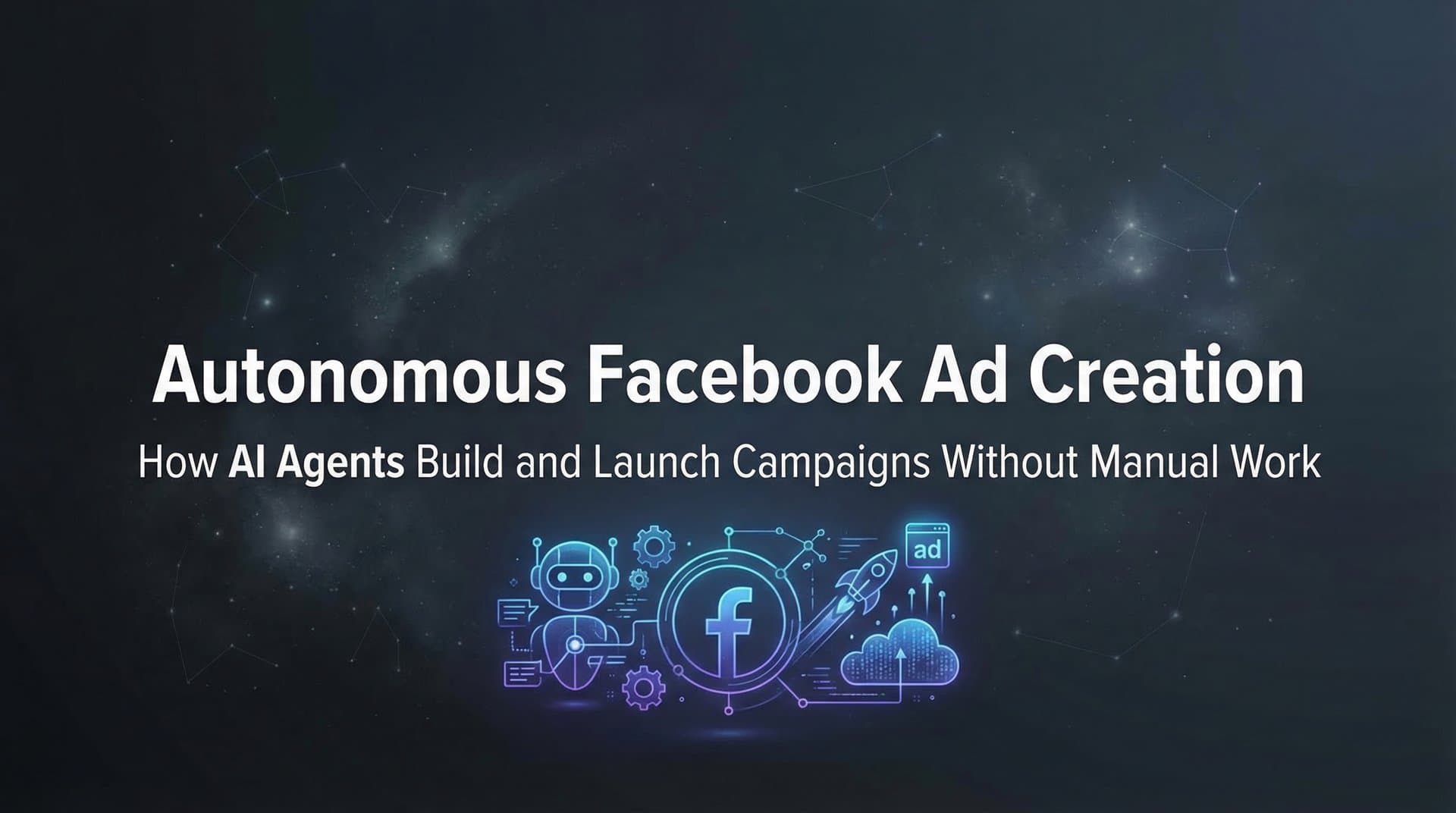
This isn't about basic automation—scheduling posts or using saved audiences. We're talking about autonomous Facebook ad creation: intelligent systems where specialized AI agents analyze your performance history, identify winning patterns, and build complete campaigns without you touching a single setting. No templates. No rules you programmed last month. Just adaptive intelligence that gets smarter with every campaign it launches.
The difference matters more than you might think. Traditional automation follows your instructions. Autonomous systems make informed decisions based on what's actually working in your account right now. One saves you from repetitive tasks. The other fundamentally changes what's possible when you're managing advertising at scale.
How AI Agents Actually Build Campaigns From Scratch
Autonomous ad creation starts with something most advertisers already have but rarely leverage systematically: historical performance data. Every campaign you've ever run contains patterns—which audiences engaged, which creative elements drove conversions, which budget allocations produced the best returns. An autonomous system treats this data as its instruction manual.
Here's where it gets interesting. Instead of one monolithic AI trying to handle everything, modern autonomous platforms deploy specialized AI agents for Facebook ads that each focus on a specific campaign function. Think of it like a team where each member has deep expertise in one area.
The Director Agent: Analyzes your business objective and determines the optimal campaign structure. It's not following a template—it's making contextual decisions based on what's worked for similar goals in your account history.
The Targeting Strategist: Examines which audience segments have delivered results, then constructs new targeting parameters that build on those insights. It identifies patterns you might miss—like how certain interests perform better when combined, or how lookalike percentages affect conversion rates at different budget levels.
The Creative Curator: Scans your asset library and performance data to select images, videos, and formats that match successful patterns. It understands that a product photo that worked in one campaign context might underperform in another, and it makes those distinctions automatically.
What makes this truly autonomous rather than just automated is the learning loop. After each campaign launches, these agents analyze the results and adjust their decision-making frameworks. The targeting strategist notices that certain demographic combinations outperformed expectations. The creative curator identifies which visual styles drove engagement. The budget allocator sees which campaign structures delivered the lowest cost per acquisition.
This creates a continuous improvement cycle. Your tenth autonomous campaign is fundamentally smarter than your first because the system has learned from nine previous experiments. It's pattern recognition at a scale and speed impossible through manual analysis.
The coordination between agents matters just as much as their individual capabilities. The budget allocator doesn't just divide your spend evenly—it considers the targeting strategist's audience complexity and the creative curator's asset availability. If you have limited creative variations, it might recommend broader audiences with lower frequency caps. If you have dozens of creative options, it might suggest tighter targeting with more aggressive testing.
The Real Cost of Manual Campaign Management
Let's be honest about what manual campaign building actually requires. You're looking at 30-45 minutes minimum for a single campaign with multiple ad sets. That's if everything goes smoothly—if you already know your targeting parameters, have your creative assets ready, and don't get distracted by Slack notifications.
Now multiply that across a realistic advertising workload. An agency managing five clients with two campaigns per week each is spending 5-7.5 hours weekly just on campaign construction. That's before monitoring, optimization, reporting, or strategic thinking. An in-house team testing three different audience segments with four creative variations is building twelve ad sets manually, each requiring individual setup and configuration.
The time investment is just the visible cost. The invisible cost is decision fatigue.
By your third campaign of the day, you're making different choices than you did on the first. Maybe you skip testing that additional audience segment because you're tired. Maybe you default to the same headline structure you used last week because coming up with fresh variations requires mental energy you don't have. Maybe you launch with "good enough" targeting because the perfect configuration would take another twenty minutes you can't spare. These are the manual Facebook ad creation challenges that compound over time.
Human cognitive bias compounds the problem. We overweight recent results—that campaign from last week feels more relevant than the similar one from two months ago, even if the older data is more statistically significant. We see patterns that don't exist and miss patterns that do. We make decisions based on incomplete information because synthesizing all available data exceeds our processing capacity.
Autonomous systems don't experience decision fatigue. The hundredth campaign gets the same analytical rigor as the first. Every relevant data point from your account history informs every decision. There's no cognitive bias toward recent results—the system weighs statistical significance objectively.
The scalability difference becomes stark when you're managing multiple campaigns simultaneously. A skilled advertiser might handle 3-4 campaign builds in a morning. An autonomous system can build dozens in the time it takes you to grab coffee. Not because it's rushing—because it's processing decisions in parallel that you have to make sequentially.
This isn't about replacing human judgment. It's about redirecting it. Instead of spending hours on mechanical setup, you're analyzing results, refining strategy, and focusing on the creative and positioning decisions that actually require human insight. The autonomous system handles execution. You handle direction.
The Intelligence Behind Self-Directing Ad Systems
Autonomous ad platforms operate on three foundational components that work in constant coordination. Understanding these components helps clarify what separates true autonomy from basic automation tools that simply execute predefined rules.
Performance Data Analysis Engines: These systems continuously scan your advertising history to identify winning combinations. Not just "this ad performed well" but "this ad performed well with this audience at this budget level during this time period." The analysis is multidimensional—looking at creative elements, audience characteristics, bidding strategies, and placement performance simultaneously.
The sophistication lies in pattern recognition across variables. Maybe your product ads perform better with broad audiences while your service ads need precise targeting. Maybe video creative works for cold audiences but static images convert better for remarketing. Maybe certain interest combinations produce qualified leads while others drive high engagement but low conversion. A robust analysis engine identifies these patterns without you manually testing every permutation.
Dynamic Audience Targeting: Traditional targeting relies on you selecting parameters upfront and hoping they perform. Autonomous targeting adapts based on real-time engagement signals. If the system launches a campaign with three audience segments and one segment shows strong early engagement, it can shift budget allocation before you even check the results. If certain demographic combinations within a broader audience are driving conversions, it can create refined segments automatically. For advertisers struggling with Facebook ad targeting, this dynamic approach eliminates much of the guesswork.
This dynamic approach matters because audience performance isn't static. What worked last month might underperform this month due to seasonal factors, competitive changes, or platform algorithm updates. Autonomous targeting systems detect these shifts and adjust without requiring you to notice the trend and manually update your campaigns.
The targeting intelligence extends beyond simple performance metrics. Advanced systems analyze engagement quality—not just whether someone clicked, but whether they took meaningful actions after clicking. They identify audience segments that produce customers with high lifetime value versus those that generate one-time purchasers. They recognize when audience fatigue is setting in and automatically introduce fresh targeting parameters.
Automated Creative Variation and Testing: Manual A/B testing is inherently limited by how many variations you have time to create and manage. You might test three headlines against each other, or try two different images, but testing twelve headline variations with eight image options across four audience segments quickly becomes unmanageable.
Autonomous creative systems approach this differently. They analyze which creative elements have historically performed well—specific headline structures, image compositions, call-to-action phrases, video lengths—and automatically generate variations that combine these winning elements in new ways. Not random combinations, but informed variations based on what's worked in similar contexts.
The testing happens continuously rather than in discrete experiments. The system isn't waiting for you to declare a winner and manually update campaigns. It's identifying performance patterns in real-time and shifting delivery toward winning variations while continuing to test new combinations. This creates an ongoing optimization cycle that compounds over time.
What makes this truly powerful is the integration between these three components. The creative system informs the targeting system about which audiences respond to which creative styles. The targeting system tells the budget allocator which segments justify increased investment. The performance analyzer identifies patterns across both creative and targeting that neither component would recognize in isolation.
Knowing When Autonomous Creation Fits Your Strategy
Autonomous ad creation isn't universally optimal for every advertising scenario. Understanding when it provides genuine strategic advantage versus when manual control makes more sense helps you deploy the technology effectively.
High-volume advertisers face a fundamental math problem that autonomous systems solve elegantly. If you're managing campaigns across multiple products, regions, or client accounts, the manual workload scales linearly with campaign count. Ten campaigns take ten times longer than one campaign. Autonomous systems break this linear relationship—the tenth campaign takes roughly the same time as the first because the system handles the execution work.
Agencies managing multiple client accounts particularly benefit from this scaling advantage. Each client needs customized campaigns based on their unique performance history, brand guidelines, and business objectives. Building these manually means either limiting how many clients you can serve or hiring proportionally more team members. The right Facebook ad creation software for agencies lets you scale client load without proportional headcount increases, fundamentally changing the agency economics.
Teams with limited bandwidth face a different but related challenge. You might have the strategic expertise to run sophisticated campaigns, but lack the time to execute them at the frequency and scale that would maximize results. This creates a gap between what you know would work and what you can actually implement. Autonomous creation closes that gap—your strategic insights get executed at machine speed.
Speed-to-market scenarios represent another clear fit. Product launches, seasonal campaigns, and time-sensitive promotions all benefit from rapid deployment. When you have a 48-hour window to capitalize on a trending topic or need campaigns live before a weekend sale starts, manual building introduces delay that costs opportunity. Autonomous systems can have campaigns live in minutes rather than hours.
Conversely, autonomous creation might be overkill for certain scenarios. If you're running a single ongoing campaign with minimal variation, the setup time for an autonomous system might exceed the time saved. If your creative strategy requires deeply custom messaging that changes frequently based on current events, the autonomous approach might lack the nuanced judgment needed. If you're in a highly regulated industry where every ad requires legal review before launch, the speed advantage becomes less relevant.
The sweet spot for autonomous creation typically involves some combination of these factors: managing multiple campaigns simultaneously, needing to test variations at scale, operating with limited manual bandwidth, or requiring fast deployment cycles. The more of these factors apply to your situation, the stronger the case for autonomous approaches.
Critical Features That Separate Real Intelligence From Marketing Hype
The autonomous advertising space has attracted its share of tools that promise AI-powered automation but deliver glorified templates. Evaluating platforms requires looking past marketing claims to understand actual capabilities.
Transparency in Decision-Making: A genuine autonomous system should explain why it made specific choices. Not just "the AI selected this audience" but "this audience was selected because it showed 23% higher conversion rates in your previous campaigns with similar creative styles." If a platform can't articulate the reasoning behind its decisions, it's likely using simpler automation dressed up as AI.
This transparency matters for learning and trust. You should be able to review the AI's rationale, understand the data it analyzed, and see which patterns influenced each decision. This creates accountability—you can evaluate whether the system's logic aligns with your business knowledge and identify when it might be missing context that requires human intervention.
Deep Meta API Integration: Surface-level integrations that only access basic campaign data can't power truly autonomous decisions. Look for platforms with comprehensive API access that can analyze detailed performance metrics, audience insights, and creative performance across all your campaigns. Understanding how to use Facebook Ads API capabilities helps you evaluate which platforms offer genuine depth versus superficial connections.
Real integration means the platform can see everything you could see in Ads Manager and more—analyzing patterns across campaigns that would take you hours to compile manually. It should access creative-level performance data, audience segment breakdowns, placement performance, and conversion tracking details. Limited data access produces limited intelligence.
Adaptive Learning Mechanisms: This is the fundamental distinction between autonomous and automated. Automated systems execute predefined rules consistently. Autonomous systems improve their decision-making based on results. Ask potential platforms: How does your system get better over time? What specific mechanisms enable learning from campaign performance?
Strong learning mechanisms show measurable improvement in campaign performance as the system processes more data from your account. Your twentieth campaign should perform better than your fifth because the AI has learned from fifteen additional data points. If performance stays static regardless of how long you use the platform, you're dealing with automation, not autonomy.
The learning should be account-specific, not just platform-wide. Generic insights from other advertisers might provide baseline intelligence, but real autonomous systems develop expertise in your specific business, products, audiences, and creative styles. They should recognize patterns unique to your account that wouldn't apply to other advertisers.
Flexibility and Control Options: Paradoxically, the best autonomous systems give you meaningful control when you need it. You should be able to set guardrails—budget limits, audience exclusions, brand guidelines—while letting the AI operate freely within those boundaries. Complete black-box systems that offer no control often indicate limited sophistication rather than advanced AI.
The Evolution From Manual to Autonomous Advertising
Autonomous Facebook ad creation represents a fundamental shift in how advertising execution works, but it's important to understand what's actually changing and what remains constant.
The technology doesn't replace strategic thinking. You still need to understand your market, define your positioning, create compelling offers, and develop creative concepts that resonate with your audience. What changes is the execution layer—taking those strategic decisions and deploying them at scale with speed and precision that manual work can't match.
Think of it as the difference between being a skilled craftsperson and having access to advanced manufacturing equipment. The craftsperson's expertise remains valuable—understanding materials, design principles, quality standards. But the manufacturing equipment lets them produce at a volume and consistency impossible through manual methods. Both the expertise and the tools matter. Neither alone is sufficient.
For competitive advertisers, autonomous systems are rapidly becoming table stakes rather than optional advantages. When your competitors can test dozens of audience and creative combinations in the time it takes you to build three campaigns manually, the speed differential compounds over time. They're learning faster, iterating faster, and optimizing faster. Manual approaches increasingly can't keep pace. This is why understanding AI vs manual Facebook ad creation differences has become essential for serious advertisers.
The trajectory is clear. As advertising platforms grow more complex—more placement options, more targeting parameters, more optimization variables—manual management becomes increasingly untenable. The human cognitive capacity for managing complexity doesn't scale with platform complexity. Autonomous systems that can process multidimensional optimization problems in real-time become not just helpful but necessary.
This doesn't mean every advertiser needs autonomous systems immediately. But understanding the capability and evaluating whether it fits your current or future needs is becoming essential. The question isn't whether AI will play a role in advertising execution—it's when you'll adopt it and how effectively you'll deploy it.
The platforms that succeed in this space will be those that combine genuine autonomous intelligence with transparency, account-specific learning, and meaningful human control. They'll augment human expertise rather than trying to replace it, handling the execution complexity that bogs down manual workflows while preserving the strategic judgment that drives advertising success.
Ready to transform your advertising strategy? Start Free Trial With AdStellar AI and be among the first to launch and scale your ad campaigns 10× faster with our intelligent platform that automatically builds and tests winning ads based on real performance data. Our 7-agent system handles everything from campaign structure to creative selection to budget allocation—giving you the execution speed of automation with the adaptive intelligence of true AI.