Writing ad copy that converts is one of the most time-consuming parts of running Meta campaigns. You need headlines that grab attention, primary text that builds desire, and calls to action that drive clicks. Multiply that by dozens of ad variations, and you're looking at hours of creative work before a single ad goes live.
AI assisted ad copywriting changes that equation entirely. Instead of staring at a blank screen trying to craft the perfect hook, you can generate multiple copy variations in minutes, test them against each other, and let performance data tell you what resonates with your audience.
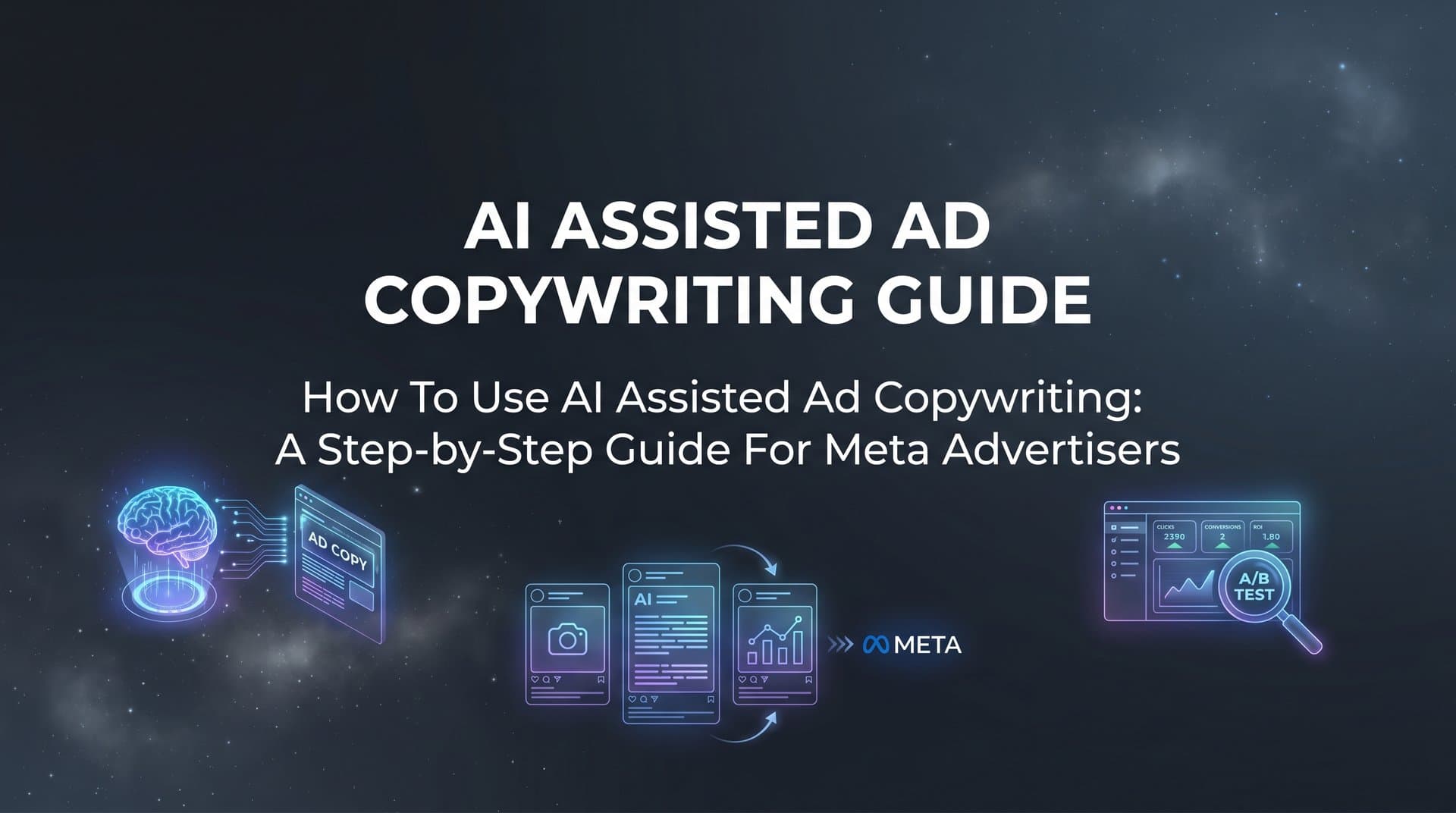
This guide walks you through the complete process of using AI to write ad copy for Meta campaigns. You'll learn how to set up your inputs for better AI output, generate copy that matches your brand voice, refine variations using chat-based editing, and scale your testing to find winning combinations faster.
Whether you're a solo marketer managing multiple accounts or an agency handling dozens of clients, these steps will help you produce more ad copy in less time while maintaining quality and brand consistency.
Step 1: Gather Your Product and Audience Inputs
The quality of your AI-generated copy depends entirely on what you feed it. Think of this step as briefing a copywriter. The more context you provide, the better the output.
Start with your product URL. This gives the AI access to your product descriptions, features, pricing, and visual elements. But don't stop there. Create a simple input document that includes your key benefits written in plain language, your unique selling points that differentiate you from competitors, and any specific value propositions you want emphasized.
Next, define your target audience with specificity. Instead of "small business owners," try "e-commerce store owners struggling with abandoned carts and looking to recover lost revenue." The more detailed your audience description, the more targeted your copy becomes. Include their pain points, desires, objections, and the language they actually use when talking about their problems. This level of detail is essential for effective automated audience segmentation later in your campaigns.
Gather any brand voice guidelines you have. If your brand is playful and irreverent, note that. If you're professional and data-driven, specify it. Include examples of existing high-performing copy if you have it. These examples teach the AI what success looks like for your brand.
Pro tip: Save a template of your best-performing ad copy. When you feed this to the AI as a reference, it can match that style and structure while creating new variations.
Pull together any competitor angles you've noticed working. You're not copying them, but you're identifying proven frameworks in your market. If competitors consistently emphasize free shipping or 30-day guarantees, that's market intelligence worth noting.
Document your campaign objectives clearly. Are you driving awareness, generating leads, or pushing direct sales? The copy for each goal looks different. A lead generation ad might emphasize a free guide, while a direct sales ad focuses on product benefits and urgency.
Success indicator: You have a clear input document with your product URL, key benefits, audience details, brand voice notes, and campaign objectives. This preparation takes 15 minutes but saves hours of back-and-forth refinement later.
Step 2: Generate Your First Round of Ad Copy Variations
Now comes the part where AI shows its real value. Instead of writing one headline at a time, you're about to generate multiple complete ad variations simultaneously.
Input your product URL into your AI ad platform. The AI analyzes your product page, extracts key features and benefits, and understands your offering at a foundational level. This automatic analysis catches details you might forget to mention manually.
Request multiple variations in one go. Ask for 5 to 10 different headline approaches, each with corresponding primary text and CTAs. This isn't about perfection on the first try. It's about generating raw material you can refine. Understanding AI ad copywriting techniques helps you get better results from these initial generations.
The AI will create different angles automatically. One variation might lead with a pain point, another with a benefit, and a third with social proof. This diversity gives you options to test against each other rather than committing to a single approach.
Review each variation for factual accuracy first. AI is powerful, but it can occasionally misinterpret product details or make assumptions. Check that claims about your product are accurate, pricing is correct, and features are described properly.
Look for brand alignment next. Does the tone match how you normally communicate? If your brand is professional but the copy sounds casual, flag it for refinement. If you're known for being edgy but the copy is bland, note that too.
What good output looks like: Your headlines should be attention-grabbing without being clickbait. Primary text should flow naturally from the headline and build a clear case for your product. CTAs should be specific and action-oriented.
Don't expect every variation to be perfect. You're looking for 2 to 3 variations that are close to ready and another 3 to 5 that have potential with some refinement. Even variations that miss the mark can contain useful phrases or angles you can extract.
Save everything at this stage. Copy that doesn't work for one campaign might be perfect for another. A headline that feels too aggressive for a cold audience might crush it for retargeting.
Success indicator: You have 5 to 10 complete ad copy variations with headlines, primary text, and CTAs. At least 2 to 3 are close to campaign-ready, and the rest show promise with refinement.
Step 3: Refine Copy Using Chat-Based Editing
This is where AI assisted copywriting gets really efficient. Instead of starting over when something isn't quite right, you refine through conversation.
Use natural language prompts to adjust your copy. Try "Make this headline more urgent" or "Adjust the tone to be more professional" or "Emphasize the time-saving benefit more strongly." The AI understands these conversational requests and modifies the copy accordingly.
Request specific structural changes without rewriting everything. Ask to shorten primary text from 150 words to 100 words, add a specific benefit to the second paragraph, or change the CTA from "Learn More" to something more action-specific. These refinements align with proven Facebook ad copywriting best practices.
Test different emphasis angles quickly. If your first round emphasized price, ask the AI to rewrite the same variation emphasizing quality instead. If you led with features, request a benefit-focused version. This rapid iteration lets you explore different messaging approaches in minutes.
Example refinement sequence: Start with a generated headline like "Save Time on Ad Creation." Refine it with "Make this more specific about how much time." Get "Create a Week's Worth of Ads in 30 Minutes." Refine again with "Add urgency." Land on "Create a Week's Worth of Ads in 30 Minutes (Before Your Competitors Do)."
Match competitor angles without copying them directly. If you notice a competitor using a "money-back guarantee" angle effectively, ask the AI to incorporate your guarantee into the copy with a fresh approach. You're borrowing the framework, not the words.
Adjust for different placements as needed. Feed copy works differently than Stories copy. Ask the AI to adapt your primary text for Stories format, making it shorter and more visual-focused while keeping the core message intact.
Keep the conversation contextual. The AI remembers what you're working on, so you can make incremental improvements without explaining everything again. "Now make it funnier" or "Add a question at the start" works because the AI knows what "it" refers to.
Success indicator: Your copy now matches your brand voice precisely, emphasizes the right benefits for your audience, and feels campaign-ready. The refinement process took minutes instead of the hours you'd spend rewriting manually.
Step 4: Clone and Adapt Competitor Ad Copy
Your competitors are running live experiments with real budget. Their successful ads represent proven frameworks you can learn from and adapt.
Start by identifying high-performing competitor ads in the Meta Ad Library. Look for ads that have been running for months, as longevity usually indicates performance. Pay attention to the angles they emphasize, the structure of their copy, and the specific benefits they lead with.
Feed competitor ad examples to your AI platform for analysis. The AI identifies the underlying frameworks, hooks, and persuasion techniques being used. It's not about copying their words but understanding their approach. This is one of the most effective Facebook ad copywriting strategies for accelerating your learning curve.
Request variations that adapt these frameworks to your product. If a competitor leads with "Stop wasting money on X," the AI can generate your version that addresses the same pain point with your unique solution. The structure is borrowed, but the execution is original.
Framework extraction example: A competitor ad might use the pattern "Problem + Agitation + Solution + Proof + CTA." You can ask the AI to apply this same structure to your product, creating copy that follows a proven formula while being completely unique to your brand.
Look for gaps in competitor messaging. If everyone in your space emphasizes speed but nobody mentions ease of use, that's an opportunity. Ask the AI to generate copy that highlights this underserved angle.
Differentiate deliberately. Once you understand what competitors are saying, ask the AI to create variations that explicitly contrast your approach. If they emphasize complexity and features, you can emphasize simplicity and outcomes.
Test competitor-informed copy against your original variations. Sometimes the fresh perspective of an outside framework outperforms your internal assumptions about what will work. Let the data decide.
Success indicator: You have competitor-informed copy variations that use proven frameworks but differentiate your brand clearly. You understand the angles working in your market and have created your own take on them.
Step 5: Build Bulk Variations for Testing
Here's where AI assisted ad copywriting delivers massive time savings. You're about to create more ad variations in minutes than you could manually write in days.
Start with your best headlines from previous steps. Select 5 to 10 headline variations that take different angles. One might emphasize speed, another cost savings, another ease of use. This diversity is intentional.
Do the same with primary text. Choose 5 to 10 primary text variations that support different value propositions and use different persuasion techniques. Some might be benefit-focused, others might tell a story, and others might use social proof. Mastering Facebook ads copywriting at scale requires this systematic approach to variation creation.
Select 3 to 5 CTA variations. Test "Get Started Free" against "Start Your Trial" against "See How It Works." Small CTA changes can significantly impact conversion rates.
Now combine them systematically. Mix every headline with every primary text option and every CTA. If you have 5 headlines, 5 primary text variations, and 3 CTAs, you just created 75 unique ad copy combinations. The AI handles this multiplication automatically.
Testing matrix strategy: You're not randomly combining elements. You're creating a structured test where each element can be evaluated independently. When you see which combinations perform best, you learn which headlines work, which primary text resonates, and which CTAs convert.
Layer in creative variations next. If you have 10 different ad creatives and 75 copy combinations, you now have 750 complete ads ready to test. This scale is impossible with manual copywriting but routine with AI assistance.
Add audience variations to the mix. The same copy might perform differently for cold audiences versus retargeting, or for different demographic segments. Create copy variations optimized for each audience segment you're testing.
Organize your variations logically. Group them by angle or theme so you can analyze patterns later. All urgency-focused variations in one group, all benefit-focused in another, all social proof-focused in a third.
Success indicator: You have dozens or hundreds of ad combinations ready for systematic testing. Each variation is unique, and you have a clear structure for understanding what performs best.
Step 6: Launch and Let AI Surface Your Winners
Your bulk variations are ready. Now you launch them and let performance data tell you what actually works with your audience.
Deploy your copy variations directly to Meta campaigns through your AI platform. The technical setup is handled automatically, so you're not manually creating hundreds of ads in Ads Manager. What would take hours happens in clicks. Our Meta ads bulk launch guide covers the technical details of deploying at scale.
Set your campaign to run with adequate budget for meaningful testing. Each variation needs enough impressions and clicks to generate reliable performance data. Underfunding your test means you'll get noise instead of signal.
Let the AI track performance across all your copy elements. It monitors which headlines generate the highest CTR, which primary text drives the lowest CPA, and which CTAs produce the best ROAS. This granular tracking is automatic.
How AI insights work: The platform creates leaderboards ranking your headlines, primary text, and CTAs by the metrics that matter to you. Set your target CPA or ROAS, and the AI scores every element against your goals. Top performers rise to the top automatically.
Watch for patterns in your winners. If all your top-performing headlines emphasize speed, that tells you something about your audience's priorities. If benefit-focused primary text consistently outperforms feature lists, you've learned a valuable lesson about your messaging.
Identify winning combinations, not just winning elements. Sometimes a headline performs well overall but crushes it when paired with specific primary text. The AI surfaces these combination insights that would be nearly impossible to spot manually across hundreds of variations.
Kill underperformers quickly. Once you have statistical significance showing certain variations aren't working, shut them down and reallocate budget to winners. The AI can flag these automatically based on your performance thresholds. Proper Meta ads performance tracking ensures you're making decisions based on reliable data.
Scale winners strategically. When you identify copy that's delivering exceptional ROAS or CPA, increase its budget. Create new variations that iterate on the winning formula. Test slight modifications to see if you can improve performance further.
Success indicator: You know exactly which copy variations drive the best results. You have clear data showing which headlines, primary text, and CTAs resonate with your audience. You're making scaling decisions based on performance, not guesswork.
Step 7: Save Winners and Build Your Copy Library
Your best-performing copy is an asset. Treat it like one by systematically saving and organizing it for future use.
Store your top-performing headlines in a Winners Hub or copy library. Tag them with performance metrics so you know not just what the headline is, but what ROAS or CPA it delivered. This context matters when deciding whether to reuse it.
Save winning primary text with notes about what made it successful. Did it work because of the specific benefit emphasized? The storytelling structure? The social proof included? Document these insights so you can replicate the approach. These learnings become the foundation for your Facebook ad copywriting tips for conversions playbook.
Organize CTAs by conversion rate and use case. Some CTAs work better for cold traffic, others for retargeting. Some drive more clicks but lower conversion rates. Some have lower CTR but higher purchase intent. Know which is which.
Building your library strategically: Don't just save everything. Curate your winners. Keep the top 20% of performers and regularly prune underperformers. A lean library of proven copy is more valuable than a bloated collection of mediocre variations.
Create templates from your winning formulas. If a specific headline structure consistently performs, turn it into a template. "Save [X amount of time/money] on [pain point]" becomes a framework you can apply to new products or campaigns.
Reuse proven elements in new campaigns with one click. When launching your next campaign, pull your best-performing headlines from previous campaigns. Mix them with new primary text to create fresh variations that leverage proven hooks.
Build a continuous learning loop. Each campaign adds more data to your library. The AI learns which copy patterns work for your specific audience and brand. Over time, the initial copy generated gets better because it's informed by your historical winners.
Share winning copy across your team or clients. If you're an agency, your copy library becomes a competitive advantage. You can show clients the exact copy that drove results and quickly spin up new campaigns using proven frameworks.
Success indicator: You have a growing library of tested, high-performing copy organized by type and tagged with performance data. Each new campaign starts from a stronger foundation than the last.
Putting It All Together
AI assisted ad copywriting transforms how you approach Meta advertising. Instead of spending hours crafting individual ads, you can generate, test, and optimize copy at scale while maintaining quality and brand consistency.
The process becomes systematic. Gather your inputs once, generate variations in minutes, refine with conversational editing, learn from competitor angles, build bulk test matrices, launch and analyze performance, then save your winners for future campaigns. Each step builds on the last, creating a workflow that gets faster and more effective over time.
Quick checklist before your next campaign: Gather product inputs and audience details. Generate initial copy variations from your product URL. Refine with chat-based editing until the tone matches your brand. Clone competitor angles for additional inspiration. Build bulk variations for comprehensive testing. Launch and monitor AI insights to surface winners. Save top performers to your Winners Hub for future use.
The real power isn't just the time savings, though that alone is significant. It's the testing velocity. You can now test more copy variations in a week than you could manually write in a month. More tests mean more learning. More learning means better performance.
Start with your next campaign and let the performance data guide your copy decisions. The more you test, the smarter your AI becomes at predicting what works for your audience. Your copy library grows, your insights deepen, and your campaigns perform better with each iteration.
Ready to transform your advertising strategy? Start Free Trial With AdStellar and be among the first to launch and scale your ad campaigns 10× faster with our intelligent platform that automatically builds and tests winning ads based on real performance data.