Running Meta ads for an ecommerce store has never been more competitive. Ad costs fluctuate, creative fatigue sets in fast, and manually managing campaigns across dozens of audiences and products is a full-time job on its own.
That is where Meta ads automation changes the game. The right automation strategy does not just save time. It helps ecommerce brands scale faster, test more creatives, and consistently find the combinations that drive real revenue.
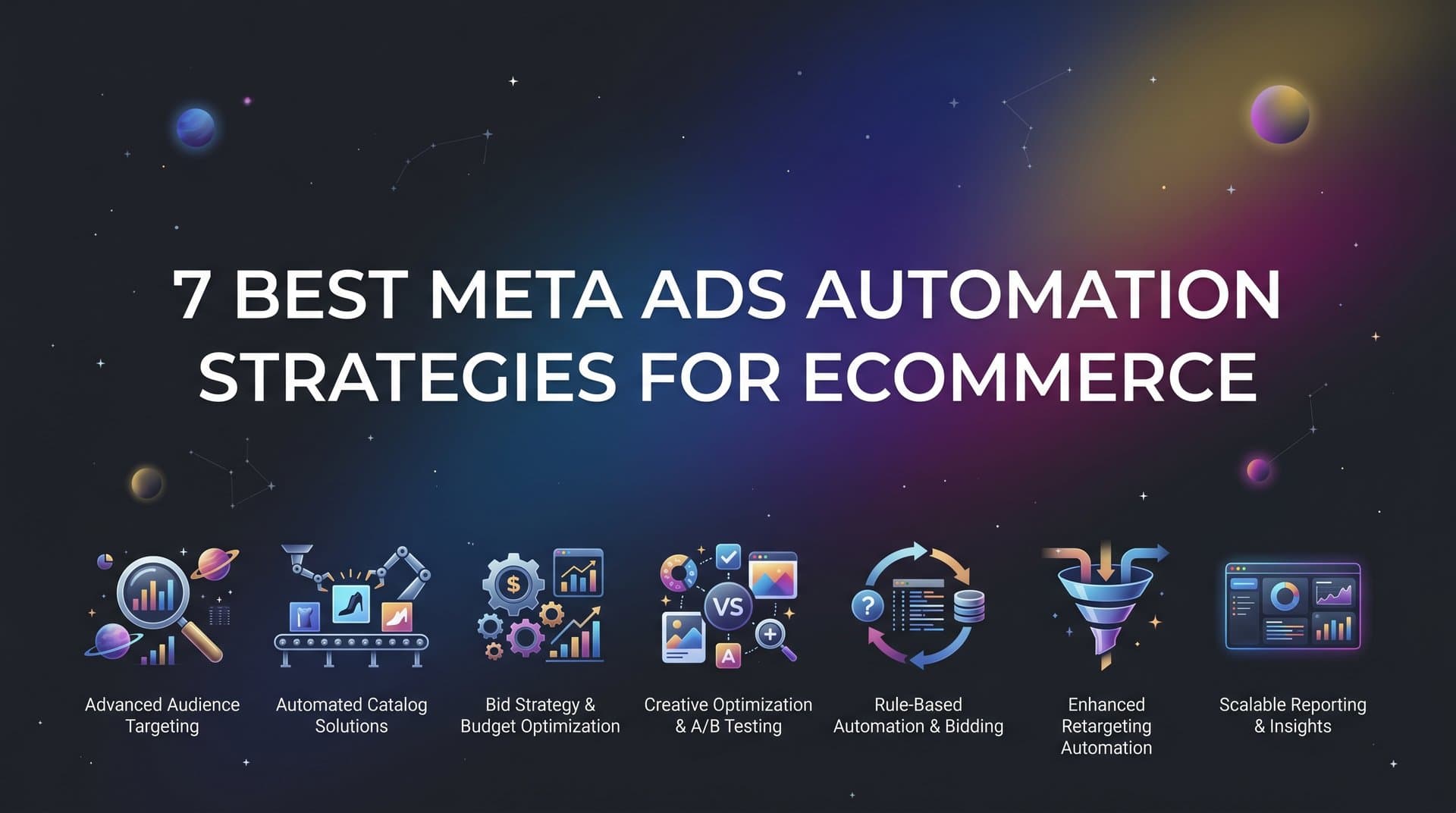
This article breaks down seven of the most effective Meta ads automation strategies for ecommerce brands in 2026, from AI-powered creative generation to automated performance scoring. Whether you are managing a lean in-house team or running ads for multiple clients at an agency, these strategies will help you get more from your Meta ad spend without adding more hours to your day.
Each strategy is practical, actionable, and built around how modern AI ad platforms actually work. Let's get into it.
1. Automate Creative Production at Scale with AI
The Challenge It Solves
Creative fatigue is one of the most persistent problems in Meta advertising. Audiences see the same ads repeatedly, engagement drops, and costs climb. For ecommerce brands with large product catalogs, the demand for fresh creative is essentially never-ending. Most teams simply cannot produce enough variations fast enough to keep up, and hiring designers or video editors to close that gap is expensive and slow.
The Strategy Explained
AI-powered creative generation removes the production bottleneck entirely. Instead of briefing a designer, waiting for revisions, and manually resizing assets, you can generate image ads, video ads, and UGC-style avatar creatives directly from a product URL. You can also clone competitor ads from the Meta Ad Library and use them as a starting point for your own variations.
The result is a continuous supply of fresh creative that your team can test, iterate on, and scale without being limited by production capacity. Chat-based editing lets you refine any ad in plain language, so no design software or technical skills are required.
Implementation Steps
1. Input your product URL into your AI creative tool and generate an initial batch of image ads, video ads, and UGC-style creatives across multiple formats.
2. Browse the Meta Ad Library to identify competitor ads that are running consistently, then clone and adapt them as additional creative starting points.
3. Use chat-based editing to refine messaging, adjust visuals, and create multiple variations of each creative before launching.
Pro Tips
Generate creatives in batches organized by product category or campaign theme. This makes it easier to rotate fresh assets on a consistent schedule rather than scrambling when performance starts to dip. The goal is always to have more creative ready than you currently need.
2. Use AI to Build Complete Campaigns from Historical Data
The Challenge It Solves
Building a Meta campaign from scratch requires dozens of decisions: which creatives to use, which audiences to target, what copy to write, how to structure ad sets. When done manually, this process is time-consuming and often relies on gut instinct rather than data. Important performance signals from past campaigns frequently get ignored simply because there is too much data to analyze by hand.
The Strategy Explained
AI campaign builders analyze your historical campaign data to identify patterns across creatives, headlines, audiences, and copy. They surface what has worked before and use those insights to automatically build complete Meta campaigns in minutes. Every decision comes with a clear rationale, so you understand the strategy behind the build rather than just accepting a black-box output.
This approach is particularly powerful for ecommerce brands that have been running ads for a while. The more historical data available, the more precisely the AI can identify winning combinations and replicate them in new campaigns.
Implementation Steps
1. Connect your Meta ad account to your AI campaign builder and allow it to ingest historical campaign data across creatives, audiences, and performance metrics.
2. Review the AI's ranked analysis of past performance to understand which elements have consistently driven results.
3. Let the AI build a complete campaign structure using top-ranked elements, then review the rationale for each decision before launching.
Pro Tips
Pay attention to the AI's reasoning, not just its recommendations. Understanding why certain creatives or audiences outperformed others helps you make better strategic decisions over time. Platforms like AdStellar provide full transparency into every AI decision so the learning compounds on both sides.
3. Launch Hundreds of Ad Variations in Minutes with Bulk Ad Launching
The Challenge It Solves
Testing ad variations is how ecommerce brands find their top performers. But building each variation manually, one ad at a time, is painfully slow. Most teams end up testing far fewer combinations than they should, which means they leave potential winners undiscovered. The bottleneck is not creativity or budget; it is execution speed.
The Strategy Explained
Bulk ad launching lets you mix multiple creatives, headlines, audiences, and copy variations at both the ad and ad set level. The platform generates every possible combination automatically and launches them all to Meta in a fraction of the time it would take to build them manually. Testing more variations increases the probability of finding a high-performing combination, and doing it at speed means you get to results faster.
For ecommerce brands running promotions, seasonal campaigns, or product launches, this capability is a significant competitive advantage. You can flood the testing environment with variations on day one rather than rolling them out slowly over weeks. Learn more about how automation compares to manual creation when it comes to launch speed and scale.
Implementation Steps
1. Prepare multiple versions of your creative assets, headlines, and ad copy before launching. Even three to four variations of each element creates a large number of testable combinations.
2. Define your audience segments and organize them by targeting approach, such as cold audiences, custom audiences, and lookalikes.
3. Use your bulk launching tool to generate every combination and push them all live simultaneously, then let performance data accumulate before making optimization decisions.
Pro Tips
Resist the urge to pause underperformers too quickly. Give combinations enough time and budget to generate statistically meaningful data before drawing conclusions. The goal of bulk launching is to surface winners, not to predict them before the test runs.
4. Score Every Ad Element Against Your Actual Business Goals
The Challenge It Solves
Not all metrics tell the same story. Click-through rates look impressive on a dashboard, but they do not pay for inventory. Many ecommerce advertisers optimize toward the metrics that are easiest to measure rather than the ones that matter most to the business. This leads to campaigns that perform well on paper but underdeliver on revenue.
The Strategy Explained
Goal-based AI scoring evaluates every element of your campaigns, including creatives, headlines, copy, audiences, and landing pages, against the metrics that actually reflect your business objectives: ROAS, CPA, and CTR. Leaderboard rankings show you at a glance which elements are winning and which are dragging performance down.
When you set your target benchmarks, the AI scores everything against those specific thresholds rather than generic industry averages. This means your optimization decisions are always anchored to what matters for your store, not what looks good in aggregate reports. Understanding your Meta ads performance metrics in depth is essential before configuring goal-based scoring.
Implementation Steps
1. Define your target metrics clearly before launching campaigns. Know your acceptable CPA, your target ROAS, and the CTR thresholds that indicate healthy engagement for your category.
2. Connect your AI insights tool and configure goal-based scoring to reflect those benchmarks.
3. Review leaderboard rankings regularly to identify which creatives, headlines, and audiences are consistently scoring above your benchmarks and which ones are falling short.
Pro Tips
Use the leaderboard data to inform future creative briefs and campaign builds. When you know that a specific type of headline or visual approach consistently scores well against your ROAS goals, you can prioritize those patterns in every new campaign. This is how you build institutional knowledge rather than starting from scratch each time.
5. Build a Winners Hub to Eliminate Guesswork on Future Campaigns
The Challenge It Solves
Without a centralized system, top-performing assets often get buried in spreadsheets or forgotten between campaigns. Teams end up rebuilding from scratch, rediscovering the same winners through expensive retesting, or worse, accidentally running the same underperformers again. The institutional knowledge from past campaigns rarely gets structured in a way that is actually useful for the next one.
The Strategy Explained
A Winners Hub centralizes your best-performing creatives, headlines, audiences, and copy in one place with real performance data attached to each asset. When you are building a new campaign, you can pull directly from proven winners instead of guessing what might work. Every asset in the hub has a track record, so the starting point for each new campaign is significantly stronger than a blank slate.
This approach is especially valuable for ecommerce brands running ongoing campaigns across multiple product lines. Over time, the Winners Hub becomes a strategic asset that compounds in value as more data accumulates. Pairing it with a robust Meta ads performance tracking dashboard ensures you always have accurate data feeding into your asset library.
Implementation Steps
1. After each campaign cycle, review performance data and tag your top-performing assets for inclusion in the Winners Hub.
2. Organize winners by category: creative format, audience type, headline style, and copy approach. This makes it easy to filter for what you need when building a new campaign.
3. When launching new campaigns, start by browsing the Winners Hub and selecting proven elements before adding any new untested variations.
Pro Tips
Treat the Winners Hub as a living library, not an archive. Regularly review whether older winners are still performing or whether audience fatigue has reduced their effectiveness. Rotate assets out when their performance data suggests they have run their course, and keep refreshing the hub with new winners from ongoing campaigns.
6. Automate Audience Targeting with AI-Driven Segmentation
The Challenge It Solves
Manual audience building is time-consuming and often relies on assumptions about who your best customers are. Ecommerce brands frequently stick with the same targeting approaches out of habit, missing high-value segments that their data could reveal. As Meta's ad environment grows more competitive, the precision of your audience targeting has a direct impact on your cost efficiency.
The Strategy Explained
AI-driven audience segmentation analyzes your historical campaign data to identify which segments have consistently driven the strongest results. It automatically layers custom audiences, lookalike audiences, and interest-based targeting to build a more complete picture of your potential buyers. Rather than manually hypothesizing who to target, you let performance data guide the segmentation strategy.
Meta's own platform has moved strongly in this direction with tools like Advantage+ audiences, reflecting the broader industry shift toward AI-based customer targeting solutions. Pairing Meta's native targeting capabilities with a dedicated AI campaign builder gives ecommerce brands even more precision and control.
For a deeper look at how AI-based targeting works in practice, explore our guide on AI-based customer targeting solutions for ecommerce advertisers.
Implementation Steps
1. Upload your customer purchase data and email lists to create high-quality custom audiences based on actual buyers rather than estimated interest groups.
2. Use those custom audiences as seed audiences for lookalike generation, prioritizing your highest-value customer segments as the source data.
3. Let your AI campaign builder analyze past audience performance and recommend segmentation structures for new campaigns based on what has driven results historically.
Pro Tips
Refresh your custom audiences regularly, especially if you have a high purchase frequency or a growing customer base. Stale audience data produces diminishing returns. The more current and accurate your seed audiences are, the better your lookalikes will perform.
7. Close the Loop with Attribution Tracking and Continuous Optimization
The Challenge It Solves
Many ecommerce brands find that Meta's native attribution reporting does not fully capture the customer journey across devices and sessions. Following iOS privacy changes, last-click attribution has become even less reliable as a signal for optimization. If your AI optimization loop is working with incomplete or inaccurate conversion data, every decision it makes is built on a shaky foundation.
The Strategy Explained
Integrating accurate third-party attribution tracking gives you a true picture of which campaigns, creatives, and audiences are actually driving revenue. That conversion data then feeds back into your AI optimization loop, so every future campaign benefits from real, verified performance signals rather than estimated or incomplete data.
Platforms like AdStellar integrate with attribution tools like Cometly to bridge this gap. When your attribution data is accurate, your AI campaign builder can make better decisions about which elements to prioritize, and your goal-based scoring reflects what is actually happening in your store rather than what Meta's reporting estimates.
Implementation Steps
1. Set up a third-party attribution tool that uses server-side tracking to capture conversions more accurately across devices and sessions.
2. Connect your attribution data to your Meta ad platform so that ROAS and CPA figures in your campaign reporting reflect verified conversions.
3. Use that clean attribution data as the foundation for your AI optimization loop, ensuring that creative scoring, audience analysis, and campaign building are all informed by accurate signals.
Pro Tips
Compare your Meta-reported conversions against your attribution tool data regularly. The gap between the two often reveals where your reporting has blind spots. Closing that gap is one of the highest-leverage improvements you can make to your overall optimization process, because every other automation strategy depends on the quality of the data feeding it.
Putting It All Together: Building Your Ecommerce Automation Stack
The most effective ecommerce advertisers in 2026 are not the ones running the most ads manually. They are the ones who have built a system where AI handles creative production, campaign building, variation testing, and performance scoring so they can focus on strategy and growth.
Here is how to approach building your own automation stack without getting overwhelmed:
Start with creative production: Removing the creative bottleneck is the highest-leverage first step. Once you have a reliable supply of fresh assets, everything else becomes easier to scale.
Layer in campaign intelligence: Connect your historical data to an AI campaign builder so your next campaign starts smarter than your last one.
Scale with bulk launching and scoring: Once you are generating and building efficiently, use bulk launching to test at volume and goal-based scoring to surface winners quickly.
Build the feedback loop: The Winners Hub and accurate attribution tracking are what transform short-term wins into compounding advantages over time.
The goal is a continuous loop: generate creatives, launch at scale, score performance, surface winners, and feed those insights back into the next campaign. Each cycle makes the next one more efficient.
Platforms like AdStellar bring all of these strategies together in one place, from AI creative generation to bulk launching to the Winners Hub, so ecommerce brands can move faster without needing a full creative and media buying team behind them.
If you are ready to stop guessing and start scaling, Start Free Trial With AdStellar and be among the first to launch and scale your ad campaigns faster with an intelligent platform that automatically builds and tests winning ads based on real performance data.