When you are scaling Meta ad campaigns, the cost of your bulk ad launcher is only part of the equation. The real question is whether the platform you choose can generate enough output, speed, and performance to justify every dollar you spend on it.
Bulk ad launchers vary widely in how they price their features, from flat monthly subscriptions to usage-based tiers, and the differences between plans can have a significant impact on your cost per creative, your testing velocity, and ultimately your return on ad spend. For digital marketers and agencies managing multiple accounts or high-volume campaigns, choosing the wrong pricing tier can mean leaving efficiency on the table or overpaying for features you rarely use.
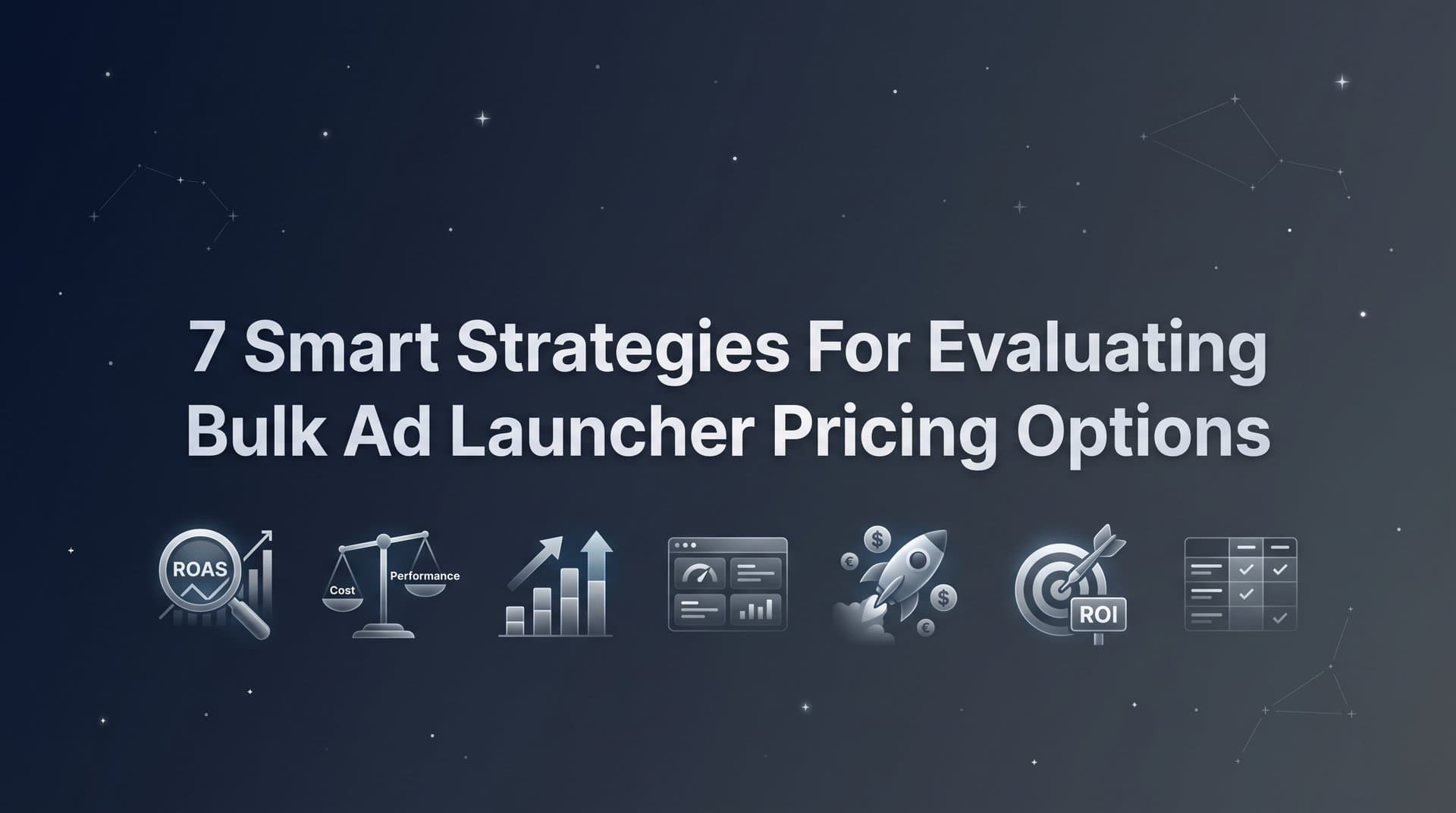
This guide walks through seven practical strategies for evaluating bulk ad launcher pricing options so you can match the right plan to your actual workflow, team size, and campaign goals. Whether you are a solo performance marketer exploring entry-level tools or an agency looking to standardize across client accounts, these strategies will help you cut through the noise and make a confident, data-backed decision.
1. Map Your Monthly Ad Volume Before Comparing Plans
The Challenge It Solves
Most marketers jump straight to comparing plan prices without first understanding their own output requirements. Volume is the single most important variable in bulk launcher pricing because most tiers are structured around output capacity. Underestimating your volume leads to hitting limits mid-campaign; overestimating means paying for capacity you never use.
The Strategy Explained
Before you open a single pricing page, sit down and calculate how many ad variations you realistically need to launch each month. Think about the number of active campaigns you run, the number of creative variations per campaign, and how frequently you refresh your ads. Factor in seasonal spikes if your business has them.
This number becomes your baseline. Every plan you evaluate should be filtered through this lens first. A platform with a tempting entry price is not a deal if you hit the variation ceiling by week two of the month.
Implementation Steps
1. List every active campaign type you run and estimate the number of ad variations each requires per month.
2. Add a buffer of roughly 20 to 30 percent to account for testing cycles and creative refreshes.
3. Use this adjusted volume figure as your minimum threshold when reviewing any plan's included variation limits.
Pro Tips
Pull your last three months of campaign data to get a realistic average rather than estimating from memory. If you are new to bulk launching, start with a conservative estimate and plan to upgrade rather than overpaying from day one. Most platforms, including AdStellar, make it straightforward to move between tiers as your volume grows.
2. Calculate the True Cost Per Ad Variation
The Challenge It Solves
The headline price of a bulk ad launcher plan is one of the most misleading numbers in SaaS marketing. A $49 per month plan sounds affordable until you realize it only supports a fraction of the variations you need. Without a cost-per-variation calculation, you are comparing plans on the wrong metric entirely.
The Strategy Explained
Divide the monthly plan cost by the realistic number of ad variations you can generate and launch within that tier. This gives you a cost-per-variation figure that lets you compare platforms and tiers on a true apples-to-apples basis.
For example, if a plan costs $129 per month and allows you to launch several hundred variations, your cost per variation may be quite low. A cheaper plan that caps you at a much smaller number could actually cost more per variation. This metric cuts through the noise of promotional pricing and reveals the actual efficiency of each option.
Implementation Steps
1. Identify the maximum number of ad variations each pricing tier supports per month.
2. Divide the monthly plan cost by that variation limit to get a cost-per-variation figure.
3. Compare this number across platforms and tiers, not just the headline monthly price.
Pro Tips
Factor in the variations you will realistically use, not just the theoretical maximum. A plan that technically supports 500 variations is only valuable if your workflow actually produces that volume. Pair this calculation with your volume map from Strategy 1 for a complete picture. Reviewing bulk ad creation tool plans side by side can help you benchmark variation limits across competing platforms.
3. Evaluate Whether Creative Generation Is Included
The Challenge It Solves
Many bulk launching tools are exactly that: launchers. They move your existing creatives into campaigns quickly, but they do not help you make those creatives. That means you are still paying for designers, video editors, or a creative agency on top of your platform subscription. The total cost of your ad stack can look very different once you account for those external expenses.
The Strategy Explained
Platforms that include AI-powered creative generation within the same subscription dramatically change the pricing math. When you can generate image ads, video ads, and UGC-style content directly inside the platform, you eliminate or significantly reduce your dependency on external creative resources.
AdStellar's AI Creative Hub lets you generate scroll-stopping creatives from a product URL, clone competitor ads directly from the Meta Ad Library, or build from scratch with chat-based refinement. No designers, no video editors, no actors needed. When creative generation is bundled into your plan, the comparison against standalone launching tools shifts considerably in favor of the all-in-one approach.
Implementation Steps
1. Estimate your current monthly spend on creative production, including design tools, freelancers, or agency fees.
2. Check whether each platform you are evaluating includes creative generation or requires you to supply finished assets.
3. Add your external creative costs to the platform subscription cost for tools that do not include generation, then compare totals.
Pro Tips
Do not overlook the time cost of managing external creative workflows. Even if a freelancer is inexpensive, the coordination overhead adds up. Platforms that handle creative generation internally save both money and calendar time, which matters when you are trying to move fast on a campaign. Explore the guide to bulk ad creation to see how creative generation and launching work together.
4. Factor In AI Campaign Intelligence as a Pricing Variable
The Challenge It Solves
Bulk uploading is a mechanical task. Any competent tool can move files into a campaign structure. The real differentiator is whether the platform thinks alongside you, analyzing what has worked before and using that knowledge to build smarter campaigns going forward. Platforms that skip this layer leave you doing the analytical heavy lifting yourself.
The Strategy Explained
When comparing pricing tiers, look closely at whether AI campaign intelligence is included and at what level. Platforms that analyze historical performance data, rank creatives and audiences by past results, and build complete campaigns with transparent rationale add measurable strategic value that goes well beyond simple bulk uploading.
AdStellar's AI Campaign Builder does exactly this. It analyzes your past campaigns, ranks every creative, headline, and audience by performance, and assembles complete Meta Ad campaigns in minutes. Critically, every decision comes with a full explanation so you understand the strategy behind the output, not just the output itself. That transparency helps you learn and improve over time. Explore more about AI advertising platform pricing to understand how this capability compares across platforms.
Implementation Steps
1. Ask each platform you evaluate whether their AI campaign building is included in the base tier or gated behind a higher plan.
2. Determine whether the AI uses your historical data specifically or applies only generic optimization logic.
3. Assess whether the platform provides transparent rationale for its decisions or operates as a black box.
Pro Tips
AI that improves with each campaign run compounds in value over time. A platform that gets smarter the longer you use it delivers increasing returns on your subscription cost, which is a fundamentally different value proposition than a static tool. Understanding campaign automation software pricing structures helps you identify which tiers actually unlock meaningful AI capabilities versus basic scheduling features.
5. Assess Reporting and Insights Depth Across Tiers
The Challenge It Solves
Reporting capabilities are frequently gated behind higher pricing tiers in marketing SaaS platforms. For bulk ad launchers specifically, basic reporting tells you what happened. Advanced insights tell you why, and more importantly, what to do next. If you are launching hundreds of variations and cannot easily identify which ones are winning, you are flying blind at scale.
The Strategy Explained
Look for leaderboard-style insights that rank your creatives, headlines, audiences, and landing pages by real performance metrics like ROAS, CPA, and CTR. Goal-based scoring that benchmarks every element against your specific targets is a significant differentiator worth paying for when you are running high-volume Meta campaigns.
AdStellar's AI Insights feature does this across every dimension of your campaign. Set your performance goals and the platform scores everything against those benchmarks in real time, surfacing winners and flagging underperformers automatically. The Winners Hub then consolidates your best-performing creatives, headlines, and audiences in one place so you can pull them directly into your next campaign without hunting through historical data.
Implementation Steps
1. Review the reporting features available at each pricing tier for any platform you are considering.
2. Confirm whether goal-based scoring or leaderboard ranking is included or reserved for higher tiers.
3. Check whether the platform integrates with attribution tools like Cometly to give you full-funnel performance visibility.
Pro Tips
Shallow reporting at scale is worse than no reporting at all because it creates false confidence. If you are launching large volumes of ad variations, invest in a tier that gives you the reporting depth to act on what you are seeing. The cost of the upgrade is almost always recovered through faster identification of winning creatives.
6. Consider Agency and Multi-Account Needs in Your Pricing Decision
The Challenge It Solves
Agencies running campaigns across multiple client accounts have fundamentally different platform requirements than solo marketers. A plan that works perfectly for a single-account operator can become a bottleneck the moment you add a second or third client. Multi-account support, separate creative libraries, and seat limits all affect which tier actually makes sense for your business model.
The Strategy Explained
For agencies, the relevant question is not just what the platform costs per month but what it costs per client account managed. If a higher tier unlocks the ability to manage five additional client accounts, the incremental cost per account may be very low. Frame the pricing decision around your revenue per client and the operational efficiency the platform delivers across your entire book of business.
Consider also whether the platform allows you to maintain separate creative libraries and campaign histories for each client. Mixing assets across accounts creates confusion and compliance risk. Platforms that support clean account separation at the agency level justify higher tier pricing through operational clarity alone. Reviewing agency Facebook ads software pricing comparisons can reveal which platforms are genuinely built for multi-client workflows versus retrofitted for agency use.
Implementation Steps
1. Count the number of client ad accounts you currently manage and project growth over the next six to twelve months.
2. Check each platform's tier limits for connected ad accounts and team seats.
3. Calculate the cost per client account at each tier and compare that figure against the revenue each client generates.
Pro Tips
If you are an agency evaluating AdStellar's Ultra plan at $499 per month, think about it in terms of client accounts served rather than as a flat monthly expense. When the platform reduces the time spent on campaign setup and creative production across multiple clients, the effective cost per hour saved can make the investment straightforward to justify. Learn more about bulk Facebook ad creation for media buyers to see how agencies maximize performance across client campaigns at scale.
7. Use a Free Trial to Validate ROI Before Committing to a Tier
The Challenge It Solves
No amount of feature comparison or pricing math replaces the experience of running a real campaign through a platform. Workflows that look clean in a demo can feel clunky in practice. Conversely, features that seem minor in a feature list can turn out to be the ones you use most. A free trial removes the guesswork from your pricing decision entirely.
The Strategy Explained
A free trial period is the most reliable way to validate whether a bulk ad launcher's pricing tier matches your actual workflow. The key is to structure your trial around a real campaign at realistic volume rather than treating it as a casual exploration. Use it like you would use the platform on a normal working day.
AdStellar offers a 7-day free trial across all tiers, which gives you enough runway to run a meaningful test. Track your cost per variation output during the trial, measure early performance signals like CTR and ROAS, and note how much time the platform saves you compared to your current workflow. The data you collect gives you a concrete basis for choosing the right plan rather than relying on estimates.
Implementation Steps
1. Select a real campaign to run during your trial period, one that reflects your typical volume and creative requirements.
2. Track the number of variations you generate and launch, the time spent on campaign setup, and early performance metrics.
3. Compare your trial results against your pre-trial cost-per-variation calculation to confirm or adjust your tier selection.
Pro Tips
Document your trial results in a simple spreadsheet. Capture time spent, variations launched, and performance data. This gives you a factual record to reference when making your final plan decision, and it creates a useful benchmark for evaluating the platform's value at your next renewal.
Putting It All Together
Evaluating bulk ad launcher pricing is not just about finding the lowest monthly cost. It is about identifying the plan that delivers the best output per dollar relative to your campaign volume, creative needs, and performance goals.
The seven strategies in this guide give you a structured path through that evaluation. Start by mapping your volume and calculating your true cost per variation. Then factor in whether creative generation is included, whether AI campaign intelligence adds real strategic value, and whether the reporting depth matches the scale at which you operate. For agencies, layer in the per-client cost calculation before making any final decision.
AdStellar offers three pricing tiers designed to match different stages of growth: Hobby at $49 per month, Pro at $129 per month, and Ultra at $499 per month. Each tier includes access to AI-powered creative generation, the AI Campaign Builder, Bulk Ad Launch, AI Insights, and the Winners Hub. The difference between tiers comes down to volume capacity, number of connected accounts, and the depth of AI capabilities available to you.
The right plan is the one that makes your next campaign faster, smarter, and more profitable than the last. Use the strategies in this guide to move past surface-level price comparisons and focus on what actually drives ROI. Then put the platform to the test before you commit.
Ready to transform your advertising strategy? Start Free Trial With AdStellar and be among the first to launch and scale your ad campaigns faster with an intelligent platform that automatically builds and tests winning ads based on real performance data.