Manual ad building at scale is one of the most frustrating bottlenecks in performance marketing. You know the drill: duplicate an ad set, swap the creative, update the copy, adjust the audience, check the settings, repeat. By the time you have built out a meaningful number of variations, you have burned through hours of setup time before a single dollar has been spent on actual testing.
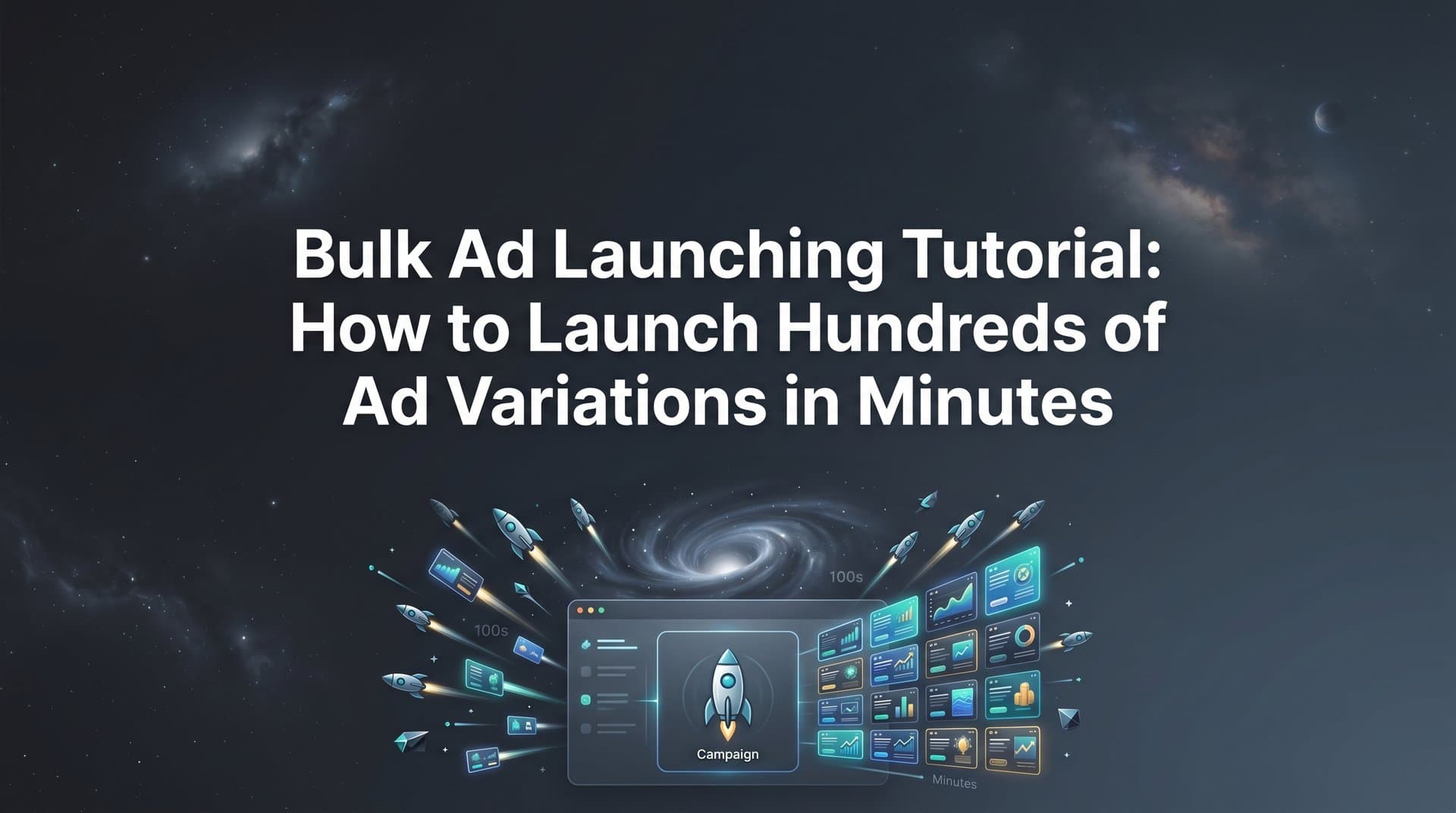
Bulk ad launching solves this problem directly. Instead of constructing each variation by hand, you bring together your creatives, headlines, copy variants, and audience segments in one place, let the system generate every possible combination automatically, and push everything live in a fraction of the time. The result is more combinations tested, cleaner data, and a much shorter path to finding your winners.
This tutorial walks you through the complete bulk ad launching process using AdStellar's Bulk Ad Launch feature, which is built specifically for performance marketers who need to move fast without sacrificing structure or data quality.
Here is exactly what you will learn in this guide: how to prepare your creative and copy assets, how to define your audience segments, how to build and review your variation matrix inside AdStellar, how to configure your campaign settings and budget, and how to launch everything to Meta and monitor early performance signals. The final section covers what to do after your test wraps up so you can scale winners and feed results back into your next launch.
Whether you are a solo marketer managing a single brand or an agency running campaigns across multiple clients, this workflow applies. The principles are the same regardless of scale. Let's get into it.
Step 1: Gather and Organize Your Creative Assets
Before you touch the bulk launch builder, your creative assets need to be ready. This step sounds obvious, but it is where many bulk launches fall apart before they even start. Uploading a disorganized mix of assets without a clear structure leads to messy combinations and unreliable test data.
The goal here is to collect all the image ads, video ads, and UGC-style creatives you plan to include in this launch and organize them by format and angle. Aim for at least three to five creative variations per format. That minimum threshold gives the system enough distinct inputs to generate combinations that produce meaningful comparative data rather than redundant noise.
What counts as a distinct creative variation? Each asset should represent a genuinely different angle. Think of it this way: one creative might lead with a product close-up, another might show the product in use, and a third might feature a UGC-style testimonial format. These are meaningfully different. Three versions of the same product shot with slightly different backgrounds are not.
If your creative library is thin, AdStellar's AI Creative Hub is the fastest way to build it out. You can generate image ads, video ads, and UGC-style avatar content directly from a product URL. You can also clone high-performing competitor ads straight from the Meta Ad Library and use those as starting points. No designers or video editors required. This is especially useful for agencies onboarding a new client who needs a full creative set built quickly.
Once you have your assets collected, label them clearly before uploading. A simple naming convention works well: format, angle, and version number. For example: "video-social-proof-v1" or "image-product-demo-v2." This makes it much easier to review your variation matrix later and spot any mismatched pairings.
Common pitfall to avoid: launching with only one or two creatives defeats the entire purpose of bulk testing. If you only have two creatives in the mix, you are not really testing creative performance. You are just running two ads. More creative diversity leads to more useful data and gives the algorithm more to work with as it optimizes delivery.
Success indicator: you have a clearly organized set of at least three to five creatives ready to upload, with each asset representing a distinct angle or format.
Step 2: Write Multiple Copy and Headline Variants
With your creatives organized, the next step is preparing your copy and headline variants. This is where many marketers underinvest, writing two or three versions that are almost identical and then wondering why their test data is not telling them anything useful.
The goal is to prepare at least three headline options and three primary copy variants per campaign objective. More importantly, each variant should test a genuinely different angle rather than minor word swaps. Think about the different reasons someone might buy your product or click your ad, and write each variant to speak to one of those distinct motivations.
A practical framework that works well for most campaigns is to structure your copy variants around three core angles:
Price or value angle: Lead with the offer, the deal, or the cost-efficiency of the product. This speaks to budget-conscious buyers who need a financial reason to act.
Social proof angle: Lead with results, reviews, or the number of customers who have already used the product. This speaks to buyers who need validation before committing.
Transformation or outcome angle: Lead with the life change, the problem solved, or the result the buyer will experience. This speaks to emotionally motivated buyers who respond to aspiration over logic.
If writing multiple distinct variants manually feels time-consuming, AdStellar's AI copy tools can generate on-brand variations quickly. You give it your product context and campaign objective, and it produces differentiated options you can refine rather than write from scratch. Understanding what makes great ad copy work is the foundation for writing variants that actually move the needle.
One underused shortcut: pull from your AdStellar Winners Hub. If you have run previous campaigns, your top-performing copy and headlines are already stored there with real performance data attached. Use those as starting templates for your new variants. You are not copying them verbatim. You are using proven angles as a foundation and iterating from a position of strength.
Common pitfall to avoid: writing copy variants that are too similar to each other produces redundant data. If all three copy variants are essentially the same message with different sentence structures, your test will not tell you which angle resonates. Make each variant meaningfully different in its core message.
Success indicator: you have a copy matrix where each variant tests a distinct message angle, and your headlines are differentiated enough that you could explain in one sentence what makes each one different from the others.
Step 3: Define Your Audience Segments
Audience setup is the third pillar of a well-structured bulk launch. The goal at this stage is to identify two to four audience segments you want to test, define them clearly, and have them ready to assign inside the bulk launch builder.
A typical mix for a bulk launch might include a cold interest-based audience, a lookalike audience built from your customer list, and a retargeting segment for people who have already engaged with your brand. Each of these segments represents a different stage of the funnel and a different level of prior brand familiarity, which means performance data across them will tell you something genuinely useful about where your creative angles land best.
Inside AdStellar's Campaign Builder, the AI analyzes your historical campaign data before you build and recommends audiences ranked by past performance. This is a significant time-saver because instead of guessing which audience configurations to test, you are starting with data-backed recommendations and adding new segments on top of proven ones.
Define each audience at the ad set level. This keeps performance data clean and comparable across segments. If multiple audiences are bundled into a single ad set, you lose the ability to see which segment is driving results.
Tip for new accounts: if you are running a new account without historical data, limit yourself to two audiences maximum for your first bulk launch. The reason is budget concentration. Spreading a limited budget across too many segments means none of them accumulate enough data to exit Meta's learning phase quickly. Two focused segments will generate more actionable signals than four underfunded ones.
For accounts with existing performance history, a good practice is to include at least one proven audience from your Winners Hub alongside one new segment you want to test. This gives you a performance baseline to compare against while still expanding your audience knowledge. AI-based customer targeting solutions can significantly sharpen this process by surfacing high-probability segments you might otherwise overlook.
Common pitfall to avoid: adding too many audience segments with a limited total budget spreads spend too thin. Meta's learning phase requires enough optimization events per ad set to function properly. If your budget cannot support the number of ad sets you are creating, your test data will be slow to arrive and difficult to act on.
Success indicator: your audience segments are defined, saved, and ready to be assigned inside the bulk launch builder, with a clear rationale for why each segment is included in this particular test.
Step 4: Build Your Variation Matrix in AdStellar
This is where the bulk launching process comes together. With your creatives organized, your copy and headlines written, and your audiences defined, you now have everything you need to build the variation matrix inside AdStellar.
Open AdStellar's Bulk Ad Launch tool and start a new bulk campaign. The interface is built around a matrix logic: you upload your creatives, paste in your copy variants, add your headlines, and assign your audience segments to their respective fields. Once all inputs are in place, AdStellar automatically generates every possible combination across all four dimensions and displays the full variation matrix for your review before anything goes live. This is the core advantage of using a dedicated bulk ad launch tool for Meta over building campaigns manually inside Ads Manager.
Take time to review this matrix carefully. Two things to check specifically:
First, confirm that the total combination count aligns with your available budget. The math here is straightforward: more variations require more budget to generate reliable data per combination. If your matrix is producing 36 variations but your daily budget only supports meaningful spend on 12, you need to reduce inputs before launching. A practical starting point for most campaigns is three creatives multiplied by three copy variants multiplied by two audiences, which produces 18 variations. Scale up or down from there based on what your budget can realistically support.
Second, use the matrix preview to spot any mismatched pairings. This is a detail that is easy to overlook but matters for data quality. For example, if you have video-specific copy that references motion or sound, you do not want that copy paired with a static image creative. Similarly, copy written for a retargeting audience that assumes prior brand familiarity should not be paired with a cold interest-based audience segment. Catch and remove these mismatches before launch so your data reflects genuine creative and copy performance rather than context mismatches.
AdStellar displays the full matrix visually, which makes this review process much faster than manually cross-checking combinations in a spreadsheet. Once you have confirmed the matrix looks clean, you are ready to move into campaign settings.
Success indicator: the variation matrix is fully populated, reviewed, and free of mismatched or redundant combinations. You have confirmed the combination count is proportionate to your budget.
Step 5: Configure Campaign Settings and Budget Allocation
With your matrix built, the next step is configuring the campaign-level settings that govern how your bulk launch runs. This includes your campaign objective, budget structure, bid strategy, placements, and timing.
Set your campaign objective first. This determines how Meta's algorithm optimizes delivery across your variations, so it needs to match your actual business goal. Conversions, traffic, and reach all produce different optimization behaviors from the algorithm.
The most important budget decision in a bulk launch is choosing between Campaign Budget Optimization (CBO) and Ad Set Budget Optimization (ABO). Here is the practical difference:
CBO lets Meta distribute your total campaign budget dynamically across ad sets, concentrating spend toward combinations that are performing better. For bulk launches focused on creative testing, CBO is often the more efficient choice. It reduces the manual overhead of adjusting individual ad set budgets and lets the algorithm do the work of finding winners faster.
ABO gives you manual control over how much budget each audience segment receives. This is useful when you specifically want to ensure each segment gets equal exposure for a controlled comparison, or when you have one high-priority audience you want to fund more aggressively than others.
Set a start date and, if relevant, an end date or a total budget cap to prevent overspending during the test window. This is especially important for bulk launches because the combination count means spend can accumulate quickly if left uncapped.
AdStellar's AI Campaign Builder will surface recommendations for bid strategy and budget allocation based on your historical performance data and the goals you have set. These recommendations are worth reviewing before you finalize settings, particularly if you are launching into a new objective or audience type where you have limited prior data. Pairing smart budget decisions with automated ad testing is what separates campaigns that generate clear winners from those that produce inconclusive results.
Common pitfall to avoid: setting budgets too low per variation means ads will not exit Meta's learning phase before you need to make decisions. Meta's learning phase generally requires around 50 optimization events per ad set. If your budget cannot support that volume across your variation count within a reasonable test window, reduce the number of variations or increase the budget before launching.
Success indicator: all campaign settings are configured, your budget is allocated appropriately for the number of variations you are launching, and the campaign is ready for final pre-launch review.
Step 6: Review, Launch, and Monitor Early Performance
Before you hit launch, run a quick pre-launch checklist. It takes five minutes and prevents the kind of tracking gaps that make bulk test data unreliable.
Confirm your pixel is firing correctly and that your conversion events are set up and verified. Check that all ad previews render properly across the placements you have selected. If you are using AdStellar's Cometly integration for attribution tracking, verify that your attribution settings are connected before submitting the campaign. Without confirmed conversion tracking, the performance data that comes back from your bulk launch will be incomplete and you will not be able to make confident optimization decisions based on it.
Once everything checks out, submit the bulk campaign to Meta directly from AdStellar. No platform switching, no exporting, no manual re-entry. The entire campaign, all variations, all settings, goes to Meta in one action.
After launch, resist the urge to start optimizing immediately. The first 24 to 48 hours are the learning phase. Meta's algorithm is gathering data and adjusting delivery. Performance signals during this window are often noisy and not representative of how your ads will ultimately perform. Making changes during the learning phase resets it and slows down the process.
Instead, use this window to set up your monitoring. In AdStellar's AI Insights dashboard, the leaderboard will begin ranking your creatives, headlines, copy variants, and audiences by real metrics including ROAS, CPA, and CTR as data accumulates. Set your performance benchmarks and goals inside AdStellar so the AI scores each variation against your specific targets automatically. This makes it much easier to spot which combinations are trending toward winners early, without having to manually compare rows of data. Tracking how to calculate ROAS correctly ensures you are measuring the right signal when evaluating which combinations are pulling ahead.
Once the learning phase clears and you have meaningful data, the leaderboard gives you a clear view of what is working and what is not across every dimension of your test.
Success indicator: all ads are live, conversion tracking is confirmed, and you are monitoring the leaderboard for early performance signals rather than making premature changes to active variations.
From Launch to Scale: What Happens After Your Bulk Test
Once sufficient data has accumulated, the optimization process becomes straightforward. Open AdStellar's AI Insights leaderboard and identify your top-performing combinations across creatives, copy, headlines, and audiences. These are your winners.
Move proven winners into the Winners Hub. This preserves them with their real performance data attached and makes them instantly accessible for your next campaign. Your Winners Hub becomes a growing library of proven elements you can pull from rather than starting from scratch each time.
Pause underperforming variations to consolidate budget toward what is working. This is standard practice, but doing it from the leaderboard view inside AdStellar makes the decision much faster because the ranking does the analysis for you.
Use your winning creative and copy combinations as the foundation for your next bulk launch. Layer in new variations around what is already proven. This is how the testing loop compounds over time: each launch informs the next one, and your creative and audience knowledge grows with every cycle. AdStellar's AI Campaign Builder learns from each completed campaign, improving its recommendations for audiences, copy, and creatives in future builds.
Here is a quick recap checklist for the full workflow:
1. Assets organized with at least three to five creative variations per format
2. Copy and headline variants written with distinct message angles
3. Audience segments defined and saved at the ad set level
4. Variation matrix built, reviewed, and cleared of mismatched pairings
5. Campaign settings configured with budget proportionate to variation count
6. Launch submitted with tracking confirmed via pixel and Cometly
7. Leaderboard monitoring active after the learning phase clears
Ready to run your first bulk launch? Start Free Trial With AdStellar and get your first bulk campaign live today with a 7-day free trial.
The Bottom Line
Bulk ad launching is not just a time-saving tactic. It is a fundamentally better way to run creative testing at scale. When you can generate and deploy dozens of ad variations in minutes rather than hours, you shorten the feedback loop between idea and insight. You find winners faster, spend less time inside campaign builders, and make optimization decisions based on real data rather than gut instinct.
The workflow in this tutorial covers everything from asset preparation through post-launch scaling. Gather and organize your creatives. Write meaningfully differentiated copy and headline variants. Define your audience segments. Build and review your variation matrix. Configure your campaign settings with budget proportionate to your variation count. Launch with tracking confirmed. Monitor the leaderboard after the learning phase and move winners into your library for the next round.
AdStellar's Bulk Ad Launch feature is built to handle this entire workflow in one place, from creative generation through campaign launch to performance ranking. No switching between tools, no manual combination building, no guesswork about what is working.
If you are still building ad variations one by one inside Meta Ads Manager, this is the workflow that changes that. Start Free Trial With AdStellar and run your first bulk launch with a 7-day free trial. More combinations tested, faster results, less manual work.