Most performance marketers know the feeling: you have a solid batch of creatives, a handful of audience segments worth testing, and three or four copy variants that could each work. On paper, that is a manageable testing plan. In practice, it means sitting inside Meta Ads Manager for hours, manually building each combination, naming every ad set, uploading each creative, pasting in copy, and repeating the whole process until your eyes glaze over. By the time everything is live, half your day is gone.
This is the manual launch problem, and it does not get better as you scale. It gets worse. The more variables you introduce into your testing matrix, the more time you spend on execution rather than strategy. And in Meta advertising, speed of learning is one of the most important competitive advantages you can have.
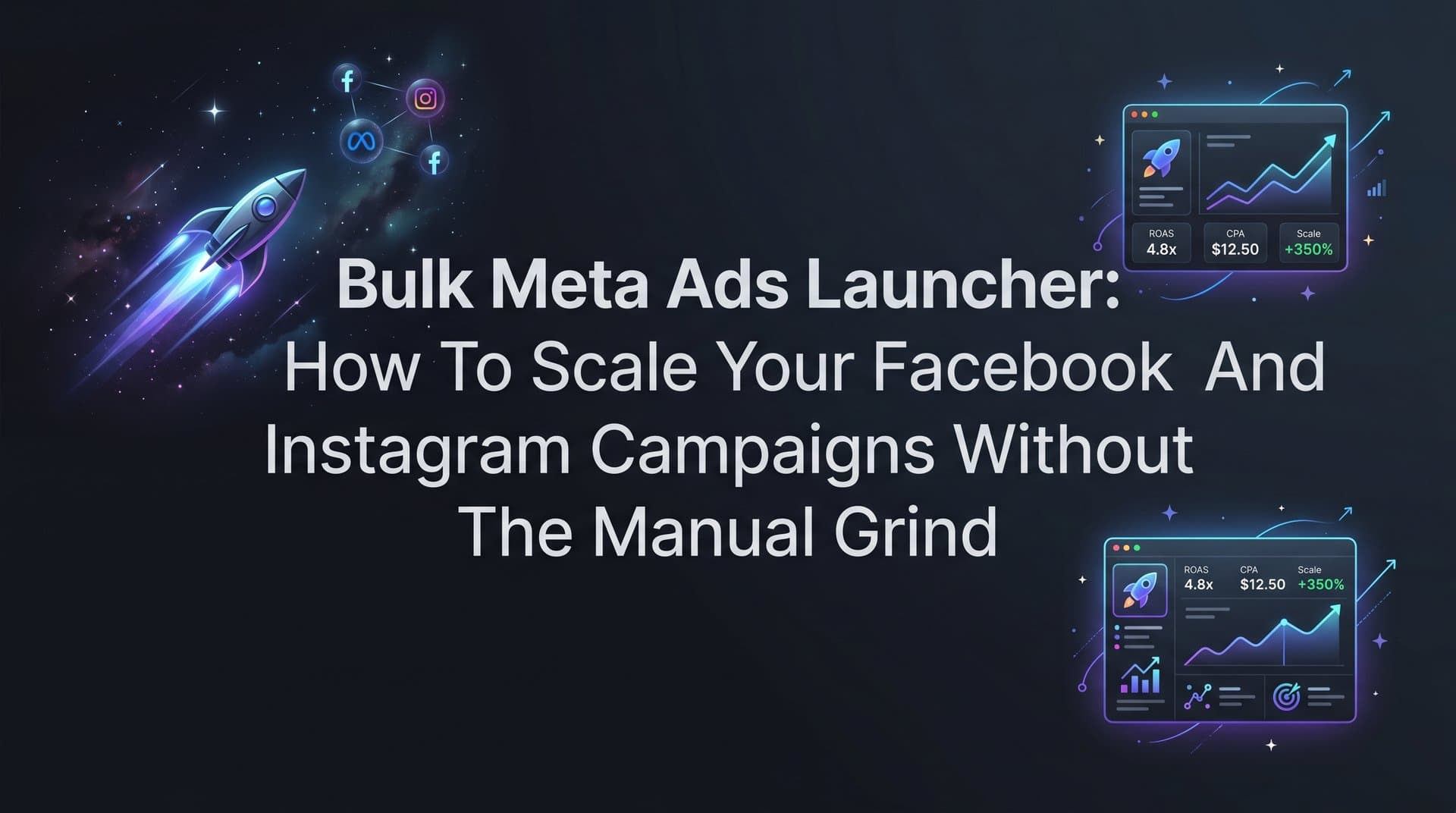
A bulk Meta ads launcher solves this directly. Instead of building combinations one by one, you generate every creative-copy-audience pairing at once and push them all live simultaneously. What used to take half a day takes minutes. But the best modern tools go further than simple automation: they use AI to decide what to launch, explain why, and surface winners automatically so the next launch cycle is smarter than the last.
This article covers exactly how that works. We will look at why manual launching breaks down at scale, what a bulk Meta ads launcher actually does under the hood, how AI makes the process smarter rather than just faster, and what to look for when evaluating tools. If you are managing Meta campaigns for a brand or across multiple client accounts, this is the workflow shift worth understanding.
Why One-by-One Ad Building Breaks Down at Scale
The math of modern Meta campaign testing is unforgiving. Take a realistic scenario: five creatives, four audience segments, and three copy variants. That is 60 distinct ad combinations. Add one more creative and one more audience, and you are at 90. These numbers compound quickly, and each combination represents a separate ad that needs to be built, named, organized, and submitted inside Ads Manager.
Meta's native tools were not designed for this kind of matrix testing. Ads Manager gives you bulk editing capabilities for existing campaigns, and Power Editor has a history of helping with volume, but neither is built to generate a combination matrix from scratch and launch it simultaneously. You are still doing most of the assembly work by hand.
The time cost is obvious, but the strategic cost is less discussed. Every hour spent inside Ads Manager doing repetitive upload work is an hour not spent analyzing performance data, refining creative strategy, or developing the next iteration of a winning concept. Manual launching does not just slow you down operationally. It actively pulls your attention away from the higher-value thinking that actually moves campaigns forward.
For agencies, this problem multiplies across every client account. If manual launching takes four hours per account per week, and you are managing ten accounts, that is forty hours of largely mechanical work. The overhead alone can limit how aggressively you test, which limits how quickly you find winning combinations, which limits the results you can deliver. Understanding how to scale Meta ads efficiently starts with recognizing this structural problem.
Testing velocity matters because Meta's algorithm rewards fast learning. The sooner you identify which creative resonates with which audience, the sooner you can concentrate budget on what works and cut what does not. Slow launch cycles create a compounding disadvantage: you are always a few weeks behind where you could be, and the campaigns that could have been profitable are still sitting in a testing queue.
This is not a problem that discipline or better spreadsheets can fix. It is a structural limitation of manual workflows applied to an inherently combinatorial problem. The solution is a fundamentally different approach to how ads get built and submitted.
What a Bulk Meta Ads Launcher Actually Does
At its core, a bulk Meta ads launcher takes your inputs (creatives, headlines, ad copy, audiences) and automatically generates every possible combination, then submits them all to Meta simultaneously rather than sequentially. What you would otherwise build one ad at a time gets created as a complete matrix and pushed live in a single action.
There are two distinct layers to bulk launching, and understanding both matters for getting the most out of the approach.
Ad-level bulk launching means testing multiple creative and copy combinations within a single ad set. You might have three image ads and four headline variants, and the tool creates every pairing automatically. This is how you find out which creative-copy combination performs best against a given audience without manually assembling each version.
Ad set-level bulk launching means testing multiple audiences in parallel, each with their own set of ad combinations. This is where you discover which segments respond best to your offer, and which creative-audience pairings have the strongest chemistry. Combining both layers gives you a comprehensive testing matrix: every creative against every copy variant against every audience, all running simultaneously.
It is worth being specific about what bulk launching is not. A CSV uploader that lets you import a spreadsheet of ad data is not the same thing. CSV-based tools automate data entry, but they do not understand campaign structure, do not apply intelligent naming conventions, and do not connect to performance data in any meaningful way. You are still doing the organizational thinking manually; you have just moved the copy-paste work into a spreadsheet. Dedicated Facebook ads bulk editing tools go considerably further than simple import utilities.
Modern bulk launchers are different in a few important ways. They understand Meta's campaign hierarchy (campaign, ad set, ad level) and structure the launch accordingly. They apply consistent naming conventions automatically so your account stays organized and your performance data is easy to read. And critically, they connect to real performance metrics so the results of one launch can directly inform the structure of the next.
The practical implication is significant. When you can go from a set of inputs to a fully launched testing matrix in minutes rather than hours, you can run more tests in a given period. More tests mean faster learning. Faster learning means you find winning combinations sooner and scale them with more confidence. The bulk launcher is not just a time-saving tool. It is a mechanism for compressing the learning cycle that determines how well your campaigns perform.
How AI Makes Bulk Launching Smarter, Not Just Faster
Speed is valuable, but launching a large volume of untested combinations blindly is not a strategy. It is expensive guesswork at scale. This is where the distinction between a simple bulk uploader and an AI-powered bulk launcher becomes meaningful.
A basic bulk tool takes whatever inputs you give it and launches them. An AI-powered system does something more useful: it analyzes your historical campaign performance before building the launch matrix, so the combinations it generates are weighted toward what has actually worked rather than what you happen to have available. This is the core promise of AI for Meta ads campaigns.
Here is how that works in practice. The AI looks at your past campaigns and ranks every element by performance: which creatives drove the best ROAS, which headlines produced the lowest CPA, which audiences delivered the strongest CTR. It uses those rankings to inform which combinations are prioritized in the new launch. Instead of treating every creative and audience as equally worth testing, the system builds a matrix that reflects real performance intelligence.
This matters because not all combinations are equally likely to succeed. A creative that has consistently underperformed across multiple campaigns is probably not worth including in your next bulk launch. An audience segment that has shown strong engagement with a particular type of messaging is worth pairing with similar creative in the next cycle. An AI system can make these connections across more data points than any human can reasonably track manually.
Transparency is a critical component of this. The best AI-powered tools do not just produce a launch plan and ask you to trust it. They explain the rationale behind every decision: why this creative was prioritized, why this audience was selected, why this copy variant was included. That transparency serves two purposes. It lets you validate the AI's reasoning against your own strategic knowledge, and it helps you build a genuine understanding of what is driving performance rather than treating the tool as a black box you feed inputs into and hope for the best.
Tools like AdStellar's AI Campaign Builder are built around this principle. The AI analyzes historical data, ranks every creative, headline, and audience by real metrics, and builds complete Meta ad campaigns with full transparency into the decision-making. Every recommendation comes with an explanation, so you understand the strategy, not just the output. And the system improves with each campaign cycle, incorporating new performance data into subsequent launch decisions.
The result is a compounding advantage. Each launch generates performance data that makes the next launch smarter. Over time, the gap between an AI marketing automation workflow and a manual one does not stay constant. It widens.
From Creative to Campaign: The End-to-End Workflow
Understanding the concept of bulk launching is one thing. Seeing how it fits into a complete workflow from creative development to live campaign is where the practical value becomes clear.
The workflow begins with creative. You need image ads, video ads, or UGC-style content before anything else can happen. In a traditional setup, this means working with designers, video editors, or sourcing from a stock library, then importing finished assets into Ads Manager. In a platform like AdStellar, this step happens inside the same tool. You can generate ad creatives directly from a product URL, letting the AI build image ads, video ads, and UGC-style avatar content without external tools or production resources. You can also clone competitor ads directly from the Meta Ad Library and use them as a starting point for your own creative development.
Once you have creatives, the next step is pairing them with headlines and ad copy. Rather than writing every variant manually, AI can generate optimized headline and copy combinations based on your goals and historical performance data. You can refine any element through chat-based editing, adjusting tone, emphasis, or messaging without starting from scratch.
With creatives and copy ready, you move into audience selection. You can import existing audiences, build new ones, or let the AI suggest segments based on past performance. This is where the ad set-level bulk logic comes in: multiple audiences get added to the launch matrix alongside your creative and copy combinations. An AI Meta ads targeting assistant can surface segment recommendations that manual research would easily miss.
The bulk launch step itself takes what would otherwise be hours of manual Ads Manager work and compresses it into minutes. AdStellar generates every combination across creatives, headlines, copy, and audiences, gives you a clear preview of what will be launched, and submits everything to Meta simultaneously. Naming conventions are applied automatically so your account stays organized from the start.
What happens after launch is just as important as the launch itself. AI insights surface winners through leaderboards ranked by real performance metrics: ROAS, CPA, CTR, and whatever goals you have set. You can see at a glance which creative is driving the best results, which audience is most responsive, and which copy variant is converting. Understanding your Meta ads performance metrics is what turns raw data into actionable decisions. The Winners Hub collects your top-performing creatives, headlines, and audiences in one place, with real performance data attached, so they are immediately available for the next bulk launch cycle.
This is the learning loop that makes bulk launching a compounding advantage rather than a one-time efficiency gain. Each cycle feeds the next. The creatives that win get reused. The audiences that respond get prioritized. The copy that converts gets iterated on. Over time, your launch matrix gets progressively more refined, and your campaigns get progressively more efficient.
Key Features to Look for in a Bulk Meta Ads Launcher
Not all bulk launching tools are built the same way. When evaluating options, a few specific capabilities separate tools that genuinely accelerate your workflow from those that just add a layer of automation on top of the same manual work.
Combination matrix generation with preview: The tool should automatically generate every creative-copy-audience combination and show you exactly what will be launched before anything goes live. This is a basic requirement. If you cannot see the full matrix before submitting, you are launching blind and creating cleanup work for yourself when naming or structure issues surface later.
Performance integration and goal-based scoring: Bulk launching without performance feedback is just volume. The tool needs to connect to real campaign metrics and score every launched element against your actual goals. ROAS, CPA, and CTR are the standard metrics, but the ability to set custom benchmarks and have the AI score everything against those benchmarks is what separates a reporting dashboard from a genuine optimization tool. A thorough Meta ads software comparison will reveal how differently platforms handle this capability. If you cannot instantly see which elements are winning and which are not, you are still doing the analysis work manually.
Native AI creative generation: The most efficient workflow is one where creative generation and bulk launching happen inside the same platform. If you need a separate design tool, a video editor, a stock library, and then a bulk launcher, you have four tools to manage, four sets of files to transfer, and four points where things can go wrong. A platform that generates image ads, video ads, and UGC-style content natively and feeds them directly into the bulk launch flow removes an entire layer of complexity from the process.
Transparent AI rationale: As discussed earlier, transparency matters. A tool that makes decisions without explaining them creates dependency without understanding. Look for platforms that surface the reasoning behind creative selection, audience prioritization, and copy choices, so you can validate, learn from, and build on the AI's recommendations rather than just accepting them.
Winners Hub or equivalent: The ability to store and quickly reuse top-performing elements is what turns individual launch cycles into a compounding learning system. Without a structured way to capture and access winners, you end up rebuilding your best-performing combinations from memory each time, which defeats part of the purpose.
Scaling Meta Ads Without Scaling Your Team
The compounding advantage of bulk launching is worth stating plainly. Faster launch cycles lead to faster learning. Faster learning leads to better-performing campaigns. Better-performing campaigns mean you can deploy more budget with confidence, because you know what works. Each of these steps reinforces the next, and the effect builds over time rather than plateauing.
For agencies, this means handling more accounts without proportionally increasing the hours spent on mechanical execution. For in-house teams, it means your advertising program can grow in sophistication and scale without requiring additional headcount just to keep up with the operational overhead. The leverage comes from compressing the launch-measure-iterate cycle, not from working more hours.
Bulk launching is not a one-off tactic for a particularly large campaign. It is a core workflow component for any Meta advertising program that takes testing seriously. The teams that consistently find winning combinations fastest are the ones that test the most combinations per unit of time. A bulk Meta ads launcher is how you do that without burning out your team on repetitive Ads Manager work.
AdStellar is built around exactly this workflow: AI-generated creatives, AI-optimized campaign structure, bulk launching across every combination, and continuous performance feedback through AI insights and the Winners Hub. It is a full-stack approach from creative to conversion, designed for the kind of systematic testing that actually moves campaign performance forward.
If you are ready to move from manual Ads Manager work to an AI-powered launch workflow, the practical next step is straightforward. Start Free Trial With AdStellar and see how much faster your testing cycles can run when the combination matrix builds itself, the launch takes minutes, and the winners surface automatically. The 7-day free trial gives you the full platform to work with, so you can see the difference in your own campaigns rather than taking anyone's word for it.