You've found a Facebook ad campaign that's crushing it—strong ROAS, steady conversions, and engagement that proves your targeting is on point. Now comes the critical question: how do you replicate that success without starting from scratch each time?
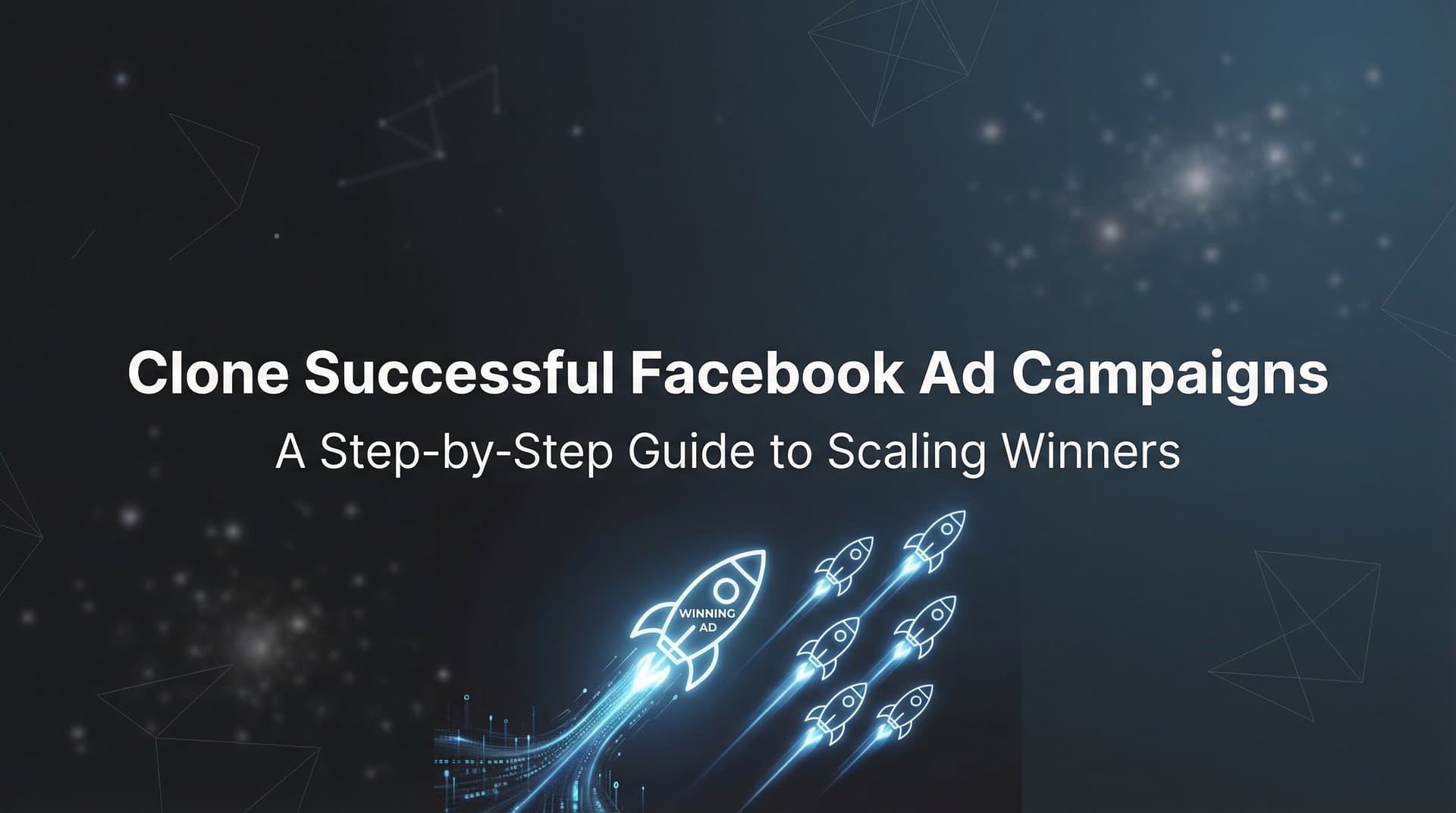
Cloning successful Facebook ad campaigns is one of the most effective ways to scale your advertising results, but doing it wrong can waste budget and dilute performance.
The challenge isn't just hitting the duplicate button in Ads Manager. It's knowing which campaigns deserve cloning, understanding what elements are actually driving performance, and launching variations that maintain your winning metrics without cannibalizing your existing success.
This guide walks you through the exact process of identifying which campaigns deserve cloning, preparing them for duplication, and launching cloned variations that preserve what's working while testing new opportunities. Whether you're a solo marketer managing multiple accounts or an agency handling dozens of client campaigns, you'll learn the strategic approach to campaign cloning that turns one winner into a scalable growth engine.
Step 1: Identify Your True Winners Worth Cloning
Not every campaign that looks good on the surface deserves to be cloned. The difference between a flash-in-the-pan performer and a true winner comes down to consistency and depth of data.
Look beyond surface-level metrics. A campaign with impressive engagement rates might look like a winner, but if those clicks aren't converting into purchases or leads, you're about to clone a pretty failure. Focus on metrics that directly tie to your business goals: return on ad spend, cost per acquisition, conversion rate, and customer lifetime value.
Here's where many marketers go wrong: they see a campaign perform well for two days and immediately duplicate it. Meta's algorithm needs time to stabilize. A campaign should demonstrate consistent performance over at least 7-14 days before you consider it clone-worthy. This ensures you're seeing real patterns, not just algorithmic noise or lucky timing.
Check for audience saturation signals. Even a winning campaign can hit diminishing returns if the audience pool is too small. Before cloning, examine your frequency metrics. If your original campaign is already showing frequency above 3.0, cloning to the same or overlapping audiences will likely cannibalize performance rather than scale it.
The most critical step is documenting exactly what's driving success. Is it the video creative that hooks viewers in the first three seconds? The headline that speaks directly to a specific pain point? The custom audience built from website visitors who viewed your pricing page? Or the placement strategy that focuses budget on Instagram Stories?
Create a winner profile for each campaign you plan to clone. Note the specific creative elements, the exact audience parameters, the placement mix, and the bidding strategy. This documentation becomes your blueprint for successful cloning and helps you understand which elements are non-negotiable versus which can be tested in variations. Many advertisers struggle with replicating successful Facebook campaigns because they skip this documentation step.
Verify statistical significance. A campaign that spent $500 and generated 10 conversions might have a great cost per acquisition, but that sample size is too small to declare victory. Make sure your winning campaigns have processed enough conversion events to give Meta's algorithm reliable data to work with. Meta recommends at least 50 conversion events per week at the ad set level for stable performance.
Step 2: Prepare Your Campaign Elements for Duplication
The difference between a successful clone and a mediocre one often comes down to preparation. Before you touch the duplicate button, organize your winning elements in a way that makes them reusable and trackable.
Export and archive your creative assets. Download all winning images, videos, and carousel elements from your successful campaigns. Create a dedicated folder structure organized by campaign name and performance tier. Include the ad copy, headlines, and descriptions in a spreadsheet alongside each creative. This library becomes your reusable asset bank for future campaigns.
Don't just save the files—annotate them with performance context. Which creative had the highest click-through rate? Which video drove the most conversions? Which headline variation resonated with your 35-44 age demographic? These notes turn a simple file folder into actionable intelligence.
Map your winning audience segments. Document the exact parameters of your best-performing audiences. If you're using custom audiences, note the source (website visitors, email list, engagement audience) and the specific timeframe or criteria. For lookalike audiences, record the seed audience and percentage. For interest-based targeting, list every interest, behavior, and demographic detail.
This level of detail matters because small variations in audience definition can significantly impact performance. A 1% lookalike audience performs differently than a 3% lookalike, and "engaged with your page in the last 30 days" targets a different group than "engaged in the last 90 days."
Document your budget allocation patterns. How did you structure your winning campaign's budget? Was it campaign budget optimization or ad set budget optimization? What was the daily or lifetime budget amount? Did you use accelerated delivery or standard delivery? Which bidding strategy produced the best results—lowest cost, cost cap, or bid cap? Understanding how to structure Facebook ad campaigns properly makes cloning significantly more effective.
Create a cloning checklist that includes every element: campaign objective, optimization event, attribution setting, placement selection, schedule, and any advanced settings you configured. This checklist ensures consistency when you're cloning multiple campaigns or working with team members who need to replicate your process.
Step 3: Clone Your Campaign Structure in Meta Ads Manager
Meta Ads Manager offers duplication at three levels: campaign, ad set, and ad. Choosing the right level determines how much control you have over the cloning process and how Meta's algorithm treats your new campaigns.
Understand the duplication hierarchy. When you duplicate at the campaign level, you copy everything: all ad sets, all ads, all settings. This works well when you want to test the exact same structure with a different geographic region or a different campaign objective. When you duplicate at the ad set level, you copy the targeting, placement, and budget settings but can choose which ads to include. This gives you more flexibility to test audience variations while keeping creative constant.
Duplicating individual ads is useful when you want to test the same creative with different audience segments or placements, but it requires manually setting up new ad sets to house those ads. For a deeper understanding of these relationships, review the Facebook ads campaign hierarchy before cloning.
Here's the critical part most marketers miss: cloned campaigns enter Meta's learning phase from scratch, even if the original campaign was optimized. The algorithm treats your clone as a new entity that needs to gather 50 conversion events before it stabilizes. This means you can't expect identical performance immediately—give your clones time to learn.
Implement a clear naming convention. Before you duplicate anything, establish a naming system that makes tracking easy. Include the date, the variation type, and the specific test element in your campaign names. For example: "2026-03-Retargeting-Video-Lookalike-3pct" tells you immediately when the campaign launched, what creative type it uses, and what audience it targets.
Consistent naming prevents the chaos of having dozens of campaigns labeled "Copy of Copy of Campaign 1" cluttering your Ads Manager. It also makes reporting infinitely easier when you're analyzing performance across multiple clones.
Adjust targeting parameters strategically. The whole point of cloning is to expand reach without cannibalizing existing performance. If your original campaign targets a custom audience of website visitors, your clone should target a different segment—perhaps a lookalike audience built from that same website visitor list, or a geographic expansion to a new region.
Set appropriate budget levels for your clones. Don't immediately match the budget of your winning campaign. Start with 50-70% of the original budget and scale up based on performance. This prevents overspending on unproven variations while giving the algorithm enough budget to gather meaningful data.
Step 4: Customize Cloned Campaigns for New Objectives
A clone isn't just a carbon copy—it's an opportunity to test strategic variations while preserving the elements that made your original campaign successful. The key is changing one variable at a time so you can attribute performance differences to specific factors.
Expand to lookalike and adjacent audiences. If your winning campaign targeted people who engaged with your Instagram profile in the last 30 days, create a lookalike audience from that engaged group and target it with your clone. This lets you reach people who share characteristics with your best performers without overlapping with your original audience.
Adjacent demographics offer another expansion path. If your winner performed well with women aged 25-34, test a clone targeting women aged 35-44 with the same creative and offer. The slight demographic shift can reveal new profitable segments while keeping the proven creative elements intact.
Test placement variations intelligently. Your original campaign might have performed well with automatic placements, but your clone can test placement-specific strategies. Create a clone that focuses budget exclusively on Instagram Stories if your creative format works well in that environment, or test Facebook Feed-only placements if your offer requires more reading time.
Keep your winning creative intact during these tests. The goal is to understand how placement affects performance, not to test creative and placement simultaneously. Multiple variables make it impossible to know what drove the results. This systematic approach is essential when building high converting Facebook campaigns.
Adjust bidding strategies based on new goals. If your original campaign used lowest cost bidding to maximize volume, your clone might test cost cap bidding to maintain profitability while scaling. Or if your winner used manual bidding, test automated bidding strategies to see if Meta's algorithm can find efficiencies you missed.
Maintain creative consistency while testing new hooks or angles. Your core creative might stay the same, but test different opening hooks in your video ads or different headline formulations that emphasize different benefits. A campaign that led with "Save 30% on your first order" might clone with "Free shipping on orders over $50" to see which value proposition resonates more strongly.
Step 5: Launch and Monitor Cloned Campaign Performance
How you launch your clones matters as much as how you configure them. Timing, monitoring setup, and performance benchmarking determine whether your clones scale your success or waste your budget.
Stagger your launch times strategically. Don't activate five cloned campaigns simultaneously. Launch them in waves—perhaps one or two per day—to prevent audience overlap issues and to give yourself manageable monitoring windows. Staggered launches also help you isolate performance patterns and understand whether timing affects results.
This approach is especially important if you're testing variations of the same audience type. Launching three lookalike audience campaigns at once can create auction competition where your own campaigns bid against each other, driving up costs unnecessarily. Managing too many Facebook ad campaigns simultaneously is a common pitfall that undermines scaling efforts.
Set up proper attribution tracking before launch. Make sure your pixel is firing correctly, your conversion events are configured properly, and your attribution window matches your business model. If you're using tools like Cometly for attribution tracking, verify that your tracking parameters are appended to your ad URLs so you can measure true incremental lift from your clones.
Without proper attribution, you can't definitively say whether your clones are generating new conversions or simply stealing credit from your original campaigns. This is particularly important for businesses with longer consideration cycles where customers might interact with multiple ads before converting.
Monitor for audience fatigue in both original and cloned campaigns. Watch your frequency metrics closely in the first week after launching clones. If your original campaign's frequency suddenly spikes or its cost per result increases, your clone might be overlapping more than intended. Meta's audience overlap tool can help you diagnose this issue, though it's not always perfectly accurate.
Establish performance benchmarks based on your original campaign's metrics. Your clone should achieve at least 70-80% of the original campaign's performance metrics within the first week. If it's significantly underperforming, that's a signal that either the variation you tested isn't working or the audience isn't as responsive as expected.
Create a monitoring dashboard that tracks key metrics across original and cloned campaigns side by side. This makes it easy to spot trends, identify winners quickly, and make data-driven decisions about which clones deserve more budget and which should be paused.
Step 6: Scale Winners and Kill Underperformers Quickly
The final step separates strategic advertisers from those who let mediocre campaigns drain budgets. Decisive action based on clear criteria turns campaign cloning from an experiment into a scalable growth system.
Define your kill criteria before launch. Remove emotion from the decision by establishing clear thresholds in advance. If a cloned campaign doesn't achieve at least 70% of your target cost per acquisition within three days and 50 conversion events, it gets paused. If frequency exceeds 4.0 with declining performance, it gets paused. If ROAS falls below your breakeven threshold for two consecutive days, it gets paused.
These predetermined rules prevent the common mistake of letting underperforming campaigns run "just a little longer" to see if they improve. They usually don't, and that patience costs you money that could be reallocated to actual winners. Learning scaling Facebook ad campaigns efficiently requires this disciplined approach to budget allocation.
Use the three-day rule for data sufficiency. Meta's algorithm needs time to optimize, and you need enough data to make statistically sound decisions. Give your cloned campaigns at least three days and ideally 50 conversion events before making major changes. Earlier than that, you're reacting to noise rather than signal.
This doesn't mean ignore obvious disasters. If a campaign burns through your daily budget in two hours with zero conversions, you don't need to wait three days to pause it. But for campaigns showing mixed signals or modest underperformance, patience usually pays off.
Scale budget incrementally on successful clones. When a clone proves itself, resist the temptation to triple the budget overnight. Meta's algorithm optimizes based on current budget levels, and dramatic budget increases can disrupt that optimization and push your campaign back into learning mode.
A safer approach is increasing budget by 20% every 48 hours as long as performance remains stable. This gradual scaling gives the algorithm time to adjust and find new converting users at the higher budget level without shocking the system. For more advanced techniques, explore strategies for scaling Facebook ad campaigns faster.
Document learnings from every clone. Whether a campaign succeeds or fails, it teaches you something valuable about your audience, creative, or offer. Keep a cloning log that records what you tested, what performed well, and what flopped. Over time, this log becomes your competitive advantage—a knowledge base that helps you predict which variations will work before you spend a dollar testing them.
Note patterns across successful clones. Do lookalike audiences consistently outperform interest-based targeting? Does video creative scale better than static images? Do certain geographic regions respond better to specific offers? These insights compound over time and inform your entire advertising strategy, not just your cloning efforts.
Putting It All Together
Cloning successful Facebook ad campaigns isn't just about hitting the duplicate button—it's a strategic process of identifying what's truly working, preserving those winning elements, and systematically testing variations that can scale your results.
Use this checklist to guide your next cloning session: verify 7-14 days of consistent performance before cloning, document all winning elements in a reusable format, clone at the appropriate level based on what you're testing, customize targeting for new audiences while preserving winning creative, stagger launches to prevent audience overlap, and establish clear success metrics before going live.
The manual cloning process requires attention to detail and systematic tracking. You're juggling multiple campaigns, monitoring performance across different audience segments, and making budget decisions that directly impact your profitability. For teams managing multiple campaigns or accounts, this process can quickly become overwhelming.
AI-powered tools like AdStellar AI can analyze your historical performance data and automatically identify winning elements worth cloning, then build and launch new variations at scale—turning a manual process into an automated growth engine. The platform's specialized AI agents examine your top-performing creatives, headlines, and audiences, then systematically test new combinations based on what's actually working in your account.
Ready to transform your advertising strategy? Start Free Trial With AdStellar AI and be among the first to launch and scale your ad campaigns 10× faster with our intelligent platform that automatically builds and tests winning ads based on real performance data.
The difference between advertisers who scale profitably and those who plateau often comes down to systematic testing and rapid execution. Campaign cloning gives you the framework. The question is whether you'll execute it manually or leverage automation to move faster than your competition.