If you're running more than a handful of Meta ad campaigns at once, you know the feeling. You're switching between tabs, cross-referencing spreadsheets, trying to remember which creative worked best in Campaign A while simultaneously troubleshooting why Campaign D is hemorrhaging budget. Your Slack is pinging with client questions about performance while you're knee-deep in audience adjustments for three different accounts.
The difficulty managing multiple ad campaigns isn't just about having too much on your plate. It's about the mental overhead of keeping dozens of moving parts synchronized while making data-driven decisions across campaigns that may have completely different objectives, audiences, and creative approaches.
When you're managing campaigns at scale, the traditional approach breaks down fast. Manual processes that work fine for one or two campaigns become impossible bottlenecks when you're running ten, twenty, or fifty simultaneously. You end up spending more time organizing and tracking than actually optimizing and scaling.
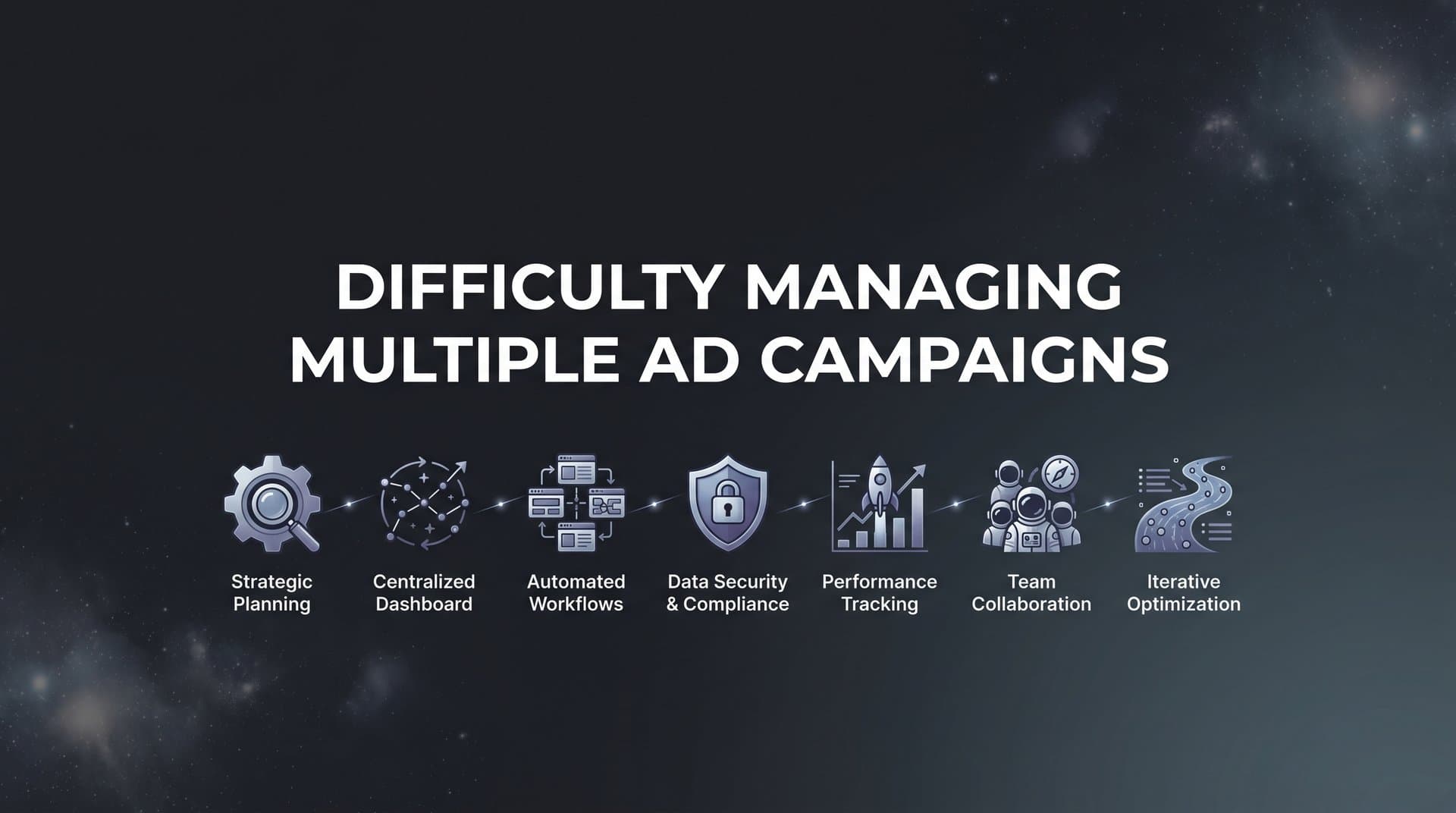
The marketers and agencies who succeed at multi-campaign management aren't just working harder. They've fundamentally restructured their approach around centralization, automation, and systematic processes. This guide breaks down seven strategies that transform chaotic campaign juggling into a streamlined, scalable system.
1. Centralize Your Campaign Command Center
The Challenge It Solves
Campaign fragmentation is the silent killer of advertising efficiency. When your campaign data lives in Meta Ads Manager, your creative assets are scattered across Google Drive folders, your performance metrics are in three different spreadsheets, and your client communication is buried in email threads, you're operating blind.
Every platform switch costs you mental energy and decision-making clarity. You waste time hunting for information instead of acting on it. Worse, you miss patterns that only become visible when all your data lives in one place. That winning headline from Campaign B could transform Campaign F's performance, but you'll never spot the connection when your insights are siloed.
The Strategy Explained
Centralization means bringing every critical element of campaign management into a single unified dashboard. This isn't just about convenience. It's about creating a single source of truth where you can see performance across all campaigns, access all creative assets, and make decisions based on complete information rather than fragmented snapshots.
The goal is to eliminate the need to toggle between platforms to understand what's happening. When you can see your entire advertising ecosystem in one view, you spot opportunities and problems faster. You identify cross-campaign patterns that inform better creative decisions. You allocate budget more intelligently because you're comparing apples to apples.
Modern platforms like AdStellar solve this by bringing creative generation, campaign building, performance tracking, and winner identification into a single interface. Agencies focused on managing multiple Meta ad accounts find this centralization particularly valuable for maintaining oversight across client portfolios.
Implementation Steps
1. Audit your current workflow and identify every platform or tool you're using for campaign management, creative production, and performance tracking.
2. Choose a centralized platform that handles multiple functions rather than trying to connect disparate tools through integrations that inevitably break or create data delays.
3. Migrate your active campaigns and creative assets into your centralized system, ensuring all historical performance data is accessible for AI analysis and optimization decisions.
4. Establish a single-platform workflow where campaign creation, launching, monitoring, and optimization all happen without leaving your command center.
Pro Tips
The power of centralization multiplies when combined with AI. Platforms that analyze your complete campaign history across all accounts can identify patterns you'd never spot manually. Look for systems that provide transparency into why certain decisions are recommended, not just what to do next.
2. Implement a Tiered Campaign Structure
The Challenge It Solves
Without clear organizational structure, your campaign list becomes an overwhelming mess. You've got awareness campaigns mixed with retargeting, evergreen campaigns alongside seasonal promotions, and no clear way to prioritize what needs attention first.
This chaos leads to critical campaigns getting neglected while you waste time on low-priority tests. Budget gets misallocated because you can't quickly identify which tier a campaign belongs to. Reporting becomes a nightmare when clients ask for performance by funnel stage and you're manually categorizing campaigns after the fact.
The Strategy Explained
A tiered structure organizes campaigns into clear hierarchies based on funnel stage, priority level, and business objective. Think of it as creating swim lanes for your campaigns so you always know what you're looking at and why it matters.
Your top tier might be revenue-driving retargeting campaigns that get daily optimization attention and the largest budget allocation. Mid-tier could be prospecting campaigns testing new audiences with moderate budgets and weekly check-ins. Bottom tier includes experimental campaigns with minimal budgets that you review monthly.
Consistent naming conventions are crucial here. Every campaign name should immediately tell you the tier, objective, audience, and creative approach without opening it. Something like "T1_RETAR_PastPurch_VideoUGC_Q2" instantly communicates priority, targeting, creative type, and timing.
Implementation Steps
1. Define your tier criteria based on business impact and required attention frequency, typically creating three to four distinct tiers from high-priority revenue drivers to low-priority experiments.
2. Create a naming convention template that includes tier designation, campaign objective, audience type, creative format, and time period, then document it for your entire team.
3. Restructure existing campaigns to fit your tiered system, renaming them according to your convention even if it means updating dozens of campaigns at once. This becomes essential when you're dealing with too many Facebook ad campaigns to manage effectively.
4. Set tier-specific optimization schedules and budget allocation rules so you're giving appropriate attention to each level without over-managing low-priority tests or under-managing critical campaigns.
Pro Tips
Your tier structure should evolve with your business. What starts as a Tier 3 experimental audience might prove so valuable it deserves Tier 1 treatment. Review your tier assignments quarterly and promote or demote campaigns based on actual performance rather than initial assumptions.
3. Automate Creative Production and Variation Testing
The Challenge It Solves
Creative production is the biggest bottleneck for most advertisers managing multiple campaigns. You need dozens of variations to properly test what resonates with different audiences, but creating them manually requires designers, video editors, and weeks of back-and-forth revisions.
By the time you've produced enough creative variations for one campaign, market conditions have shifted and you're already behind. Agencies managing multiple clients face this multiplied across every account. The result is either severely limited creative testing or completely unsustainable production costs.
The Strategy Explained
AI-powered creative automation generates scroll-stopping ad creatives at the speed and scale that manual production can't match. Instead of briefing designers and waiting for deliverables, you can produce image ads, video ads, and UGC-style content in minutes from a product URL or by cloning high-performing competitor ads.
This isn't about replacing quality with quantity. Modern AI creative tools produce genuinely effective ads that perform as well or better than manually designed creatives because they're built on patterns from millions of successful ads. The AI understands what visual elements, compositions, and messaging frameworks actually drive conversions.
AdStellar's AI Creative Hub exemplifies this approach. You can generate complete ad creatives from scratch, clone winning ads directly from the Meta Ad Library, or refine existing ads through chat-based editing. No designers, no video production team, no actors needed. You're producing creative variations at the pace your testing strategy demands, not at the pace your production team can deliver.
Implementation Steps
1. Start with your best-performing existing ads and use AI to generate variations that test different visual approaches, messaging angles, and formats while maintaining the core elements that made the original successful.
2. Implement competitor creative cloning by identifying top performers in your niche through Meta Ad Library, then using AI to adapt their winning approaches for your brand and products.
3. Build a creative testing framework where every campaign launches with multiple AI-generated variations testing different hooks, visual styles, and calls-to-action rather than putting all your budget behind a single creative.
4. Use chat-based refinement to quickly iterate on AI-generated creatives, adjusting specific elements based on early performance signals without starting the production process from scratch. Understanding AI marketing campaigns helps you leverage these tools more effectively.
Pro Tips
The real power of AI creative automation emerges when you combine it with performance data. Generate variations, let them run, then feed the performance insights back into your next creative generation. The AI learns what works for your specific audience and improves with every iteration.
4. Adopt Bulk Launching for Multi-Campaign Deployment
The Challenge It Solves
Launching campaigns one at a time is painfully inefficient when you're managing multiple accounts or testing at scale. You're manually duplicating ad sets, swapping out audiences, changing headlines, uploading new creatives, and repeating the same process dozens of times.
This manual approach doesn't just waste time. It introduces errors. You forget to update a headline in one variation, accidentally use the wrong audience in another, and end up with inconsistent campaign structures that make performance analysis difficult. By the time you've launched everything, you're too exhausted to properly monitor the results.
The Strategy Explained
Bulk launching means creating hundreds of ad variations simultaneously by mixing multiple creatives, headlines, audiences, and copy at both the ad set and ad level. Instead of building each campaign individually, you define your variables once and let the system generate every combination automatically.
Think of it like a multiplication table for advertising. If you have five creatives, three headlines, four audiences, and two copy variations, that's 120 unique ads. Building those manually would take hours. Bulk launching creates all 120 variations in minutes with perfect consistency across every element.
This approach is particularly powerful for agencies managing multiple clients or brands running campaigns across different product lines. Learning how to launch multiple ads quickly becomes a competitive advantage when speed to market matters.
Implementation Steps
1. Prepare your variables in advance by gathering all creatives, headlines, body copy variations, and audience segments you want to test before starting the bulk launch process.
2. Use a platform with bulk launching capabilities to mix and match your elements at both the ad set level for audience variations and the ad level for creative and copy combinations.
3. Preview the complete campaign structure before launching to ensure the system is generating the combinations you intended and that your naming conventions are applied consistently.
4. Launch all variations to Meta simultaneously, then monitor initial performance to identify which combinations deserve increased budget allocation and which should be paused.
Pro Tips
Bulk launching works best when combined with clear hypotheses about what you're testing. Don't just create variations randomly. Define specific questions you're answering, like whether video outperforms static images for cold audiences or whether benefit-focused headlines beat feature-focused ones. Structure your bulk launches around these hypotheses for clearer insights.
5. Build a Performance Leaderboard System
The Challenge It Solves
When you're running multiple campaigns, identifying your actual best performers becomes surprisingly difficult. You might know Campaign A has a better ROAS than Campaign B, but which specific creative, headline, or audience is driving that performance? Which elements should you scale and which should you kill?
Without systematic performance ranking, you're making optimization decisions based on incomplete information. You might be scaling a campaign that's only performing well because of one winning ad while the other 15 variations are losing money. You're missing opportunities to take your best elements and deploy them across other campaigns.
The Strategy Explained
A performance leaderboard system automatically ranks every element of your campaigns by the metrics that actually matter to your business. Instead of manually digging through campaign data, you get instant visibility into which creatives, headlines, copy, audiences, and landing pages are true winners based on ROAS, CPA, CTR, or whatever goals you've set.
This isn't just sorting by a single metric. Advanced leaderboard systems score elements against your specific benchmarks and goals. If your target CPA is $25, the system shows you which creatives are beating that benchmark and by how much. You can instantly spot not just what's working, but what's exceeding your performance standards.
AdStellar's AI Insights feature exemplifies this with leaderboards that rank everything by real performance data. Set your target goals and the AI scores every element against your benchmarks. You get instant clarity on what deserves more budget, what needs optimization, and what should be paused.
Implementation Steps
1. Define your primary success metrics and target benchmarks for each campaign objective, whether that's ROAS thresholds for purchase campaigns or CPA targets for lead generation.
2. Implement automated leaderboards that rank creatives, headlines, audiences, and copy variations by your defined metrics, updating in real-time as performance data comes in.
3. Create separate leaderboards for different funnel stages since a winning creative for cold traffic might perform differently than one for retargeting audiences. This is especially important when Meta campaigns show inconsistent results across different segments.
4. Review your leaderboards daily for top-tier campaigns and weekly for lower-priority tests, using the rankings to inform budget reallocation and creative production priorities.
Pro Tips
The most valuable insights come from cross-campaign leaderboards that show you which elements win consistently across multiple campaigns. A headline that ranks in the top three across five different campaigns is a proven performer worth building your next creative around. Look for patterns across your leaderboards, not just individual winners.
6. Create a Winners Library for Rapid Redeployment
The Challenge It Solves
You've spent weeks testing to identify your best-performing creatives, headlines, and audiences. Then when you're building a new campaign, you can't remember which specific elements drove those great results. You're digging through old campaigns, trying to recreate winning combinations from memory, and probably missing some of your best assets entirely.
This scattered approach to winner management means you're constantly reinventing the wheel. Every new campaign starts from scratch instead of building on proven performers. You waste budget re-testing elements you've already validated simply because you don't have an organized system for capturing and reusing winners.
The Strategy Explained
A winners library is a centralized hub where all your best-performing elements live with their actual performance data attached. When you identify a winning creative, headline, audience, or copy variation, it automatically gets added to your library with the metrics that prove why it's a winner.
This transforms campaign building from guesswork into strategic assembly. Instead of starting with blank templates, you're selecting from a curated collection of proven performers. You can instantly see which creative got a 4.2% CTR, which headline drove a $18 CPA, and which audience delivered a 6x ROAS. You're building new campaigns from your best historical performance, not from scratch.
The real power emerges when your winners library is integrated with your campaign building process. Platforms like AdStellar's Winners Hub let you select any proven element and instantly add it to your next campaign. This approach also helps when you're focused on replicating successful Facebook campaigns across different audiences or accounts.
Implementation Steps
1. Establish clear criteria for what qualifies as a winner based on your performance benchmarks, such as creatives that exceed your target ROAS by 20% or headlines that beat your average CTR by 50%.
2. Create a centralized repository where winning elements are automatically added when they hit your performance thresholds, tagged with relevant metadata like campaign type, audience, and performance metrics.
3. Organize your winners library by element type and use case so you can quickly find relevant assets when building new campaigns, such as separate sections for cold traffic creatives versus retargeting ads.
4. Make winner redeployment part of your standard campaign building process, always starting with proven performers before testing new variations.
Pro Tips
Your winners library should evolve as performance changes. An element that was a winner six months ago might not perform as well today due to creative fatigue or market shifts. Regularly audit your library and remove or flag elements that no longer meet your performance standards. Keep your library fresh with recent winners, not just historical ones.
7. Let AI Handle Campaign Building and Optimization
The Challenge It Solves
Building optimized campaigns requires analyzing massive amounts of historical data to identify which combinations of audiences, creatives, and messaging actually work. Doing this manually means you're either relying on gut instinct or spending hours in spreadsheets trying to spot patterns across dozens of variables.
The complexity multiplies when managing multiple campaigns. Each new campaign should learn from all your previous performance data, but synthesizing those insights across accounts, objectives, and time periods is practically impossible without automation. You end up making decisions based on limited data or recent bias rather than comprehensive historical performance.
The Strategy Explained
AI campaign building means letting intelligent systems analyze your complete campaign history, rank every element by actual performance, and build new campaigns based on proven patterns rather than guesswork. The AI identifies which creatives, headlines, audiences, and copy variations have historically driven the best results for campaigns similar to what you're building now.
This isn't black box automation where you have no idea why decisions are being made. The best AI systems provide full transparency into their reasoning. You see exactly why the AI selected specific audiences, why it's recommending certain creative approaches, and what historical data informed each decision. You maintain strategic control while letting AI handle the analytical heavy lifting.
AdStellar's AI Campaign Builder exemplifies this approach. The AI analyzes your past campaigns, ranks every creative, headline, and audience by performance, and builds complete Meta Ad campaigns in minutes. Every decision is explained with full transparency so you understand the strategy, not just the output. The AI gets smarter with every campaign you run, continuously learning from your performance data. This represents the future of advertising technology where human strategy combines with machine intelligence.
Implementation Steps
1. Connect your historical campaign data to an AI system that can analyze performance across all your accounts and identify patterns in what drives results for different objectives and audiences.
2. Start with AI-assisted campaign building where the system makes recommendations but you retain approval authority, allowing you to understand the AI's logic before fully trusting its decisions.
3. Feed performance data back into the AI system continuously so it learns from every campaign result and improves its recommendations based on your specific business and audience.
4. Gradually increase AI autonomy for routine campaign builds while maintaining human oversight for strategic decisions and new initiatives that fall outside historical patterns. Understanding Facebook automation vs manual campaigns helps you find the right balance for your workflow.
Pro Tips
AI campaign building becomes exponentially more powerful as your data set grows. The system needs sufficient historical performance data to identify reliable patterns. If you're just starting out, combine AI recommendations with your own expertise until the system has enough campaign data to make highly confident predictions. The investment in feeding the AI pays off as it becomes increasingly accurate at predicting what will work.
Your Path to Multi-Campaign Mastery
The difficulty managing multiple ad campaigns stems from trying to scale manual processes that were never designed for the volume and complexity of modern advertising. Spreadsheets, scattered tools, and human-only decision making simply can't keep pace when you're running dozens of campaigns simultaneously.
The transformation happens when you shift from fragmented, manual workflows to centralized, AI-powered systems. Start by consolidating everything into a single command center where you can see and control all campaigns from one place. Implement structured organization through tiered campaign hierarchies and consistent naming conventions.
Eliminate production bottlenecks by automating creative generation and variation testing. Deploy campaigns at scale through bulk launching instead of building them one by one. Let performance leaderboards surface your winners automatically rather than hunting through campaign data manually. Build a winners library that turns every successful test into a reusable asset for future campaigns.
Most importantly, let AI handle the analytical complexity of campaign building and optimization. The marketers who thrive at managing multiple campaigns aren't superhuman. They've simply built systems that handle the repetitive, data-intensive work while they focus on strategy and creative direction.
Ready to transform your multi-campaign chaos into a streamlined system? Start Free Trial With AdStellar and experience a platform that brings all these strategies together. From AI creative generation to bulk launching to automated winner identification, AdStellar handles the complexity of managing multiple campaigns so you can focus on scaling what works. See how managing multiple campaigns can actually be manageable.