So, what exactly are AI marketing campaigns? Put simply, they use artificial intelligence to handle the heavy lifting of decision-making, personalization, and optimization. It creates smarter, faster, and far more effective advertising.
Think of it as ditching your crumpled paper map for a real-time GPS. One gets you there eventually, but the other gives you the smartest route, helps you dodge traffic jams, and finds the destination with pinpoint accuracy. This isn't some far-off concept anymore—it's a must-have tool for any serious advertiser today.
The New Reality of AI Powered Marketing

Trying to run a modern marketing campaign without AI is like navigating a packed city with that old paper map while everyone else zips by using Waze. It’s the difference between relying on manual guesswork and leaning on intelligent automation. This is a fundamental shift in how we work.
And no, this isn't about robots taking over your job. It's about giving marketers tools that deliver a level of speed, intelligence, and personalization that was once unimaginable. The proof is in the numbers. The AI marketing space was valued at a modest $12.05 billion back in 2020 but is expected to explode to $107.5 billion by 2028. That’s a nearly tenfold jump, showing just how fast this is becoming the new standard.
From Artisan Craft to Factory Scale
The old way of doing marketing was like the work of a skilled artisan. You could create a beautiful, handcrafted campaign, but the process was slow, painstaking, and almost impossible to scale effectively. AI brings a high-tech factory mindset to the process.
An AI-powered system can produce thousands of flawless, personalized products—or in this case, ads—at a scale and speed no human team could match. It learns from every interaction to continuously improve quality.
This new reality is built on a few core capabilities that AI brings to the table:
- Unmatched Speed: An AI can generate, test, and launch hundreds of campaign variations in the time it takes a human to build just a few by hand.
- Deep Intelligence: It crunches performance data in real-time, instantly spotting which creatives, audiences, and messages are actually working. This eliminates costly guesswork.
- Precise Personalization: Campaigns can finally be tailored to individual user behaviors and preferences, making the experience more relevant and engaging for every single person.
To really get a handle on this shift, it's worth exploring how AI is rewriting the rules of B2B marketing. The best part is that this power is no longer locked away for data scientists. By using an artificial intelligence marketing platform, any marketer can start putting these advantages to work for their own growth. This guide will show you exactly how.
Decoding the Engine Behind AI Marketing
To really get what’s going on with AI marketing campaigns, you don’t need a degree in data science. You just need to peek under the hood at the core technologies making it all happen. Once you clear away the jargon, these powerful systems are built on concepts that are surprisingly straightforward.
Let's break down the three main engines that power modern AI marketing. We'll use some simple analogies to see how they turn abstract data into real-world results.
Predictive Analytics: The Crystal Ball
Imagine an expert stock trader who has spent decades studying market history. They can look at past performance, current trends, and tiny market signals to guess which stocks are about to soar and which are ready to tank. That’s pretty much what predictive analytics does for your marketing.
This technology chews through mountains of your historical campaign data—every click, every conversion, every impression—to find patterns a person could never spot. It then uses those patterns to make some very educated guesses about the future.
- Who is most likely to buy? It looks at your current customers to build a profile of your ideal buyer, then hunts for new audiences that look just like them.
- Which customers might leave? It can spot declining engagement and predict churn, giving you a heads-up to re-engage those customers before they’re gone.
- What will the next top-performing ad be? It forecasts which creative elements are most likely to click with your target audience.
By predicting outcomes with incredible accuracy, this AI engine makes sure your marketing budget is spent on what’s most likely to work, not just on what happened to work in the past.
Natural Language Generation: The Instant Copywriter
Now, picture a team of world-class copywriters on call 24/7. You feed them a core message, a target audience, and a list of product benefits. In a flash, they come back with hundreds of perfectly written ad variations—headlines, body copy, and calls-to-action—each tweaked for a specific demographic or interest group. This is Natural Language Generation (NLG) in action.
NLG is the creative engine of AI marketing. It takes structured data (like product features or sale details) and spins it into text that sounds completely human. For marketers, this is a massive breakthrough.
Instead of spending hours writing a handful of ads, you can generate hundreds of context-aware variations in seconds. This allows you to test messaging at a scale that was previously impossible.
An e-commerce brand, for example, could use NLG to create unique ad copy for every single product in its inventory, each version highlighting different features for different shoppers. This results in hyper-relevant messaging that speaks directly to what an individual cares about, a huge factor in driving up engagement and conversion rates. Understanding these underlying mechanisms can provide powerful AI-driven marketing insights that sharpen your overall strategy.
Machine Learning: The Tireless Intern
Finally, think of machine learning as the ultimate marketing intern—one who never sleeps, never complains, and learns from every single task. You give this intern a goal, like "get the most conversions for the lowest cost," and it just gets to work.
Every time a user clicks (or doesn't click) an ad, the machine learning model logs that data point. It’s always watching to see which ad creative, audience segment, and time of day deliver the best results.
But unlike a human intern who needs new instructions, the algorithm automatically adjusts its own strategy based on this constant flow of new information. It’s always refining its approach without anyone needing to step in.
- It learns which ad variations are winners and automatically shifts more budget toward them.
- It spots underperforming ads and pulls the plug to prevent wasted spend.
- It discovers new audience pockets that are responding well and scales up campaigns to reach them.
This creates a self-optimizing loop that gets smarter and more efficient with every dollar you spend. It’s this learning process that turns a static campaign into a dynamic, intelligent system that drives continuous improvement.
Transforming Your Workflow With AI Automation
Talking about AI marketing in theory is one thing, but seeing it in action is where the real "aha" moment happens. The difference between the old, manual way of launching campaigns and an AI-powered approach is night and day. It’s like switching from navigating with a paper map to using a real-time GPS.
The traditional campaign workflow is a slow-moving assembly line that’s full of bottlenecks and educated guesses. It kicks off with days of audience research, moves on to a designer and copywriter spending hours on just a handful of ads, and ends with an anxious wait for data. Then it’s back to the spreadsheets, trying to piece together what actually worked.
An AI-powered workflow smashes that linear timeline. It pulls strategy, creative production, and optimization into a single, intelligent system where everything happens at once. Suddenly, one marketer can manage the output of what used to take an entire team.
This flow shows how the technology works behind the scenes, moving from forecasting to writing and—most importantly—learning from the results to get smarter over time.
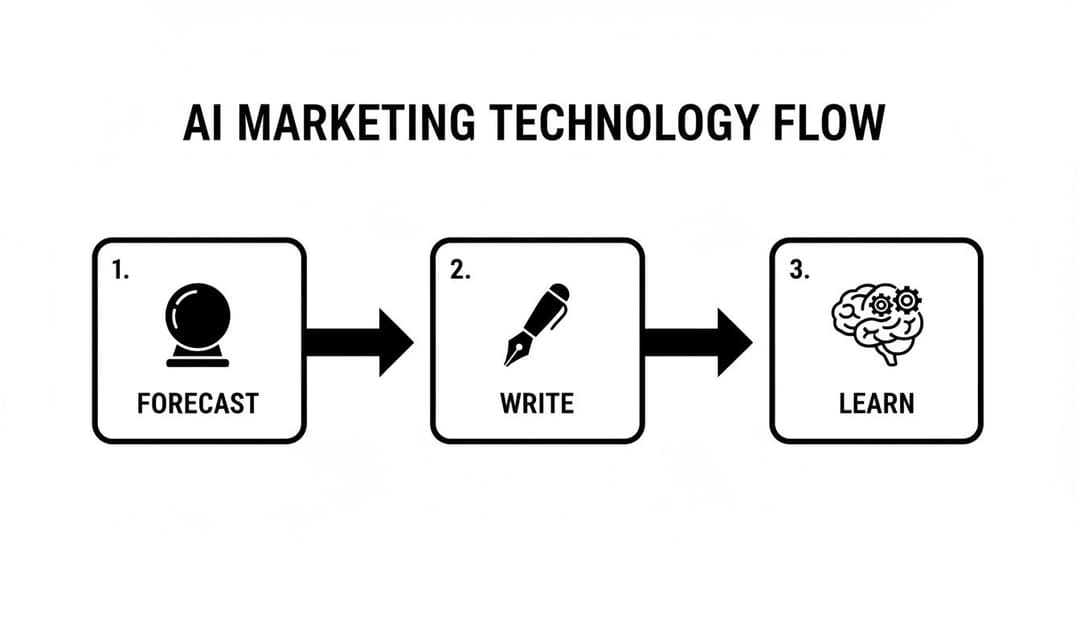
This simple loop—forecast, write, learn—is the engine that drives continuous improvement and takes the guesswork out of performance marketing.
The Old Way: A Manual Grind
Let's get specific about what the "before AI" picture really looked like. Running a campaign was a chain of tedious, disconnected tasks that drained time and resources.
- Audience Discovery: This meant manually pulling customer lists, uploading them into ad platforms, and just hoping the platform's lookalike algorithm could find a decent match. It was basically a shot in the dark.
- Creative Production: A designer and copywriter might spend a full week just to come up with five ad variations. Testing any more than that was often too expensive and slow to be practical.
- Campaign Setup: The campaign manager would then sink hours into Ads Manager, building out every ad set and ad one by one, constantly double-checking for mistakes.
- Optimization: This was often the most painful part. It involved exporting performance data into huge spreadsheets and trying to spot trends by hand, leading to slow, reactive budget shifts based on incomplete data.
The whole system was slow, fragile, and relied far too much on gut feelings instead of hard data. Every new campaign felt like starting over from square one.
The New Way: Automated Intelligence
AI platforms completely tear down and rebuild this outdated process. Instead of a series of manual handoffs, you get one integrated system that handles the heavy lifting for you.
The point of AI automation isn't just to do the same old tasks faster. It's about unlocking a fundamentally different and more intelligent way of marketing that simply wasn't possible before.
Imagine giving an AI platform a single objective: "Launch a campaign for our new product, and target customers who look like our most profitable buyers." The system immediately gets to work.
Predictive Strategy: First, the AI digs into your historical data. It pinpoints the creative elements, copy angles, and audience segments that drove the most profit in the past and uses that insight to build the campaign's strategic foundation.
Mass Creative Generation: In minutes, it generates hundreds of creative variations. The AI mixes and matches your best headlines, images, and calls-to-action, creating a massive portfolio of ads ready for testing.
One-Click Launch: The platform then assembles these hundreds of variations into a complex, multi-layered campaign structure and pushes it live across all your channels with a single click.
To see just how different these two approaches are, take a look at the side-by-side comparison. It highlights the manual bottlenecks that AI completely removes from the process.
Traditional vs AI-Powered Campaign Workflow
| Campaign Stage | Traditional Workflow (Manual) | AI-Powered Workflow (Automated) |
|---|---|---|
| Strategy & Planning | 2-3 days of audience research, manual segmentation, and brainstorming. | Minutes of AI-driven analysis of historical data to predict winning audiences and creative angles. |
| Creative Production | 3-5 days for a designer and copywriter to produce 5-10 ad variations. | Minutes for the AI to generate hundreds of creative and copy variations. |
| Campaign Setup | 4-8 hours of manually building campaigns, ad sets, and ads in a platform's interface. | One click to automatically build and launch a multi-layered campaign structure with all variations. |
| Initial Learning Phase | 5-7 days of waiting for enough data to come in before making the first optimization move. | 24-48 hours for the AI to gather initial data and begin real-time budget and creative optimization. |
| Ongoing Optimization | 2-4 hours weekly spent in spreadsheets, trying to manually identify winning ads and shift budget. | Continuous and automated real-time budget allocation to top-performing ad combinations. |
The contrast is clear. The AI-powered workflow doesn't just speed things up; it creates a more dynamic and responsive system from start to finish. This rapid execution is a massive advantage.
Performance data backs this up, with companies reporting that AI-driven campaigns launch 75% faster and achieve 47% better click-through rates. You can find more on these powerful results, including how businesses are seeing 20-30% higher ROI, by digging into the latest research on AI marketing campaigns.
Once a campaign is live, the AI’s job is far from over. It shifts into a continuous optimization mode, automatically moving budget to the winning ad combinations in real-time. This gives a single marketer the power of an entire analytics and media buying team. You can get a much deeper look into how this works in our complete guide to AI marketing automation.
All the theory in the world doesn't mean much until you see how it works in the trenches. It's one thing to talk about AI models and algorithms, but it's another to see how they actually move the needle for real businesses.
Let's put the technical jargon aside and look at what happens when the rubber meets the road. These aren't just hypothetical scenarios; they're the everyday success stories of businesses that have woven AI into their marketing fabric. We're talking about tangible results—more revenue, shrinking costs, and countless hours saved.

E-commerce Holiday Sale Domination
We've all seen this story play out: an e-commerce store bracing for the holiday shopping frenzy. In the past, their marketing team would spend weeks grinding away, manually creating and testing maybe a dozen different ads. The results were a crapshoot, with a big chunk of their budget burning up on ads that just didn't connect before they could pivot.
Then, they switched to an AI-powered platform. Instead of a handful of ad concepts, the team simply uploaded their core product images and key selling points. Within minutes, the AI had generated 500 unique ad variations, testing countless combinations of headlines, images, and calls-to-action across different audience segments.
The platform didn't just test; it learned. It instantly identified the winning combinations and automatically funneled the budget toward them. The result was a staggering 60% increase in Return on Ad Spend (ROAS) compared to the previous year's manual efforts.
This is a perfect example of how AI transforms creative testing from a slow, manual chore into a powerful, automated discovery engine.
Slashing SaaS Customer Acquisition Costs
Now, let's switch gears to a B2B SaaS company. They were stuck in a common trap: a sky-high customer acquisition cost (CAC). Their team was casting a wide, expensive net, hoping to find qualified leads for their niche software. It was an inefficient and costly guessing game.
They brought in an AI platform to build smarter audiences. The system dug into their existing customer data, zeroing in on the behaviors of their most profitable and engaged users. Using these deep insights, it constructed incredibly precise lookalike audiences.
The impact was immediate. Campaigns aimed at these AI-crafted audiences performed dramatically better, reaching prospects who were a natural fit from the get-go. This laser-focused targeting allowed the company to cut their customer acquisition cost by 40% while simultaneously improving the quality of their leads. It shows how AI can turn broad guesswork into a scientific process. Getting inspiration from how AI can be used in visual marketing is also a great way to find new ideas, as you can see in our post about AI generated commercials.
Agency Efficiency and Strategic Growth
Finally, picture a digital marketing agency juggling dozens of client accounts. Their account managers were drowning in repetitive, low-impact work—pulling reports, crunching numbers in spreadsheets, and manually tweaking daily budgets. This left them with almost no time for the high-level strategic work their clients actually valued.
By bringing an AI ad platform into their workflow, they automated these critical but time-sucking tasks. The system took over, generating daily performance reports, highlighting key trends, and making intelligent budget adjustments aligned with each client's unique goals.
This simple shift freed up an average of 15 hours per account manager every week. Instead of being buried in spreadsheets, the team could finally focus on what they do best: crafting long-term growth strategies, brainstorming new creative campaigns, and building stronger client relationships. It’s a classic case of AI handling the execution so humans can drive the strategy.
An AI marketing campaign isn’t a “set it and forget it” machine. It’s more like a prodigy that needs coaching. To get the most out of it, you need to be its guide, giving it the right feedback and a clear report card to track its progress.
This means moving past old-school metrics like clicks and impressions. Instead, you need to focus on the key performance indicators (KPIs) that actually tie back to business growth.
Unlike the fragmented data you get from native ad managers, a dedicated AI ad platform brings everything under one roof. It creates a unified, real-time leaderboard, ranking every creative, audience, and line of copy against your business goals. This turns optimization from a manual guessing game into an automated feedback loop.
Redefining Your Core Metrics
In a world powered by AI, your metrics have to get smarter too. A standard ad platform might show you a basic Return on Ad Spend (ROAS), but that’s just part of the story. An AI platform can calculate True ROAS, which factors in everything from creative production costs to customer lifetime value. It gives you a much more honest look at your profitability.
You also need to start tracking new KPIs that reveal what’s happening under the hood:
- Creative Performance Decay: How quickly does an ad get stale? AI can spot the early signs of audience fatigue and automatically swap in fresh creative before your performance tanks.
- Audience Value Scoring: The AI is constantly scoring your audience segments based on their value and conversion rates. This lets you double down on your most profitable customer pockets without lifting a finger.
- Time-to-Insight: How long does it take you to find a winning ad combination? With AI, you can slash this cycle from weeks to hours, since it can analyze data faster than any human team ever could.
AI fundamentally changes how we measure success. We stop asking "Did this campaign work?" and start asking "How quickly can the AI find what works best and scale it?" The focus shifts from a single outcome to the speed of learning and adaptation.
This level of detailed measurement is what allows you to make strategic decisions instead of just reacting to surface-level trends. For a deeper look, check out our guide on how to measure advertising effectiveness with modern tools.
Automating Large-Scale Testing
The old way of A/B testing—pitting one ad against another—is just too slow and narrow for modern advertising. AI campaigns are built for A/B/n testing, where "n" can be hundreds or even thousands of variations tested at the same time. Trying to analyze that mess of data manually is a non-starter.
This is where AI truly flexes its muscles. It automates all the heavy statistical analysis, confidently declaring winners and losers in a fraction of the time. But it doesn't just tell you which ad won; it tells you why by breaking down the performance of individual elements like headlines, images, and calls-to-action.
This creates a powerful feedback loop. You systematically put your budget behind proven winners, which in turn makes the AI smarter for the next cycle.
Beyond just campaign metrics, this automated approach delivers huge efficiency gains. For instance, organizations using AI for personalization and content generation have seen a 43% increase in email open rates and a 67% reduction in content production costs. As you can discover in more detail, these efficiencies extend across the board, enabling marketers to publish more content while saving hours of manual work every week, as detailed in recent research on AI marketing impacts. This lets your team focus on strategy, not spreadsheets.
Your Action Plan for Launching AI Campaigns
Putting powerful ai marketing campaigns into motion shouldn't require a Ph.D. in data science. The real secret is moving away from scattered spreadsheets and clunky manual workflows and adopting an intelligent system that can act as your central command center. This is exactly where a dedicated AI advertising platform proves its worth.
Think of it like the cockpit of a modern airliner. The pilot isn't manually crunching numbers for wind speed and fuel burn—they’re managing sophisticated systems that handle those complex calculations. This frees them up to focus on the most important thing: guiding the plane to its destination. An AI platform does the same for your marketing, automating the heavy lifting so you can focus on strategy.
The Components of an AI Command Center
A solid AI platform pulls several critical functions into a single, unified home base. This creates a scalable and repeatable process for growth. These aren't just separate tools working in isolation; they are interconnected systems that constantly feed insights into one another, creating a powerful cycle of continuous improvement.
Here are the key components that work together to make it happen:
- Unified Creative Library: This is much more than a simple folder of images. It’s an intelligent hub where every single creative asset—your images, videos, and ad copy—is tagged, organized, and tracked for performance.
- Advanced Audience Builder: It’s time to move past basic lookalikes. This tool uses predictive analytics to pinpoint your most valuable customer segments and builds hyper-targeted audiences based on real conversion data, not just guesswork.
- Cross-Channel Performance Dashboard: Finally, you can see everything in one place. This dashboard provides a clear, consolidated view of what’s working across all your campaigns, ranked by the business goals that actually matter, like ROAS or CPA.
When these elements work together, they give a single marketer the power of an entire analytics and media buying team.
Your Path to Scalable Growth
So, how do you actually put this into practice? The good news is you don't have to overhaul everything at once. Mastering AI marketing campaigns is a journey that starts with small, data-driven steps that build momentum. With a platform like AdStellar AI, this process becomes surprisingly straightforward.
The goal isn't just to automate old tasks; it's to unlock a new level of strategic execution. You are empowering yourself to operate at a scale and speed that was previously out of reach, turning insights into action instantly.
Start by connecting your ad accounts and just letting the AI analyze your historical data. You’ll be surprised by the insights this initial audit alone can uncover about your best-performing creative and audiences. From there, you can launch your first test campaign using the AI’s recommendations.
- Generate and Test: Use the platform to generate dozens of ad variations based on your proven winners. Let the system run a structured test to find the next breakthrough combination of copy, creative, and audience.
- Analyze and Learn: Keep an eye on the performance dashboard as the AI automatically ranks every ad element. You'll start to understand why certain ads are winning—is it the headline, the image, or the audience?
- Scale and Repeat: Double down on what works. Reinvest your budget into the ads and audiences delivering the highest return, and use those learnings to fuel your next campaign cycle.
This simple, repeatable loop is the engine of exponential growth. It’s a clear action plan that puts the power of AI directly into your hands, helping your team drive more revenue from every ad dollar you spend.
Frequently Asked Questions About AI Marketing
It's completely normal to have questions when you first start exploring AI. Even with all the buzz, figuring out how it impacts your job, your budget, and where to even start can feel like a lot. Let's tackle some of the most common concerns we hear from marketers.
First, know you're not alone in this. A major 2026 survey revealed that 94% of marketing professionals are already using AI tools every single day. North America is at the forefront, with the U.S. in particular pushing the boundaries of what's possible in content generation and ad optimization. You can discover more insights about AI content adoption to see how deeply these tools are now woven into marketing.
It's clear that getting comfortable with AI isn't just a "nice to have" anymore—it's becoming a core part of the modern marketer's toolkit.
Will AI Replace My Job as a Marketer?
No. A better way to think about it is that AI is your new, incredibly powerful co-pilot. It’s here to take over the tedious, data-heavy lifting—like churning out hundreds of ad variations or constantly monitoring budget pacing—so you can get back to the high-impact work that actually moves the needle. Think strategy, creative direction, and telling your brand's story.
AI is a force multiplier for your expertise. It lets you operate at a massive scale and make smarter decisions, faster than ever before. It handles the "how" so you can finally focus on the "why" and the "what."
Your role isn't disappearing; it's evolving. A marketer who knows how to use AI to drive real results will be more valuable than one who doesn't. This is about making you better, not obsolete.
Is AI Marketing Only for Big Companies?
Not anymore. It's true that early AI was incredibly complex and came with a hefty price tag, putting it out of reach for most. But today, modern platforms have completely changed the game. Subscription-based AI advertising platforms are now built to be affordable and intuitive enough for startups, e-commerce shops, and agencies of all sizes.
These tools effectively level the playing field. They give smaller teams access to the same kind of sophisticated optimization and automation that was once only available to companies with enterprise-level budgets. You no longer need a huge team or a seven-figure budget to compete.
How Do I Get Started with AI Marketing Campaigns?
The easiest way to dip your toes in is by using a platform that plugs right into your existing ad accounts, like Meta or Google. You absolutely do not need to build anything from scratch.
Here’s a simple, practical way to begin:
- Analyze Your History: The first step is to let the AI look at your past campaigns. It can quickly spot hidden patterns and tell you which ads and audiences have been your real winners.
- Generate New Variations: Next, use the platform's tools to create new versions of your top-performing ads. Test out different headlines, images, or new angles on your copy.
- Launch a Small Test: Don't go all-in at once. Start with a small, controlled test campaign to see if the AI's suggestions hold up. This is your chance to learn from the data and build confidence.
- Scale Up Gradually: Once you see positive results, you can start to expand your campaigns and give the AI more responsibility for optimization.
The key is to start smart, not big. One small, focused test will teach you more than reading about this for another six months.
Ready to stop guessing and start scaling your campaigns with data-backed intelligence? With AdStellar AI, you can launch, test, and optimize hundreds of ad variations in minutes, not days. Discover how our platform automates the heavy lifting so you can focus on strategic growth by visiting AdStellar AI today.