Let's be honest, the old ad creation playbook is collecting dust on the shelf. In performance marketing, speed is everything, and the traditional, weekslong process just doesn’t cut it anymore. Today, ai generated commercials aren't some futuristic fantasy—they're a core tool for teams that need to create, test, and scale campaigns at a pace that was unimaginable just a few years ago.
The Inevitable Shift to AI Advertising
The move away from slow, manual ad production isn't coming; it's already here. Top-tier DTC brands and sharp digital agencies are already using AI-powered workflows to get a serious leg up on platforms like Meta. This isn't about firing your creative team. It’s about giving them superpowers.
For any marketer focused on growth, the advantages are real and available right now:
- Unmatched Speed: You can go from one creative idea to a hundred testable ad variations in hours, not weeks. This means you can finally react to market trends while they're still relevant.
- Scalable Production: Need more assets? No problem. AI can generate scripts, voiceovers, and visuals on demand, letting you build a huge library of creative combinations without your production budget exploding.
- Data-Informed Creativity: AI helps you stop guessing and start knowing. It can analyze what’s actually working and help you iterate on the winning elements, making sure your creative decisions are backed by hard performance data.
This shift is so fundamental that specialized AI development services are now shaping the entire future of content creation.
To really see the difference, let's compare the old way with the new. The traditional ad production workflow was a slow, expensive relay race between different departments. The AI-powered approach turns it into a streamlined, one-person operation.
Comparing Traditional vs AI Ad Production Workflows
| Stage | Traditional Manual Process | AI-Powered Process | Key Advantage |
|---|---|---|---|
| Concepting | Long brainstorming sessions, limited by human bandwidth. | AI generates dozens of concepts based on performance data and prompts. | Massive idea generation |
| Scripting | A copywriter writes a few scripts; feedback is slow. | AI writes unlimited script variations in seconds for A/B testing. | Speed and iteration |
| Asset Creation | Requires photographers, designers, and editors. Weeks of work. | AI generates visuals, voiceovers, and animations in minutes. | Drastic cost and time savings |
| Variations | Manually creating each variation is costly and time-consuming. | AI systemically creates hundreds of combinations automatically. | Scalable testing |
| Launch | A slow, manual upload and setup process for a few ads. | Ads are generated, assembled, and launched in a few clicks. | Efficiency and agility |
This table shows a complete overhaul of the process. We're moving from a world of scarcity, where every creative was precious, to one of abundance.
Out with the Old, In with the New
Think about the traditional process: siloed teams, endless feedback loops, and huge production costs for tiny creative changes. A single 15-second video ad could easily get stuck in production for weeks, bouncing between writers, videographers, editors, and designers. That model is simply too slow and expensive to support the high-volume testing that paid social demands today.
Platforms like AdStellar are built for this new reality. They bring the entire process under one roof, allowing a single marketer to manage the production of hundreds of ads. If you want to go deeper, check out our guide on what AI-powered advertising really means.
The fundamental change is a shift from a linear, project-based mindset to a continuous, system-based one. We’re no longer asking, "How do we make one great ad?" Instead, the question is, "How do we build a system that constantly discovers and scales great ads?"
This change makes high-level production accessible to more teams. A recent study found that 85% of marketers using generative AI have seen a major productivity boost in creating content and ads. By taking over the repetitive work of making variations, AI lets marketing teams get back to what they do best: strategy, analysis, and scaling the winners. For performance marketers, the choice is simple: adapt to this new workflow or get left behind.
Building Your High-Volume Creative Testing Engine
To win on paid social platforms like Meta, the old way of launching a few ads and hoping for the best is dead. You need a system—a machine that constantly learns, adapts, and spits out winners. This is where high-volume creative testing, powered by AI, becomes your secret weapon. It’s not about throwing spaghetti at the wall; it’s about running structured experiments at a scale that was impossible just a few years ago.
First Things First: Nail Down Your Strategy
Before you even think about generating a single asset, you need a rock-solid plan. This all starts with getting laser-focused on your campaign's core purpose. Are you trying to drive sales? Get more leads? Boost app sign-ups? Your main goal will dictate the metrics you live and die by.
You absolutely have to define your Key Performance Indicators (KPIs) from day one.
- Return on Ad Spend (ROAS): For any e-commerce brand, this is the holy grail. It’s the total revenue you make for every single dollar you put in.
- Cost Per Acquisition (CPA): Whether you're selling products or services, this tracks how much it costs to land a brand-new customer. It's a fundamental measure of profitability.
- Cost Per Lead (CPL): If you're in B2B or running a service-based business, this is your go-to metric for keeping the sales pipeline full and healthy.
Once your KPIs are locked in, it's time to get into your audience's head. Go way beyond basic demographics. What are their biggest frustrations? What truly motivates them? What kind of language do they use when talking about their problems? For a DTC skincare brand, this means creating distinct personas like "The Eco-Conscious Millennial" versus "The Busy Professional Over 40." Each one needs a completely different message.
Letting AI Build Your Creative Arsenal
With your strategy set, you can now unleash the AI to do the heavy lifting. The objective here is to build a massive, interchangeable library of creative assets. You’re not trying to make one perfect ad; you're creating all the necessary components to assemble hundreds of AI-generated commercials.
Think of it as stocking a kitchen with every possible ingredient. You’re not making one dish; you’re prepping to cook anything on the menu.
Script Variations: Start by feeding your core messaging and persona pain points into a script generator. Ask for tons of different hooks, body copy, and calls-to-action (CTAs). For a single product, you could easily generate 10 opening lines, 5 value props, and 5 CTAs. Just like that, you have 250 potential script combinations ready to go.
AI Talent and Voiceovers: Next, pick a variety of AI-generated presenters that match your different audience personas. Choose avatars with diverse appearances, ages, and styles. Then, pair them with different AI voices—some high-energy and exciting, others calm and trustworthy. This lets you test how different on-screen personalities resonate with your audience.
Visuals and Backdrops: Finally, generate a library of background images or videos. For a fitness app, you could have scenes in a gym, a park, a home office, and a kitchen. With AI, you can crank out dozens of these backdrops in minutes, keeping your ads from ever looking stale.
This flowchart shows just how dramatically an AI-powered workflow changes the game compared to the old, manual process.
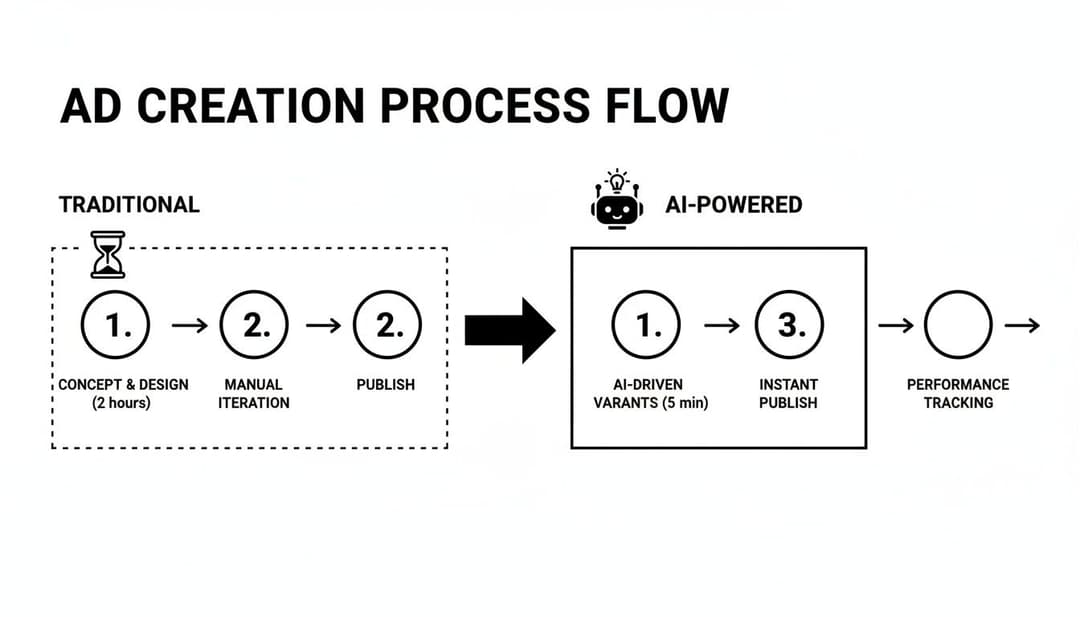
You can see the shift from a slow, step-by-step assembly line to a rapid, parallel system where every creative piece is developed at the same time.
Assembling and Launching Your Campaign
With your asset library stocked, the final step before launch is putting it all together. This is where a platform designed for this workflow becomes your best friend. Trying to manually create hundreds of ad variations by mixing and matching scripts, avatars, voices, and backgrounds would take days of tedious work.
Key Takeaway: The real power of AI in advertising isn't just generating a single cool asset. It's the automated assembly of thousands of assets into a structured testing framework that finds winners for you.
Tools like AdStellar are built for this. You can set up rules to automatically combine your assets into hundreds of unique video ads, ready for launch. It’s this ability to create a structured campaign, where every variable is an isolated element for testing, that is so crucial.
This approach feeds Meta's algorithm the volume and variety it craves to exit the "learning phase" faster and pinpoint your top-performing ad combinations. If you want to dive deeper into this, you can learn more about the most effective Meta ads creative testing methods and how to structure your campaigns for massive success.
When you structure your campaigns this way, you’re not just launching ads—you're launching a data-gathering machine. Every impression, click, and conversion gives you a signal that helps you understand exactly which creative levers are driving your results.
A great strategy is just a good idea until you execute on it. Now it's time to roll up your sleeves and build a production workflow that can actually turn your high-volume testing blueprint into a reality.
Making successful ai generated commercials isn’t about finding one magical, all-in-one tool. The real secret is orchestrating a set of specialized AI models and centralizing your assets to move at lightning speed.
This means breaking ad creation down into its core parts—script, visuals, and voice—and picking the best AI for each job. Then, you pull it all together into a system that lets you build, test, and iterate faster than you ever thought possible.
The Modern AI Creative Stack
A fragmented toolkit is the enemy of speed. While individual AI tools are impressive, the real advantage comes from integrating them into a seamless workflow. Your goal is to build a creative production line, not just a collection of one-off projects.
Here’s a look at the essential components and how they fit together:
Scripting Engines: Use large language models like GPT-4 or Claude 3 to brainstorm endless script variations. Feed them your core messaging, audience personas, and hook ideas. You can ask them to generate ten different opening lines for your "eco-conscious millennial" persona, each hitting a different pain point.
Visual Generators: Tools like Midjourney, DALL-E 3, or Runway are fantastic for creating unique background visuals and even short video clips. Prompting is everything here. Don't just ask for "a modern kitchen." Get specific: "A bright, minimalist kitchen with natural light, marble countertops, and a single green plant, photorealistic, 4K."
Voice Synthesizers: With platforms like ElevenLabs or PlayHT, you can generate countless voiceovers in different tones, accents, and languages. This makes it easy to A/B test a calm, reassuring voice against a high-energy, enthusiastic one using the exact same script.
To really get this process humming, marketers need access to the right tools. You can explore the top AI content creation tools for marketers to see what’s available for each stage of this workflow.
Unifying Your Workflow with a Media Library
Having all these great assets is one thing, but manually stitching them together is a major bottleneck. This is where a centralized Media Library, like the one inside a platform like AdStellar, becomes your secret weapon. It acts as the command center for your entire operation, keeping all your AI-generated components organized and ready for automated assembly.
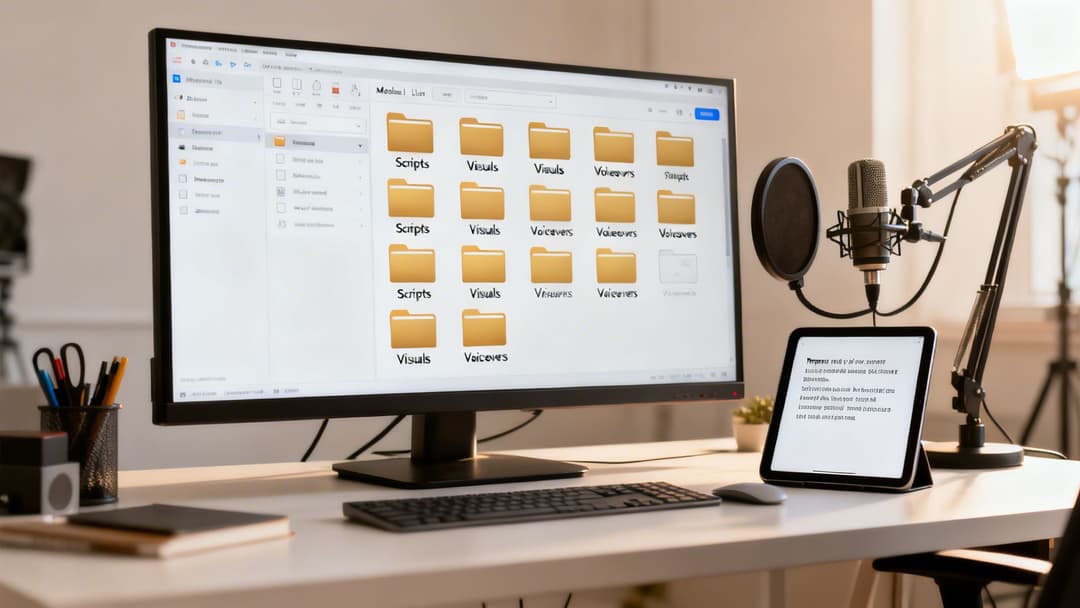
Think of it as your own digital prop house. Every script, voiceover, image, and video clip is tagged and categorized, ready to be deployed instantly. This level of organization is what unlocks true scale.
The most productive teams don't just generate assets; they build a system. Your Media Library isn't just a storage folder—it's an active inventory for your creative testing engine, allowing you to mix and match components on the fly.
A systematic approach like this prevents chaos and helps you track exactly which elements are driving performance. If you want to dig deeper into building this kind of streamlined process, our guide on creative automation tools offers some more advanced strategies.
Pro Tips for Effective AI Prompting
The quality of your AI-generated assets always comes back to the quality of your prompts. Vague instructions will give you generic, forgettable results. If you want visuals and copy that actually feel like your brand, you have to be obsessively specific.
Crafting Prompts for Visual Consistency: To keep your brand aesthetic consistent across dozens or even hundreds of AI-generated commercials, you need a "style prompt" that you can reuse.
| Prompt Element | Example for a Luxury Skincare Brand |
|---|---|
| Subject | A woman in her late 30s with clear, glowing skin |
| Setting | A serene, minimalist bathroom with soft, warm lighting |
| Style | Photorealistic, cinematic, shallow depth of field |
| Mood | Calm, confident, and elegant |
| Negative Prompts | --no cartoon, --no oversaturated colors, --no text |
Using a consistent style prompt ensures that whether you're generating a new background or a completely different scene, the look and feel stay locked in with your brand's identity.
Mini-Case Study: Turning One Idea Into 200 Ads
Let's see how this all comes together. A direct-to-consumer (DTC) coffee subscription brand wanted to test a new "work from home" angle for their Meta ads.
- The Idea: Their coffee boosts your afternoon productivity. Simple enough.
- Asset Generation (15 Minutes):
- Scripts: Using AI, they generated 5 hooks (e.g., "Hit the 2 PM wall?"), 4 value props (e.g., "Smooth energy, no jitters"), and 2 CTAs ("Try your first bag" vs. "Find your perfect blend").
- Visuals: They generated 5 different home office backgrounds using a consistent "warm and cozy" style prompt.
- Voiceovers: They created 2 voiceover styles—one male (energetic) and one female (calm).
- Automated Assembly (5 Minutes):
- They uploaded all these components into their AdStellar Media Library.
- The platform then automatically assembled every possible combination: 5 hooks x 4 props x 2 CTAs x 5 backgrounds = 200 unique video ads.
In less than an hour, the brand went from a single creative concept to a massive, structured testing campaign ready to launch. This is the power of a mastered AI creative workflow. It’s not just about making ads faster; it's about building a system that discovers which ads work best.
How to Test and Optimize AI Commercials on Meta
Getting your AI-generated commercials live on Meta is just the first step. The real money is made in what comes next: disciplined testing and lightning-fast optimization. When you're juggling hundreds of creative variations, gut feelings won't cut it. You need a data-driven system to tell you what's working, what’s a dud, and where to allocate your next dollar.
The magic of AI in advertising isn't just about creating the ads; it's about building a rapid feedback loop. This cycle lets you analyze performance, double down on what’s resonating, and systematically cut the dead weight, ensuring your budget is always working as hard as possible.
Decoding Early Performance Signals in Meta
Once your campaign launches, the clock is ticking. You need to read the initial data from Meta Ads Manager without making any knee-jerk reactions. The first 24-72 hours are critical for gathering early signals, but it's a huge mistake to make big changes while the algorithm is still in its learning phase.
Instead, focus on the leading indicators that signal genuine user interest, even before the conversions start pouring in.
- Hook Rate (First 3 Seconds): What percentage of your audience is still watching after the three-second mark? A strong hook rate tells you the opening is doing its job and stopping the scroll.
- Hold Rate (Mid-Video): Are people sticking around for your core message? If you see a massive drop-off here, it could mean your value proposition is weak or your visuals are falling flat.
- Click-Through Rate (CTR): This is a classic for a reason. A solid CTR shows your creative and copy are compelling enough to make someone take action.
These early metrics are your first real clues. If a group of ads has a terrible hook rate and a dismal CTR across the board, you can probably pause them with confidence, even if they haven't spent much. This frees up budget for the variations that are actually showing signs of life.
Using AI Analytics to Pinpoint Winners
Trying to manually sift through performance data for hundreds of ad variations is a surefire way to make mistakes and miss huge opportunities. This is where AI-powered analytics tools, like the ones we’ve built into platforms like AdStellar, become your secret weapon. They completely automate the process of dissecting performance, connecting every dollar spent back to the specific creative elements that drove a result.
Instead of just glancing at ad-level CPA, these systems break it all down by component. Imagine seeing a real-time leaderboard ranking your best-performing elements:
- Hooks: You might find that "Is your coffee giving you jitters?" pulls a 2.1% CTR, while "Tired of bland morning brew?" only manages a 0.8%.
- AI Avatars: A 30-year-old male avatar could be crushing it with your male audience, bringing in a $35 CPA, while a female avatar is the clear winner for women at a $42 CPA.
- Calls-to-Action: "Shop Now" might lead to a higher ROAS, but maybe "Learn More" is driving a much lower cost-per-lead for a different campaign objective.
This is the kind of granular analysis that allows for truly intelligent optimization. You're no longer guessing which part of your video is working; you have hard data telling you exactly which hooks, avatars, and messages are hitting the mark.
The goal is to move from optimizing individual ads to optimizing a system of creative components. When you know which ingredients are most effective, you can constantly recombine them to create new, high-potential "recipes" for success.
Creating a Continuous Feedback Loop
With these insights, you can build a powerful cycle of continuous improvement. The process itself is pretty straightforward: identify your winners, give them more fuel, and use the data to inform the next batch of creatives.
First, reinvest in what's working. Once an ad or a specific creative-audience combination proves itself by hitting your target CPA or ROAS, it's time to scale. You can move it into its own dedicated "scaling" campaign to give it the budget and breathing room it needs to fly.
Next, be ruthless with what's not. Any ad variation that is clearly underperforming after a fair test period needs to be shut off. This stops budget bleed and keeps your ad account healthy and efficient. One study found that 40% of users believe well-placed AI ads actually improve their online experience—but "well-placed" also means "relevant and high-performing."
Finally, you iterate and redeploy. Use your performance data to guide the next wave of ai generated commercials. If you found a specific hook is a clear winner, tell your AI script generator to create ten new variations around that angle. If a particular visual style is driving a low CPA, generate more scenes and backgrounds with that same aesthetic.
This iterative loop—Test, Analyze, Scale, Repeat—transforms your advertising from a series of gambles into a predictable, data-backed growth engine. For a deeper look at structuring these kinds of tests, our guide on advanced Facebook ad optimization offers even more tactical advice. This is how you turn creative chaos into campaign clarity and, ultimately, more profit.
Scaling Your Winners and Navigating AI Ethics
You’ve launched the tests, dug through the early data, and found a few AI-generated commercials that are absolutely crushing your KPIs. This is where the real fun starts. The next move isn't just to blindly pump more money into a winning ad; it’s about building a smart scaling strategy around it—while carefully walking the ethical and legal tightrope of AI creative.
True scaling is more than just upping the budget. It’s about using your performance data to build entirely new campaigns around proven creative and audience pairings. This is how you expand your reach without torpedoing the performance that made the ad a winner in the first place.

A Structured Approach to Scaling AI Creatives
Once a variation proves its worth, the goal is to replicate that success systematically. Don't just duplicate the ad set and call it a day. You need to break down why it worked and use those insights to build fresh campaigns with a high probability of success.
First, isolate the winning formula. Pinpoint the exact creative-audience combo that drove those results. Was it a specific AI avatar paired with your "eco-conscious millennial" audience? Or a particular hook that hit home with professionals over 40? Get granular here.
With that winner identified, it's time to build Lookalike Audiences in Meta. A 1% Lookalike is the perfect place to start, as it targets users who most closely mirror your highest-performing segment.
Now, create "spinoff" creatives. Instead of just reusing the same ad until it burns out, take the winning components—the hook, the value prop, the visual style—and generate new variations. If one hook worked, create five more with slightly different phrasing. If a certain visual style drove a low CPA, generate new scenes with that exact aesthetic.
This approach keeps your creative from going stale while sticking to a formula you know works. For anyone looking to master this expansion phase, our guide on how to effectively scale Facebook ads offers a much deeper playbook.
Navigating the Murky Waters of AI Ethics and Copyright
As you start scaling your ai generated commercials, you’re stepping into a legally and ethically complicated space. Moving fast is great, but protecting your brand’s integrity is everything. Ignoring these issues isn't just risky; it can destroy customer trust and open you up to serious legal headaches.
The biggest immediate concern is copyright. AI models are trained on gigantic datasets, many of which contain copyrighted material scraped from the web without permission. While "fair use" gets tossed around a lot, it's far from a settled legal shield.
According to the U.S. Copyright Office, works created entirely by AI without sufficient human authorship cannot be copyrighted. This leaves you in a tricky spot: you can't own the raw output, and you could potentially be infringing on the original work the AI learned from.
This means you have to be proactive about managing legal risk. Your safest bet is to use AI image generators trained on licensed or public domain content, like Adobe Firefly or Getty Images' AI tool. These platforms are built to give you a much higher degree of legal protection against infringement claims.
A Pre-Launch Checklist for Ethical AI Advertising
To scale with confidence, every single AI commercial needs to go through a final review. This isn't about slowing down your workflow; it's about building a sustainable process that protects your brand for the long haul.
Your Pre-Launch Ethical and Legal Review:
- Copyright Check: Did you use an AI tool trained on licensed stock imagery? If not, have you substantially modified the output to create a new, transformative work? And never, ever use prompts that directly reference living artists or trademarked styles.
- Likeness and Publicity Rights: Does the AI-generated person look a little too much like a real individual, especially a celebrity? Using a recognizable likeness without permission can violate their right of publicity. Just don’t do it.
- Transparency and Disclosure: Are you being upfront about using AI? A simple hashtag like #AIgenerated or #MadeWithAI is quickly becoming standard practice. Research shows 40% of users feel that well-placed AI ads actually improve their online experience, but that goodwill hinges on transparency.
- Bias and Misinformation Review: Has a human reviewed the ad to make sure it's free of unintentional bias? Check that the creative isn’t reinforcing negative stereotypes or presenting misleading claims. The final call on what represents your brand must always, always be human.
By building this checklist into your process, you can confidently scale your winning commercials, knowing you've done your due diligence to operate ethically and protect your business from legal troubles you can easily avoid.
Common Questions About AI Generated Commercials
As you start diving into AI-generated commercials, you're bound to have questions. Everyone does. For performance marketers, the excitement of scaling creative is often mixed with a healthy dose of concern about brand integrity and creative quality.
These are valid worries. The good news is that with the right approach, they're completely manageable. Let's tackle some of the most common questions I hear from marketers making this shift.
How Do I Maintain Brand Consistency with AI Commercials?
This is a big one, and it's non-negotiable. Your brand has to stay your brand, no matter what tools you use. The trick is to stop thinking of AI as a random generator and start treating it like a new team member who needs to be onboarded properly.
You need to give it a rock-solid brand kit. This isn't just a suggestion; it's essential for getting consistent results. Your AI-specific brand kit should be a living document that includes:
- Specific hex codes for all your primary and secondary colors.
- Approved font styles and clear rules on how and where to use them.
- Logo placement rules, including safe zones and variations.
- A well-defined tone of voice, complete with examples of what to say and what not to say.
When you're writing prompts, especially for visuals, get into the habit of using recurring style commands. A prompt like, "photorealistic, warm afternoon lighting, minimalist aesthetic, using a color palette of #F5F5DC and #2E4053," will get you much closer to your brand look than just asking for a picture. Platforms that let you store and manage brand assets in a central library make this a whole lot easier.
Think of AI as the executor of your vision, not the visionary itself. You set the strategy and the brand rules; the AI handles the scaled-up production inside those guardrails.
What Are the Biggest Mistakes to Avoid When Starting Out?
It's easy to stumble out of the gate, but most early mistakes are completely avoidable. The single biggest pitfall I see is not testing enough. The true magic of AI is iterating at scale. If you only launch a couple of ads, you're leaving huge performance gains on the table.
Another critical error is getting emotionally attached to a creative idea. We all do it, but you have to let the data lead. An ad that you and your team absolutely love might be a total flop with your actual audience.
Always let performance metrics like ROAS and CPA dictate which creatives get more budget.
Finally, don't ever skip the legal and ethical check. It’s tempting to move at lightning speed, but you have to verify asset licensing and be transparent about your use of AI. It’s all about building and keeping trust with your audience.
Can AI Really Replace Human Creativity in Advertising?
Short answer: no. AI doesn't replace creativity; it supercharges it. The most successful teams I've seen all use a "human-in-the-loop" model where a person provides the core strategic idea and has the final say.
Think of AI as an incredibly powerful creative partner. It can take a single concept from your strategist and spit out hundreds of testable variations at a speed no human team could ever dream of matching.
This frees up your best people from the grunt work of production. Instead, they can focus on high-level strategy, digging into the data, and figuring out the next big creative angle. The real breakthrough results happen when you combine sharp human insight with the raw power of AI execution.
Ready to turn creative chaos into campaign clarity? AdStellar AI is the platform built for performance marketers to launch, test, and scale Meta campaigns 10x faster. Learn more about AdStellar AI.