You open Ads Manager to launch a product campaign and the same pattern shows up again. Duplicate an ad set. Change one headline. Swap one image. Rename the campaign so nobody on the team accidentally overwrites it. By the time everything is live, the market has already moved, the creative is already aging, and half the learning is trapped in spreadsheets nobody wants to clean up.
That workflow still passes for “testing” in a lot of teams. It isn’t testing at scale. It’s manual survival.
Advertising for product on Meta works when you stop thinking in terms of individual ads and start thinking in terms of a repeatable system. The teams that keep winning aren’t just writing better copy. They’re building engines that generate, launch, rank, and recycle learnings faster than human-only workflows can manage.
Beyond the Boost Button A Modern Playbook for Meta Ads
A familiar scene plays out inside a lot of growth teams. Someone has a decent product, a few winning customer reviews, and a backlog of creative ideas. Then the work begins. One buyer builds three audiences manually. Another designer exports five image sizes. Somebody else writes copy variations in a doc. Two days later, the account has a handful of ads, very little signal, and no real way to know whether the audience, offer, angle, or format caused the result.

That’s the gap most advice ignores. A lot of content about product ads still focuses on isolated tactics, like a better hook or a smarter CTA. Useful, but incomplete. One overlooked area is AI-driven bulk creative testing at scale for Meta campaigns, especially for teams managing 100+ creatives, copies, and audience combinations manually, which can consume 80% of media buyers’ time. The same source notes that Meta ad fatigue is hitting 65% faster for repetitive creatives, while AI platforms can reduce production time by 10x and improve ROAS by 25% through auto-learning models, according to Brax’s discussion of advertising angles and modern creative workflows.
The old pattern breaks for two reasons. First, manual testing is too slow to generate enough variation. Second, many still interpret performance as if Meta reporting is perfectly clean. It often isn’t. If you’re trying to address the FB Ads ROAS disconnect, you already know that reporting friction can distort what looks like a winning campaign.
Practical rule: If your testing process depends on manual duplication, naming conventions, and memory, it won’t hold up once spend increases.
For product advertisers, this changes the job. You’re not just launching ads. You’re designing a machine that can turn product pages, hooks, audience inputs, and historical learnings into a constant stream of testable combinations. Even a basic understanding of the mechanics behind a sponsored post on Facebook becomes more useful when it sits inside a larger operating system rather than a one-off campaign.
Small A/B tests still have a place. They just can’t be the whole playbook anymore.
Laying the Strategic Foundation for Your Product Ads
Most Meta accounts don’t fail because the buyer picked the wrong button in setup. They fail earlier. The offer is vague, the KPI is muddy, and the message doesn’t match where the buyer is in the journey. When that happens, more testing only creates more noise.
The starting point is simple. Pick the one metric that determines whether the campaign deserves more budget. For e-commerce, that’s often ROAS. For lead generation, it may be CPL. For direct-response offers with tight economics, CPA is usually cleaner. What matters is choosing one primary scorecard and forcing the campaign to answer to it.
Digital channels are crowded enough that this discipline matters from day one. Global digital ad spend is projected to reach $832 billion in 2025, and Meta accounts for 19.9% of U.S. digital spend. The same source notes that personalized ads boost engagement by 50%, and 80% of consumers are more likely to buy from brands offering personalized experiences, according to WordStream’s advertising statistics roundup. In a channel that competitive, generic messaging gets punished fast.
Start with the KPI that controls the budget
A product campaign gets cleaner when every decision can be traced back to one outcome.
| Campaign type | Primary KPI | What to optimize around |
|---|---|---|
| E-commerce purchase campaigns | ROAS | Average order value, margin, repeat purchase potential |
| Lead generation | CPL | Lead quality, downstream close rate, speed to contact |
| Direct purchase or trial signup | CPA | Payback window, conversion friction, audience intent |
A common mistake is mixing these in the same campaign conversation. Teams say they want efficient growth, then judge creative by CTR, audiences by CPC, and scale decisions by blended revenue. That creates conflict. Leading indicators matter, but they should support the main KPI, not replace it.
Deconstruct the offer before you touch creative
Strong advertising for product starts with what the customer is buying. Not the item itself. The outcome.
A skincare brand may think it sells a serum. The customer may see “fewer steps in the morning.” A B2B SaaS product may think it sells analytics. The buyer may really want “fewer reporting meetings” or “faster executive answers.” Those distinctions shape the angles that work on Meta.
Use a short offer breakdown before any ad goes live:
Core job to be done
What problem does the product remove, simplify, or speed up?Proof mechanism
What makes the claim believable? That could be product design, social proof, demo clarity, or a visible before-and-after.Friction points
What objections will stop the click or kill the conversion? Shipping, setup time, trust, compatibility, price, or effort.Message priority
Which point belongs in the ad, and which point belongs on the landing page? Teams often overload the ad with details that should appear later.
If you want a useful framework for packaging that thinking into a store and product narrative, Marvyn AI's Shopify marketing insights are worth reviewing.
A weak product angle doesn’t become a strong campaign because the targeting is sharper. Better targeting just shows more people the same unclear offer.
Match the message to audience temperature
Meta punishes message mismatch more than most advertisers admit. A cold audience doesn’t want the same ad a cart abandoner needs. Treating everyone with one script is one of the easiest ways to waste spend.
A simple mapping framework works:
- Cold traffic needs interruption and relevance. Lead with a problem, a pattern break, or a specific promise.
- Warm traffic already knows something about you. Give them proof, differentiation, and a reason to return.
- Hot traffic needs friction removal. Answer objections, reduce uncertainty, and make the next action feel obvious.
This is also where economics matter. If your product depends on repeat purchase, your campaign strategy should reflect customer value over time, not just front-end acquisition cost. For a useful refresher on that lens, review how customer lifetime value in marketing changes bidding and budget decisions.
Build the campaign around one promise
Before launching, force the team to answer three questions in plain language:
- Why this product now
- Why buy from this brand
- Why should this audience care today
If the answers are soft, the campaign will be soft. If the answers are sharp, creative production gets easier because every ad variation pulls from the same strategic center instead of wandering into random hooks.
That’s what separates a campaign plan from ad assembly. One gives you signal. The other just creates inventory.
Constructing Audiences That Convert
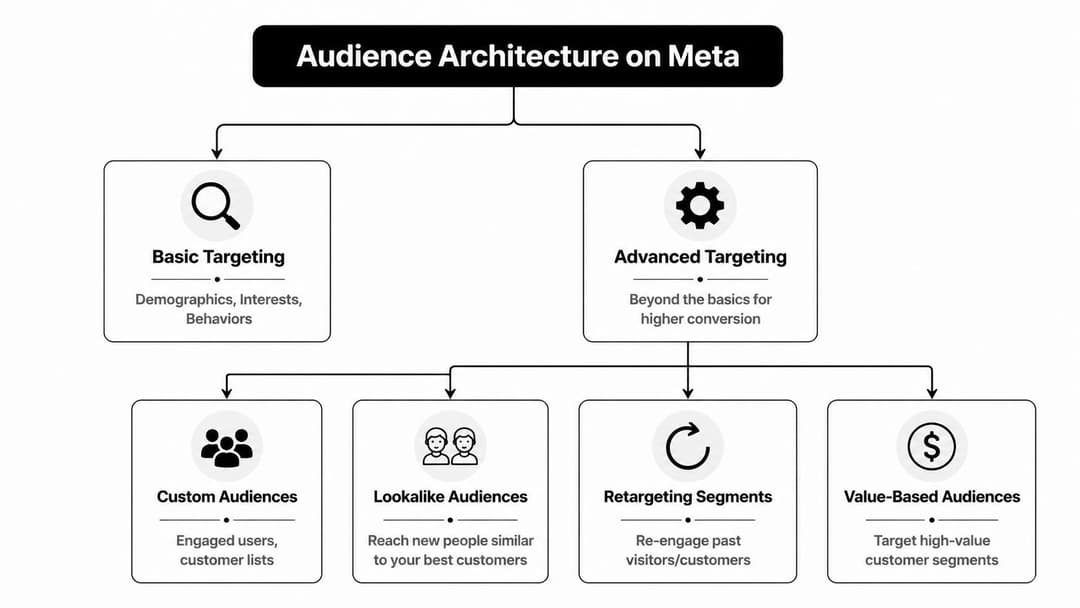
Audience strategy on Meta usually falls apart in one of two ways. Teams go too broad too early and call the result “algorithmic learning,” or they overbuild tiny segments that never gather enough signal to teach the account anything useful. Both problems come from weak architecture.
The simplest way to keep an account clean is to think in temperature layers. Cold, warm, and hot. Not because it’s trendy terminology, but because each layer serves a different job inside the system.
Cold audiences should hunt for new demand
Cold traffic is where most product advertisers either overcomplicate or underthink. Interest stacks can still be useful, but they work best when they’re built from a real hypothesis. Broad can work too, especially when the creative is strong and conversion data is healthy. The mistake is assuming broad targeting is strategy on its own.
Cold audience construction usually comes down to a few workable buckets:
Broad targeting
Useful when the account has enough conversion history and the creative speaks clearly to the product category.Interest and behavior clusters
Best when you’re testing distinct market angles, customer identities, or use cases.Lookalikes from meaningful seed data
Better than generic customer lists when the seed reflects your best buyers, not all buyers.
A lot of upside sits in segments advertisers ignore because they don’t look obvious inside Ads Manager. According to ProductLed Alliance’s underserved market positioning piece, 40% of e-commerce brands miss 20-30% potential ROAS by ignoring unserved niches, and AI insights can uncover hidden high-intent signals 3x faster than manual analysis. That’s the practical case for using historical winners to build niche lookalikes and expansion audiences rather than relying only on broad, crowded segments.
Warm audiences should recover attention
Warm traffic is where a lot of profitable Meta work happens, but only if you segment it well enough to matter. “All website visitors” is easy to build and often too blunt to use well.
Break warm traffic into behavior-based pools:
| Warm segment | What they did | What the ad should do |
|---|---|---|
| Video viewers | Consumed part of your message | Extend curiosity and introduce proof |
| Page engagers | Touched the brand socially | Move them from awareness to consideration |
| Product viewers | Showed concrete interest | Answer objections and deepen product context |
| Site visitors by page type | Browsed key pages | Match message to what they explored |
The messaging has to reflect what they’ve already seen. A person who watched a demo video doesn’t need the same ad as someone who bounced after the homepage.
If your team hasn’t formalized this kind of structure, a guide on audience segmentation strategies can help turn rough audience ideas into actual campaign logic.
Warm audiences don’t need louder ads. They need more specific ones.
Hot audiences should remove friction
Hot traffic sits closest to conversion. Cart abandoners, checkout initiators, high-value leads who didn’t book, repeat visitors to pricing pages, and customer lists for upsell or cross-sell all belong here.
This layer is where product advertisers should get blunt. State the benefit clearly. Surface trust. Remove the final objection. Don’t try to be clever if the buyer is already convinced on category and just needs a reason to act now.
A few practical rules work well:
- Keep recency tight when intent matters. Someone who viewed a product yesterday is different from someone who visited six weeks ago.
- Separate purchasers from non-purchasers so you don’t waste budget repeating acquisition ads to existing customers.
- Create value-based seeds when your economics vary by customer quality, not just volume.
AI should help you expand, not replace judgment
AI is useful in audience building when it surfaces patterns the team wouldn’t have seen manually. It’s less useful when marketers treat it like a substitute for product knowledge. The strongest setup combines both. Human operators define the commercial logic. AI helps rank, cluster, and expand based on actual performance.
That matters most in overlooked subsegments. A niche use case, customer profile, or product bundle can become a profitable audience lane long before it looks large enough to impress anyone in a planning deck.
The result isn’t “better targeting” in the abstract. It’s cleaner audience intent, sharper creative matching, and a much easier time deciding where additional budget should go.
Building a Scalable Creative Testing Engine
Most Meta creative testing still looks like a smaller version of a workflow that broke years ago. A buyer picks two headlines, maybe three images, one call to action, and launches what they call a test. Then they wait. The account spends money, but the learning is thin because too little variation went into market.
That approach misses the point. The goal isn’t to prove one ad beat another. The goal is to build a system that finds patterns across many combinations and turns those patterns into the next round of ads.
Test variables in families, not one-offs
The practical shift is to stop creating isolated ads and start organizing inputs into variable groups.
A clean testing matrix usually includes:
Hooks
Problem-first, outcome-first, comparison-led, objection-led, social-proof-ledFormats
Static image, short video, product demo, UGC-style clip, testimonial assetCopy angles
Speed, simplicity, savings, trust, status, convenience, clarityCTAs
Low-friction click language versus direct purchase languageAudience pairings
The same creative family shown to different intent layers
When teams do this well, they don’t ask, “Did Ad 4 win?” They ask, “Which hook family consistently works with cold traffic?” or “Which proof style holds up across product viewers and broad lookalikes?” That’s a much more valuable result.
Volume matters because creative fatigue is real
On Meta, repetition catches up fast. If your production pace is slow, your account ends up leaning too hard on yesterday’s winners. That creates the illusion of stability right before performance starts fading.
The better move is to build a repeatable cadence where new assets enter testing constantly, but in a structured way. That means every variation should be traceable back to a testing hypothesis, not just a brainstorm.
A simple creative matrix might look like this:
| Variable | Example set A | Example set B | Example set C |
|---|---|---|---|
| Hook | Save time | Avoid mistakes | Get better results |
| Visual | Product close-up | Customer using product | Before-and-after |
| Copy style | Short and direct | Proof-heavy | Story-led |
| CTA | Shop now | Learn more | See how it works |
The operational utility of AI-assisted production is evident. In Meta advertising, a systematic A/B testing method can involve automating the generation of 100+ variations across creative elements and audiences. Successful e-commerce brands using this approach report a 15-25% uplift in conversion rates, and campaigns using this level of multivariate testing often achieve 2-3x higher ROAS, according to Amplitude’s write-up on product metric pitfalls and testing methodology.
Build from historical winners, not blank pages
Most creative teams waste time starting from scratch. They should start from prior signal. That means pulling top-performing hooks, formats, thumbnails, and opening lines from historical campaigns, then recombining them into new variants.
That process tends to outperform random ideation because it’s anchored in account-specific evidence. One account may respond to founder-led video. Another may repeatedly reward product demo clips. Another may win on ugly but clear static images. The point is not style preference. The point is observed response.
If you need help sharpening the narrative side of those assets, this guide to impactful product storytelling is a useful companion to performance testing.
Put automation where humans bottleneck
The human part of testing should be the hypothesis and the review. The machine part should be the assembly, labeling, deployment, and first-pass ranking.
Good automation reduces four kinds of drag:
Creative assembly drag
Teams lose time resizing, duplicating, renaming, and pairing assets manually.Launch drag
A test backlog sits in docs instead of entering market quickly.Analysis drag
Buyers spend hours sorting ad-level results that should already be grouped by variable.Iteration drag
Winning patterns don’t flow into the next batch fast enough.
One option in this category is creative automation tools. Platforms in that class can generate large sets of creative, copy, and audience combinations and push them live without hand-building every permutation. That doesn’t replace judgment. It makes judgment usable at scale.
The best testing engine doesn’t produce more ads for the sake of volume. It produces more interpretable signal per week.
Judge tests by what they teach you
A test only matters if it changes the next decision. That’s why naming structure, variable control, and reporting discipline matter so much. If your account can’t tell you whether the hook, the visual, or the audience drove the result, you haven’t really learned anything.
For advertising for product on Meta, the creative engine is the center of the system. Not because creative is everything, but because creative is where product positioning meets audience reality. When you can test that intersection at scale, the account starts compounding instead of resetting every time a winner burns out.
Automating Your Launch Optimization and Scaling
Launch day isn’t the hard part anymore. Interpreting the first wave of data without overreacting is where most accounts get damaged. Teams kill ads too early, scale too clumsily, or treat noisy indicators like final truth. The result is familiar. Good campaigns get cut before they stabilize, and weak campaigns survive because they looked efficient for a short window.
The fix is a tighter operating model. You need clear rules for what counts as an early signal, what counts as confirmation, and what triggers action.

Read leading indicators without worshipping them
Early in a campaign, some metrics matter because they tell you whether the ad is getting traction before enough conversion volume exists to judge the final KPI cleanly. CTR can tell you whether the hook is landing. Landing page view quality can hint at click intent. Conversion rate trends can reveal friction. But none of these should overrule the business metric the campaign was built around.
A practical review rhythm looks like this:
First check
Is the ad earning attention from the intended audience, or is the message missing?Second check
Are post-click behaviors consistent with the promise made in the ad?Third check
Once enough signal accumulates, does the campaign support the target KPI?
This helps prevent a common mistake. Buyers often scale an ad because it wins on cheap clicks, even when those clicks don’t hold up on revenue or qualified lead outcomes.
Operator note: A good early metric is a directional clue. It is not permission to ignore the economics.
Separate kill decisions from scale decisions
The discipline to cut weak ads and the discipline to scale strong ones are different skills.
Kill decisions should be based on patterns that persist, not one bad patch of delivery. If an ad consistently shows weak engagement relative to its siblings, poor post-click quality, and no sign of recovery against the main KPI, it probably shouldn’t keep spending. But if the hook is working and the downstream metric is still stabilizing, killing it early can erase a future winner.
Scaling decisions require a different lens. Ask:
| Decision type | What you’re looking for | Common mistake |
|---|---|---|
| Kill | Persistent underperformance across key signals | Cutting before enough data forms |
| Hold | Mixed early data with one promising indicator | Tweaking too many variables mid-learning |
| Scale | Stable performance tied to the primary KPI | Increasing budget before confirming repeatability |
The smoothest scaling usually comes from adding budget to structures that have already shown consistency, not from throwing spend at a single ad because yesterday looked good.
Retargeting deserves special treatment
Retargeting often produces the clearest high-intent wins in a Meta account, but only if you separate those audiences properly and refresh the message often enough. Broad retargeting pools can hide meaningful differences between a casual product viewer and someone who initiated checkout.
The optimization case is strong. During this phase, retargeted display ads can generate up to 10x higher CTRs, and 72% of retargeted shoppers are likely to convert, based on the earlier-cited WordStream data. That’s why high-intent audience identification and budget allocation should be handled deliberately, not as an afterthought.
A few rules help:
Break out high-intent actions
Product viewers, cart abandoners, and checkout initiators shouldn’t all see the same sequence.Adjust creative by recency
Someone who visited recently needs a different prompt from someone who’s gone cold.Exclude recent converters
This sounds obvious, yet plenty of accounts still waste spend here.
Let automation handle the repetitive judgment calls
The account gets better when humans focus on interpretation and strategy, while automation handles repeated monitoring and execution. That includes identifying top performers against your actual KPI, spotting audience pockets that deserve more spend, and applying scaling rules consistently.
A workflow built around FB ads automation can reduce the amount of dashboard babysitting required after launch. That matters because fatigue affects operators too. The longer a buyer has to monitor dozens of ad sets manually, the more likely they are to make reactive edits that interrupt learning.
Scale by expanding proven components
There are several ways to scale without wrecking performance:
Increase budget on stable winners
Best when the campaign has shown repeatability and the audience still has room.Duplicate winning concepts into new audience lanes
A hook that works in warm traffic may adapt well to lookalikes or adjacent cold segments.Extend the creative family
Instead of milking one ad, build variations from the same winning angle.Layer in stronger retargeting sequences
Especially useful when prospecting is creating traffic but not enough conversions yet.
The key is controlled expansion. Scale the parts that have earned it. Don’t assume one winning ad equals a winning system.
From Creative Chaos to Campaign Clarity
The old way of running Meta ads for products still survives because it feels manageable. A few ad sets. A few creatives. A few manual tweaks every morning. It gives the team a sense of control. It also traps the account in a constant cycle of rebuilding.
That’s the key shift. Winning at advertising for product on Meta isn’t about finding one clever angle and squeezing it until it dies. It’s about building a system that can continuously surface fresh angles, pair them with the right audiences, and make smarter decisions faster than a manual workflow can.
The strongest accounts usually share the same traits:
- They choose one primary KPI and let that metric control the budget conversation.
- They structure audiences by intent, so cold, warm, and hot traffic don’t get forced through the same message.
- They test creative in volume, using organized variation rather than one-off guessing.
- They optimize with rules, not mood, and scale components that have earned more spend.
That last point matters more than most buyers admit. Random wins create false confidence. Systems create repeatability.
A lot of teams don’t need more ad ideas. They need a better operating model. They need a process that keeps historical learning accessible, turns testing into a reliable production cycle, and reduces how much depends on one media buyer manually holding the whole account together.
Manual effort can launch campaigns. It can’t reliably compound them.
The practical advantage of an engine mindset is clarity. You know what’s being tested. You know why it’s being tested. You know which signal matters first and which signal matters most. That makes it easier to kill weak work, preserve promising work, and expand strong work without turning the account into a mess.
Meta still rewards sharp offers, strong creative, and clean audience matching. None of that has changed. What has changed is the pace required to keep those ingredients working. Small-scale testing and spreadsheet-heavy management can still produce occasional winners. They usually can’t produce consistent scale.
If your current workflow feels like controlled chaos, that feeling is probably accurate. The fix isn’t another hack inside Ads Manager. The fix is building a machine that can create more signal, faster, with less guesswork.
If your team is spending too much time manually building variations, launching tests, and sorting through noisy Meta results, AdStellar AI is built for that exact workflow. It helps teams generate and launch large batches of creative, copy, and audience combinations, uses historical performance data connected through secure OAuth, and ranks what’s working against metrics like ROAS, CPL, or CPA so you can make scaling decisions with less manual overhead.