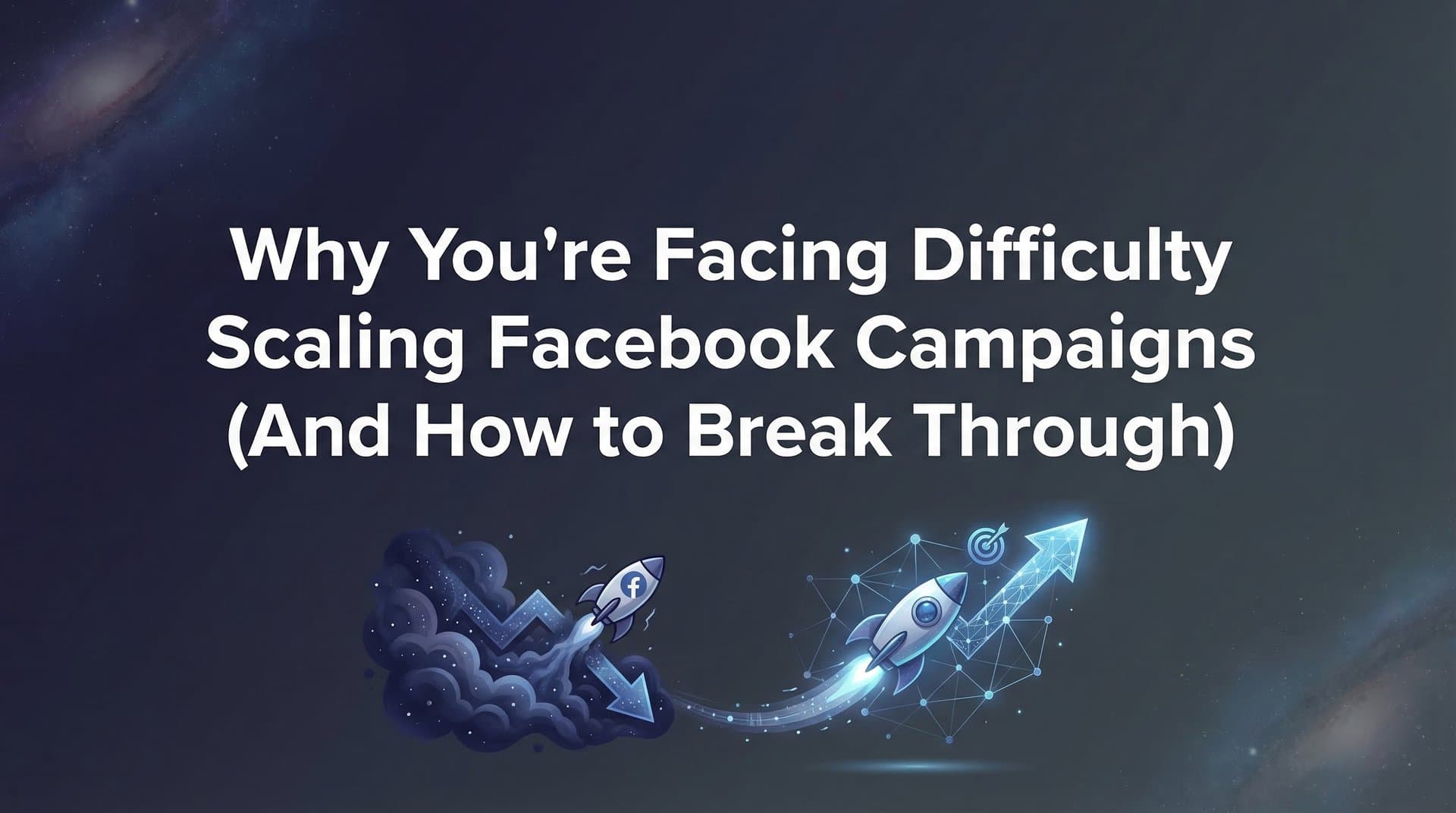
Your Facebook campaign is crushing it at $50 per day. A steady 3.2 ROAS, consistent conversions, and CPAs that make your CFO smile. So you do what any rational marketer would do—you double the budget to $100 per day.
Within 48 hours, everything falls apart.
Your ROAS drops to 1.4. Your cost per acquisition skyrockets. The conversions that flowed steadily now trickle in sporadically. You're spending more money to get worse results, and you have no idea what went wrong. Welcome to the most frustrating paradox in digital advertising: the campaign that performs beautifully at modest spend suddenly becomes a money pit the moment you try to grow it.
If you're facing difficulty scaling Facebook campaigns, you're not alone—and more importantly, you're not doing anything wrong. Scaling challenges aren't a sign of failure or incompetence. They're the predictable result of how Meta's advertising system actually works, combined with fundamental audience and creative dynamics that most advertisers don't fully understand until they hit the scaling wall.
This article will walk you through the exact mechanics of why scaling breaks campaigns, from Meta's learning phase algorithm to audience saturation dynamics to creative fatigue patterns. More importantly, you'll learn the systematic approach to scaling that actually works—the preparation, structure, and execution strategies that separate campaigns that scale successfully from those that collapse under their own growth.
The Learning Phase Trap: Why Meta's Algorithm Fights Your Growth
Here's what most advertisers don't realize: when you significantly increase your campaign budget, you're not just spending more money on the same optimization. You're forcing Meta's algorithm to start learning all over again.
Meta's advertising system operates through what it calls the "learning phase"—a period where the algorithm gathers data to understand which users are most likely to convert based on your optimization goal. During this phase, performance is inherently unstable as the system tests different user segments, placements, and delivery patterns to find the sweet spot.
The learning phase officially ends when your campaign generates approximately 50 conversion events within a 7-day window. This threshold isn't arbitrary—it's the volume of data Meta's algorithm needs to stabilize its predictions and deliver consistent results. Once you exit learning, performance typically stabilizes and becomes more predictable. Understanding campaign learning Facebook ads automation can help you navigate this critical phase more effectively.
But here's the trap: Meta resets the learning phase whenever you make significant changes to your campaign. And "significant" is defined as budget increases of roughly 20% or more in a single adjustment. When you double your budget from $50 to $100, you're not just spending more—you're throwing away all the optimization data the algorithm had gathered and forcing it to relearn from scratch.
The consequences are immediate and painful. Your campaign re-enters the learning phase, performance becomes erratic, and your costs spike as the algorithm experiments with new delivery patterns at a higher spend level. If your budget increase is aggressive enough that the campaign can't generate 50 conversions within 7 days at the new spend level, you may never exit learning at all—you'll be stuck in perpetual optimization limbo, burning money while the algorithm searches for stability it can't find.
This is why the industry standard guidance suggests gradual scaling: budget increases of 10-20% every 3-4 days. This approach keeps you below the threshold that triggers learning phase resets, allowing the algorithm to adapt to higher spend levels while maintaining the optimization data it's already gathered. It's slower and requires more patience, but it's the only way to scale without repeatedly sabotaging your own performance.
Think of it like training for a marathon. You don't go from running 5 miles to running 20 miles overnight—you gradually increase your distance so your body can adapt without breaking down. Meta's algorithm needs the same gradual adaptation to maintain performance as spend increases.
Audience Saturation: The Invisible Ceiling on Your Ad Spend
Even if you navigate the learning phase perfectly, there's another fundamental limit waiting for you: your audience simply isn't large enough to sustain the budget you're trying to spend.
Audience saturation occurs when you've shown your ad to everyone in your target audience who's likely to convert. At that point, continued spending doesn't reach new high-intent users—it just shows the same ad to the same people over and over again. This repetition is measured through a metric called "frequency," which tracks the average number of times each person in your audience has seen your ad.
For cold audiences (people who haven't interacted with your brand before), frequency typically becomes problematic when it exceeds 3-4 impressions per person over a 7-day period. Beyond that threshold, you're dealing with frequency fatigue—people have already decided whether they're interested in your offer, and showing them the same ad again won't change their mind. It just annoys them and wastes your money.
The symptoms of audience saturation are unmistakable. Your click-through rate drops as people stop engaging with ads they've already seen multiple times. Your CPMs (cost per thousand impressions) rise because Meta's auction system recognizes that your ads are performing poorly and charges you more to continue reaching an exhausted audience. Your conversion rate plummets because you're no longer reaching fresh, high-intent prospects—you're just re-targeting people who already said no. These are classic Facebook ad scaling problems that every advertiser eventually encounters.
The relationship between audience size, daily budget, and sustainable reach is mathematical. If your target audience contains 500,000 people and you're spending $200 per day, you'll reach that entire audience relatively quickly—especially if your ads are performing well and Meta's algorithm is showing them aggressively. Once you've reached most of that audience, there's nowhere left to scale within that targeting parameters.
This is why successful scaling almost always requires audience expansion. You can't just keep spending more money on the same audience—you need to identify new audience segments, test broader targeting parameters, expand into new geographic markets, or develop lookalike audiences based on your existing converters. Scaling isn't just about spending more; it's about finding more people to spend on.
Creative Fatigue: When Your Best Ads Stop Working at Scale
Let's say you've solved the learning phase problem through gradual budget increases, and you've expanded your audience to avoid saturation. There's still one more scaling killer waiting for you: your creative simply can't sustain performance at higher budget levels.
The ad creative that worked brilliantly at $50 per day—that compelling image, that persuasive headline, that irresistible offer—starts to lose effectiveness as you scale. Not because it's suddenly a bad ad, but because the same people are seeing it repeatedly, and even great creative gets stale with repetition.
This phenomenon is called creative fatigue, and it's directly proportional to your budget. The more you spend, the more impressions you generate, and the faster any individual creative wears out. An ad that could run profitably for weeks at low spend might burn out in days when you 3x your budget, simply because you're exhausting its novelty much faster.
The solution is what performance marketers call "creative velocity"—the rate at which you produce and test new ad variations. To scale sustainably, your creative production needs to scale proportionally with your budget. If you're spending 3x more, you need roughly 3x more creative variations in rotation to prevent any single ad from over-saturating your audience. Learning building high converting Facebook campaigns requires mastering this creative rotation strategy.
This creates a testing-to-scaling ratio that many advertisers miss. You can't just find one winning ad and scale it aggressively. You need a pipeline of proven creatives—multiple ads that have demonstrated strong performance at lower spend levels—before you attempt major budget increases. Without that pipeline, you're scaling on a single point of failure. The moment that one creative fatigues, your entire campaign collapses.
Smart advertisers build their creative pipeline before they scale. They continuously test new ad variations at modest budgets, identify winners, and graduate them into their scaling campaigns. By the time they're ready to increase spend significantly, they have 5-10 proven creatives in rotation, each capable of handling a portion of the increased budget without individual ads fatiguing too quickly.
The manual workload of this approach is substantial—you're constantly creating new ads, launching tests, analyzing results, and rotating creatives in and out of your scaling campaigns. But it's the only way to maintain performance as you grow. Creative fatigue is inevitable at scale; the question is whether you've built the creative infrastructure to handle it.
Structural Scaling Strategies That Actually Work
Understanding why scaling fails is only half the battle. The other half is knowing which structural approaches actually work when you're ready to grow your spend.
The fundamental choice in scaling strategy is between vertical scaling and horizontal scaling. Vertical scaling means increasing the budget on your existing campaigns—taking that $50/day campaign and gradually raising it to $100, then $150, then $200. Horizontal scaling means duplicating your successful campaigns with new audiences or creatives, so instead of one campaign at $200/day, you have four campaigns at $50/day each. For a deeper dive into these approaches, explore how to scale Facebook ad campaigns effectively.
Vertical scaling is simpler to manage but riskier. You're putting all your eggs in one basket, and if that campaign hits audience saturation or creative fatigue, your entire growth strategy collapses. Horizontal scaling spreads your risk across multiple campaigns, maintains algorithm stability by keeping individual campaign budgets in ranges where they've already proven successful, and allows you to test different audiences and creatives simultaneously.
Many experienced advertisers favor horizontal scaling specifically because it avoids triggering the learning phase resets that plague aggressive vertical scaling. When you launch a new campaign with proven creative and targeting, it enters its own learning phase—but your original campaign continues performing at its established level. You're adding new spend without disrupting existing performance.
Within your campaign structure, you'll also need to decide between CBO (Campaign Budget Optimization) and ABO (Ad Set Budget Optimization). CBO gives Meta's algorithm control over how your budget is distributed across ad sets within a campaign, automatically allocating more spend to better-performing segments. ABO gives you manual control over each ad set's budget, allowing you to force spend toward specific audiences or tests even if they're not the top performers. Understanding how to structure Facebook ad campaigns is essential for making this decision correctly.
For scaling purposes, CBO is generally favored because it allows Meta's algorithm to find the most efficient distribution of your increased budget across your audience segments. As you scale, CBO automatically shifts more spend toward the ad sets that can handle it without performance degradation. With ABO, you'd need to manually adjust each ad set's budget as you scale, which becomes increasingly complex as your campaign structure grows.
The campaign multiplication approach combines these concepts into a systematic scaling framework. Instead of trying to scale a single campaign from $50 to $500 per day, you launch multiple parallel campaigns—each targeting slightly different audiences or using different creative approaches—and scale them all gradually. You might have one campaign targeting lookalike audiences, another targeting interest-based audiences, and a third testing broader targeting, each running at $100-150 per day. Together they deliver the $300-450 per day total spend you're targeting, but no individual campaign is stretched beyond its sustainable performance range.
Building a Scaling-Ready Campaign Infrastructure
The dirty secret of Facebook advertising is that most scaling failures happen before you ever increase your budget. They happen in the preparation phase—or more accurately, in the lack of preparation.
Successful scaling requires three foundational elements to be in place before you attempt to grow spend. First, you need audience research depth. You can't scale into audiences you haven't identified and validated. This means having a documented list of lookalike audiences, interest segments, geographic markets, and demographic variations that you've either tested or have strong reason to believe will perform. Your scaling runway is limited by the size of your validated audience pool.
Second, you need creative library size. As we discussed earlier, creative fatigue accelerates at higher budgets, so you need multiple proven ad variations before you scale. The rule of thumb is having at least 5-10 creative variations that have demonstrated strong performance at your current spend level. These don't need to be completely different ads—variations of headlines, images, or opening hooks on the same core offer work fine—but you need enough variety to prevent any single creative from over-saturating your audience as you grow.
Third, you need conversion data volume. If your campaign is barely generating 50 conversions per week at current spend, aggressive scaling will push you right back into the learning phase because you won't have enough conversion volume at the higher budget to maintain optimization stability. Before scaling significantly, you want to be generating at least 70-100 conversions per week, giving you a buffer that allows the algorithm to maintain stable performance even as you increase spend and potentially see some efficiency loss during the scaling process.
Beyond these prerequisites, you need to identify your scaling ceiling—the realistic maximum budget your campaign can sustain given your audience size and conversion economics. This calculation is straightforward: take your validated audience size, divide by 7 (days), and multiply by your acceptable frequency threshold (typically 3-4 for cold audiences). That gives you the maximum daily impressions you can deliver without over-saturating your audience. Divide that by your historical CTR to estimate your maximum daily budget before hitting saturation.
For example, if you have a validated audience of 1 million people, you can reach roughly 140,000 people per day (1M ÷ 7) at a frequency of 1. At a frequency cap of 3-4, you can deliver 420,000-560,000 impressions per day before saturation becomes problematic. If your ads historically achieve a 2% CTR, that's 8,400-11,200 clicks per day. At a $2 CPC, your sustainable budget ceiling is roughly $16,800-22,400 per day. Try to scale beyond that within this audience, and you'll hit saturation regardless of your strategy.
This is where automation becomes not just helpful but essential. The manual workload of maintaining the testing velocity, campaign management, and creative rotation required for sustainable scaling is enormous. You're constantly launching new ad variations, monitoring performance across multiple campaigns, adjusting budgets, rotating creatives, and analyzing which audiences are approaching saturation. Exploring Facebook ads scaling automation can dramatically reduce this operational burden. For most advertisers, this workload becomes the practical bottleneck to scaling—not budget, not strategy, but simply the time required to execute properly.
Breaking Through the Scaling Ceiling
The core insight you need to internalize is this: difficulty scaling Facebook campaigns isn't a sign that you're doing something wrong. It's a sign that you're encountering the predictable mechanical limits of how Meta's advertising system works.
The learning phase resets that sabotage aggressive budget increases aren't bugs—they're features of an algorithm that needs data stability to optimize effectively. Audience saturation isn't a failure of your targeting—it's the mathematical reality that every audience has a finite size. Creative fatigue isn't evidence that your ads are bad—it's the inevitable result of showing any message repeatedly to the same people.
What separates campaigns that scale successfully from those that collapse is preparation. The advertisers who break through the scaling ceiling are the ones who build the infrastructure before they need it. They develop their creative pipeline while campaigns are still small. They validate new audience segments before their current audiences saturate. They structure their campaigns for horizontal scaling before they hit the limits of vertical growth. Learning scaling Facebook ads efficiently means mastering these preparatory steps.
They also recognize that the manual workload of proper scaling—the constant testing, monitoring, adjusting, and optimizing—eventually exceeds what's humanly sustainable. This is why AI-powered Facebook advertising tools have fundamentally changed the scaling equation. When you can automate the testing velocity and campaign management that manual scaling demands, you remove the practical bottleneck that limits most advertisers' growth.
The future of Facebook advertising at scale isn't about working harder or spending more hours managing campaigns. It's about building systems—whether through disciplined processes or intelligent automation—that can maintain the testing velocity, creative rotation, and audience expansion required to sustain performance as budgets grow. Discovering how to automate Facebook ad campaigns is the first step toward sustainable growth.
Ready to transform your advertising strategy? Start Free Trial With AdStellar AI and be among the first to launch and scale your ad campaigns 10× faster with our intelligent platform that automatically builds and tests winning ads based on real performance data.