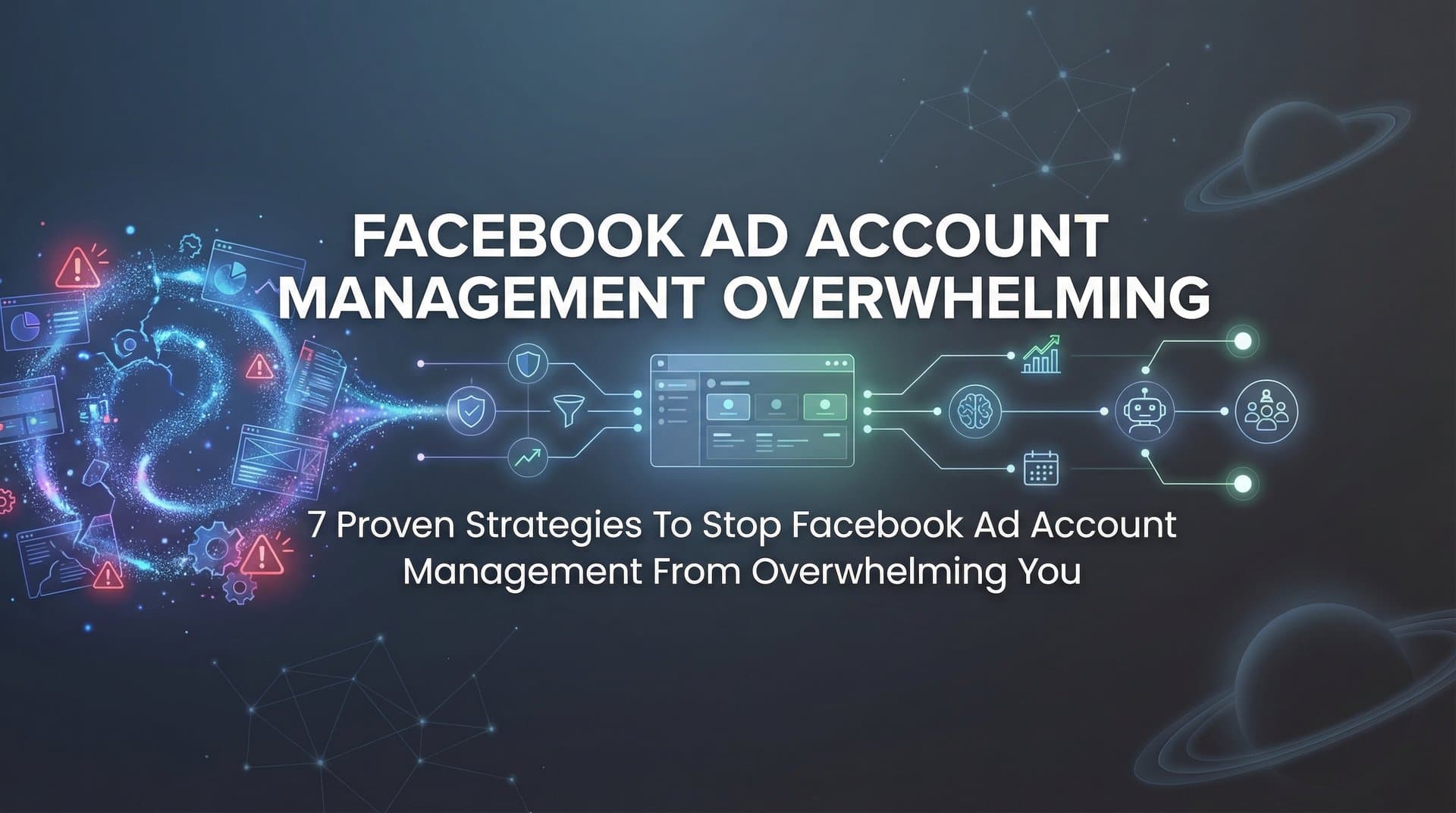
Managing Facebook ad accounts has become exponentially more complex. What used to be a manageable workflow of launching campaigns and checking performance now involves juggling creative production, audience segmentation, budget optimization, A/B testing, performance tracking, and constant algorithm adjustments. The platform's sophistication has outpaced most marketers' processes, creating a gap between what needs to get done and what's humanly possible in a workday.
Here's what most people get wrong: they think feeling overwhelmed means they're not cut out for this work. The truth? Your processes simply haven't scaled with the platform's demands.
The marketers who consistently deliver results aren't working longer hours or possessing superhuman abilities. They've built systems that handle complexity systematically. This guide breaks down seven proven strategies that transform chaotic ad management into a streamlined operation. Whether you're managing multiple client accounts or running campaigns for your own business, these approaches will help you regain control without compromising performance.
1. Implement a Tiered Campaign Structure
The Challenge It Solves
When every campaign lives in a flat structure, you're forced to make dozens of micro-decisions daily. Should you adjust this prospecting campaign? Is that retargeting ad underperforming? The mental load of treating every campaign with equal urgency creates decision fatigue before lunch.
A tiered structure eliminates this noise by organizing campaigns into clear categories with predefined management protocols. You'll know exactly which campaigns need daily attention and which can run on automated rules.
The Strategy Explained
Organize your campaigns into three distinct tiers: Prospecting (cold audiences), Retargeting (warm audiences who've engaged), and Retention (existing customers). Each tier operates with different budget allocations, performance expectations, and optimization frequencies.
Prospecting campaigns typically require the most creative variation and testing. Retargeting campaigns benefit from tighter messaging around specific actions. Retention campaigns focus on repeat purchase behavior and upsells. By separating these functions, you can apply tier-specific rules and reduce the number of daily decisions.
Set up automated rules within each tier. For example, prospecting campaigns might auto-pause ads with CTR below 1% after 1,000 impressions, while retargeting campaigns focus on conversion rate thresholds. This structure creates a self-managing system that only surfaces issues requiring human judgment. For more guidance on structuring your accounts effectively, explore these Facebook ad account organization tips.
Implementation Steps
1. Audit your current campaigns and categorize them into Prospecting, Retargeting, or Retention based on audience temperature and campaign objective.
2. Create naming conventions that instantly identify tier and purpose (e.g., "PROSP_ImageAds_Q1" or "RETARG_CartAbandoners_March").
3. Establish tier-specific automated rules in Meta Ads Manager based on your performance thresholds for each category.
4. Schedule tier-specific review times: daily quick checks for prospecting, every other day for retargeting, weekly for retention.
Pro Tips
Don't create more than three tiers initially. The goal is simplification, not additional complexity. Start with broad categories and refine as you identify patterns. Document your tier definitions and rules in a shared document so your entire team operates from the same playbook.
2. Batch Your Creative Production
The Challenge It Solves
Reactive creative production is a productivity killer. You notice an ad's performance declining, scramble to create a replacement, wait for design approvals, then realize you need three more variations for proper testing. This cycle repeats weekly, consuming hours that should be spent on strategy.
Batching transforms creative production from a constant interruption into a controlled, predictable process. You'll always have fresh creatives ready to deploy, eliminating the panic of underperforming ads with no backup plan.
The Strategy Explained
Instead of creating ads reactively, dedicate one focused period per month to producing all your creative assets. During this sprint, you'll generate image ads, video content, copy variations, and headlines in bulk. The rest of the month, you're deploying from this library rather than creating from scratch.
This approach leverages the psychological benefits of deep work. When you're in creative mode for an extended session, you produce higher quality work faster than when context-switching between creative tasks and campaign management throughout the day. A robust Facebook ad creative management system makes this process significantly easier to maintain.
Build a systematic creative library organized by format, message angle, and performance history. Tag creatives with metadata like "problem-focused," "benefit-driven," or "social proof" so you can quickly assemble campaigns around specific themes without starting from zero.
Implementation Steps
1. Block a full day (or two half-days) at the start of each month exclusively for creative production, treating it as non-negotiable as a client meeting.
2. Create a production checklist covering all formats you regularly use: static images, carousel ads, video ads, story formats, and corresponding copy variations.
3. Set up a creative library system using folders, naming conventions, and tagging that makes assets easily searchable by theme, product, or audience.
4. During your monthly sprint, aim to produce 30-50 creative variations to cover your typical monthly testing needs, including backup options for underperformers.
Pro Tips
Schedule your creative batch session right after reviewing the previous month's performance data. You'll have fresh insights about what's working, making your new creatives more strategically informed. Consider using AI creative tools to multiply your output during these sessions without extending the time investment.
3. Establish Clear Performance Thresholds
The Challenge It Solves
Staring at your ad dashboard without clear decision criteria creates analysis paralysis. Is a 2.5% CTR good or bad? Should you scale a campaign with $15 CPA when your target is $12? Without predetermined thresholds, every performance check becomes a new debate, wasting time and mental energy.
Clear benchmarks eliminate guesswork. You'll make faster, more consistent optimization decisions because you've already defined what success and failure look like for your specific business goals.
The Strategy Explained
Before launching any campaign, document your target metrics: acceptable CPA range, minimum ROAS, CTR benchmarks, and conversion rate expectations. Then create decision trees that map performance scenarios to specific actions.
For example: If CPA is within 10% of target after 50 conversions, maintain current spend. If CPA exceeds target by 20% after 30 conversions, pause and diagnose. If ROAS exceeds target by 30% after one week, increase budget by 20%. These predetermined rules remove emotion from optimization.
Document these thresholds in a simple spreadsheet or dashboard that you reference during every performance check. Over time, you'll refine these benchmarks based on accumulated data, but having any threshold is infinitely better than making subjective calls repeatedly. This systematic approach is essential for reducing Facebook ad management time significantly.
Implementation Steps
1. Define your primary success metric (CPA, ROAS, or conversion volume) and set your target based on business profitability, not arbitrary industry benchmarks.
2. Establish secondary metrics that indicate campaign health: CTR for creative effectiveness, CPM for audience saturation, conversion rate for landing page performance.
3. Create a decision matrix with three columns: Metric Range, Interpretation, and Action to Take, covering scenarios from significantly underperforming to exceeding expectations.
4. Set minimum data thresholds (impressions, clicks, or conversions) before making optimization decisions to avoid reacting to statistical noise.
Pro Tips
Your thresholds should account for different campaign objectives. Prospecting campaigns naturally have higher CPAs than retargeting. New product launches may accept worse initial metrics while gathering data. Build flexibility into your framework rather than applying one-size-fits-all rules across all campaigns.
4. Consolidate Testing Into Structured Experiments
The Challenge It Solves
Running multiple simultaneous tests across audiences, creatives, placements, and copy creates a data interpretation nightmare. When everything changes at once, you can't isolate what's actually driving performance shifts. This chaotic approach to testing generates noise instead of insights.
Structured experimentation replaces this chaos with sequential, documented tests that produce actionable learnings. You'll build a knowledge base of what works rather than constantly starting from scratch.
The Strategy Explained
Instead of testing everything simultaneously, implement a sequential testing framework. Each week or campaign cycle, test one variable while keeping others constant. Week one might test three creative angles. Week two tests audience segments using the winning creative. Week three tests placement strategies with the winning audience-creative combination.
Document every test with a hypothesis, control setup, test parameters, and results. This creates institutional knowledge that compounds over time. Six months of structured testing produces a playbook of proven approaches. Six months of chaotic testing leaves you guessing.
Use Meta's built-in A/B testing feature for critical tests, but don't limit yourself to formal experiments. Your regular campaign structure can serve as ongoing testing when you change one variable at a time and track results systematically. A dedicated Facebook campaign management platform can help you track these experiments more effectively.
Implementation Steps
1. Create a testing calendar that maps out which variable you'll test each week or campaign cycle, ensuring you're not changing multiple elements simultaneously.
2. Build a testing log template that captures: hypothesis, test setup, budget allocation, success criteria, results, and key learnings for every experiment.
3. Establish minimum sample sizes before declaring test winners, typically requiring at least 100 conversions per variation for statistical significance.
4. Review your testing log monthly to identify patterns and update your campaign playbook with proven approaches that can be applied systematically.
Pro Tips
Focus your testing efforts on variables with the highest potential impact. Creative typically drives the biggest performance swings, followed by audience selection, then tactical elements like placement or bid strategy. Don't waste testing budget on minor tweaks when major optimization opportunities remain unexplored.
5. Automate Reporting
The Challenge It Solves
Manually pulling data from Meta Ads Manager, transferring it to spreadsheets, creating charts, and calculating metrics consumes hours every week. This time investment doesn't improve campaign performance. It just documents what already happened while preventing you from focusing on what happens next.
Automated reporting eliminates this time sink by surfacing insights continuously. You'll spend minutes reviewing dashboards instead of hours compiling data, freeing up capacity for actual optimization work.
The Strategy Explained
Build or subscribe to reporting dashboards that automatically pull data from Meta's API and display key metrics in real-time. Focus on exception-based reporting: dashboards that highlight what needs attention rather than overwhelming you with every data point.
Set up automated alerts for critical thresholds. When a campaign's CPA exceeds your target by 25%, you receive a notification. When daily spend hits 150% of budget, you get an alert. This transforms reporting from a reactive task you do on a schedule into a proactive system that notifies you when intervention is needed. The right Facebook ad account automation software handles much of this heavy lifting automatically.
Create different dashboard views for different stakeholders. Your daily management dashboard shows granular performance metrics. Your client or executive dashboard shows high-level trends and ROI. This separation prevents you from recreating reports for different audiences.
Implementation Steps
1. Identify your five most important daily metrics and build a dashboard that displays them at a glance without requiring clicks or filters.
2. Configure automated rules in Meta Ads Manager to alert you when campaigns exceed budget, fall below performance thresholds, or achieve exceptional results.
3. Set up scheduled email reports that deliver weekly performance summaries automatically, reducing the need for manual report generation.
4. Create a mobile-friendly dashboard view so you can check critical metrics from anywhere without logging into Ads Manager.
Pro Tips
Don't build dashboards that simply recreate what's already visible in Ads Manager. Focus on calculated metrics that require manual work: blended ROAS across platforms, customer acquisition cost including overhead, or lifetime value trends. Automate the insights that are tedious to calculate manually but valuable for decision-making.
6. Create a Winners Library
The Challenge It Solves
Every time you launch a new campaign, you're reinventing the wheel. You scroll through past campaigns trying to remember which creative performed well, search for that headline that crushed it three months ago, or attempt to recreate an audience that delivered strong ROAS. This archaeological dig through campaign history wastes time and risks forgetting proven winners.
A Winners Library solves this by organizing your best-performing elements in one accessible location. You'll assemble new campaigns in minutes by combining proven components rather than starting from scratch every time.
The Strategy Explained
Build a centralized repository of your top-performing creatives, headlines, ad copy, audiences, and landing pages, tagged with actual performance data. When a creative achieves ROAS above your benchmark, it goes in the library. When an audience consistently delivers low CPA, it gets documented with setup instructions.
This isn't just a folder of files. It's a searchable database with metadata: performance metrics, target audience, product category, messaging angle, and any contextual notes about why it worked. You can quickly filter for "video ads with ROAS above 4x targeting women 25-45" and instantly access proven assets. Effective Facebook ads creative library management makes this process seamless.
Update your Winners Library monthly during your performance review sessions. Remove elements that no longer perform as audiences shift and add new winners as they emerge. This creates a living playbook that evolves with your market.
Implementation Steps
1. Create a folder structure or database system organized by asset type: Creatives, Headlines, Copy, Audiences, Landing Pages.
2. Establish criteria for what qualifies as a "winner" based on your performance thresholds, ensuring only genuinely successful elements make it into the library.
3. For each winning element, document: performance metrics (CPA, ROAS, CTR), target audience, campaign context, and date range to track how long it remained effective.
4. During monthly reviews, spend 30 minutes updating your Winners Library with new top performers and archiving elements that have declined in effectiveness.
Pro Tips
Don't just save the winners. Document why they worked. Did the creative use social proof? Did the headline address a specific pain point? These insights help you replicate success patterns rather than just reusing specific assets. Over time, you'll identify themes that consistently drive performance for your specific audience.
7. Leverage AI for Heavy Lifting
The Challenge It Solves
Even with optimized processes, Facebook ad management remains time-intensive. Creative production requires design skills and iteration. Campaign building involves dozens of configuration decisions. Performance analysis demands pattern recognition across massive datasets. These tasks consume hours even when you're working efficiently.
AI tools compress these time-intensive processes into minutes by automating the repetitive, analytical, and creative work that doesn't require human strategic judgment. You'll multiply your output without expanding your team or working longer hours.
The Strategy Explained
Modern AI platforms can generate ad creatives from product URLs, build complete campaign structures based on historical performance data, and surface insights from your metrics automatically. This isn't about replacing human strategy. It's about automating the execution that follows strategic decisions.
Instead of spending three hours creating ad variations, you describe your product and target audience to an AI tool that generates dozens of options in minutes. Rather than manually configuring campaign settings based on past learnings, AI analyzes your historical data and builds campaigns using proven patterns. Performance analysis shifts from manual data pulls to AI-surfaced insights about which elements are driving results.
The compound effect is significant. When AI handles creative production, campaign building, and performance analysis, you reclaim hours every week. These hours get reinvested in strategy, testing, and optimization activities that genuinely require human expertise. Agencies especially benefit from Facebook ad management software for agencies that incorporates these AI capabilities.
Implementation Steps
1. Identify your biggest time sink: creative production, campaign setup, or performance analysis, and prioritize AI tools that address that specific bottleneck first.
2. Test AI-generated outputs against your manual work to validate quality before fully committing, ensuring the automation maintains your performance standards.
3. Establish workflows that combine AI efficiency with human oversight, using AI for initial creation and bulk work while you focus on strategic refinement.
4. Track time savings quantitatively by measuring how long tasks took manually versus with AI assistance, documenting the actual efficiency gains.
Pro Tips
Look for AI platforms that explain their decisions rather than operating as black boxes. When AI recommends a specific audience or creative approach, understanding the rationale helps you learn and refine your own strategic thinking. The best AI tools make you smarter, not just faster.
Putting It All Together
Feeling overwhelmed by Facebook ad account management isn't a personal failing. It's a signal that your processes haven't evolved to match the platform's complexity. The strategies outlined here transform chaotic workflows into systematic operations that scale without burning you out.
Start with the strategy that addresses your biggest pain point. If you're drowning in creative production, implement batching and explore AI generation tools. If performance analysis consumes your days, prioritize automated reporting and clear thresholds. If you're constantly rebuilding campaigns from scratch, focus on your Winners Library and tiered structure.
The marketers who consistently deliver results aren't superhuman. They've built systems that handle complexity systematically. Each strategy you implement compounds with the others. Batching works better when you have a Winners Library to draw from. Automated reporting is more valuable when you've established clear thresholds. Structured testing produces insights that feed your Winners Library.
Consider how platforms designed specifically for efficiency can accelerate this transformation. Start Free Trial With AdStellar and experience how AI-powered creative generation, campaign building, and performance analysis can compress hours of work into minutes. When you combine smart processes with intelligent automation, you don't just reduce overwhelm. You create a sustainable competitive advantage that lets you focus on strategy while systems handle execution.
The goal isn't to work harder or longer. It's to build systems that work for you, transforming Facebook ad management from an overwhelming burden into a scalable growth engine.