Every digital marketer knows the frustration: you need to check last month's retargeting performance, but you're scrolling through 47 campaigns with names like "Campaign Copy 3" and "Test - Final - ACTUAL." Five minutes later, you're still searching. Meanwhile, your client wants to know why the new product launch isn't scaling, but you can't quickly identify which audiences are working because your ad sets are a jumbled mess of overlapping segments.
Poor Facebook ad account organization isn't just annoying—it's expensive. When you can't quickly find what you need, you waste time. When you can't see clear performance patterns, you miss optimization opportunities. When your structure is chaotic, onboarding new team members becomes a nightmare of explaining one-off exceptions and inconsistent naming.
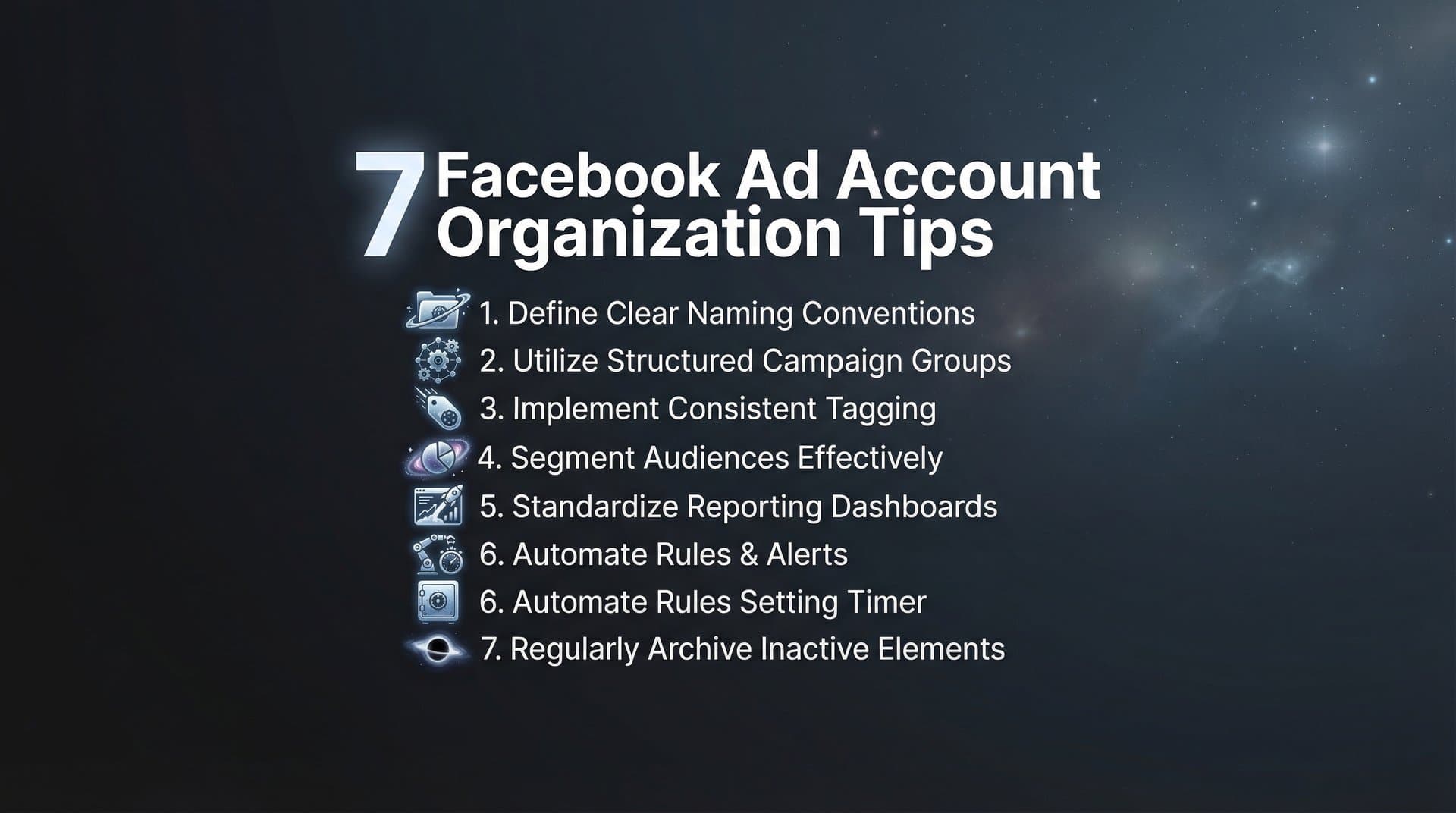
The good news? A well-organized ad account transforms this chaos into clarity. With the right structural framework, you'll launch campaigns faster, spot winning patterns immediately, and scale with confidence. These seven strategies will help you build an organizational system that saves hours every week while improving your advertising results.
1. Establish a Consistent Naming Convention System
The Challenge It Solves
Without standardized naming, your ad account becomes a digital junk drawer. You'll spend valuable time hunting for specific campaigns, struggle to compare performance across similar initiatives, and find it nearly impossible to use Ads Manager's filtering tools effectively. When multiple team members create campaigns with their own naming preferences, the chaos multiplies exponentially.
The Strategy Explained
A naming convention is a standardized template that includes key identifiers in a consistent order across all campaigns, ad sets, and ads. The most effective conventions include elements like launch date, campaign objective, target audience, geographic focus, and creative type—all separated by clear delimiters like underscores or pipes.
For example, a campaign name might follow this structure: [Date]_[Objective]_[Audience]_[Product]_[Geo]. This becomes: "2026-03_CONV_LAL-Purchasers_SpringCollection_US" at the campaign level. At the ad set level, you might add budget and placement details: "2026-03_CONV_LAL-Purchasers_SpringCollection_US_$50-FB-IG".
Implementation Steps
1. Document your naming template in a shared resource (Google Doc, Notion page, or internal wiki) that all team members can access, including examples for campaigns, ad sets, and ads.
2. Create a naming convention guide that defines each element—specify date format (YYYY-MM or YYYY-MM-DD), abbreviations for objectives (CONV for conversions, TRAF for traffic), and audience descriptors (LAL for lookalike, CRM for customer list, INT for interest-based).
3. Apply the convention retroactively to existing campaigns during your next optimization session, focusing first on active campaigns and those you reference frequently.
4. Set up a quality check process where one team member reviews new campaigns weekly to ensure naming consistency before significant budget is allocated.
Pro Tips
Keep your naming convention flexible enough to accommodate different campaign types, but rigid enough that filtering actually works. Include version numbers (v1, v2, v3) for iterative tests so you can track evolution. Avoid overly long names—Ads Manager truncates them in certain views, making the most important identifiers invisible if they're buried at the end.
2. Structure Campaigns by Funnel Stage
The Challenge It Solves
Many advertisers organize campaigns by product or promotion, which seems logical until you realize you're competing against yourself. When your prospecting and retargeting efforts live in the same campaign structure, you can't easily allocate budget based on funnel efficiency. You also risk audience overlap, where the same person sees both your cold prospecting ad and your warm retargeting message simultaneously, wasting impressions and confusing your messaging strategy.
The Strategy Explained
Funnel-based organization means creating distinct campaign groups for each stage of the customer journey: prospecting (cold audiences who've never interacted with your brand), retargeting (warm audiences who've engaged but haven't converted), and retention (existing customers). This structure aligns your account organization with how people actually move through your marketing funnel.
Within each funnel stage, you can then organize by objective or product. For instance, your prospecting campaigns might include separate initiatives for brand awareness and conversion optimization, while your retargeting campaigns segment by engagement level (website visitors versus video viewers versus cart abandoners). Understanding how to structure Facebook ad campaigns properly is essential for maintaining this organizational clarity.
Implementation Steps
1. Audit your current campaigns and categorize each one by funnel stage—create a spreadsheet listing every active campaign with its primary audience type and conversion goal.
2. Create new campaign structures organized by funnel stage, starting with three core groups: Prospecting, Retargeting, and Retention (you can add more granular stages like Consideration or Loyalty as needed).
3. Set up exclusion audiences systematically—ensure your prospecting campaigns exclude anyone who's already a customer or has recently engaged, while retargeting campaigns exclude cold audiences and existing customers.
4. Establish budget allocation guidelines for each funnel stage based on your business model—many businesses find that 60-70% of budget goes to prospecting, 20-30% to retargeting, and 10-15% to retention, though this varies significantly by industry.
Pro Tips
Use Meta's campaign naming to make funnel stages immediately visible—prefix campaigns with [PROSP], [RETARG], or [RETAIN] so you can filter and analyze by stage instantly. Review your exclusion audiences monthly to ensure they're updating correctly, especially if you're using dynamic audiences based on website activity or engagement windows.
3. Create a Dedicated Testing Framework
The Challenge It Solves
When testing and scaling live in the same campaigns, you create a data nightmare. New creative tests with limited data sit alongside proven winners with months of performance history, making it difficult to identify what's actually working. You might prematurely kill a promising new approach because it's being judged against established winners, or accidentally scale a test before it has statistical significance.
The Strategy Explained
A testing framework separates experimental campaigns from proven scaling campaigns with clear graduation criteria. Your testing campaigns operate with smaller budgets and shorter evaluation periods, focused solely on identifying winners. Once a test meets your graduation criteria (specific ROAS threshold, conversion volume, or cost-per-acquisition target), it moves to your scaling campaigns where you allocate larger budgets.
This separation maintains clean data for both environments. Your testing campaigns show you what's worth scaling, while your scaling campaigns show you true performance at volume. You avoid the common mistake of judging everything by the same standards regardless of maturity or data volume.
Implementation Steps
1. Define your graduation criteria explicitly—for example, a test might need to achieve at least 20 conversions and a 2.5× ROAS over 7 days before graduating to scaling, with thresholds adjusted based on your average order value and conversion volume.
2. Create separate campaign structures labeled clearly as "Testing" and "Scaling"—within testing, you might have sub-campaigns for creative tests, audience tests, and offer tests.
3. Set budget caps on testing campaigns to prevent overspending on unproven approaches—many advertisers allocate 15-25% of total ad spend to testing, with the remainder going to proven scaling campaigns.
4. Establish a weekly review cadence where you evaluate test results against graduation criteria and move winners to scaling campaigns, documenting what you learned from tests that didn't graduate.
Pro Tips
Don't test too many variables simultaneously within a single campaign. If you're testing three new audiences and four new creatives at once, you won't know which combination drove results. Test one variable at a time, or use a structured approach where you test audiences first, graduate winners, then test creative variations within those winning audiences. Keep a testing log that tracks what you've tested, results, and key learnings—this prevents you from repeatedly testing the same failed approaches. Many advertisers find that difficulty scaling Facebook ad campaigns stems from poor testing frameworks that fail to identify true winners.
4. Implement Audience Library Management
The Challenge It Solves
Your audience library grows organically over time—a lookalike audience created for a holiday campaign, a custom audience from a webinar six months ago, saved audiences from various tests. Without systematic management, you end up with hundreds of audiences, many outdated or duplicative, making it difficult to find the right targeting option when launching new campaigns. You might accidentally use an old audience definition when a newer, better version exists, or waste time recreating audiences that already exist under unclear names.
The Strategy Explained
Audience library management means treating your saved audiences, custom audiences, and lookalike audiences as strategic assets that require naming conventions, regular maintenance, and documentation. Just as you organize campaigns systematically, your audiences need clear naming, categorization, and hygiene practices to remain useful as your library grows.
Effective audience management includes consistent naming that identifies audience type, source, and creation date. It also means regularly archiving outdated audiences, updating dynamic audiences to ensure they're populating correctly, and documenting which audiences perform best for different campaign objectives. If you're struggling with Facebook ad targeting, poor audience organization is often the root cause.
Implementation Steps
1. Audit your current audience library and categorize audiences by type (custom, lookalike, saved interest-based) and status (active, testing, archive-worthy)—export your audience list and review it in a spreadsheet to identify duplicates and outdated options.
2. Establish audience naming conventions that match your campaign naming system—for example: [Type]_[Source]_[Date]_[Description] becomes "LAL_Purchasers-90d_2026-03_1pct" for a 1% lookalike audience based on 90-day purchasers created in March 2026.
3. Create audience documentation that tracks your core audiences with notes on typical performance, recommended use cases, and any special considerations—a simple spreadsheet works, with columns for audience name, type, size, creation date, best use case, and average performance metrics.
4. Schedule quarterly audience hygiene sessions where you archive audiences that haven't been used in 90+ days, verify that dynamic custom audiences are populating correctly, and refresh lookalike audiences based on updated source audiences.
Pro Tips
Use Meta's audience folders to group related audiences—create folders for different funnel stages, product lines, or campaign types. When creating lookalike audiences, include the percentage and source date in the name so you can quickly identify the most recent version. Set calendar reminders to refresh high-value custom audiences quarterly, especially purchase-based audiences that should reflect your most recent customer data.
5. Use Campaign Budget Optimization Strategically
The Challenge It Solves
Campaign Budget Optimization (CBO) can be powerful, but many advertisers either avoid it entirely or throw too many ad sets into a single CBO campaign, creating organizational chaos. When you have 15 ad sets competing within one CBO campaign, Meta's algorithm often concentrates budget on just a few, leaving others with insufficient data. You lose visibility into what's working because performance is determined by algorithmic budget distribution rather than strategic allocation.
The Strategy Explained
Strategic CBO usage means grouping related ad sets thoughtfully—typically 3-5 ad sets per CBO campaign that test similar hypotheses or target comparable audience segments. This gives Meta's algorithm enough options to optimize toward your best performers while maintaining sufficient budget for each ad set to generate meaningful data.
The key is balancing algorithmic optimization with strategic control. Use CBO when you want Meta to find the best performers within a defined set of options. Use ad set budgets when you need precise control over spending across different audiences or when testing requires equal budget distribution. Learning how to scale Facebook ads profitably requires mastering this balance between automation and manual control.
Implementation Steps
1. Identify which campaigns benefit from CBO versus ad set budgets—CBO works well for testing similar audiences or creative variations, while ad set budgets make sense when you need guaranteed spend across different funnel stages or when testing dramatically different approaches.
2. Limit CBO campaigns to 3-5 ad sets to prevent budget concentration—if you have more variations to test, create multiple CBO campaigns rather than cramming everything into one.
3. Set minimum spend limits on ad sets within CBO campaigns when you need to ensure each option receives sufficient budget to generate data—this prevents Meta from abandoning ad sets too quickly before they've had a fair chance.
4. Monitor budget distribution within CBO campaigns during the first 3-5 days—if one ad set is receiving 80%+ of budget immediately, consider whether the other ad sets are truly comparable or if they should be in separate campaigns.
Pro Tips
Use CBO campaign names to indicate how many ad sets are included and what's being tested—for example: "2026-03_CBO-3AS_CONV_LAL-Testing_SpringCollection" immediately tells you this is a CBO campaign with 3 ad sets testing lookalike audiences. Don't mix dramatically different audience types in the same CBO campaign—keep cold prospecting separate from warm retargeting even when using CBO, as they require different optimization approaches and have different efficiency expectations.
6. Build a Creative Asset Tagging System
The Challenge It Solves
You've run hundreds of ad creatives, but when you try to identify patterns in what works, you're stuck manually reviewing individual ads. Which video hook performed best? Do testimonial-style images outperform product shots? Is your "Shop Now" CTA more effective than "Learn More"? Without systematic creative tagging, these insights remain hidden in your data, forcing you to rely on intuition rather than evidence when developing new creative.
The Strategy Explained
Creative asset tagging means categorizing every ad creative with consistent labels that describe its key attributes—format (image, video, carousel), hook type (problem-solution, social proof, educational), visual style (lifestyle, product-focused, UGC), and call-to-action. These tags become searchable metadata that let you filter and analyze creative performance by attribute rather than by individual asset.
This system transforms creative analysis from "this specific ad worked" to "ads with testimonial hooks and lifestyle visuals consistently outperform product-only images." You can identify winning patterns across multiple creatives, making your creative strategy data-driven rather than based on isolated successes. The practice of reusing winning Facebook ad elements becomes much easier when you have proper tagging in place.
Implementation Steps
1. Define your creative taxonomy with 4-6 tag categories that matter for your business—common categories include format, hook type, visual style, primary benefit highlighted, CTA type, and tone (urgent, casual, professional).
2. Create a creative tracking spreadsheet that lists every ad with its tags and performance metrics—include columns for ad name, each tag category, impressions, clicks, conversions, cost per result, and any other metrics that matter for your goals.
3. Incorporate tags into your ad naming convention so they're visible in Ads Manager—for example, an ad name might include: "Video_ProblemSolution_Lifestyle_ShopNow" to indicate format, hook, visual style, and CTA.
4. Analyze creative performance by tag category monthly—create pivot tables or use reporting tools to compare average performance metrics across different hook types, visual styles, and CTAs to identify winning patterns.
Pro Tips
Start with a simple tagging system and expand as needed—if you try to tag 15 different attributes from day one, you'll abandon the system. Begin with format and hook type, then add categories as you see value. Use consistent tag abbreviations in ad names to keep them readable: "VID" for video, "IMG" for image, "PS" for problem-solution, "SP" for social proof. Create a creative brief template that requires tagging decisions before production begins, making tagging part of your creative process rather than an afterthought. Strong Facebook ad copywriting tips become more actionable when you can track which copy approaches perform best through systematic tagging.
7. Automate Repetitive Organization Tasks
The Challenge It Solves
Even with perfect organizational systems, maintenance takes time. You need to pause underperforming ad sets, receive alerts when campaigns hit budget thresholds, and ensure new campaigns follow naming conventions. Doing all of this manually means either spending hours on account maintenance or letting organizational standards slip as your account grows.
The Strategy Explained
Automation handles repetitive organizational tasks so you can focus on strategy and creative development. Meta's built-in rules can pause campaigns that exceed cost thresholds, send notifications when performance drops, or increase budgets on winning ad sets. Third-party tools can enforce naming conventions, execute bulk operations, and provide alerts for structural issues like audience overlap or broken tracking pixels.
The most sophisticated approach combines Meta's native automation with AI-powered tools that maintain organizational standards automatically. These systems can ensure every new campaign follows your naming convention, flag campaigns that don't fit your funnel structure, and even suggest optimizations based on your account's performance patterns. Understanding how to automate Facebook ad campaigns is essential for maintaining organization at scale.
Implementation Steps
1. Set up basic Meta automated rules for common maintenance tasks—create rules to pause ad sets when cost per result exceeds your target by 50%, send notifications when daily spend reaches 80% of budget, or increase budgets by 20% when ROAS exceeds targets for 3 consecutive days.
2. Implement bulk operation workflows for repetitive tasks—use Meta's bulk editing features or third-party tools to update multiple campaigns simultaneously when making structural changes, updating tracking parameters, or adjusting budgets across campaign groups. The best bulk Facebook ad launcher tools can dramatically reduce time spent on these repetitive tasks.
3. Create notification systems that alert you to organizational issues—set up rules that notify you when new campaigns are created without proper naming conventions, when audience sizes drop below thresholds, or when campaigns don't have appropriate exclusion audiences applied.
4. Explore AI-powered advertising tools that maintain organizational standards automatically while building and optimizing campaigns—these platforms can enforce your naming conventions, ensure proper funnel structure, and apply your audience management rules without manual intervention. Modern Facebook ad account management tools offer sophisticated automation capabilities that weren't available just a few years ago.
Pro Tips
Start with simple automations before building complex rule sets—a single rule that pauses terrible performers is better than 20 rules that conflict with each other. Test automation rules with small budgets first to ensure they behave as expected. Document all automated rules in your team's shared resources so everyone understands what's happening automatically versus what requires manual decisions. Review automation performance monthly to refine thresholds and ensure rules still align with your current strategy.
Building Your Organizational Foundation
These seven strategies work together to transform ad account chaos into a scalable system. Start with naming conventions and funnel-based structure as your foundation—these two changes alone will save you hours of searching and provide immediate clarity on performance by customer journey stage.
Layer in your testing framework next, separating experiments from proven winners so you can confidently allocate budget based on data maturity. Then tackle audience library management and creative tagging, which turn your historical performance into actionable insights for future campaigns.
Finally, implement strategic CBO usage and automation to maintain your organizational standards without constant manual effort. The time invested in building these systems pays dividends every single day—faster campaign launches, clearer performance insights, and more confident scaling decisions. If you're wasting time on Facebook ad setup, these organizational improvements will have an immediate impact on your efficiency.
Remember that organization isn't a one-time project. Schedule monthly account hygiene sessions to archive outdated audiences, update naming for any campaigns created outside your system, and refine your organizational approach based on what's working. As your account grows and your team expands, these disciplined practices become even more valuable.
For teams managing multiple ad accounts or looking to scale beyond what manual organization can support, AI-powered tools can maintain these structural standards automatically. Start Free Trial With AdStellar AI and experience how intelligent automation can enforce naming conventions, maintain funnel structure, and build organized campaigns in under 60 seconds—letting you focus on strategy and creative while the system handles organizational discipline automatically.