Let's be honest about what manual Facebook advertising actually costs you. Not just money, but time. Every hour you spend toggling between Ads Manager tabs, rebuilding audiences from scratch, and manually assembling ad sets is an hour you are not spending on strategy, creative direction, or growth decisions that actually move the needle.
Facebook ad automation changes that equation. Instead of managing every variable by hand, automation handles the repetitive work: generating creatives, building audience sets, launching variations, and surfacing what is actually working. The result is a faster testing loop, more combinations in market simultaneously, and a cleaner signal on what deserves more budget.
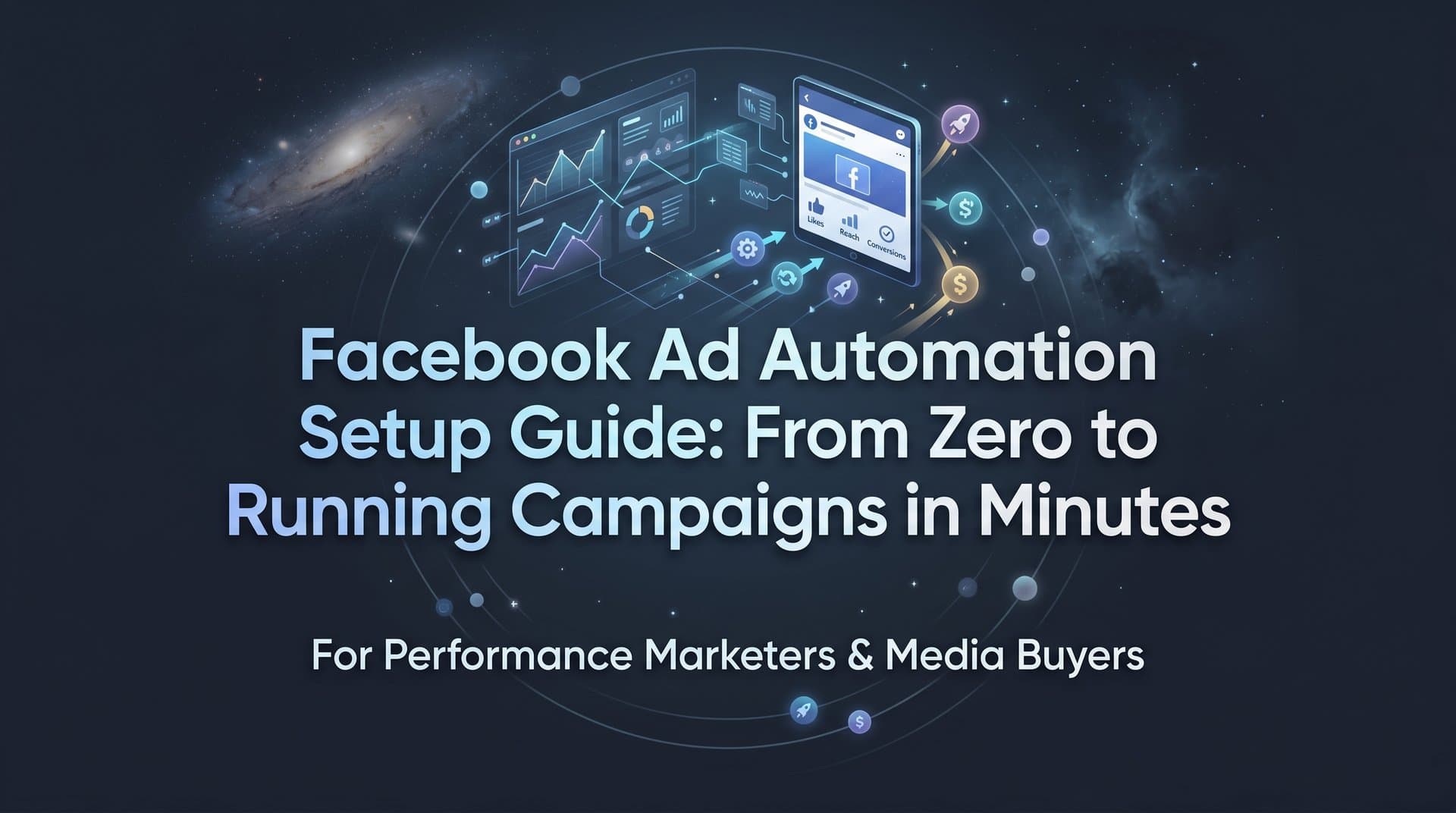
This guide walks you through setting up Facebook ad automation step by step. From connecting your account and generating AI-powered creatives to bulk launching campaigns and using performance data to scale winners, every step is designed to get you from setup to live campaigns as quickly as possible.
Whether you are a solo performance marketer managing a handful of accounts or running ads for multiple clients at an agency, the goal is the same: build a system that tests more, learns faster, and removes the manual bottlenecks slowing you down.
By the end of this guide, you will have a working automated ad setup that generates creative variations, launches them to Meta, and continuously feeds you the performance data you need to make smart scaling decisions. No designers needed. No spreadsheet juggling. Just a clean, repeatable process you can run again and again.
Step 1: Connect Your Meta Ad Account and Define Your Goals
Before any automation can do its job, it needs access to the right accounts and a clear understanding of what success looks like. This step sounds administrative, but it is actually foundational. Get it wrong and everything downstream suffers.
Start by connecting your Facebook Business Manager and ad account to your automation platform. In AdStellar, this is a straightforward OAuth connection that grants the platform access to your ad account, your Facebook Page, and your Meta Pixel. Make sure you are connecting the correct ad account, especially if you manage multiple clients or brands under one Business Manager.
The permissions you need to grant include ad account access, pixel access, and page access. Missing any of these will create gaps later, particularly around creative publishing and conversion tracking. Take two minutes to verify all three are confirmed before moving on.
Next, set your campaign objective. This is not a detail you can revisit later without disrupting your setup. Are you optimizing for purchases, leads, traffic, or a specific ROAS target? Your objective determines how Meta's delivery system optimizes your ads and how the AI scores performance across your creative and audience variations.
Define your goal benchmarks at this stage. If your target CPA is a specific dollar amount, or your minimum acceptable ROAS is a specific multiple, input those numbers now. These benchmarks become the scoring baseline the AI uses to rank every creative, headline, and audience in your campaigns. Without them, the system is optimizing in the dark.
Finally, verify your Meta Pixel is firing correctly on your destination URL before launching any paid traffic. Use the Meta Pixel Helper browser extension to confirm events are triggering as expected. A purchase event that is not firing, or a lead form that is not passing data back to the pixel, will corrupt your optimization signal from day one. If you find this campaign setup process time consuming, automation platforms are specifically designed to eliminate that friction.
Common pitfall: Skipping goal setup because it feels like extra configuration. If the AI has no benchmark to score against, it cannot distinguish between a creative that is performing well and one that is burning budget. This step takes five minutes and saves hours of troubleshooting later.
Step 2: Generate Your Ad Creatives with AI
This is where the time savings become immediately obvious. Instead of briefing a designer, waiting for drafts, running revision rounds, and then formatting for Meta specs, you generate a full set of ad creatives in a single session.
Start by inputting your product URL. AdStellar's AI pulls product details, imagery, and copy angles automatically from the page, giving it the raw material to build creatives without you having to manually describe your offer. The quality of what you get back is directly tied to how well your product page communicates your value proposition, so if your landing page is thin on detail, it is worth adding context manually.
Choose your creative formats based on your offer and where your audience is in the funnel. Image ads work well for direct response and retargeting. Video ads tend to perform better for awareness and top-of-funnel audiences who need more context before they convert. UGC-style avatar creatives are particularly effective for products where social proof and relatability drive purchase decisions. Generating across all three formats in one session gives your testing matrix real variety.
One of the more powerful features in this step is the clone function. You can pull competitor ads directly from the Meta Ad Library and build variations around proven formats in your category. This is not about copying, it is about understanding what creative approaches are already resonating with your target audience and using that as a reference point for your own angles.
Use chat-based editing to refine any generated creative without going back to a designer. Want to change the headline overlay, adjust the color palette, or swap the call-to-action button? You can do it directly in the platform through a conversational interface. This removes the back-and-forth that typically slows down creative iteration. Pairing this with Facebook ad copywriting automation means you can refine both visuals and messaging in the same workflow.
Generate multiple creative angles in one session rather than committing to a single approach. Benefit-led creatives highlight the outcome your product delivers. Problem-solution creatives open with a pain point before presenting your offer as the fix. Social proof formats lead with results or testimonials. Direct response creatives cut straight to the offer and the call to action. Each angle speaks to a different mindset, and you will not know which resonates best until you test them.
Tip: Aim for at least five to eight creative variations per campaign. Automated testing needs enough signal diversity to identify patterns. If you launch with two creatives, you learn very little. If you launch with eight across different formats and angles, the data you collect is genuinely useful.
Success indicator: You have a set of diverse creatives ready to pair with multiple headlines and copy variants. If everything looks like a slight variation of the same ad, go back and add more format or angle diversity.
Step 3: Build Your Audience Sets and Ad Copy Variations
Creatives get attention. Copy and audiences determine whether that attention converts. This step is about building the combinations that give your automated system enough to work with.
Define your core audience segments before you start writing copy, because your messaging should match the audience mindset. At minimum, build three types: interest-based audiences for top-of-funnel cold traffic, lookalike audiences built from your customer list or pixel data for mid-funnel prospecting, and retargeting segments for people who have already visited your site or engaged with your content.
Lookalike audiences built from high-value customer data tend to outperform broad interest targeting for conversion-focused campaigns. If you have a customer list of your best buyers, that is your most valuable seed audience. Upload it and build a lookalike from there rather than relying solely on interest categories. Facebook ad targeting automation can significantly accelerate how quickly you build and test these audience combinations at scale.
For copy, write multiple headline and body copy variants for each creative angle. A benefit-led creative should have a headline that reinforces the benefit, but also test a curiosity-driven headline and a direct offer headline against the same creative. The system needs combinations to test, and copy is often the variable that tips a good creative into a great performer.
Use AI-generated copy suggestions as a starting point, then refine based on your brand voice. The suggestions give you a solid framework and save you from staring at a blank page, but your brand has a specific tone and your audience has specific language patterns. A few minutes of editing goes a long way.
Pair broad audiences with strong creative for top-of-funnel testing, and narrow audiences with direct response copy for retargeting. Someone who has already visited your product page does not need an awareness-level message. They need a reason to come back and complete the action.
AdStellar's AI Campaign Builder analyzes your historical campaign data to rank which audience and copy combinations have performed before. This means new campaigns start with a head start rather than from zero, because the AI already has context on what has worked in your account.
Tip: Resist the urge to over-narrow your audiences at this stage. Automated optimization systems need sufficient volume to generate meaningful signals. An audience that is too small will exhaust quickly and give you data that is hard to act on.
Step 4: Use Bulk Ad Launch to Create and Deploy Hundreds of Variations
This is the step where the scale advantage of automation becomes tangible. Everything you have built in the previous steps, your creatives, headlines, copy variants, and audience sets, gets fed into the bulk launch system, and the platform handles the combinatorial math.
Feed all your inputs into AdStellar's Bulk Ad Launch tool. The platform generates every combination automatically: each creative paired with each headline, each copy variant, and each audience segment. What would take hours of manual ad set building in Ads Manager happens in minutes. This is one of the core reasons Facebook automation outperforms manual campaigns when you are testing at any meaningful scale.
Before you launch, review the generated ad set structure. Confirm that the combinations align with your strategy. Check that your retargeting audiences are not being paired with top-of-funnel messaging, and that your broad prospecting audiences are getting the right creative angles. The system builds the combinations, but you are still the strategist making sure the logic holds.
Once you are satisfied with the structure, launch all variations to Meta in one action. Your campaigns go live with multiple ad sets running simultaneously, each testing a different combination of creative, copy, and audience. This is the test matrix that gives you real performance data across every variable at once.
Think about what you are actually measuring when you do this. Creative performance tells you which visual formats and angles capture attention. Copy performance tells you which messaging drives action. Audience fit tells you which segments respond to your offer. Placement data tells you where your audience is most receptive. All of this runs simultaneously rather than sequentially, which compresses your learning timeline significantly. For e-commerce advertisers specifically, Facebook ad automation for e-commerce unlocks this kind of multi-variable testing without requiring a large team.
Common pitfall: Launching too many variations with too small a daily budget. If you have fifty ad set combinations and a modest daily budget, each combination receives very little spend, which means it takes much longer to collect statistically meaningful data. Before you launch, calculate roughly how many combinations you are creating and ensure your daily budget can support meaningful data collection across that variation count. A good rule of thumb is to have enough budget to generate at least a handful of conversions per ad set per week before making optimization decisions.
Success indicator: Your campaigns are live in Meta Ads Manager with multiple ad sets running simultaneously. You can see spend distributing across combinations and initial impression data starting to populate.
Step 5: Set Up Conversion Tracking and Attribution
Here is a truth that experienced performance marketers know well: your optimization is only as good as your tracking. If the data flowing into your AI system is inaccurate or incomplete, every decision it makes downstream is built on a shaky foundation.
Start by confirming your Meta Pixel events are mapped correctly to the actions that matter for your campaign objective. For e-commerce, that means purchases, add-to-cart events, and initiate checkout. For lead generation, it means form submissions or phone calls. For SaaS, it might be trial signups or demo requests. Each event should be firing with the correct parameters so Meta can optimize delivery toward the right outcomes.
Connect attribution tracking through Cometly integration to get a more complete picture of what is actually driving conversions. Meta's native attribution has known limitations, particularly around cross-channel journeys and iOS privacy changes. A third-party attribution tool gives you a cross-channel view that accounts for touchpoints outside of Meta's visibility, which is especially important if you are running traffic from multiple sources.
Set up UTM parameters on all destination URLs so you can trace performance back to specific creatives, audiences, and ad sets. This creates a second layer of attribution data that you can cross-reference with both Meta's reporting and your attribution tool. When all three data sources agree, you have high confidence in your performance numbers.
Define your attribution window based on your sales cycle. If you sell impulse purchases, a one-day click window is probably appropriate. If you sell higher-consideration products where buyers research for days or weeks before converting, a seven-day or longer window will give you a more accurate picture of which ads are actually influencing decisions.
Run a test conversion before scaling spend. Click your own ad, go through the purchase or lead flow, and confirm the conversion event fires and appears in both Meta Events Manager and your attribution tool. This five-minute check can save you from discovering a tracking gap after you have already spent significant budget. Understanding how Facebook advertising workflow automation connects tracking to optimization decisions is what separates accounts that scale efficiently from those that waste spend.
Tip: This step is foundational, not optional. Without accurate conversion tracking, the AI optimization loop has no reliable signal to work from. You would essentially be asking the system to optimize toward a goal it cannot measure.
Step 6: Read the AI Insights Leaderboard and Identify Winners
After your campaigns have been running long enough to collect meaningful data, it is time to shift from setup mode to analysis mode. This is where the AI Insights leaderboard becomes your primary decision-making tool.
Open the leaderboard and you will see performance rankings across every variable in your campaigns: creatives, headlines, copy, audiences, and landing pages. Everything is ranked by real metrics, not vanity numbers. Filter by your primary goal metric, whether that is ROAS, CPA, or CTR, depending on what you defined as your campaign objective in Step 1. This filter ensures you are evaluating performance against the outcome that actually matters for your business.
The AI scores every element against your defined benchmarks. This means you do not have to manually calculate whether a creative is performing above or below your target CPA. The system does that comparison for you and surfaces a clear ranking. At a glance, you can see what is above target, what is borderline, and what is clearly underperforming. This is the core value of Facebook ad testing automation: replacing manual spreadsheet analysis with a ranked, real-time signal on what is actually working.
Look for patterns rather than just individual winners. Is one creative format consistently outperforming others across multiple audience segments? That tells you something about your audience's visual preferences. Is one audience segment consistently delivering lower CPA regardless of which creative it sees? That tells you something about audience quality. These patterns are what inform your next campaign, not just which single ad performed best.
When you identify top performers, flag them in the Winners Hub. This is your organized library of proven ad elements, with real performance data attached. Every creative, headline, audience, and copy variant that clears your benchmark gets saved here so it is immediately accessible when you are building your next campaign.
Common pitfall: Making optimization decisions too early. Give your campaigns enough time and spend to collect data that is statistically meaningful before cutting underperformers. An ad set that looks weak after two days and $20 in spend might be a strong performer at day seven with $100 in spend. Patience in the analysis phase is a discipline that pays off in accuracy.
Step 7: Scale Winners and Build a Continuous Testing Loop
The first campaign cycle is where you collect data. Every cycle after that is where you compound on it. This final step is about turning your initial results into a repeatable system that gets smarter with each run.
Pull your winning creatives, headlines, and audiences from the Winners Hub and add them directly to your next campaign. You are not starting from scratch. You are starting from a proven baseline, which immediately raises the floor on your next campaign's performance. The ramp time shrinks because you already know what works.
Increase budget on ad sets with proven performance rather than spreading spend equally across all variations. The goal of the testing phase is to identify winners. Once you have identified them, concentrate spend there. Continuing to fund underperformers at the same level as your best performers is a common budget leak that automation helps you avoid. Agencies managing multiple clients benefit especially from this approach — Facebook ad automation for agencies makes it possible to run this kind of disciplined scaling process across many accounts simultaneously.
Generate new creative variations that build on what your winning formats have in common. If your top-performing creatives share a particular visual style, a specific copy angle, or a consistent offer framing, use those as the brief for your next creative generation session. You are iterating on signal rather than guessing from scratch.
Schedule regular campaign reviews using the leaderboard data. A weekly or bi-weekly review cadence works well for most accounts. In each review, retire the bottom performers, promote new test variations, and update your Winners Hub with anything that has cleared your benchmarks. This keeps your campaigns fresh and your testing loop active.
AdStellar's AI Campaign Builder improves with each campaign cycle. As it accumulates more historical performance data from your account, its ability to rank creative, audience, and copy combinations becomes more accurate. The system gets smarter the more you use it, which means the compounding value of automation increases over time rather than plateauing.
Tip: Treat automation as a system, not a one-time setup. Marketers who get the most value from automated platforms are the ones who run consistent test cycles, feed winners back into new campaigns, and use the data to inform creative and strategic decisions. The platform handles the execution. Your job is to keep the inputs sharp and the strategy clear.
Success indicator: You have a documented library of proven creatives, audiences, and copy in your Winners Hub that meaningfully shortens the ramp time for every new campaign you launch. Each cycle starts stronger than the last.
Putting It All Together
Setting up Facebook ad automation is not about removing human judgment from your campaigns. It is about removing the manual work that slows judgment down. When the system handles creative generation, variation building, and performance ranking, your focus shifts to strategy: which offers to test, which markets to expand into, and how to scale what is working.
Here is a quick-start checklist to confirm you have completed every step:
Account setup: Meta ad account connected and all permissions granted.
Goal definition: Campaign objectives and performance benchmarks defined before launch.
Creative generation: AI creatives generated across multiple formats and angles, with at least five to eight variations ready.
Audience and copy: Audience sets and copy variants built and paired appropriately by funnel stage.
Bulk launch: All combinations deployed to Meta with campaigns live and distributing spend.
Conversion tracking: Meta Pixel events verified, attribution connected, UTM parameters in place, and test conversion confirmed.
Performance analysis: Winners Hub populated with top performers from your first campaign cycle and leaderboard reviewed for patterns.
If you are ready to move from manual campaign management to a fully automated testing and scaling system, AdStellar brings every step in this guide into one platform. Generate creatives, build campaigns, launch at scale, and surface your winners without switching tools or waiting on designers. Start Free Trial With AdStellar and run your first automated campaign today.