
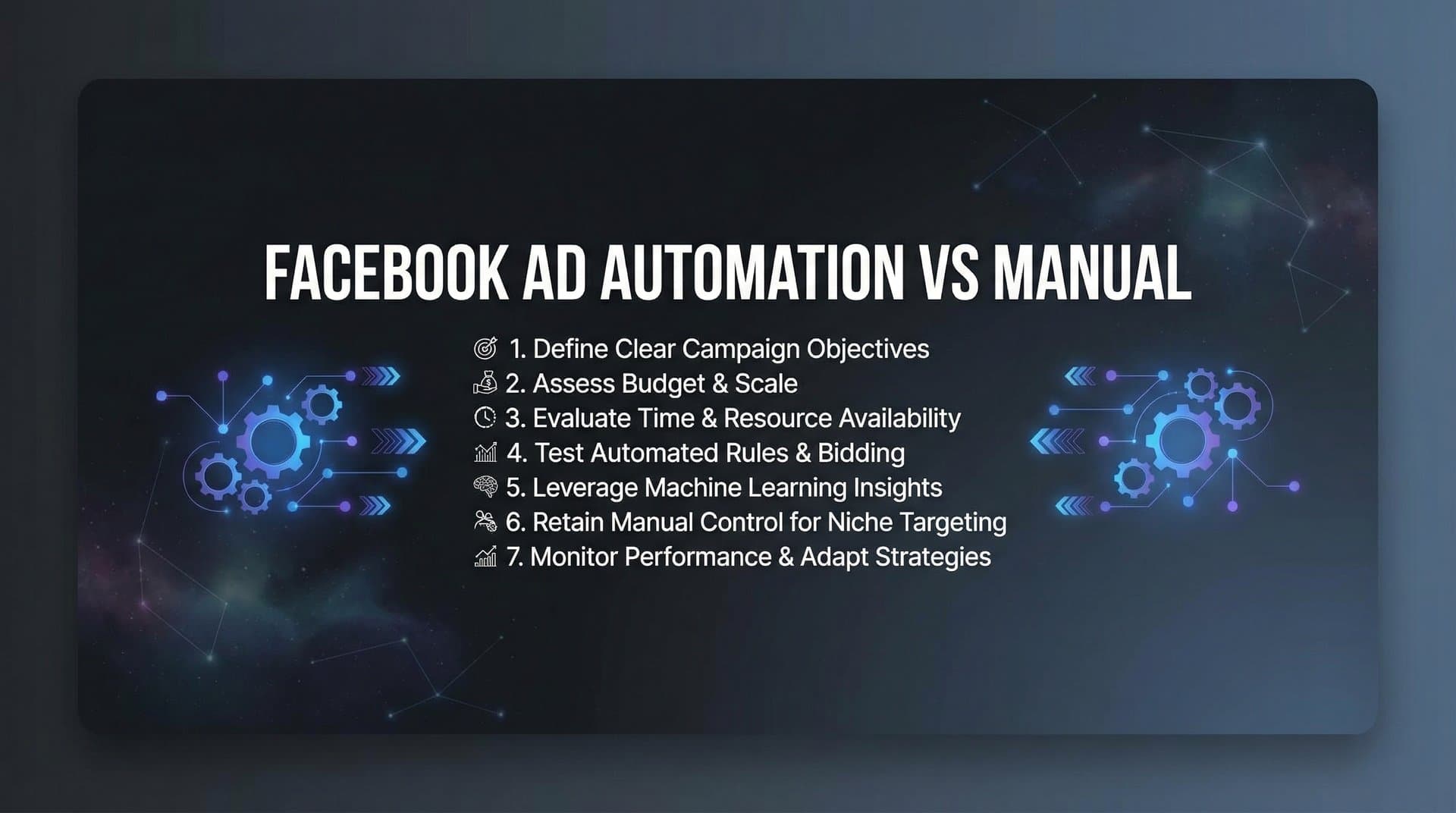
The automation versus manual debate in Facebook advertising misses the point entirely. This is not about choosing sides. It is about understanding which tasks deserve your strategic attention and which ones are draining hours you could spend on higher-impact work.
Most marketers fall into one of two camps. Either they cling to manual control because they fear losing oversight, or they jump into full automation without understanding what they are actually giving up. Both approaches leave performance on the table.
The reality? Your best campaigns will come from a thoughtful blend of both methods. Automation handles the repetitive execution tasks that consume your day. Manual oversight focuses on the strategic decisions that actually move your metrics.
This guide walks through seven strategic approaches to help you decide when to automate, when to stay hands-on, and how to build a workflow that scales with your business. Whether you are managing a single account or juggling multiple clients, these strategies will help you allocate your time where it creates the most value.
1. Audit Your Current Time Allocation to Find Automation Opportunities
The Challenge It Solves
You likely spend hours each week on tasks that feel productive but do not actually require your strategic thinking. Checking campaign performance multiple times a day. Adjusting bids manually. Copying successful ad elements into new campaigns. These activities create the illusion of control while consuming time you could spend on creative strategy or audience research.
Without tracking where your hours actually go, you cannot identify which tasks are worth automating and which ones genuinely need your expertise.
The Strategy Explained
Start with a simple time audit. For one full week, track every Facebook Ads task you perform and how long it takes. Break them into categories like performance monitoring, bid adjustments, creative uploads, audience management, and reporting.
At the end of the week, analyze your log. Look for patterns. Which tasks happen daily? Which ones follow the same process every time? Which activities require actual strategic thinking versus mechanical execution?
The goal is not to automate everything. It is to identify the repetitive, rules-based tasks that consume disproportionate time compared to their strategic value. These are your prime automation candidates. Understanding the benefits of campaign automation can help you prioritize which tasks to tackle first.
Implementation Steps
1. Create a simple spreadsheet with columns for date, task type, duration, and whether the task required strategic judgment or was purely mechanical execution.
2. Log every Facebook Ads activity for five business days, being honest about how much time each task actually takes including context switching.
3. Calculate total hours spent on each task category and identify the top three time consumers that follow repeatable processes.
4. Research automation solutions specifically for those high-volume, low-judgment tasks before moving to other areas.
Pro Tips
Track context switching separately. The five minutes you spend checking campaign performance might seem minor, but if you do it eight times a day, that is 40 minutes plus the mental overhead of constantly shifting focus. These micro-interruptions are often the best candidates for automation through scheduled reporting or alert-based monitoring instead of manual checking.
2. Match Your Automation Level to Campaign Maturity
The Challenge It Solves
New campaigns and experimental audiences need different management approaches than established campaigns with months of performance data. Treating them the same way either wastes your time on stable campaigns or risks letting automation make uninformed decisions with insufficient data.
The learning phase is real. Automated systems need historical performance to make smart optimization decisions. When you automate too early, you are essentially asking AI to make strategic calls without enough information. Understanding campaign learning in Facebook ads automation helps you navigate this critical phase.
The Strategy Explained
Think of campaign maturity on a spectrum. Brand new campaigns testing unproven audiences or creative angles sit at one end. They need manual oversight to gather initial data and validate assumptions. Established campaigns with consistent performance over weeks or months sit at the other end. They are perfect candidates for automation.
The middle ground includes campaigns that have completed their learning phase but are still being optimized. These benefit from a hybrid approach where automation handles execution but you maintain closer monitoring than fully mature campaigns.
Your automation strategy should shift as campaigns move through this lifecycle. Start hands-on, gradually introduce automation as data accumulates, then fully automate once performance stabilizes.
Implementation Steps
1. Categorize your current campaigns into three buckets: Learning (less than 50 conversions or under two weeks old), Optimizing (50-200 conversions, stable but still improving), and Mature (200+ conversions, consistent performance for 30+ days).
2. Keep Learning campaigns on manual management with daily check-ins to validate targeting assumptions and catch early warning signs.
3. Apply limited automation to Optimizing campaigns, focusing on bid adjustments and budget pacing while maintaining manual control over creative and audience decisions.
4. Fully automate Mature campaigns for routine optimization while scheduling weekly strategic reviews to ensure continued alignment with business goals.
Pro Tips
Set clear graduation criteria before launching new campaigns. Decide in advance what metrics and timeframes qualify a campaign to move from manual to automated management. This removes emotional decision-making and creates a systematic approach to scaling your automation as your account grows.
3. Leverage AI for Creative Testing at Scale
The Challenge It Solves
Testing creative variations manually is a bottleneck. You might test three ad variations when you should be testing thirty. The manual process of creating variations, uploading them individually, and tracking which combinations perform best consumes hours while limiting your ability to find winning creative faster.
Meanwhile, your competitors using automated creative testing are identifying winning combinations in days that would take you weeks to discover manually.
The Strategy Explained
Separate creative strategy from creative execution. Your strategic brain should focus on the concepts, messaging angles, and visual directions worth testing. AI should handle the mechanical work of generating variations, launching every combination, and surfacing which ones actually drive results.
This approach lets you test exponentially more creative variations without proportionally increasing your workload. Instead of manually creating and uploading each ad, you define the parameters and let automation generate the combinations.
The key is maintaining control over creative strategy while automating the repetitive execution tasks. You decide what to test. AI handles the how.
Implementation Steps
1. Identify your top three performing creative concepts from the past 90 days and document what made them successful (visual style, messaging angle, offer presentation).
2. Use an AI-powered creative platform to generate multiple variations of each winning concept, testing different headlines, visual treatments, and call-to-action combinations.
3. Launch all variations simultaneously using campaign launch automation rather than uploading each one individually.
4. Set up automated performance tracking that ranks variations by your key metrics and surfaces top performers within the first week.
Pro Tips
Focus your manual creative effort on developing new strategic directions rather than producing variations of existing concepts. Once you validate a creative direction works, automation can efficiently test dozens of executions to find the absolute best performer. This frees you to explore new angles instead of endlessly tweaking existing ones.
4. Keep Manual Control Over Strategic Budget Decisions
The Challenge It Solves
Automated budget optimization works well during stable market conditions but can make costly mistakes during volatile periods. Black Friday traffic spikes, competitor promotions, seasonal demand shifts, or unexpected news events all require human judgment that AI cannot replicate without broader business context.
Handing over complete budget control to automation means trusting algorithms to make the right calls during market conditions they have never seen before.
The Strategy Explained
Create a clear division between tactical budget adjustments and strategic budget decisions. Automation can handle the micro-adjustments that happen constantly based on performance data. Shifting budget between ad sets that differ by a few percentage points in ROAS. Scaling winning campaigns incrementally. Pausing underperformers that hit predetermined thresholds.
But major budget reallocations, aggressive scaling decisions, or defensive budget cuts during market volatility should stay in human hands. These decisions require understanding business priorities, cash flow constraints, inventory levels, and competitive dynamics that exist outside your campaign data. This is where the automated vs manual campaign distinction becomes most critical.
Implementation Steps
1. Define clear thresholds that separate automated micro-adjustments from manual strategic decisions, such as any single budget change over 30% or total daily budget shifts exceeding $500.
2. Configure your automation tools to handle routine optimization within those boundaries while flagging larger decisions for manual review.
3. Schedule daily budget reviews during high-stakes periods like product launches or major promotions rather than relying on automation during critical windows.
4. Document your manual budget decisions and the reasoning behind them to build a knowledge base that helps you refine automation rules over time.
Pro Tips
Create a manual override protocol for predictable volatility. If you know Black Friday is coming, temporarily tighten your automation parameters the week before rather than letting AI learn from scratch during your most important sales period. Return to normal automation once conditions stabilize.
5. Use Automation for Data Analysis and Manual Judgment for Interpretation
The Challenge It Solves
Staring at campaign dashboards trying to spot patterns is both time-consuming and prone to human bias. You might fixate on vanity metrics, miss subtle trends, or let recency bias influence your interpretation. At the same time, blindly following automated recommendations without understanding the context behind them leads to poor strategic decisions.
The solution is not choosing between human analysis and AI analysis. It is using each for what it does best.
The Strategy Explained
Let AI handle the computational heavy lifting. Analyzing thousands of data points across campaigns, creatives, audiences, and time periods to surface patterns you would never catch manually. Ranking performance across every variable. Identifying correlations and anomalies.
But reserve human judgment for interpretation. AI can tell you that creative A outperforms creative B by 40% on ROAS. Only you can interpret whether that difference comes from a scalable insight about your audience or a temporary market condition. Only you know whether doubling down on that creative aligns with your brand positioning and long-term strategy.
Implementation Steps
1. Implement an AI insights platform that automatically ranks all your creatives, audiences, headlines, and landing pages by your target metrics without requiring manual data pulls.
2. Schedule weekly review sessions where you examine the AI-surfaced top and bottom performers and ask why they succeeded or failed beyond just the numbers.
3. Document patterns you identify during these reviews, such as certain visual styles consistently outperforming others or specific audience segments showing different creative preferences.
4. Use those documented insights to inform your next round of creative strategy and audience testing rather than just reacting to individual data points.
Pro Tips
When AI surfaces a winning ad, do not just scale it. Ask what made it work. Was it the visual? The headline? The offer? The timing? Understanding the why behind performance lets you replicate success systematically rather than hoping lightning strikes twice.
6. Build a Hybrid Workflow That Scales With Your Business
The Challenge It Solves
Ad hoc decisions about when to automate and when to go manual create inconsistency. Different team members make different choices. Processes that work at small scale break down as you add campaigns. Knowledge stays trapped in individual heads instead of becoming systematic and repeatable.
Without documented workflows, your automation strategy cannot scale beyond your personal capacity to manage it.
The Strategy Explained
Create decision trees that define exactly when automation handles tasks and when human intervention is required. These should cover common scenarios like launching new campaigns, scaling winners, pausing underperformers, and responding to performance anomalies. A comprehensive workflow automation strategy helps you systematize these decisions.
The goal is to systematize your decision-making so automation handles the routine execution while flagging exceptions that need your attention. This creates leverage. As your account grows, automation handles the increasing volume of routine tasks while you focus on the growing number of strategic opportunities.
Documentation is critical. Your future self and any team members need to understand not just what you automate but why, and under what conditions you override automation.
Implementation Steps
1. Document your current decision-making process for five common scenarios: launching new campaigns, scaling successful campaigns, pausing poor performers, responding to sudden ROAS drops, and testing new creative directions.
2. Identify which steps in each scenario are purely mechanical (checking if metrics hit thresholds, copying winning elements into new campaigns) versus strategic (deciding if a performance drop requires immediate action or is acceptable variance).
3. Configure automation rules to handle the mechanical steps while creating alert triggers for the strategic decision points.
4. Review and refine your workflows monthly as you identify new patterns or edge cases that require adjustments to your automation rules.
Pro Tips
Build your workflows in stages. Start by automating the single most time-consuming repetitive task. Once that runs smoothly for two weeks, add the next one. This gradual approach lets you catch issues early and build confidence in your automation rather than trying to automate everything at once and losing control.
7. Evaluate Automation Tools Based on Transparency and Control
The Challenge It Solves
Black box automation tools make decisions without explaining their reasoning. You cannot learn from their choices, cannot identify when they are making suboptimal decisions based on incomplete context, and cannot confidently override them when business priorities shift. This creates a dependency where you are stuck trusting systems you do not understand.
The wrong automation tool can actually make you less effective by removing your ability to apply strategic judgment when it matters most.
The Strategy Explained
Choose automation platforms that explain their reasoning and allow you to override recommendations. Transparency means understanding why the AI suggested scaling a particular campaign or pausing a specific ad set. Control means being able to disagree with that recommendation and implement your own decision without fighting the system.
The best automation tools act as intelligent assistants, not autonomous decision-makers. They surface insights and recommendations but recognize that you have business context they cannot access. They make it easy to accept, modify, or reject their suggestions based on your judgment. Reviewing automation platforms compared can help you identify which tools offer this level of transparency.
Implementation Steps
1. When evaluating automation platforms, specifically ask how they explain their recommendations and whether you can see the data and logic behind each suggestion.
2. Test whether you can easily override automated decisions without disabling automation entirely, ensuring you maintain control during exceptions.
3. Look for platforms that learn from your overrides and manual adjustments rather than treating them as errors to be corrected.
4. Prioritize tools that provide performance transparency across every element of your campaigns, not just aggregate metrics, so you can validate automation decisions against actual results.
Pro Tips
The best automation platforms show their work. AdStellar provides full transparency into why it makes each recommendation, from creative selection to audience targeting to budget allocation. This lets you learn from the AI's analysis while maintaining the ability to apply your business judgment when needed. Look for similar transparency in any automation tool you consider.
Finding Your Optimal Balance
The most effective Facebook advertising strategy is rarely pure automation or pure manual management. It is a thoughtful combination that plays to the strengths of each method.
Start by auditing where your time actually goes. You will likely find hours consumed by repetitive tasks that create the illusion of productivity without requiring strategic thinking. These are your prime automation candidates.
Then systematically automate the execution tasks that do not need your expertise. Bulk creative testing. Routine bid adjustments. Performance monitoring and reporting. Data analysis and pattern recognition. Let AI handle the computational heavy lifting.
Reserve your manual attention for the decisions that actually move the needle. Creative strategy and messaging direction. Budget allocation during volatile periods. Interpreting what performance data means for your specific business context. Strategic pivots when market conditions shift.
As your campaigns mature and you gather more performance data, you can confidently shift more tasks to automation. The key is maintaining transparency and control so you understand what automation is doing and can override it when your business judgment says otherwise.
The goal is not to work less. It is to redirect your effort toward the strategic decisions that create competitive advantage while automation handles the repetitive execution that used to consume your day.
Ready to transform your advertising strategy? Start Free Trial With AdStellar and be among the first to launch and scale your ad campaigns 10× faster with our intelligent platform that automatically builds and tests winning ads based on real performance data.


