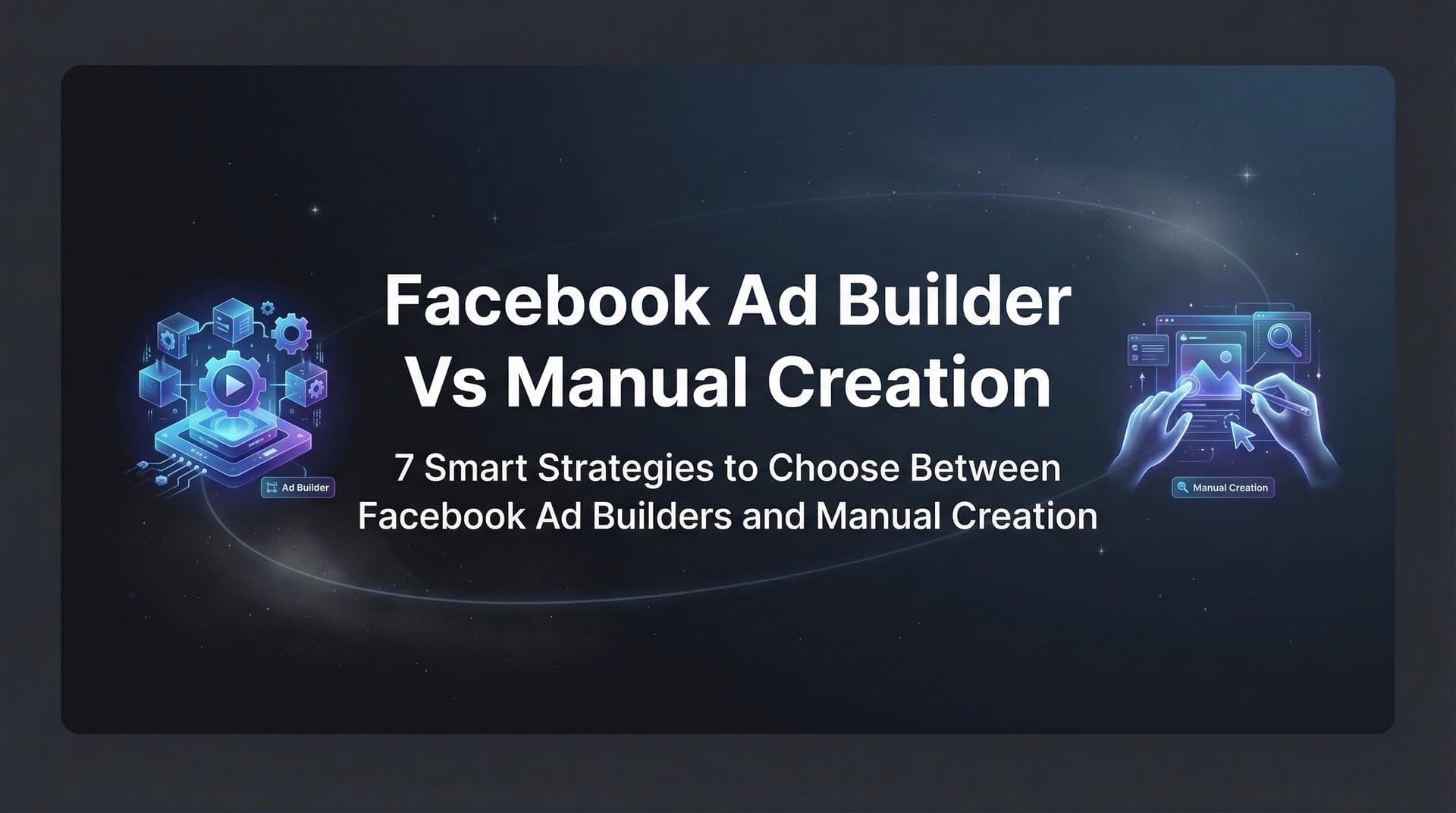
Every digital marketer faces the same dilemma: spend hours manually crafting each Facebook campaign with surgical precision, or let automation handle the heavy lifting while you focus on strategy. The choice isn't as simple as "old school versus new tech"—it's about understanding where your time creates the most value.
Manual campaign creation gives you complete control over every targeting parameter, creative element, and budget allocation. You're the architect, the builder, and the quality inspector all in one. But that control comes at a cost: time, scalability, and the mental bandwidth to manage dozens of campaigns simultaneously.
AI-powered ad builders promise a different approach. They analyze your historical performance data, identify winning patterns, and generate campaign variations at speeds no human team can match. The question isn't which method is "better"—it's which approach fits your specific situation.
Your campaign volume, team expertise, performance goals, and scaling ambitions all factor into this decision. A boutique agency running five carefully crafted campaigns per month faces entirely different challenges than a growth team launching 50+ ad variations weekly. The smartest advertisers don't pick sides—they strategically deploy both methods where each delivers maximum value.
These seven strategies will help you build a decision framework that matches your creation method to your actual business needs, not theoretical best practices or vendor marketing claims.
1. Audit Your Campaign Volume to Determine Automation Needs
The Challenge It Solves
You're spending half your workweek building campaigns manually, wondering if there's a better way. The truth is, manual creation makes perfect sense at low volumes—but there's a tipping point where the time investment stops being strategic and starts being wasteful. Without understanding your actual workload, you can't make an informed decision about automation.
The Strategy Explained
Track your team's ad creation time over two weeks. Count every campaign built, every audience configured, every ad set duplicated. Calculate the average time per campaign and multiply by your monthly volume. If manual creation consumes more than 40% of your team's available hours, automation becomes a strategic necessity rather than a luxury.
The math reveals patterns you might miss day-to-day. That "quick" campaign setup actually takes 45 minutes when you factor in asset gathering, audience research, and quality checks. Multiply that across 30 campaigns monthly, and you're looking at 22+ hours of pure execution work—time that could be spent on creative strategy, performance analysis, or client communication. Understanding why manual Facebook ad creation is time consuming helps justify the shift toward automation.
Implementation Steps
1. Create a simple time-tracking spreadsheet with columns for campaign name, creation date, time spent, and complexity level (simple/medium/complex).
2. Have each team member log their actual build time for two weeks, including all the "hidden" tasks like asset preparation, audience research, and campaign duplication.
3. Calculate your team's total monthly capacity (available work hours minus meetings, analysis, and strategic planning time), then compare against time spent on campaign creation.
4. Identify your volume threshold—the point where manual creation starts consuming strategic time that could be better spent elsewhere.
Pro Tips
Don't just track "campaign creation" time—break it down by task type. You might find that audience configuration takes 60% of your build time, making that the perfect candidate for automation while keeping creative development manual. Track complexity levels too—simple campaigns often take as long as complex ones due to repetitive manual work that automation handles instantly.
2. Match Your Approach to Campaign Complexity Levels
The Challenge It Solves
Not all campaigns deserve the same level of manual attention. Treating every campaign as if it requires custom hand-crafting wastes time on simple tests while potentially rushing complex strategic launches. You need a clear framework for deciding which campaigns warrant manual precision and which benefit from automated speed.
The Strategy Explained
Create a three-tier complexity framework. Simple campaigns (single product, straightforward offer, standard audience) are perfect candidates for ad builders that can generate multiple variations quickly. Medium complexity campaigns (multiple products, seasonal offers, layered audiences) benefit from hybrid approaches—automated structure with manual creative oversight. High complexity campaigns (multi-stage funnels, custom attribution, unique creative requirements) often justify full manual control.
The framework isn't about automation versus manual—it's about matching method to outcome. Simple campaigns need speed and volume to find winners through testing. Complex campaigns need strategic thinking that current AI can't fully replicate. Most advertisers discover that 60-70% of their campaigns fall into the "simple" category, making them ideal automation candidates. Exploring automated vs manual Facebook campaigns in depth reveals where each approach excels.
Implementation Steps
1. Review your last 20 campaigns and categorize each by complexity using these criteria: number of products, audience sophistication, creative requirements, and funnel depth.
2. Document the performance difference between complexity levels—you'll often find that simple campaigns with high testing volume outperform manually-crafted complex campaigns with limited variations.
3. Create a decision tree: If campaign has fewer than 3 products AND uses standard audiences AND needs multiple test variations = automation candidate. If campaign requires custom attribution OR unique creative strategy OR complex funnel mapping = manual creation.
4. Test your framework on 5 new campaigns, deliberately choosing the "wrong" method for 2 of them to validate your decision criteria.
Pro Tips
Complexity often hides in unexpected places. A "simple" single-product campaign might actually be complex if it's targeting multiple customer lifecycle stages. Conversely, a campaign promoting 10 products might be simple if they all target the same audience with similar messaging. Let audience and creative requirements—not product count—determine your complexity assessment.
3. Leverage Performance Data to Guide Your Method Selection
The Challenge It Solves
Many teams choose creation methods based on habit or assumption rather than actual performance outcomes. You might be manually building campaigns because "that's how we've always done it," while your data quietly suggests that automated variations are outperforming your carefully crafted manual campaigns. Without performance-based decision making, you're optimizing for process instead of results.
The Strategy Explained
Run a controlled comparison over 30 days. Create 10 campaigns manually using your standard process, and 10 similar campaigns using an ad builder. Track not just performance metrics (ROAS, CPA, conversion rate) but also creation time, testing velocity, and time-to-winner identification. The data will reveal which method delivers better outcomes for your specific business model and advertising goals.
Look beyond surface-level metrics. Manual campaigns might show better initial performance due to careful targeting and creative selection, but automated campaigns often identify winning variations faster through higher testing volume. Calculate your "cost per winning campaign discovered" by factoring in both ad spend and team time investment. A thorough AI vs manual Facebook ad creation analysis helps quantify these differences.
Implementation Steps
1. Select 20 similar campaigns (same product category, budget range, and goals) and randomly assign 10 to manual creation and 10 to automated building.
2. Track comprehensive metrics including: time to launch, number of variations tested, days to identify winner, final ROAS, and total team hours invested per campaign.
3. Calculate your "efficiency score" for each method: (ROAS × number of winners identified) ÷ (total team hours + ad spend). This reveals true ROI including your time investment.
4. Document qualitative factors too—which method felt more sustainable? Which allowed more strategic thinking time? Which created less team stress?
Pro Tips
Don't let perfect be the enemy of good. Your manually-crafted campaigns might achieve 10% better ROAS, but if automated campaigns let you test 5× more variations in the same time, you'll likely discover more winners overall. Performance data should measure both quality and quantity of successful campaigns, not just individual campaign metrics.
4. Align Team Skills with the Right Creation Method
The Challenge It Solves
Your team's expertise directly impacts which creation method will succeed. A junior marketer struggling with Facebook's campaign structure won't suddenly become effective just because they're building manually—but they might excel with an AI-powered builder that handles technical complexity. Conversely, a seasoned strategist might feel constrained by automation that limits their creative control. Misalignment between team skills and tools creates frustration and poor results.
The Strategy Explained
Map your team's capabilities across three dimensions: technical platform knowledge, creative strategy skills, and data analysis abilities. Ad builders excel at bridging technical knowledge gaps—they understand Meta's campaign structure, audience layering, and budget optimization automatically. Manual creation rewards strategic thinking and creative intuition but demands deep platform expertise.
The strongest teams use automation to elevate junior members while freeing senior strategists for high-value work. Your newest team member can launch effective campaigns through an AI Facebook ad builder on day one, while your veteran marketer focuses on analyzing performance patterns and developing creative strategy that feeds back into the automation system.
Implementation Steps
1. Conduct honest skills assessments with each team member across platform knowledge (campaign structure, targeting options, optimization strategies), creative abilities (copywriting, visual selection, messaging), and analytical skills (data interpretation, testing methodology).
2. Identify skill gaps that automation can fill immediately versus gaps that require training. A junior marketer who doesn't understand audience layering benefits from automation; one who lacks strategic thinking needs mentorship, not tools.
3. Assign creation methods based on strengths: technical experts might prefer manual control, strategic thinkers might excel at guiding AI builders, and analytical minds might thrive in hybrid workflows where they optimize automated outputs.
4. Create a 30-day rotation where team members try both methods, then discuss which approach amplified their strengths rather than exposing their weaknesses.
Pro Tips
Skills alignment isn't about finding the "easiest" tool for less experienced team members. It's about matching methods to how people think. Some strategists feel more creative when freed from technical execution, while others need hands-on control to develop ideas. Let working style—not just skill level—inform your assignments. For those just starting out, a Facebook ad builder for beginners can dramatically shorten the learning curve.
5. Implement a Hybrid Workflow for Maximum Flexibility
The Challenge It Solves
Treating this as an either-or decision creates unnecessary limitations. You don't need to choose between automation and manual creation across your entire advertising operation—you need both methods working in concert. Pure automation misses strategic nuance, while pure manual creation can't scale efficiently. The solution is a hybrid approach that deploys each method where it delivers maximum value.
The Strategy Explained
Build a workflow that uses automation for high-volume testing and manual creation for flagship campaigns. Let AI builders handle your testing layer—generating multiple audience and creative variations to identify winning patterns quickly. Then use those insights to manually craft your scaling campaigns with strategic refinements that automated systems might miss.
Think of it as a two-stage system. Stage one uses automation to discover what works through rapid testing and data collection. Stage two applies human strategic thinking to refine and scale those winners. This approach combines the speed of automation with the nuance of manual optimization, creating better outcomes than either method alone. Learning how to automate Facebook ad creation effectively is the foundation of this hybrid strategy.
Implementation Steps
1. Designate 70% of your monthly campaign volume as "testing layer" suitable for automated building—these campaigns focus on discovering winning combinations through volume and variety.
2. Reserve 30% of campaigns as "strategic layer" for manual creation—these are your highest-budget campaigns, complex funnels, or brand-defining initiatives that warrant custom attention.
3. Create a feedback loop where insights from automated testing inform manual campaign strategy. If your AI builder discovers that carousel ads with customer testimonials outperform single images, apply that learning to your manually-created flagship campaigns.
4. Schedule weekly "insight harvesting" sessions where your team reviews automated campaign results specifically to extract strategic learnings for manual application.
Pro Tips
The hybrid approach works best when you resist the urge to manually tweak automated campaigns prematurely. Let your testing layer run for at least 7 days before applying manual optimizations—early intervention often disrupts the learning process. Save your manual expertise for strategic decisions informed by data, not gut-feel adjustments to active tests.
6. Prioritize Speed-to-Market When Timing Matters
The Challenge It Solves
Seasonal trends, competitive moves, and viral moments don't wait for your manual campaign creation process. By the time you've carefully crafted the perfect Black Friday campaign structure, the weekend might be half over. When timing determines success, the ability to launch quickly often matters more than marginal improvements in targeting precision or creative polish.
The Strategy Explained
Develop rapid deployment capabilities for time-sensitive opportunities. AI-powered ad builders can launch complete campaigns in minutes rather than hours, letting you capitalize on trending topics, respond to competitor moves, or activate seasonal promotions the moment they become relevant. The speed advantage often outweighs any theoretical benefits of manual fine-tuning.
Speed-to-market creates competitive advantages beyond just being first. Early entry into seasonal trends means more data collection time, faster identification of winning approaches, and better positioning before market saturation. A campaign launched three days earlier with 90% optimization often outperforms a "perfect" campaign that launches late to the opportunity. Discovering how to speed up Facebook campaign creation becomes essential for capitalizing on these windows.
Implementation Steps
1. Identify your time-sensitive campaign categories: seasonal promotions, trend-responsive content, competitive reactions, flash sales, and product launches with fixed dates.
2. Pre-build campaign templates in your ad builder for common time-sensitive scenarios. When Black Friday arrives, you're not building from scratch—you're activating pre-structured campaigns with updated creative and offers.
3. Establish a "rapid response protocol" where specific campaign types automatically get assigned to automated building rather than entering your standard manual workflow queue.
4. Track the relationship between launch timing and performance for seasonal campaigns. Calculate whether launching 2-3 days earlier with automation delivers better results than launching later with manual precision.
Pro Tips
Speed-to-market doesn't mean sacrificing quality—it means pre-planning your quality standards. Build your rapid deployment templates during slow periods when you have time for strategic thinking. Then when the time-sensitive moment arrives, you're executing a pre-considered strategy quickly, not rushing through decisions under pressure.
7. Scale Testing Velocity Without Sacrificing Quality
The Challenge It Solves
Manual campaign creation naturally limits your testing capacity. Even the fastest marketer can only build so many variations in a day, which means you're testing fewer hypotheses and potentially missing winning combinations. Low testing velocity extends your time-to-insight and limits your ability to optimize based on comprehensive data rather than limited samples.
The Strategy Explained
Use AI-powered tools to dramatically increase the number of campaign variations you test simultaneously while maintaining quality standards. Instead of manually creating 5 ad variations, let automation generate 20+ variations that test different audience segments, creative approaches, and messaging angles. More tests mean faster identification of winning patterns and more robust data for optimization decisions.
Higher testing velocity creates a learning advantage that compounds over time. Each additional variation provides data points that inform future campaigns. Teams that test 10× more variations don't just find winners faster—they develop deeper understanding of what resonates with their audiences across different contexts and conditions. A bulk Facebook ad creation tool makes this scale of testing operationally feasible.
Implementation Steps
1. Calculate your current testing velocity: number of unique variations tested per week across all campaigns. This is your baseline for improvement.
2. Identify the bottlenecks limiting your testing capacity. Is it creative production? Audience research? Campaign setup time? Ad builders primarily solve the setup bottleneck, so ensure that's actually your constraint before expecting velocity improvements.
3. Implement a structured testing framework where automation handles variation generation while you define the strategic parameters: which audiences to test, what creative themes to explore, which value propositions to emphasize.
4. Set quality gates for automated variations: minimum creative standards, audience size thresholds, budget allocation rules. Automation should increase volume within your quality parameters, not replace quality standards.
Pro Tips
More variations only improve outcomes if you're testing meaningful differences. Don't let automation generate 50 nearly-identical campaigns that test trivial variations. Define strategic hypotheses first—different audience segments, contrasting creative approaches, alternative value propositions—then use automation to execute those tests at scale. Quality testing at high velocity beats random variation generation every time. Understanding why scaling Facebook ads manually has become difficult reinforces the importance of automated testing infrastructure.
Putting It All Together
The choice between Facebook ad builders and manual creation isn't binary—it's strategic. Your decision should be driven by campaign volume, complexity levels, team capabilities, and performance data rather than philosophical preferences about automation versus manual control.
Start with an honest audit of where your team actually spends time. If manual campaign creation consumes more than 40% of available hours, automation becomes a necessity for scaling. Use the complexity framework to identify which campaigns truly need manual attention versus which benefit from automated speed and testing volume.
The hybrid approach delivers the best of both worlds. Let AI-powered builders handle your high-volume testing layer, rapidly generating variations that identify winning patterns. Then apply manual strategic thinking to your flagship campaigns, informed by insights from automated testing. This combination scales your testing velocity while preserving strategic control where it matters most.
Performance data should guide your ongoing decisions. Track not just campaign metrics but also time investment, testing velocity, and team satisfaction. The "best" method is the one that delivers optimal results for your specific situation—which might be different from another advertiser's optimal approach.
Remember that speed-to-market often determines success for time-sensitive opportunities. Build rapid deployment capabilities for seasonal campaigns, competitive responses, and trend-responsive content. Pre-plan your quality standards during calm periods so you can execute quickly when timing matters.
Ready to transform your advertising strategy? Start Free Trial With AdStellar AI and be among the first to launch and scale your ad campaigns 10× faster with our intelligent platform that automatically builds and tests winning ads based on real performance data.