Dropshipping success on Facebook lives or dies by your ad creatives. Unlike brands with established recognition, dropshippers need to stop the scroll, build instant trust, and drive purchase intent all within a single ad. The challenge is doing this consistently across multiple products, audiences, and formats without a design team or video production budget.
Here is the reality: most dropshippers launch one creative, watch it underperform, and then blame the product. The issue is rarely the product. It is the creative system, or rather, the lack of one.
This guide walks you through exactly how to build high-converting Facebook ad creatives for dropshipping, from choosing the right format to testing at scale. Whether you are selling a single winning product or managing a catalog of items, these steps give you a repeatable system for creative production that does not rely on guesswork or expensive freelancers.
By the end, you will know how to match creative formats to your product type, craft copy that converts cold traffic, structure your visual assets for maximum impact, and use AI tools to generate and test variations faster than manual production allows. Each step builds on the last, so follow them in order for the best results.
Step 1: Match Your Creative Format to Your Product Type
Before you open a design tool or brief a freelancer, you need to answer one foundational question: does your customer need to see this product in action to understand why they want it?
The answer determines your entire creative approach. There are three core formats for dropshipping Facebook ads, and each serves a different purpose.
Static image ads work best for products with a clear, visually obvious value proposition. Think products with strong before/after contrast, products with a striking visual design, or impulse-buy items where the benefit is immediately apparent. A bold image with a punchy headline can be enough to drive a click when the product sells itself visually.
Video ads are better suited for products that need context. If your product solves a specific problem, has a mechanism that needs explaining, or looks unremarkable in a still image, video gives you the runway to demonstrate value. Facebook's autoplay behavior in the feed makes video a natural format for capturing attention even when a user is not actively looking for your product.
UGC-style ads (content designed to look like organic user posts or reviews) work particularly well for cold audiences who have never heard of your brand. Because they do not look like traditional advertising, they tend to feel more authentic and can help bridge the trust gap that is common in dropshipping, where brand recognition is minimal.
To evaluate your product, ask yourself three questions. First, would a customer understand the benefit from a single image? Second, does the product need to be seen in use to create desire? Third, is social proof from a "real person" more persuasive than a polished graphic for this category?
A common pitfall is defaulting to one format across your entire store because it is the easiest to produce. A phone grip might convert well with a static ad. A posture corrector almost certainly needs video. Treating every product the same way costs you money.
Success indicator: Before producing a single asset, you have identified the primary creative format for each product based on its value proposition and the level of explanation it requires.
Step 2: Build Your Visual Assets Around the Hook
Once you know your format, the next decision is your hook. The hook is the single most important element of any Facebook ad creative for dropshipping because it determines whether someone stops scrolling or keeps moving. Everything else, the copy, the offer, the call to action, only matters if the hook works first.
The hook must be decided before any design work begins. Designing without a defined hook is like building a house without a foundation. You might end up with something that looks fine but collapses under pressure.
For static ads, the hook is the hero image or the dominant visual element in the frame. It should communicate a benefit, create curiosity, or show the product in a context the viewer immediately connects with. High contrast, unexpected visuals, and images that show the product solving a problem all tend to perform well.
For video ads, the hook is the first two to three seconds. Meta's own creative guidance emphasizes placing your most important message or visual at the very beginning of a video ad because attention in the feed drops off quickly. Your opening frame should show the product in use, make a bold claim, or present a surprising visual that makes the viewer want to know what comes next. Do not open with a logo animation or a slow product reveal. You will lose people before you have said anything.
When it comes to sourcing visuals, dropshippers typically have a few options. Supplier-provided product images are a starting point, but they are often generic and shared by many other sellers. Lifestyle photos, where available, add context and help viewers picture themselves using the product. The most efficient option for many dropshippers today is generating creatives directly from a product URL using an AI creative tool.
AdStellar's AI Creative Hub lets you do exactly this. Paste in your product URL and the platform generates image ads and video ads without requiring a designer, video editor, or stock photo subscription. You can also clone competitor ads directly from the Meta Ad Library, which is useful for understanding what hooks are already working in your niche before you invest in production.
Contrast, color, and motion in the first frame are the primary drivers of thumb-stop rate. If your opening visual blends into the feed, no amount of great copy will save the ad.
Success indicator: Your creative leads with a visual that communicates value or creates curiosity before a single word of text is read.
Step 3: Write Ad Copy That Converts Cold Traffic
Dropshipping audiences are almost always cold. They have no relationship with your brand, no reason to trust you, and no prior context for your product. Your copy needs to do a lot of heavy lifting in a short amount of space.
Cold traffic copy for Facebook ad creatives in dropshipping needs to accomplish three things in sequence: create immediate relevance, establish credibility, and drive urgency. If your copy skips any of these, you leave conversions on the table.
A reliable structure for primary text looks like this:
1. Open with the problem or desire. Start where your customer already is mentally. If your product relieves back pain, open with the discomfort of back pain, not with the product. If it is a fashion item, open with the desire to look a certain way. Cold audiences respond to recognition, not product descriptions.
2. Present the product as the solution. Once you have established relevance, introduce your product in terms of what it does for the customer, not what it is. "This adjustable lumbar support eliminates lower back tension in minutes" is more compelling than "Our lumbar support is made from high-quality memory foam."
3. Add a credibility signal. For dropshippers, this is critical. You do not have brand equity, so you need borrowed trust. Review counts, customer outcomes, or specific claims about the product's effectiveness can all serve this purpose. Keep it specific rather than vague.
4. Close with a clear call to action. Tell the reader exactly what to do next. "Shop now," "Grab yours today," or "Get yours before stock runs out" are all direct and functional. Pair urgency with a reason when possible.
For headlines, keep them benefit-focused and specific. Generic phrases like "Check this out" or "You need this" give the reader no reason to click. A headline like "Finally, a solution for chronic wrist pain" tells the viewer exactly who the ad is for and why it matters.
One important testing principle: change one copy variable at a time. If you rewrite both the headline and the primary text simultaneously, you will not know which change drove any performance shift. Isolate your variables so your data is actually useful. Using AI copywriting for Facebook ads can help you generate multiple distinct angles quickly without starting from a blank page.
A common pitfall is writing copy that describes the product rather than the outcome. Customers do not buy products. They buy the version of themselves that the product creates.
Success indicator: Your primary text answers "what is in it for me" within the first line, without requiring the reader to already know your brand.
Step 4: Create Multiple Variations for Testing
Single-creative launches rarely find winners, especially for new dropshipping products entering cold audiences. The Facebook algorithm needs data to optimize delivery, and data requires volume. Launching one creative and waiting for results is not a testing strategy. It is a coin flip.
The minimum viable test for a dropshipping product is at least three creative variations, ideally testing different hooks or formats rather than minor cosmetic differences. Three versions of the same image with slightly different text colors are not meaningful variations. Three different opening frames, three different copy angles, or a static versus video comparison are.
What to vary across your test set:
Hook or opening frame: This is the highest-leverage variable. Different hooks can produce dramatically different CTR results even when everything else stays the same.
Headline: Test benefit-focused versus problem-focused versus curiosity-driven headlines to see which framing resonates with your specific audience.
Primary text angle: Try a problem-first approach against a social proof-first approach. The same product can be positioned multiple ways, and the winning angle is not always obvious before testing.
Creative format: If budget allows, test a static image against a video or a UGC-style creative. Format preferences vary by audience and product category.
To structure your variation matrix, list your creative assets down one axis and your copy angles across the other. Map the combinations you want to test, prioritize the ones with the most distinct differences, and build your launch set from there. Understanding common Facebook ad creative testing challenges ahead of time will help you avoid the pitfalls that slow most dropshippers down.
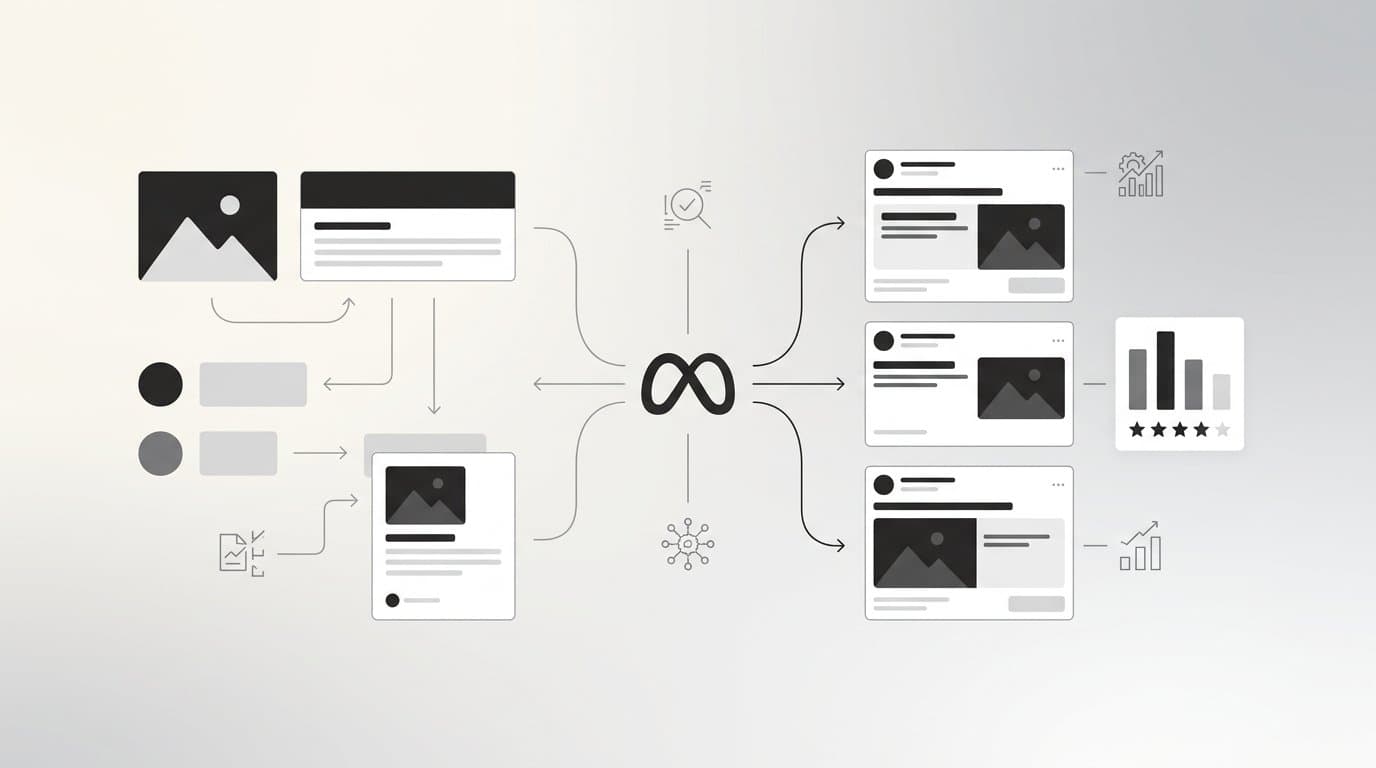
The operational challenge for most dropshippers is that building and launching dozens of variations manually takes hours. AdStellar's Bulk Ad Launch feature solves this directly. You mix multiple creatives, headlines, audiences, and copy variations, and the platform generates every combination and launches them to Meta in minutes rather than hours. What would take a full day of manual setup becomes a task measured in clicks.
Keep your audience and budget consistent across creative variations during a test. If you change the audience at the same time as the creative, you will not be able to attribute performance differences to the right variable.
Success indicator: You have a structured test matrix with at least three distinct creative angles, each testing a meaningfully different hook or copy approach, ready to launch simultaneously.
Step 5: Launch and Track Performance by Creative Element
Launching your variations is only the beginning. The real work is in reading the data correctly and knowing which signals actually matter.
The way you structure your campaigns determines the quality of data you get back. If your tracking is set up at the ad set level rather than the individual ad level, you will see aggregate performance but not the specific creative element driving it. Set up your campaigns so that performance data is tied to each individual creative, not just the ad set it lives in.
For dropshipping creatives, the metrics that matter most are:
CTR (link click-through rate): This tells you how compelling your creative and copy are at driving clicks. A low CTR suggests your hook or headline is not working. Benchmarking your results against the average click-through rate for Facebook ads in your category gives you a meaningful baseline for evaluation.
CPC (cost per click): Useful in context with CTR. A high CTR with a high CPC can still be profitable depending on your conversion rate.
Add-to-cart rate: This tells you whether your landing page and offer are converting interest into intent. If CTR is high but add-to-cart is low, the problem is downstream from the creative.
Cost per purchase and ROAS: These are your bottom-line metrics. Everything else is context that helps you explain why these numbers look the way they do.
A common mistake is optimizing for CTR alone. A creative that over-promises in the ad but under-delivers on the landing page can generate impressive click rates with terrible conversion. High CTR with low conversion is a signal that your creative and your offer are misaligned.
AdStellar's AI Insights leaderboard ranks your creatives, headlines, copy variations, and audiences by real metrics like ROAS and CPA. You set your target goals and the AI scores every element against your benchmarks, so instead of manually comparing spreadsheets, you can see at a glance which creative is performing above target and which is dragging your average down.
On timing: give each creative enough spend to generate meaningful data before making cut decisions. Pausing ads too early, before the algorithm has had time to optimize delivery, is one of the most common and costly mistakes in Facebook advertising. Meta's own documentation recommends allowing campaigns to exit the learning phase before drawing conclusions.
Success indicator: Within your first test cycle, you can identify which specific creative element is driving the best cost per purchase, not just which ad set is performing best overall.
Step 6: Scale What Works and Refresh What Does Not
Finding a winning creative is not the finish line. It is the starting point for the next phase of your dropshipping campaign strategy.
A winning creative is one that delivers consistent performance above your ROAS or CPA target over multiple days, not just a single good day. Single-day spikes can be noise. Consistent performance over three to five days with sufficient spend behind it is a real signal.
When you identify a winner, scale the budget on that ad set gradually. Doubling or tripling spend overnight can shock the algorithm and push the ad back into a learning phase, disrupting the delivery optimization it has built up. A more measured approach, increasing budget by a meaningful but controlled increment every few days, tends to preserve performance more reliably. Pairing this with an AI-powered Facebook ads platform makes it easier to monitor performance signals and act before a winning ad starts to slip.
AdStellar's Winners Hub is designed specifically for this moment. As your ads run, top-performing creatives, headlines, and audiences are stored with their real performance data attached. When you are ready to build your next campaign, you can pull directly from your proven winners rather than starting from scratch. This is the difference between building a library of assets that compounds over time and starting over with every new product launch.
Creative fatigue is a real and documented phenomenon on Meta's platform. As an ad runs and your target audience sees it repeatedly, frequency rises, CTR falls, and CPM increases. These are the warning signs that a winning creative is losing its effectiveness. When you see this pattern, the instinct is often to kill the ad entirely. That is usually the wrong move.
Instead, refresh the creative by changing the hook while keeping the proven copy. If a static image is fatiguing, test a UGC-style version of the same concept. If a particular headline has been running for weeks, swap it while keeping the primary text that has been converting. You are preserving what works while removing what the audience has tuned out.
AdStellar's AI Campaign Builder takes this further by analyzing your historical performance data across all your campaigns. It ranks every creative, headline, and audience by performance and builds new campaigns using the elements that have already proven themselves. Every decision comes with a clear explanation of why that element was selected, so you are not just getting an output. You are understanding the strategy behind it. And because the AI learns from each campaign you run, its recommendations improve over time.
Build a Winners Hub habit from day one. Even if you are just starting out and your first few campaigns are learning exercises, document what worked and why. That library becomes one of your most valuable assets as you scale.
Success indicator: You have a documented process for scaling winning creatives, a refresh cycle that extends their life before fatigue sets in, and a growing library of proven assets you can pull from for every new campaign.
Putting It All Together
Creating effective Facebook ad creatives for dropshipping is a system, not a single decision. When you match your format to your product, lead with a strong visual hook, write copy for cold traffic, test multiple variations, track by creative element, and scale winners while refreshing fatigued ads, you build a repeatable engine for profitable campaigns.
Before your next launch, run through this checklist:
Format selected based on whether your product needs demonstration or sells itself visually.
Hook identified and leading the creative before any brand or product information appears.
Copy structured around customer outcome, not product description, with a credibility signal and a clear call to action.
At least three variations ready for testing, each with a meaningfully different hook or copy angle.
Tracking set up at the individual creative level so you can attribute performance to specific elements.
A scaling and refresh plan in place so winning creatives are extended, not abandoned, when fatigue sets in.
The biggest bottleneck for most dropshippers is production speed. Generating creatives, building variations, launching campaigns, and analyzing results manually takes time that most operators do not have, especially when managing multiple products.
AdStellar removes that bottleneck entirely. The platform generates image ads, video ads, and UGC-style creatives from a product URL, launches hundreds of variations to Meta in minutes, and surfaces winners automatically through AI-powered insights and goal-based scoring. One platform, from creative to conversion, with no designers, no video editors, and no guesswork.
If you want to run this system without the manual overhead, Start Free Trial With AdStellar and see how fast you can go from product URL to live, optimized campaign.