Most Meta advertisers have been there: you spend hours crafting creatives, carefully writing headlines, choosing audiences, and launching what feels like a solid campaign. Then the results come in and one ad absolutely crushes it while another barely moves the needle. The frustrating part is not the underperformer. It is not knowing why it underperformed, or more importantly, what to build next time that will actually work.
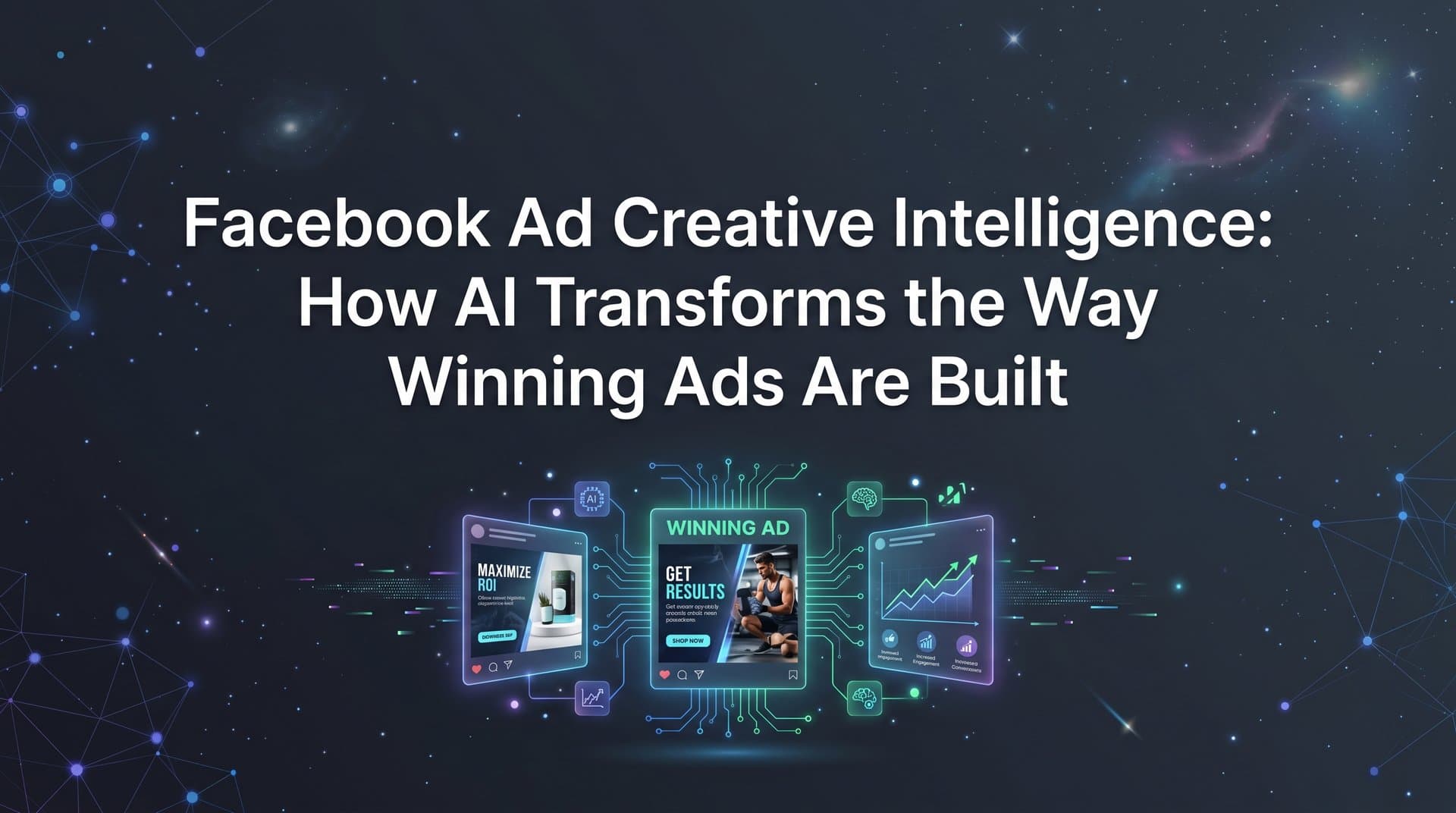
This is the gap that Facebook ad creative intelligence is designed to close. Not just telling you what won, but explaining why it won, which elements drove the result, and how to replicate that success systematically across future campaigns.
For performance marketers, this distinction matters enormously. Meta's platform has become increasingly automated on the audience and bidding side. Advantage+ audiences handle a significant portion of targeting decisions, which means the creative itself has become the primary lever that marketers can actually control. If your creative strategy is still built on instinct and basic A/B testing, you are leaving a significant performance advantage on the table.
This article breaks down exactly what Facebook ad creative intelligence is, how it works at the element level, and how modern AI platforms are making it accessible to teams of every size. Whether you are managing campaigns for a single brand or running ads across dozens of clients, understanding this concept will change how you approach creative strategy.
We will cover the core definition, what gets measured and how, how creative intelligence shapes campaign decisions, why creative volume matters more than most teams realize, and how to build a system that gets smarter with every campaign you run. Let's get into it.
Beyond Gut Feeling: What Creative Intelligence Actually Means
At its core, Facebook ad creative intelligence is the systematic use of AI and performance data to evaluate, score, and predict how individual creative elements will perform. Not the campaign as a whole, but the specific components within it: the visual format, the headline structure, the copy tone, the call-to-action phrasing, and how all of those elements interact with a given audience.
This is a meaningfully different concept from traditional A/B testing. When you run a standard split test, you get a winner. Ad A beat Ad B. That is useful information, but it stops short of being actionable intelligence. You know what won. You do not know why it won, which element was responsible for the lift, or what that tells you about what to build next.
Creative intelligence answers the deeper questions. Was it the video format versus the static image? Was it the urgency in the headline? Was it the specific call-to-action phrase? By analyzing performance at the element level rather than the ad level, AI systems can surface patterns that would be nearly impossible to identify manually, especially when you are running dozens or hundreds of variations simultaneously.
The data inputs that power this kind of analysis include several layers working together. Historical campaign performance provides the foundation: which creatives, headlines, and copy combinations have generated strong ROAS, low CPA, and high CTR over time. Engagement signals add another dimension, capturing how audiences interact with specific visual and copy formats. Audience behavior patterns reveal which creative elements resonate with different segments. And goal-based benchmarks ensure the scoring is calibrated to what actually matters for your specific objectives.
Think of it like this: basic analytics tells you the score at the end of the game. Creative intelligence watches every play, tracks every player's contribution, and builds a model that predicts which lineup will win the next match.
This shift from reactive reporting to predictive insight is what makes creative intelligence so valuable for performance marketers. Instead of launching campaigns and hoping the algorithm figures it out, you are entering each campaign with a data-backed view of which elements are most likely to drive results. The guesswork does not disappear entirely, but it gets replaced by informed hypotheses grounded in real performance history.
For teams that have been running Meta campaigns for any length of time, this represents a genuine operational upgrade. All of that historical data you have been accumulating becomes an active strategic asset rather than a archive you rarely revisit. Exploring dedicated Facebook ad intelligence tools is one of the most effective ways to unlock the value already sitting in your campaign history.
The Building Blocks: What Gets Measured and Why It Matters
Creative intelligence does not treat an ad as a single unit. It breaks every ad down into its component parts and evaluates each one independently against real performance metrics. Understanding what gets measured and how helps clarify why this approach produces better creative decisions than subjective evaluation ever could.
Visual format and creative type: Whether an ad uses a static image, a video, a carousel, or a UGC-style avatar creative is one of the first variables AI systems analyze. Different formats perform differently depending on the objective, the audience, and the placement. Creative intelligence identifies which formats are driving results for your specific goals rather than relying on general industry assumptions.
Headline structure and messaging angle: The headline is often the first thing a user reads, and the structure matters as much as the content. AI systems analyze patterns across winning headlines: question-based versus statement-based, benefit-led versus problem-led, short and punchy versus descriptive. Over time, the system builds a picture of which structural approaches resonate most with your audience.
Ad copy tone and length: Copy tone, whether it is conversational, authoritative, urgent, or empathetic, interacts differently with different audiences and objectives. Creative intelligence tracks which tonal approaches correlate with strong performance and scores new copy variations against those patterns.
Call-to-action phrasing: The CTA is a small element that carries significant weight. "Shop Now," "Learn More," "Get Started," and "Claim Your Offer" can produce meaningfully different click-through rates depending on context. AI systems track CTA performance at a granular level and use that data to inform future recommendations.
Landing page alignment: Creative intelligence extends beyond the ad itself to consider how well the ad's message aligns with the destination. An ad promising a specific offer that leads to a generic homepage creates friction that shows up in conversion data. Scoring systems that incorporate landing page alignment provide a more complete picture of why an ad did or did not convert.
Critically, all of this scoring happens against real metrics, not vanity metrics. ROAS, CPA, and CTR are the benchmarks that matter because they connect directly to business outcomes. An ad with strong engagement but poor conversion is not a winner, and a creative intelligence system calibrated to real performance signals will reflect that accurately.
Goal-based scoring adds another layer of precision. An ad optimized for purchase conversions is evaluated differently than one optimized for video views or lead generation. The same creative element might score highly for one objective and poorly for another. This context-sensitivity is what separates sophisticated creative intelligence from simple performance ranking.
The practical implication is significant. When every element of every ad is scored against your specific goals and benchmarks, you stop making decisions based on which ad looked best in the preview and start making decisions based on which elements have actually proven to work in your campaigns. Teams that struggle with too many Facebook ad variables to evaluate manually will find that element-level scoring brings immediate clarity to what would otherwise be an overwhelming amount of data.
From Data to Decisions: How Creative Intelligence Shapes Campaign Strategy
Knowing which elements performed well in past campaigns is only half the value. The other half is using that knowledge to make better decisions about what to create and test next. This is where creative intelligence transitions from an analytical tool into a strategic one.
When AI systems analyze patterns across your winning ads, they surface insights that are difficult to see when you are reviewing campaigns one at a time. Maybe UGC-style creatives consistently outperform polished studio visuals for your audience. Maybe shorter video formats under 15 seconds drive significantly better completion rates than longer formats. Maybe benefit-led headlines with a specific structure keep showing up in your top performers. These patterns exist in your data, but finding them manually across hundreds of campaigns is a real challenge.
Creative intelligence surfaces these patterns automatically and translates them into actionable creative direction. Instead of starting each campaign from a blank slate, you are building on a foundation of what has already proven to work. The creative team's energy gets focused on refining and iterating on proven angles rather than generating ideas without data to guide them.
AI agents take this a step further by not just surfacing insights but acting on them. Platforms like AdStellar's AI Campaign Builder analyze your historical campaign data, rank every creative element, headline, and audience by performance, and then build complete Meta ad campaigns using only the combinations most likely to succeed. Every decision comes with full transparency: the AI explains its rationale so you understand the strategy, not just the output. This matters because it keeps the marketing team in a position of informed oversight rather than blind delegation. Understanding what Facebook campaign optimization actually involves at a systematic level helps teams appreciate why AI-driven pattern recognition outperforms manual review at scale.
Competitive intelligence adds another valuable dimension to this picture. Meta's Ad Library is a publicly available tool that shows active ads from any advertiser page. AI platforms can analyze this data to identify creative patterns in competitor campaigns: which formats they are using, what messaging angles they are leaning on, how frequently they are rotating creatives. These signals do not tell you what to copy, but they do inform your creative direction and help you identify gaps or opportunities in the competitive landscape.
AdStellar's AI Creative Hub, for example, allows you to clone competitor ads directly from the Meta Ad Library and use them as a starting point for your own creative variations. This is not about replication. It is about using competitive signals as one data input alongside your own performance history to make more informed creative decisions.
The result is a campaign strategy that is grounded in evidence from multiple sources: your own historical performance, real-time competitive signals, and AI-powered Facebook ads software working together to inform what gets built and tested next.
The Testing Advantage: Scaling Creative Variations Without Scaling Workload
Here is a reality that every Meta advertiser eventually runs into: the algorithm needs data to optimize, and data requires volume. The more creative variations you run, the faster the algorithm learns which combinations are working, and the more efficiently it can allocate your budget toward winners. Running two or three creatives per campaign is not enough to generate the signal volume that drives meaningful optimization.
The problem is that producing creative volume at scale is genuinely difficult. Writing multiple headline variations, creating different copy angles, designing multiple visual formats, and then manually building out every combination across ad sets takes significant time. For most teams, this is a real bottleneck that limits how much they can test and ultimately how quickly they can find winning combinations. The Facebook ad creative testing bottleneck is one of the most common constraints holding back otherwise well-resourced campaigns.
Bulk ad creation directly addresses this constraint. Instead of building each ad variation manually, AI-powered bulk launch tools allow you to input multiple creatives, headline variations, copy options, and audience segments, then automatically generate every possible combination and launch them to Meta in minutes rather than hours.
Think about what this unlocks in practice. If you have five creative assets, four headline variations, three copy options, and two audience segments, that is 120 unique ad combinations. Building those manually would take a full day of work. With bulk launch, it takes a few clicks. The time between idea and live campaign compresses dramatically, which means you can run more tests, generate more data, and find winners faster.
AdStellar's Bulk Ad Launch feature is built specifically for this workflow. You mix creatives, headlines, audiences, and copy at both the ad set and ad level, and AdStellar generates every combination and launches them to Meta automatically. The creative production side is handled by the AI Creative Hub, which generates image ads, video ads, and UGC-style avatar creatives from a product URL, meaning you can go from product page to hundreds of live ad variations without a designer or video editor in the loop.
The strategic implication here goes beyond efficiency. When you can consistently produce and test more creative variations, you generate more performance data, which feeds the creative intelligence system with better signals, which improves the quality of future recommendations. Volume and intelligence reinforce each other in a cycle that compounds over time. Teams looking to launch multiple Facebook ads quickly without sacrificing creative quality will find that bulk creation tools fundamentally change what is operationally possible.
Turning Winners Into a Repeatable System
Finding a winning ad is satisfying. Building a system that reliably produces winning ads is the actual goal. Creative intelligence makes this possible through two interconnected mechanisms: a curated winners library and a continuous learning loop.
The concept of a creative winners library is straightforward but powerful. Instead of letting top-performing creatives, headlines, audiences, and copy live scattered across campaign dashboards, you consolidate them into a single, organized collection backed by real performance data. When you are ready to build a new campaign, you are not starting from scratch. You are pulling from a library of proven elements that have already demonstrated their ability to drive results against your specific goals. The practice of reusing winning Facebook ad elements systematically is one of the highest-leverage habits a performance marketing team can build.
AdStellar's Winners Hub is designed exactly for this purpose. It surfaces your best-performing creatives, headlines, audiences, and more in one place, complete with the performance data that earned them their spot. Selecting a winner and adding it to a new campaign takes seconds, which means your best work compounds over time rather than getting buried in historical campaign data.
The continuous learning loop is what makes this system progressively more valuable. Each campaign you run generates new performance data. That data feeds back into the AI's scoring model, refining its understanding of which elements work for your audience, your objectives, and your competitive context. The next campaign the AI helps build is informed by everything that came before it. The system genuinely gets smarter with each iteration.
This learning loop also changes how the AI scores creative elements over time. Early in a campaign history, the scoring model is working with limited data and making broader generalizations. As more campaigns run and more performance signals accumulate, the scoring becomes more precise and more specific to your unique context. What works for a direct-to-consumer brand selling apparel is different from what works for a B2B software company, and the AI's model reflects those differences as it learns from your specific data.
Perhaps the most meaningful operational shift that creative intelligence enables is the change in how marketing teams spend their time. When AI handles the production, analysis, and initial scoring work, the team's role shifts from manual execution to strategic oversight. Marketers review AI rationale, set creative direction, identify new angles to test, and make decisions about which winning elements to scale. This is a more valuable use of creative talent than building out ad variations manually or sifting through performance reports to find patterns.
For agencies managing multiple client accounts, this shift is especially significant. The capacity to run multi-client Facebook ads management workflows across many accounts simultaneously, without proportionally increasing the team's workload, creates real scalability that manual processes simply cannot match.
Putting Creative Intelligence to Work: A Practical Starting Point
Understanding creative intelligence conceptually is one thing. Knowing how to actually implement it is another. The good news is that the starting point is simpler than most teams expect, especially if you have been running Meta campaigns for any length of time.
The first step is auditing your existing creative performance data. Look at your historical campaigns and identify the elements that have consistently shown up in your top performers. Which creative formats have driven the strongest ROAS? Which headline structures have produced the best CTR? Which audience segments have delivered the lowest CPA? This audit does not need to be exhaustive, but it should give you a clear picture of where your performance patterns already exist.
The second step is ensuring your attribution and conversion tracking is clean. Creative intelligence is only as reliable as the data feeding it. If your conversion tracking is broken, delayed, or misattributed, the AI is scoring creative elements against inaccurate signals, which produces unreliable recommendations. Clean attribution, connecting ad clicks to actual conversions and revenue, is a genuine prerequisite for accurate creative scoring. AdStellar integrates with Cometly for attribution tracking, which ensures the performance data informing creative decisions reflects real business outcomes rather than platform-reported estimates.
The third step is feeding your performance data into an AI platform that can analyze it, surface patterns, and generate new creative variations based on what it finds. This is where the workflow transforms from manual analysis to systematic intelligence.
AdStellar is built as a full-stack platform for exactly this workflow. The AI Creative Hub generates image ads, video ads, and UGC avatar creatives from a product URL or by cloning from the Meta Ad Library. The AI Campaign Builder analyzes your historical data, ranks every creative element by performance, and builds complete campaigns with full transparency on the rationale behind every decision. Bulk Ad Launch generates hundreds of combinations and launches them to Meta in minutes. AI Insights surfaces leaderboard rankings scored against your goals, and the Winners Hub keeps your top performers organized and ready to deploy.
Pricing starts at $49 per month for the Hobby plan, with Pro at $129 per month and Ultra at $499 per month for teams running higher volume campaigns. All plans include a 7-day free trial, which gives you enough time to run the full creative intelligence workflow from creative generation through campaign launch and initial performance data.
The practical reality is that most teams already have the raw material they need to get started. The historical campaign data exists. The performance signals are there. What creative intelligence provides is the system to turn that raw material into a strategic asset that informs every creative decision going forward.
The Bottom Line on Creative Intelligence
The core shift that Facebook ad creative intelligence enables is moving from reactive guessing to proactive, data-driven creative decisions. Instead of building ads based on what feels right, launching them, and hoping the algorithm figures it out, you are entering each campaign with a clear view of which elements have proven to work and why.
This is not about replacing creative thinking. The best creative intelligence systems are designed to give creative instinct a foundation of real performance data. The ideas still come from people. The strategic direction is still set by marketers who understand their brand and their audience. What AI provides is the analytical layer that tells you which ideas are worth pursuing, which elements to prioritize, and which combinations are most likely to drive results before you spend a dollar testing them.
The teams that will consistently outperform on Meta are not necessarily the ones with the biggest budgets or the most experienced designers. They are the ones who build systematic creative intelligence into their workflow so that every campaign makes the next one smarter.
If you are ready to move beyond guesswork and build a creative system that compounds over time, Start Free Trial With AdStellar and experience the full creative intelligence workflow firsthand. From AI-generated creatives to bulk campaign launch to real-time winner surfacing, AdStellar handles the entire process in one platform so you can focus on strategy while the AI handles the heavy lifting. The 7-day free trial gives you everything you need to see the difference that data-driven creative intelligence makes in practice.