Campaign ready. Budget approved. Audiences defined. And then: nothing. You're waiting on a designer who has three other projects ahead of yours, a revision cycle that's already on its third round, and an approval chain that moves at the speed of a committee meeting. Meanwhile, your campaign window is closing and your competitors are already in the feed.
This is the quiet killer of Meta advertising performance. Not bad strategy. Not wrong audiences. Not even weak offers. Slow creative production is one of the most common and least discussed reasons campaigns underperform, and it costs more than most marketers realize.
When creatives take too long to produce, you miss the trend windows that make certain hooks land harder than others. Your winning ads run past the point of fatigue because replacements aren't ready. Your cost per result climbs while you wait for fresh assets. And by the time new creatives finally launch, the learning cycle has to start all over again.
The good news is that slow creative production isn't a creativity problem. It's a process and tooling problem, and process problems have solutions. This article breaks down exactly why production bottlenecks happen, why they compound over time, and what modern teams are doing to eliminate them entirely.
The Hidden Bottlenecks Slowing Down Your Creative Pipeline
Most marketers think of creative production as a single task. In reality, it's a chain of dependencies, and each link in that chain is a potential delay.
The traditional handoff model looks something like this: a marketer writes a brief, sends it to a designer or agency, waits for a first draft, reviews it, sends feedback, waits for revisions, reviews again, gets final approval, and then finally exports and uploads to Ads Manager. On paper, that sounds like a one-day process. In practice, it routinely stretches to a week or more.
External designers and agencies add coordination overhead that's easy to underestimate. They're managing multiple clients. Your project sits in a queue. Time zones create communication gaps. A single round of revisions that should take an hour can take 48 hours when you account for back-and-forth email threads and competing priorities.
Internal approval chains create their own friction. Creative needs to pass through a marketing lead, sometimes a brand team, sometimes a founder or executive who has opinions about the headline font. Every stakeholder adds a round-trip. Every round-trip adds days.
Brief writing itself is often underestimated as a bottleneck. A vague brief produces an asset that misses the mark, which triggers more revisions. A precise brief takes time to write well. Either way, the process slows down before the designer has even opened their software.
Now multiply this by the volume modern Meta advertising actually requires. A single hero creative for one campaign is manageable, even with a slow pipeline. But testing five creative concepts across three audience segments with two copy variations means you're looking at dozens of individual assets. Each one goes through the same handoff cycle. The delays don't add up linearly; they compound, because each bottleneck affects every asset in the queue.
Small teams and solo operators feel this most acutely. When you're a one-person marketing operation or a small team without in-house design resources, every hour you spend briefing, coordinating, and revising is an hour you're not spending on strategy, offer development, or audience testing. The creative production bottleneck doesn't just slow down your ads. It crowds out the higher-leverage work that actually moves the needle.
The structural problem is that the traditional creative pipeline was designed for brand advertising with long lead times. It was built for campaigns that run for months, not for performance advertising that needs fresh creative every week or faster. The tools and workflows haven't caught up with the demands of modern Meta campaigns, and teams that don't recognize this are paying for it in both time and money.
Why Creative Fatigue Turns Slow Production Into a Real Business Problem
Creative fatigue is what happens when your audience sees the same ad too many times. Engagement drops. People start scrolling past without registering. Frequency scores rise. And because Meta's delivery system is constantly evaluating ad relevance, fatigued creatives don't just underperform. They actively become more expensive to run.
Meta's algorithm deprioritizes ads with declining engagement signals. When your creative starts fatiguing, relevance scores fall, which pushes your CPMs higher. You end up paying more to reach the same people with an ad they've already tuned out. The result is a double hit to your ROAS: lower conversion rates from a disengaged audience and higher costs from an algorithm that's penalizing your declining engagement.
The vicious cycle that slow production creates here is worth understanding clearly. Your ad starts fatiguing. You recognize the performance decline. You brief new creative. The production cycle begins, and it takes a week. In that week, your fatigued ad keeps running, burning budget at worsening efficiency. New creative finally launches, but now it needs time to exit the learning phase before you can evaluate it. You've lost two weeks of optimal performance, and the cycle is already starting again on the new creative.
The only way to break this cycle is to have fresh creative ready before fatigue sets in, not after you've already noticed the performance drop. That requires a production process fast enough to stay ahead of your audience's exposure curve, not scrambling to catch up with it.
The timeline varies depending on your audience size, budget, and targeting approach. Smaller audiences with higher spend can fatigue creatives in days. Broader audiences at lower spend might give you weeks. But in every case, the team that can produce and rotate new creatives faster has a structural advantage. They're always running fresh, relevant ads while slower teams are running tired ones and waiting for replacements.
This is why creative fatigue isn't just a performance metric to monitor. It's a forcing function that reveals whether your production process is actually fast enough for the environment you're advertising in. If your pipeline takes a week and your creatives fatigue in ten days, you're perpetually behind.
The Volume Problem: Why Testing at Scale Demands Speed
Here's a fundamental truth about how Meta advertising works today: the creative is the targeting. As Meta has moved toward broader targeting, Advantage+ placements, and increasingly automated audience optimization, the variable that separates winning campaigns from losing ones is overwhelmingly the creative itself.
This shifts the primary job of a performance marketer. The work isn't just about finding the right audience anymore. It's about producing enough creative variations to give Meta's algorithm the signal it needs to find winners quickly.
Meta's algorithm learns from data. When you launch a campaign with two or three creative variations, the algorithm has limited signal to work with. It takes longer to identify which creative is resonating, which means your campaigns spend more time in the learning phase and less time in optimized delivery. When you launch with a dozen or more variations, the algorithm has richer signal, it can identify patterns faster, and it can shift spend toward winners more efficiently.
Most teams produce far fewer variations than they need, not because they lack ideas or strategic direction, but because production capacity is the bottleneck. A marketer might have ten strong creative concepts in their head, but if each one takes three days to produce, they're looking at a month of production time before they can run a meaningful test. So they compromise. They test three concepts instead of ten. They skip the copy variations. They don't test different formats. And they wonder why their learning velocity feels slow.
The concept of a creative testing cadence is useful here. Think about how many new creatives your campaigns need to enter rotation each week to stay ahead of fatigue, keep the algorithm learning, and give you enough data to make confident scaling decisions. For many active Meta advertisers, that number is higher than their current production process can support.
A realistic testing cadence for a campaign with meaningful spend might require several new creative variations entering rotation every week. Manual production, with its handoffs and revision cycles, simply cannot keep pace with that cadence without significant design resources or agency spend. The math doesn't work at the speed traditional production operates.
This is the core of the volume problem: testing at the scale Meta advertising rewards requires a production speed that traditional workflows cannot deliver. Teams that solve this problem don't just test more. They learn faster, find winners sooner, and scale those winners before fatigue sets in. Teams that don't solve it are running fewer tests, learning more slowly, and scaling less confidently.
How AI Ad Creation Changes the Production Equation
The fundamental shift AI brings to creative production is removing the designer-dependency bottleneck entirely. Instead of writing a brief, waiting for a designer, reviewing a draft, and cycling through revisions, a marketer can generate image ads, video ads, and UGC-style creatives directly from a product URL or a short description. What previously took days now takes minutes.
This isn't about replacing creative judgment. It's about removing the production friction that slows down the execution of creative judgment. A marketer who has a strong sense of which hooks, formats, and messages are likely to resonate can now act on that instinct immediately, rather than waiting for a production pipeline to catch up.
AdStellar's AI Ad Creative capability illustrates what this looks like in practice. You can generate scroll-stopping image ads, video ads, and UGC-style avatar content from a product URL, clone competitor ads from the Meta Ad Library, or let AI build creatives from scratch. You can refine any ad with chat-based editing, iterating on the output in real time without a designer in the loop. No external dependencies, no coordination overhead, no revision cycles that stretch across days.
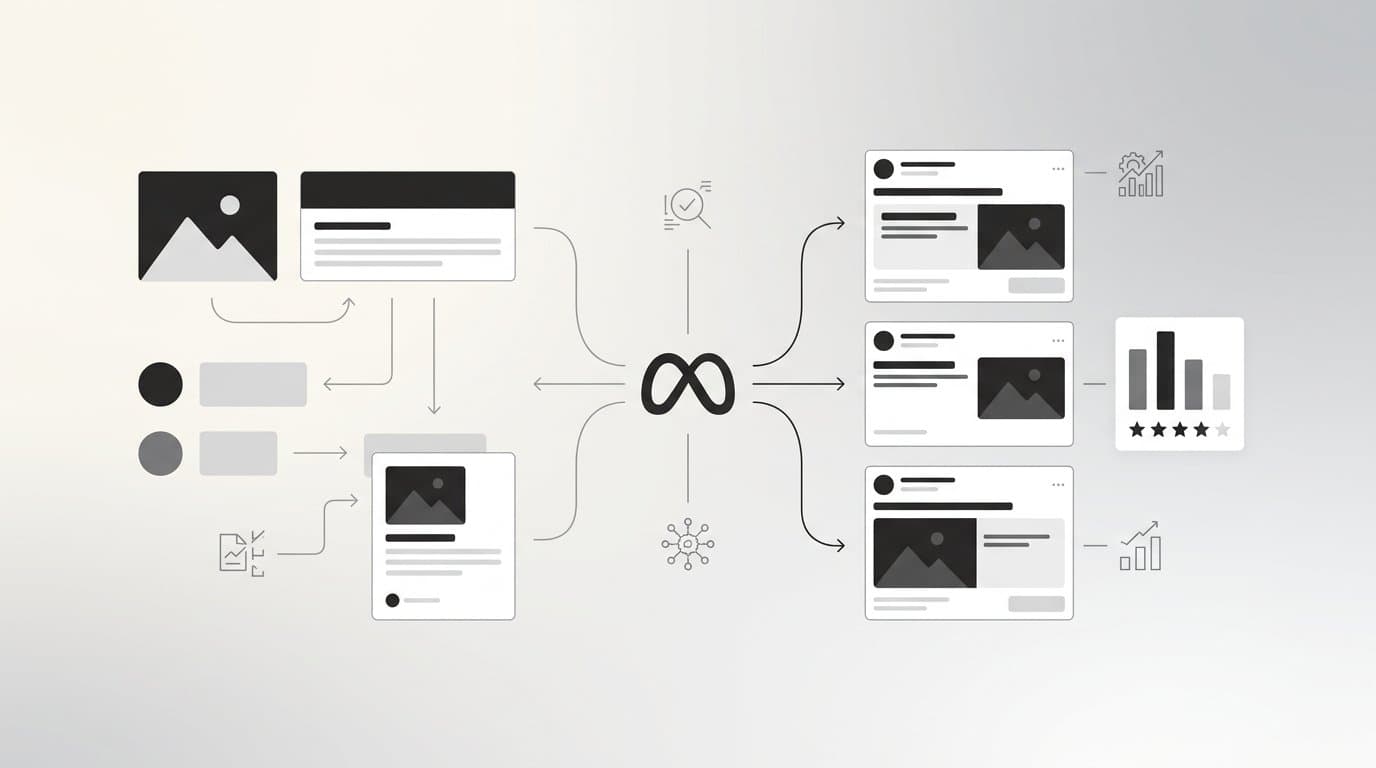
The bulk creation capability is where the volume problem gets solved. Instead of producing variations one at a time, you can mix multiple creatives, headlines, copy variations, and audiences automatically, and AdStellar generates every combination and prepares them for launch. What would have required hours of manual assembly, each variation built and named and uploaded individually, happens in a few clicks. This is how small teams can realistically run the volume of creative tests that Meta's algorithm rewards.
AI campaign builders go a layer deeper by accelerating the strategy layer, not just the production layer. AdStellar's AI Campaign Builder analyzes your past campaigns, ranks every creative, headline, and audience by performance, and builds complete Meta campaign structures around proven combinations. Every decision is explained with full transparency, so you understand the reasoning behind the structure, not just the output. The AI gets smarter with every campaign, which means the recommendations improve as your account accumulates more data.
The practical implication is significant. A solo operator or small team can now operate with the creative output and testing velocity of a much larger team, without adding headcount, hiring a design agency, or spending weeks in production. The infrastructure that previously required a team of designers, copywriters, and coordinators is compressed into a single automated Facebook creative production platform that a single marketer can operate.
From Slow Loop to Fast Feedback: Closing the Creative Cycle
Speed in production only creates value when it's paired with speed in feedback. Launching more creative variations faster is only useful if you can quickly identify which ones are working and act on that information before the learning opportunity passes.
This is where AI insights tools close the loop. Rather than manually pulling data from Ads Manager, building spreadsheets, and trying to identify patterns across dozens of variables, AI-powered insights surfaces winners automatically by ranking creatives, headlines, audiences, and landing pages against real metrics like ROAS, CPA, and CTR.
AdStellar's AI Insights feature does exactly this. Leaderboards rank every element of your campaigns against the metrics that matter. You set your target goals, and the AI scores everything against your benchmarks, so you can instantly spot which creatives are outperforming, which headlines are driving conversions, and which audiences are delivering the best return. The signal that used to require hours of manual analysis is surfaced automatically and continuously.
The Winners Hub takes this a step further by creating a persistent library of your best-performing assets. Your top creatives, headlines, audiences, and more are stored in one place with real performance data attached. When you're building a new campaign, you're not starting from scratch or guessing which elements are likely to work. You're pulling from a proven pool of winners and combining them with new variations to test.
This creates a compounding advantage that's worth understanding clearly. Fast production means you're always feeding the algorithm fresh creative. Fast feedback means you're identifying winners quickly rather than waiting weeks to see which variations are performing. The Winners Hub means your next campaign starts from a higher baseline than the last one, because you're building on proven elements rather than starting over.
The contrast with the traditional approach is stark. In a slow production environment, a team might recognize creative fatigue weeks after it starts, brief new creative, wait for production, launch, and then wait again for enough data to evaluate performance. The feedback loop is so long that by the time they act on insights, the opportunity has often passed. In a fast production and fast feedback environment, the team is always running its best creative, always learning, and always improving, rather than perpetually reacting to problems that started weeks ago. Teams looking to improve Facebook ad ROI consistently find that tightening this feedback loop is one of the highest-leverage changes they can make.
Building a Creative Production Process That Scales
Understanding why creative production is slow is useful. Having tools to speed it up is essential. But neither creates lasting results without a process that ties them together. Here's a practical framework for restructuring creative production so it scales with your campaigns rather than constraining them.
Define a testing cadence first. Before anything else, decide how many new creative variations need to enter rotation each week for your campaigns to stay in active learning. This number should be based on your spend levels, audience sizes, and how quickly you're observing fatigue in your current creatives. Make this a standing commitment, not a reactive scramble.
Set a minimum variation floor. Decide on a minimum number of creative variations you'll launch with for any new campaign or ad set. Running below this floor should be treated as a process failure, not a resource constraint. When you have AI-powered bulk creation available, the constraint is no longer production capacity. It's discipline in using the tools consistently.
Let performance data drive your briefs. One of the most common sources of wasted production time is creating new creatives based on intuition rather than evidence. Before briefing or generating new creative, pull your AI Insights data to understand which hooks, formats, and messages are currently resonating. Use your Winners Hub to identify the elements worth iterating on. This means every new creative you produce is informed by real performance signal, not a guess.
Separate automation from judgment. Not everything in the creative process should be automated. Identifying the strategic angle for a new campaign, understanding your audience's current pain points, and deciding which offer to test are all human judgment calls. Production, variation generation, and performance ranking are where automation creates the most leverage. Know which is which, and apply your time accordingly.
Treat your Winners Hub as a living asset. The compounding advantage of fast feedback only materializes if you're actively using your performance data to inform the next round of production. Review your top performers regularly, identify the patterns in what's working, and build those patterns into your next batch of creatives. Over time, your campaigns start from a progressively higher baseline because you're building on proven elements rather than reinventing from scratch each time.
The teams that scale their Meta advertising most effectively aren't necessarily the ones with the biggest budgets or the most creative talent. They're the ones who have built a production process that keeps pace with what the algorithm rewards: constant fresh creative, rapid testing, and fast iteration on winners. AI platforms like AdStellar are the infrastructure layer that makes this process possible for small teams, allowing them to operate with the creative output and testing velocity of much larger organizations without the overhead.
The Bottom Line on Creative Speed
Slow Facebook ad creative production isn't a creativity problem. It's not a budget problem. It's a process and tooling problem, and it has a direct, measurable impact on campaign performance. The traditional production pipeline was built for a slower advertising environment. Today's Meta campaigns demand constant fresh creative, rapid testing, and real-time optimization. Teams that keep running the old process in the new environment will keep paying for it in rising CPMs, fatigued creatives, and missed scaling opportunities.
The solution isn't to hire more designers or spend more on agencies. It's to restructure the production process around tools that remove the bottlenecks entirely: AI that generates creatives in minutes instead of days, bulk creation that produces dozens of variations without manual assembly, performance insights that surface winners automatically, and a Winners Hub that means every new campaign starts from proven ground.
The teams winning on Meta right now aren't waiting for production to catch up with strategy. They're running fresh creative constantly, learning faster than their competitors, and scaling winners before fatigue sets in. That's the compounding advantage that fast production creates.
If your creative pipeline is the bottleneck between your strategy and your results, Start Free Trial With AdStellar and be among the first to launch and scale your ad campaigns faster with an intelligent platform that automatically builds and tests winning ads based on real performance data. From AI-generated creatives to bulk launch to performance insights, everything you need to stop waiting and start winning is in one place.