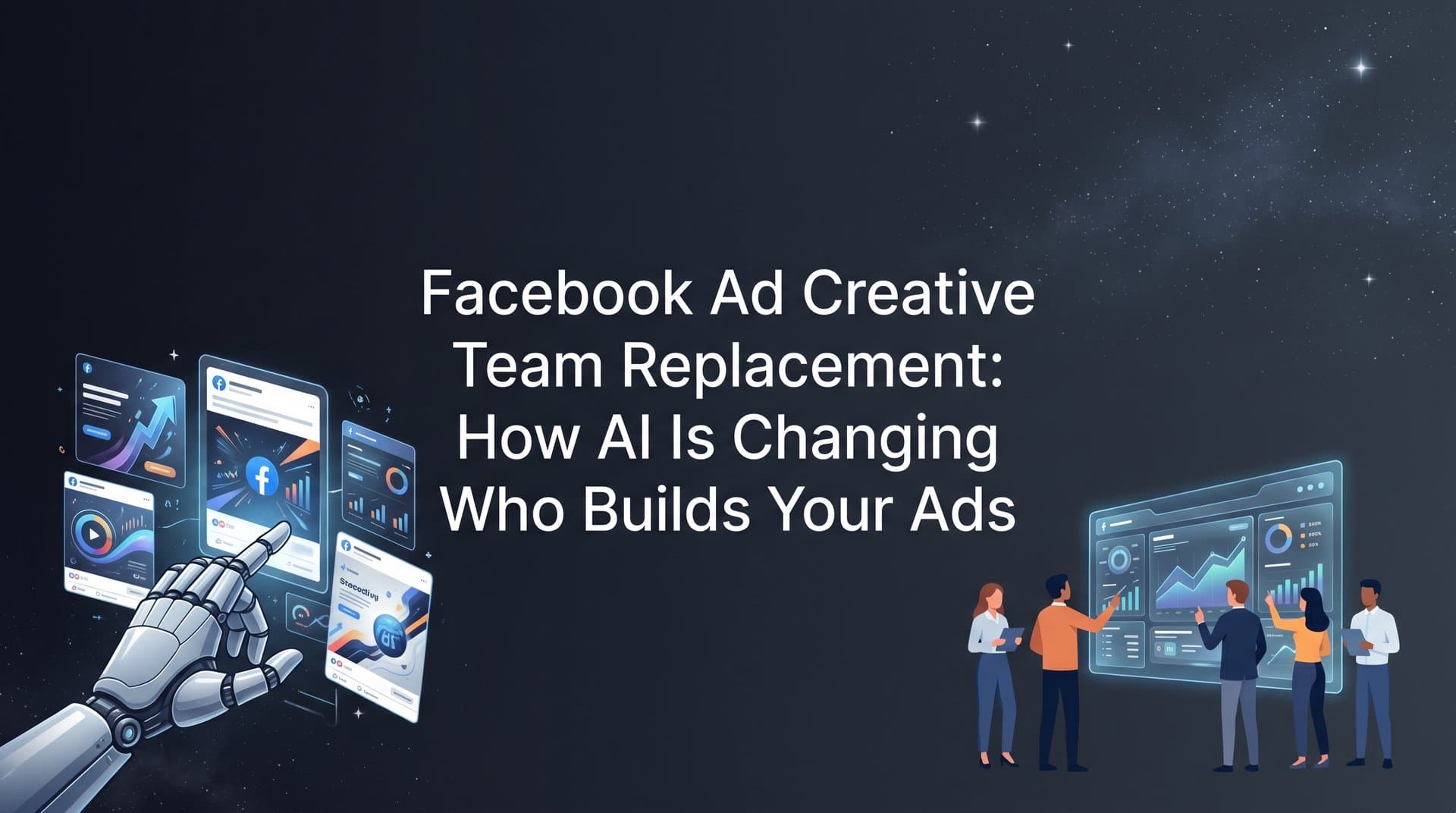
Let's talk about the math that most marketing teams quietly ignore. A graphic designer, a video editor, a copywriter, a media buyer, and a creative strategist. That is a full Facebook ad creative team, and before a single ad goes live, you are looking at a significant monthly payroll. Add freelancer fees, project management overhead, and the inevitable revision cycles, and the cost of running a traditional ad creative operation becomes one of the biggest line items in a marketing budget.
And yet, the output is often frustratingly slow. A single ad concept can take days to move from brief to live campaign. When you need to test more creatives to find winners faster, the answer has always been the same: hire more people. That ceiling has held back performance marketers for years.
Something is changing. AI tools have matured to the point where they can genuinely handle the work that used to require a full creative team. Not as a rough approximation, but as a functional replacement for the execution layer: generating image ads, video ads, and UGC-style content; writing and testing copy variations; building and launching campaigns; and surfacing performance winners automatically.
This article is for marketers, business owners, and agency operators who are asking the honest question: do I still need a traditional Facebook ad creative team, or can AI handle those functions now? We will break down what each role in a traditional team actually does, what AI can genuinely replace, where human judgment still matters, and what a modern lean setup looks like in practice.
The Real Cost of a Traditional Facebook Ad Creative Team
To understand what AI is replacing, you first need to understand what a traditional Facebook ad creative team actually consists of. Most teams, whether in-house or assembled from freelancers, rely on five core functions.
The Graphic Designer handles static image ads: layouts, product visuals, branded templates, and any creative that does not involve video. Good designers are not cheap, and they are rarely idle. Every new campaign, every seasonal promotion, every A/B test variation requires their time.
The Video Editor produces video ads, reels, and increasingly UGC-style content. Video has become the dominant format on Meta platforms, which means this role has grown in importance and cost. Sourcing footage, editing cuts, adding captions, and rendering multiple aspect ratios for different placements all add up to significant production hours.
The Copywriter writes headlines, primary text, and calls to action. This sounds straightforward, but effective ad copy requires understanding the product, the audience, and the psychological triggers that drive clicks and conversions. Testing multiple copy angles simultaneously means producing a high volume of variations on a regular cadence.
The Media Buyer manages campaign structure, audience targeting, bidding strategy, and ongoing optimization. This is the role that actually puts the ads in front of people, and it requires both technical platform knowledge and analytical judgment to adjust spend based on performance signals.
The Creative Strategist sits above all of this, deciding which concepts to pursue, which audiences to target with which messages, and how to interpret performance data to inform the next round of creative. This is the most senior and expensive function on the team.
The compounding problem is not just cost. It is speed. Even with all five roles filled, production moves slowly. A brief goes to the designer, who has three other projects in queue. The first draft comes back, goes through revisions, gets approved, then moves to the copywriter, then to the media buyer for campaign setup. A single ad concept that could theoretically launch in a day routinely takes a week or more.
The scaling problem makes this worse. Performance marketing success on Facebook is largely a function of creative testing velocity. Teams that can produce and test more creative variations find winning ads faster. But producing more variations has always meant more headcount, more briefing, more revision cycles. The traditional model creates a hard ceiling on how aggressively you can test and iterate, and that ceiling directly limits your ability to scale.
What Modern AI Tools Can Now Generate
The capabilities of AI ad creative tools have moved well beyond simple template-based image generation. What is available now covers the full range of creative formats that a Facebook ad campaign requires.
Starting with static image ads: AI can generate polished, scroll-stopping image ads from a product URL or a text prompt. Feed the tool your product page and it will pull in product imagery, generate background visuals, apply design principles around contrast and hierarchy, and produce ad-ready creative without a designer touching a single file. The output is not a rough draft. It is campaign-ready creative that can go directly into a Meta ad set.
Video ads represent a bigger leap. AI video generation now allows brands to produce short-form video ads with motion graphics, text overlays, and branded elements without a video editor. More significantly, UGC-style avatar content lets brands create the kind of talking-head, direct-to-camera video that has become one of the highest-performing formats on Meta, without hiring a single creator or actor. This is a meaningful shift. UGC-style content historically required sourcing talent, scripting, filming, and editing. AI collapses that entire process into a generation step.
On the copy side, AI can analyze product categories, audience segments, and messaging frameworks to generate multiple headline and body copy variations simultaneously. Instead of a copywriter producing three variations per brief, AI can produce dozens, covering different angles: price-focused, problem-focused, outcome-focused, social proof-focused. More variations means more data, and more data means faster identification of what actually resonates.
Here is where it gets particularly interesting for experienced media buyers. AI tools that integrate with the Meta Ad Library can clone competitor ads as a creative starting point. Rather than starting from a blank brief, the AI can identify what formats and messages are already running in your market, reverse-engineer the structure of high-volume ads, and build new creative from proven frameworks. This is not copying. It is using competitive intelligence as a foundation, which is exactly what experienced creative strategists have always done manually. AI just does it faster and at scale.
Tools like AdStellar's AI Creative Hub bring all of this together in one place. Generate image ads, video ads, and UGC avatar content from a product URL, clone competitor ads from the Meta Ad Library, or build from scratch with chat-based editing. No designers, no video editors, no actors. The creative production function of a traditional team is handled inside a single platform.
From Creative to Campaign: Replacing the Media Buyer Function
Creative production is only half of what a traditional team does. The other half is getting those creatives in front of the right audiences in the right campaign structure, and then optimizing based on what the data shows. This is the media buyer's domain, and it is where a lot of time and expertise has traditionally been required.
Campaign setup on Meta involves more decisions than most people outside the industry realize. Audience selection, campaign objective, ad set structure, bidding strategy, budget allocation, placement selection, and the logic of how to organize multiple creatives across multiple ad sets. An experienced media buyer builds this structure based on accumulated knowledge of what works. A less experienced one makes costly mistakes. Either way, it takes time.
AI campaign builders address this by doing something the traditional process cannot: analyzing your historical performance data at scale before building anything. Instead of relying on a media buyer's memory or a spreadsheet of past results, AI can ingest your entire campaign history, rank every creative, every headline, and every audience segment by real performance metrics like ROAS and CPA, and use those rankings to inform the structure of the next campaign.
AdStellar's AI Campaign Builder works exactly this way. The AI analyzes past campaigns, identifies which elements performed best against your goals, and builds complete Meta ad campaigns in minutes. Every decision comes with a transparent explanation, so you understand the strategy behind the output rather than just accepting a black box recommendation. The AI gets smarter with each campaign it builds, because it is continuously learning from new performance data.
Bulk ad launching takes this further. In a traditional setup, a media buyer manually assembles ad sets: selecting a creative, pairing it with a headline, choosing an audience, setting a budget. Doing this for dozens of combinations is tedious and time-consuming. AI bulk launching generates every combination of creatives, headlines, audiences, and copy automatically and launches them to Meta in minutes rather than hours. What used to be a half-day task for a media buyer becomes a few clicks.
The testing implications are significant. When you can launch hundreds of ad variations quickly, you compress the timeline between idea and insight. Instead of waiting weeks to know which creative angle is working, you know in days. This is not a marginal improvement. It fundamentally changes how fast you can iterate and scale.
The Role AI Cannot Replace: Creative Strategy and Brand Judgment
This is the part that deserves honest treatment. AI is genuinely powerful at execution and iteration. It is not yet a replacement for the upstream thinking that determines what to execute in the first place.
Creative strategy involves decisions that require context AI does not have access to by default. What is the brand's positioning in the market? What problem does this product actually solve for this specific audience? What is the emotional story that makes this brand different from every competitor running similar ads? These are not questions AI can answer on its own. They require human knowledge of the business, the customer, and the competitive landscape.
The creative strategist role does not disappear in an AI-powered setup. It shifts. Instead of spending time managing a team, reviewing designer drafts, writing briefs, and sitting in revision meetings, a strategist using AI tools focuses almost entirely on inputs. Product positioning. Audience insights. Goal setting. Competitive framing. The strategist defines what good looks like, and AI handles the volume of output required to test and find it.
This is a leverage shift more than a replacement. One skilled marketer with the right AI ad platform can do the work that previously required a team of five or six, because the time-consuming execution layer is handled automatically. The marketer's judgment is applied at the point where it creates the most value: deciding what to test, interpreting what the results mean, and directing the next iteration.
Brand consistency is another area where human judgment remains important. AI can generate dozens of ad variations quickly, but ensuring that those variations feel cohesive with the brand's visual identity and tone of voice requires someone who understands the brand deeply. The good news is that this is a quality control function, not a production function. It takes far less time to review and approve AI-generated creative than to brief and manage a designer through multiple revision cycles.
The honest framing is this: AI handles execution at scale, humans handle strategy and judgment. That division of labor is more efficient than any traditional team structure, and it produces more output with less overhead.
What a Modern Lean Ad Team Actually Looks Like
So what does this look like in practice? The modern lean ad team is often a single performance marketer, or a small team of two or three people, operating with an AI platform that covers the full stack from creative generation to campaign launch to performance analysis.
The workflow starts with creative generation. Instead of briefing a designer and waiting, the marketer inputs a product URL or a creative brief into the AI platform, generates a batch of image ads, video ads, and UGC-style content, and has campaign-ready creative in minutes. Chat-based editing allows for quick refinements without going back to a designer.
From there, the AI Campaign Builder analyzes historical data and builds the campaign structure. The marketer reviews the AI's recommendations, understands the rationale behind each decision, and approves the setup. Bulk ad launching then creates every combination of creatives, headlines, and audiences and pushes them live to Meta.
The continuous learning loop is where the lean team model really compounds over time. AdStellar's AI Insights leaderboards rank every creative, headline, copy variation, audience, and landing page by real metrics against your specific goals. The Winners Hub captures top performers so they can be instantly pulled into the next campaign. Instead of a dedicated analyst manually pulling reports and building spreadsheets, the platform surfaces what is working automatically.
Each new campaign benefits from everything that came before it. The AI scores every element against your benchmarks, the winners get saved and reused, and the testing loop gets tighter with every iteration. This replaces not just the production work of a traditional team, but also the analytical and reporting work that used to require a dedicated resource.
For agencies, this model creates a different kind of opportunity. An agency using an AI creative platform can serve more clients with the same team size. Custom creatives and campaigns for each client can be generated without proportionally increasing headcount. The bottleneck shifts from production capacity to strategic capacity, which is exactly where experienced agency teams want to be spending their time.
Making the Transition: Where to Start
If you are running a traditional Facebook ad creative setup right now, the transition to an AI-powered model does not have to be a complete overhaul on day one. The most practical approach is to audit your current workflow and identify where the execution bottlenecks are.
Start by separating the work your team does into two categories: pure execution and strategic judgment. Pure execution includes designing ad assets, editing video, writing copy variations, setting up campaigns, and pulling performance reports. Strategic judgment includes deciding which product angles to test, interpreting performance data, and setting creative direction. AI can absorb the execution category almost immediately. The strategic category stays with your team.
The best entry point is creative generation and testing. Use AI to produce more ad variations than your current team can manually create in the same timeframe. Run those variations through bulk launching and let the performance data tell you what is working. You will likely find that you are generating more actionable insights in less time than your current process allows, because you are testing more ideas simultaneously.
From there, layer in the campaign building and optimization functions. As you see the AI's recommendations align with what your experienced team members would have decided manually, confidence in the system builds and the reliance on manual setup decreases naturally.
AdStellar is built specifically for this use case. It covers the full stack: AI creative generation for image ads, video ads, and UGC-style content; an AI Campaign Builder that analyzes historical data and builds complete Meta campaigns; bulk ad launching for rapid variation testing; AI Insights leaderboards for automatic performance ranking; and a Winners Hub that captures your best performers for reuse. The platform integrates with Cometly for attribution tracking, so the performance data feeding the AI's decisions is accurate and complete.
Pricing starts at $49 per month for the Hobby tier, with Pro at $129 per month and Ultra at $499 per month. Every plan comes with a 7-day free trial, which is enough time to generate your first batch of AI creatives, run them through the campaign builder, and see the bulk launching workflow in action before committing.
The Bottom Line
The question of whether AI can replace parts of a Facebook ad creative team has a clear answer now: yes, it can, and the execution layer is the place where the replacement is most complete. Creative production, campaign setup, bulk testing, and performance reporting are all functions that AI handles faster, at higher volume, and with less overhead than a traditional team.
What this means in practice is not lower quality or reduced output. It means the opposite. Marketers who reorganize around AI tools produce more creative variations, run more tests, find winning ads faster, and scale with less friction than teams relying on traditional headcount-based models.
The human role does not disappear. It becomes more valuable. When AI handles the execution volume, the strategist's time goes entirely toward the decisions that actually drive results: what story to tell, which audience to reach, and what the data means for the next move.
The shift is already happening across performance marketing. The marketers and agencies moving fastest are the ones who have stopped asking whether AI is ready and started building workflows around what it can already do.
If you are ready to see what a full-stack AI ad platform looks like in practice, Start Free Trial With AdStellar and experience the platform that takes you from your first AI-generated creative all the way through to your final performance report, covering every function a traditional team used to handle, in one place.