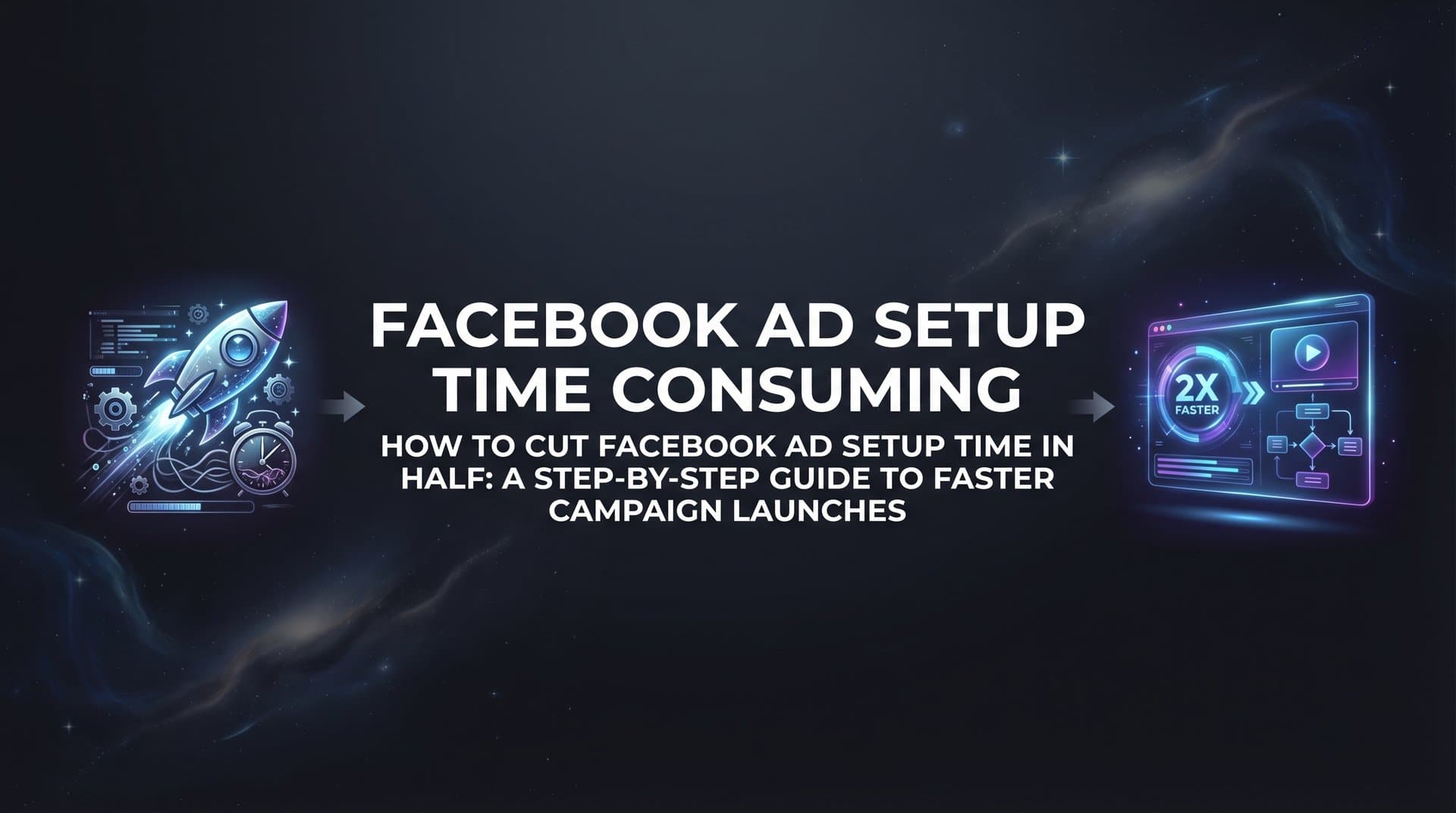
Most marketers spend 3-5 hours setting up a single Facebook campaign. Not because the work is complex, but because it is repetitive, manual, and filled with tedious clicks. You are copying audiences from old campaigns, uploading the same creative variations one by one, writing similar ad copy for the hundredth time, and manually building out campaign structures that look nearly identical to the last dozen you launched.
The irony? While you are buried in setup tasks, your competitors are already testing, learning, and scaling.
Facebook ad setup does not have to consume your week. The difference between marketers who spend hours in Ads Manager and those who launch campaigns in minutes comes down to systems. Not shortcuts that compromise quality, but structured approaches that eliminate repetitive work while actually improving results.
This guide walks you through six steps to cut your Facebook ad setup time in half or more. You will learn how to identify where your time actually goes, build reusable asset libraries, create templated workflows, and leverage automation tools that handle the grunt work. Whether you manage one account or fifty, these systems will help you reclaim hours every week while maintaining (or improving) campaign performance.
Let's get started.
Step 1: Audit Your Current Setup Process to Find Time Drains
You cannot fix what you do not measure. Most marketers have a vague sense that Facebook ad setup takes too long, but few know exactly where the time goes.
Start by tracking your next three campaign setups from start to finish. Break the process into distinct phases: creative sourcing and preparation, audience building and configuration, copywriting and messaging, campaign structure setup, and final review and launch. Use a simple timer or time-tracking tool to record how long each phase actually takes.
The results often surprise people. What feels like a quick 20-minute task might actually consume 45 minutes once you account for finding the right creative files, waiting for designer revisions, or rebuilding audiences from scratch because you forgot to save the last one.
Pay special attention to repetitive tasks you perform for every campaign. Are you manually uploading the same logo variations? Recreating similar audience combinations? Writing nearly identical headlines with minor tweaks? These repetitive actions compound quickly across multiple campaigns.
Document your most common campaign types and their standard configurations. If you run lead generation campaigns monthly, what audience settings, placements, and optimization goals do you typically use? If you launch product promotions quarterly, what creative formats and copy angles work best? Creating this documentation reveals patterns you can template.
Here's the critical insight most marketers miss: the true cost of manual setup is not just the hours spent clicking buttons. It is the missed optimization opportunities. Every hour you spend on setup is an hour you are not analyzing performance data, developing creative concepts, or refining your targeting strategy. When you calculate the opportunity cost, suddenly investing time in better systems becomes an obvious priority.
By the end of this audit, you should have a clear breakdown of where your time goes and a prioritized list of setup bottlenecks to address. Most marketers find that creative preparation and manual ad variation creation are the biggest time drains, often consuming 60-70% of total setup time.
Step 2: Build a Reusable Creative Library with Pre-Approved Assets
Creative development is typically the biggest bottleneck in Facebook ad setup. Waiting for designers, sourcing stock images, editing videos, or creating variations from scratch can turn a quick campaign launch into a multi-day project.
The solution is building a creative library organized for instant access and reuse. Start by gathering all your winning creatives from the past six months. Pull the image ads, video ads, and carousel assets that delivered your best ROAS, lowest CPA, or highest CTR. These proven performers are your foundation.
Organize them by product or service, audience segment, and funnel stage. Create folders like "Product A - Cold Audience - Awareness" or "Service B - Retargeting - Conversion." This structure lets you quickly find relevant creatives when launching new campaigns without scrolling through hundreds of unorganized files.
Set up naming conventions that make assets instantly searchable. Include key information in the file name: product, format, angle, and performance indicator. For example: "ProductA_ImageAd_PainPoint_HighCTR_v3.jpg" tells you everything you need to know at a glance.
Now here's where modern tools change the game entirely. Instead of waiting days for a designer to create variations, AI creative tools can generate scroll-stopping image ads, video ads, and even UGC-style avatar content directly from a product URL. You paste in your product page, and the AI analyzes it to generate multiple creative variations in different styles and formats.
This eliminates the traditional creative bottleneck. No more back-and-forth with designers. No more searching for stock footage. No more hiring actors for UGC content. You can generate dozens of creative variations in minutes and immediately test them.
The key is building a system where you can quickly generate new variations from proven performers. If a certain visual style or messaging angle works, you want to create similar versions instantly rather than starting from scratch each time. AI tools let you clone winning ads or use them as inspiration for new variations while maintaining the elements that drive performance.
Your creative library should be a living system that grows with every campaign. When you identify a new winner, add it to the library with proper tagging and organization. Over time, you build an arsenal of proven assets you can deploy instantly for any new campaign.
Step 3: Create Saved Audience Templates for Instant Targeting
Building audiences from scratch for every campaign wastes significant time. You are recreating the same interest combinations, rebuilding lookalikes, and reconfiguring custom audiences you have used successfully before.
The fix is creating a library of saved audience templates you can deploy instantly. Start by identifying your best-performing audiences from past campaigns. Which custom audiences, lookalike audiences, or interest-based targeting configurations delivered the strongest results? These become your templates.
Save these audiences in Ads Manager with clear, descriptive names. Instead of generic labels like "LAL 1%" or "Interests Group A," use names that explain what they are: "LAL 1% - Past Purchasers - US" or "Cold - Competitor Interests - 25-45 - High Income." When you launch a new campaign, you can instantly select the right audience without rebuilding it.
Document which audience combinations work for different campaign objectives. Create a simple reference guide: for cold traffic awareness campaigns, you typically use broad interest targeting plus LAL 3-5%. For conversion campaigns, you use LAL 1% plus engaged audiences. For retargeting, you use website visitors from the past 30 days who viewed specific product pages.
This documentation becomes your targeting playbook. Instead of guessing or trying to remember what worked last time, you have a clear framework for audience selection based on proven results.
Set up a system to quickly duplicate and modify audiences for new campaigns. Maybe your winning audience for Product A was "Women 25-45 interested in organic skincare." For Product B in the same category, you can duplicate that audience and swap in relevant interests rather than building from zero.
The most sophisticated approach uses historical performance data to pre-select winning audience configurations. If you know that LAL 1% based on past purchasers consistently delivers 3x ROAS while LAL 5% delivers 1.5x ROAS, you can prioritize the stronger performer automatically rather than testing both every time.
Your saved audience library eliminates one of the most time-consuming parts of campaign setup while actually improving targeting accuracy by ensuring you use proven combinations.
Step 4: Develop Copy Frameworks That Scale Across Campaigns
Writing ad copy from scratch for every campaign is another major time drain. You stare at a blank text box, trying to craft the perfect headline, primary text, and description for each ad variation.
The solution is developing copy frameworks you can quickly customize rather than writing from zero each time. Start by creating headline and primary text templates for each product or offer type. If you sell software, you might have templates for free trial offers, feature-focused ads, and problem-solution messaging.
Build a swipe file of your highest-converting copy elements. Save the headlines that drove the most clicks, the opening hooks that stopped the scroll, and the calls-to-action that generated conversions. Organize them by product, audience, and campaign objective so you can quickly find relevant examples.
Use structured copywriting frameworks that provide a proven formula. The PAS framework (Problem, Agitate, Solution) works well for cold audiences: identify their pain point, make it feel urgent, then present your solution. The AIDA framework (Attention, Interest, Desire, Action) guides prospects through awareness to conversion. These frameworks give you a starting structure to fill in rather than creating copy from scratch.
Here's a practical example. For a cold audience awareness campaign, your PAS template might look like: "Struggling with [specific problem]? [Agitation of why this problem matters]. [Your solution] helps [target audience] [achieve desired outcome] without [common obstacle]." You can customize this template for any product in minutes.
Modern AI tools can generate copy variations while maintaining your brand voice. You provide the key product benefits and target audience, and the AI creates multiple headline and copy options. You review, select the strongest versions, and make minor tweaks rather than writing everything manually.
The key is balancing efficiency with quality. Templates and AI-generated copy should be starting points you refine, not final outputs you use verbatim. But starting from a proven framework or AI-generated draft is dramatically faster than staring at a blank page.
Create a copy library organized by campaign type, product, and performance. When a headline or primary text delivers exceptional results, save it with notes about what made it work. Over time, you build a collection of proven copy elements you can mix and match for new campaigns. This approach directly addresses why Facebook ad copywriting is time consuming for most marketers.
Step 5: Implement Bulk Launch Systems for Multi-Variation Testing
Creating ad variations manually is where Facebook ad setup becomes truly time-consuming. You want to test three creatives with five headlines and four audience segments. That's 60 potential ad combinations. Building each one individually in Ads Manager could take hours.
Bulk launch systems solve this problem by automatically creating every combination from your inputs. Instead of manually building 60 ads, you provide the creatives, headlines, copy variations, and audiences, then the system generates all combinations and launches them to Meta in minutes.
Start by organizing your testing variables. List out the creatives you want to test, the headline variations, the primary text options, and the audience segments. For a typical campaign, you might have three image creatives, five headlines, three primary text variations, and four audiences.
Traditional setup would require you to create each ad manually: select creative, paste headline, paste primary text, choose audience, set budget, repeat 60 times. Bulk Facebook ad creation lets you input all variables once and generate every combination automatically.
The configuration happens at both the ad set and ad level. At the ad set level, you can test different audiences, placements, and optimization goals. At the ad level, you test creative and copy variations. Bulk systems handle the mixing automatically, creating a complete testing matrix from your inputs.
Naming conventions become critical when launching dozens or hundreds of ads. You need a system that makes performance tracking straightforward. A good naming structure includes campaign objective, audience type, creative identifier, and variation number: "Conversion_LAL1_ImageA_Headline2_v1." This lets you quickly identify what each ad is testing when analyzing results.
The time savings are dramatic. What used to take 3-4 hours of manual ad creation now takes 10-15 minutes of setup. You spend your time making strategic decisions about what to test rather than clicking through Ads Manager repetitively.
Bulk launching also improves testing quality. When manual ad creation is time consuming, you tend to test fewer variations. When it is automated, you can test more combinations and find winners faster. You might discover that Creative A with Headline 3 targeting Audience 2 dramatically outperforms other combinations, an insight you would have missed with limited manual testing.
The key is having systems that handle the execution while you focus on the strategy. What should we test? Which audiences deserve budget? What creative angles might resonate? These questions drive results. Clicking buttons in Ads Manager does not.
Step 6: Automate Performance Tracking and Winner Identification
Launching campaigns quickly is only valuable if you can identify winners just as fast. Manual performance analysis, where you export data to spreadsheets and calculate metrics, consumes hours and delays optimization decisions.
Automated performance tracking solves this by surfacing top performers based on real metrics without manual analysis. Set up dashboards that automatically rank your creatives, headlines, copy, audiences, and landing pages by ROAS, CPA, CTR, or whatever metrics matter for your goals.
The system should update in real-time as campaign data comes in. Instead of waiting until Monday to analyze last week's performance, you see which ads are winning or losing immediately. This speed lets you scale winners and pause losers before wasting significant budget.
Create alerts for ads that hit performance thresholds. If an ad achieves 4x ROAS (your winner threshold), you get notified immediately so you can increase budget. If an ad drops below 1x ROAS (your loser threshold), you get alerted to pause it. These automated triggers prevent the common mistake of letting poor performers drain budget while you are focused elsewhere.
Build a system to capture winning elements for reuse in future campaigns. When a creative, headline, or audience combination performs exceptionally, it should automatically be flagged and added to your library of proven assets. This creates a continuous improvement loop where each campaign makes future campaigns stronger.
AI insights take this further by scoring ad elements against your specific goals without manual analysis. Instead of manually calculating which headline drove the lowest CPA, the system ranks all headlines by CPA automatically. Instead of comparing audience performance across multiple metrics, the AI provides a single score based on your priority goals.
The goal is making optimization decisions based on data, not gut feel, without spending hours in spreadsheets. You should be able to answer questions like "Which creative is driving the most conversions?" or "Which audience has the best ROAS?" in seconds, not hours.
This automated approach also prevents analysis paralysis. When data is hard to access, marketers often delay optimization decisions. When insights are instant and clear, you act faster and improve results sooner. This is essential for reducing Facebook ad management time across your entire workflow.
Set up a weekly review process where you examine top performers and losers. What made the winners work? Can you replicate those elements? What made the losers fail? Can you avoid those mistakes? This strategic analysis is where you should spend your time, not on calculating basic metrics.
Putting It All Together
Reducing Facebook ad setup time is not about cutting corners or sacrificing campaign quality. It is about building systems that eliminate repetitive work while actually improving results through better testing and faster optimization.
The marketers who win on Facebook are not the ones spending the most hours in Ads Manager. They are the ones who have freed up time to focus on strategy, creative concepts, and continuous improvement. They launch campaigns in minutes, identify winners in hours, and spend their energy on decisions that drive results rather than manual execution.
Start by auditing where your time actually goes. Track your next few campaign setups and identify the biggest bottlenecks. For most marketers, creative development and manual ad creation consume 60-70% of setup time.
Then systematically address each bottleneck. Build your creative library with winning assets organized for instant access. Create saved audience templates based on proven performers. Develop copy frameworks that provide proven starting points. Implement bulk launch systems that create dozens of variations automatically. Set up automated performance tracking that surfaces winners without manual analysis.
Each system compounds with the others. When you have a creative library, saved audiences, and copy templates, bulk launching becomes incredibly fast. When you have automated performance tracking, you identify which elements to add to your libraries for future campaigns. The whole system creates a continuous improvement loop.
Here's your quick implementation checklist. First, audit your current process and identify your top three time drains. Second, build your creative library with winning assets and set up AI tools for quick generation. Third, create saved audience templates for your most common targeting configurations. Fourth, develop copy frameworks and swipe files for each campaign type. Fifth, implement bulk launch systems for multi-variation testing. Sixth, set up automated performance tracking and winner identification.
You do not need to implement everything at once. Start with your biggest bottleneck. If creative development is your main time drain, focus there first. If manual ad creation kills your productivity, prioritize bulk launching. Each improvement compounds over time.
The difference between spending five hours on campaign setup and spending 30 minutes is not talent or experience. It is systems. Build the systems once, use them repeatedly, and reclaim hours every week while improving campaign performance.
Ready to cut your Facebook ad setup time dramatically? Platforms like AdStellar combine AI creative generation, campaign building, and bulk launching into one workflow. Generate scroll-stopping image ads, video ads, and UGC content from a product URL. Launch complete campaigns with AI-optimized audiences, headlines, and copy. Create hundreds of ad variations by mixing creatives, headlines, and audiences automatically. Surface winners with real-time performance tracking and AI insights. Start Free Trial With AdStellar and go from product URL to live campaign in minutes, not hours.