Your campaign strategy is brilliant. The creative brief is approved. Your budget is ready. But somehow, three days have passed since you decided to launch, and you're still clicking through Facebook Ads Manager, second-guessing audience selections, reformatting images, and manually calculating budget splits across ad sets.
This isn't a skills problem. You know how to run Facebook ads. This is a bottleneck problem.
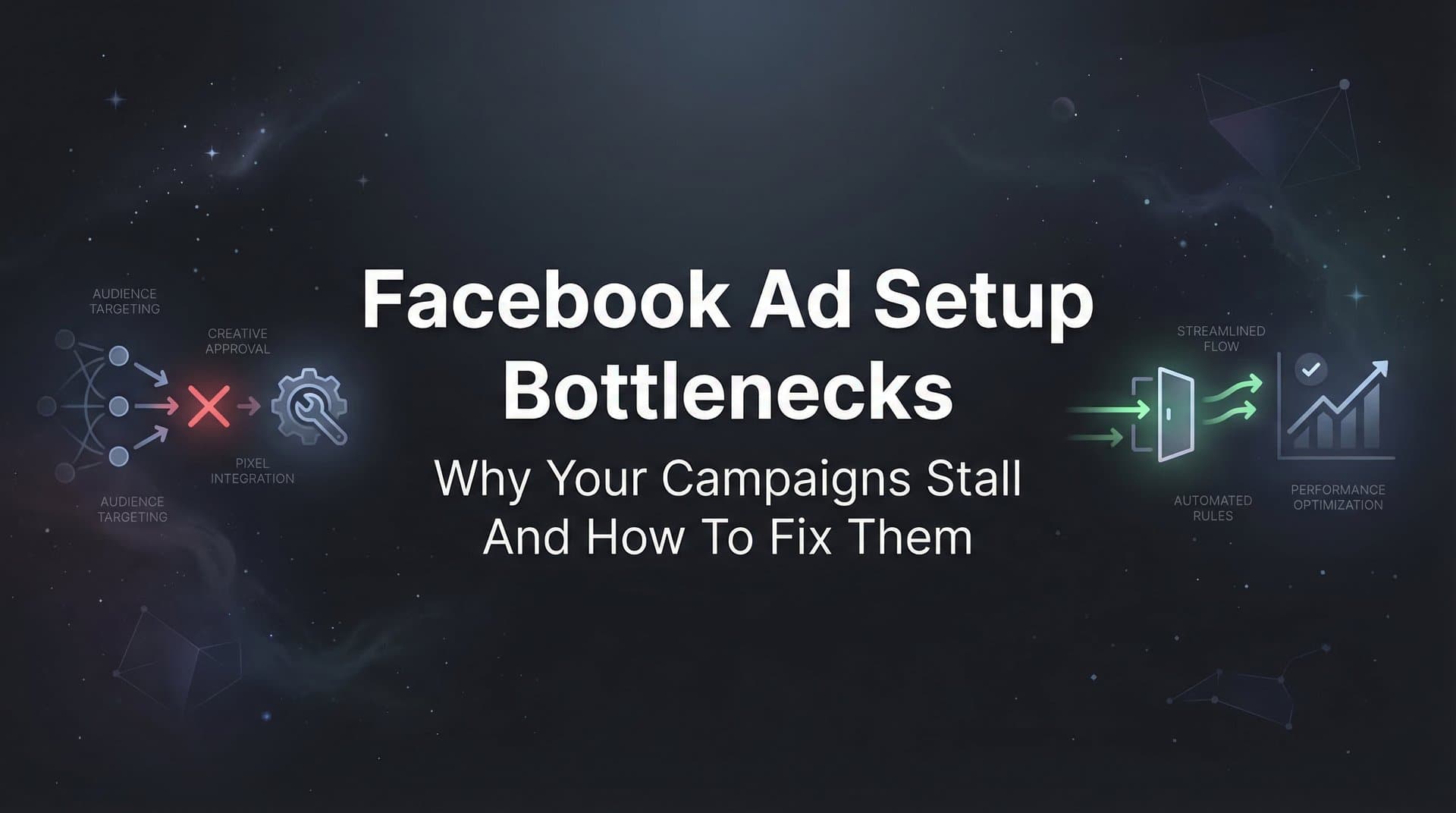
Facebook ad setup bottlenecks are the silent killers of campaign performance. While you're stuck in the setup phase, your competitors are already gathering data, optimizing, and scaling. Every hour spent wrestling with Ads Manager is an hour the algorithm isn't learning from your campaigns. Every day of delay is a day of missed conversions, wasted budget runway, and lost market share.
The frustrating part? Most advertisers accept these bottlenecks as inevitable. "That's just how Facebook advertising works," they tell themselves. But the reality is different. Setup friction isn't a feature of Meta advertising—it's a solvable process problem that's costing you more than you realize.
In this guide, we'll identify the specific chokepoints that stall campaigns, examine why they compound into serious competitive disadvantages, and explore systematic solutions that eliminate friction between strategy and execution. Because in 2026's advertising landscape, speed to launch isn't just convenient—it's a competitive advantage.
The Hidden Cost of Campaign Launch Delays
When your campaign launches three days late, you don't just lose three days of potential conversions. You lose something far more valuable: learning time.
Meta's algorithm needs data to optimize. Every day your campaign isn't running is a day it's not collecting signals about which audiences respond, which creatives resonate, and which placements convert. Your competitors who launched on Monday have already gathered thousands of impressions and hundreds of clicks by Thursday. Their campaigns are already optimizing. Yours hasn't even started learning.
This creates a compounding disadvantage. While their cost per acquisition drops as the algorithm identifies winning patterns, you're still in the setup phase, burning hours on tasks that should take minutes. By the time you finally launch, they've already captured the early-week traffic, tested multiple variations, and identified their winners.
The ripple effects extend beyond just timing. Delayed launches compress your testing windows. If you planned a two-week test cycle but spent four days on setup, you've lost nearly 30% of your learning period before a single impression runs. Seasonal opportunities become even more punishing—that Black Friday campaign you meant to launch on November 1st finally goes live on November 4th, giving you three fewer days of optimization before the critical shopping weekend.
Setup friction also creates a secondary cost that's harder to measure: opportunity cost. Every hour you spend manually building campaigns is an hour you're not spending on strategy, creative ideation, or analyzing performance data. The highest-value activities—the ones that actually move the needle—get squeezed out by low-value manual tasks.
Teams often underestimate this because setup time feels productive. You're clicking buttons, making decisions, building something. But productivity and progress aren't the same thing. If those same decisions could be made systematically based on historical data, and those same tasks could be automated, that "productive" time becomes wasted time on Facebook ad setup.
The advertisers winning in 2026 understand this distinction. They've optimized for speed to launch because they recognize that campaign velocity—the rate at which you can test, learn, and iterate—matters more than perfection. A good campaign launched today beats a perfect campaign launched next week, because the good campaign is already gathering the data needed to become great.
Creative Production: Where Most Campaigns Get Stuck
You've finalized your campaign strategy. You know exactly what you want to test. But now you need the assets, and suddenly everything grinds to a halt.
The creative-to-launch gap is where most campaigns die a slow death. Your designer is booked until next Tuesday. The approval chain involves three stakeholders across two time zones. The video you want to test needs to be reformatted into 1:1, 4:5, and 9:16 ratios for different placements. Each delay adds another day to your launch timeline.
Even when you have assets ready, version control becomes a nightmare. You're testing five audiences with three creative variations each, which means 15 different ads to build. You need to track which headline pairs with which image, ensure each variation maintains consistent messaging, and document everything so you can identify winners later. One mismatched combination, and your test results become meaningless.
This is where many advertisers make a critical mistake: they treat creative selection as a creative decision rather than a data decision. They choose assets based on what looks good or what they personally prefer, completely ignoring the performance data sitting in their account history. That image that drove a 4.2% conversion rate last quarter? Buried in a folder somewhere. That headline variation that cut your cost per lead in half? Lost in a spreadsheet from three months ago.
The manual nature of creative management also creates consistency problems. Different team members build campaigns differently. One person always uses carousel ads. Another prefers single images. A third swears by video. Without systematic approaches, you end up with fragmented data that makes it nearly impossible to identify what's actually working across your account.
Agencies face an amplified version of this problem. Managing creative assets across dozens of client accounts means thousands of images, videos, and copy variations scattered across different folders, drives, and platforms. Finding that winning creative from six months ago that you want to repurpose for a new client? Good luck. You'll spend an hour searching before you give up and create something new from scratch.
The bottleneck intensifies when you want to scale winning campaigns. You've identified a winning ad, and now you want to test it across new audiences. But the creative is locked in the original ad set. You need to duplicate it, adjust the targeting, update the copy for the new audience, and hope you didn't accidentally change something that breaks the winning formula. Multiply this across multiple winning ads and multiple new audiences, and you've just added days to your timeline.
Modern advertising demands creative velocity. You should be able to launch new variations quickly, test aggressively, and scale winners immediately. But most teams are stuck in a production model designed for monthly campaigns, not daily optimization. The gap between what you should be testing and what you can actually produce becomes the limiting factor in campaign performance. Understanding how to leverage reusing winning Facebook ad elements can dramatically accelerate this process.
Audience Targeting Paralysis and Decision Fatigue
Facebook offers thousands of targeting options. Detailed targeting, lookalike audiences, custom audiences, Advantage+ audiences, demographic layering, behavior targeting, interest stacking—the possibilities are nearly infinite. This should be empowering. Instead, it's paralyzing.
You sit down to build a campaign and immediately face decision fatigue. Should you use a 1% lookalike of your purchasers or a 3% lookalike? Should you layer in interest targeting or let the algorithm find your audience? Should you exclude past purchasers or include them? Should you use CBO or ABO? Every decision branches into more decisions, and each choice feels critical because you know it will impact performance.
Many advertisers respond to this complexity by falling into patterns. They use the same targeting strategy for every campaign because it's familiar, not because it's optimal. They avoid testing new audience configurations because the setup complexity isn't worth the potential upside. They stick with what's worked before, even when performance gradually degrades, because starting from scratch feels overwhelming.
This creates a hidden cost: you're leaving money on the table because you're not testing the audiences that might perform better. Your current targeting might deliver a $50 cost per acquisition, but there could be an audience configuration that delivers $35—you just haven't tested it because the setup friction makes experimentation too expensive in time and effort.
The problem compounds when you manage multiple campaigns. You're running five different offers across three different products, and each needs its own targeting strategy. But you're building each campaign from scratch, manually researching and selecting audiences every single time. There's no systematic way to apply learnings from one campaign to another. What worked for Product A might work for Product B, but you'll never know because you don't have a process for testing cross-product audience patterns.
Agencies face this at scale. Managing 20 client accounts means making thousands of targeting decisions every month. Without systematic approaches, every campaign becomes a custom project. Different team members make different decisions. Best practices don't transfer between accounts. Winning audience strategies get lost when team members leave or move to different clients. If you're struggling with Facebook ad targeting, you're not alone—it's one of the most common pain points in the industry.
The research burden adds another layer of friction. Identifying which audiences actually convert requires analyzing performance data across campaigns, looking for patterns, and making informed predictions about which segments to test next. But most advertisers don't have time for this level of analysis. They're too busy building the next campaign to analyze the last one. So they rely on intuition, guesswork, or whatever targeting strategy is trending in their Facebook group this week.
The irony is that your account already contains the answers. Your historical performance data shows which audience types convert, which demographic segments respond, and which targeting approaches deliver the best ROI. But extracting those insights requires time, analytical skills, and systematic processes that most teams don't have. So the data sits unused while you continue making targeting decisions based on incomplete information.
Budget Allocation Bottlenecks That Drain Performance
You've built your campaign structure. Five ad sets, three ads each, and now you need to allocate your $5,000 monthly budget across them. Out comes the spreadsheet.
You calculate daily budgets, adjust for expected performance differences between audience segments, set minimums to ensure each ad set gets enough spend for the algorithm to learn, and build in buffers for fluctuations. Thirty minutes later, you've got a budget allocation plan that feels reasonable. You enter the numbers into Ads Manager, double-check your math, and launch.
Two days later, everything has changed. Ad Set 3 is performing better than expected and hitting its daily cap by noon. Ad Set 1 is underperforming and needs its budget reduced. Ad Set 4 isn't spending at all because your bid is too low. You need to rebalance, which means opening the spreadsheet again, recalculating the splits, and manually adjusting every ad set.
This is reactive budget management, and it's where most advertisers live. You're constantly adjusting budgets based on what already happened, always one step behind actual performance. By the time you've identified a problem and made the adjustment, market conditions have shifted, and your "fix" is already outdated.
The manual nature of budget allocation creates another problem: you can't move fast enough to capitalize on opportunities. When an ad set suddenly starts performing well, the optimal response is to immediately increase its budget and capture the momentum. But by the time you notice the performance spike, analyze whether it's sustainable, calculate the new budget split, and make the adjustment, the opportunity window may have closed.
Campaign Budget Optimization was supposed to solve this by letting Facebook automatically allocate budget to the best-performing ad sets. But CBO introduces its own bottlenecks. You lose granular control over spend distribution. Low-performing ad sets can get starved of budget before they've had enough impressions to properly test. High-performing ad sets can consume your entire budget before you've validated that the performance is sustainable.
The result? Many advertisers spend hours manually managing budgets that should be managed algorithmically, or they use CBO and accept suboptimal allocation because they don't have time to constantly monitor and adjust campaign settings. Those who are experiencing difficulty scaling Facebook ad campaigns often trace the problem back to these budget allocation inefficiencies.
Budget misallocation has a direct cost. When you're feeding budget to underperforming ad sets while starving winners, you're literally paying more for worse results. A campaign that should deliver a $40 CPA ends up at $60 because your budget allocation doesn't match actual performance patterns. Multiply this across multiple campaigns, and poor budget management can easily add 30-50% to your overall acquisition costs.
The complexity increases with scale. Managing budgets for one campaign is manageable. Managing budgets for ten campaigns across three products with different margin structures and different performance goals? That's a full-time job. You need spreadsheets to track spend, performance, and pacing. You need alerts to catch when campaigns are over or underspending. You need rules to automatically pause poor performers before they waste too much budget.
Most teams don't have this infrastructure. They're managing budgets manually, checking Ads Manager multiple times per day, and hoping they catch problems before they become expensive. It's exhausting, time-consuming, and ultimately unsustainable as accounts grow.
Breaking the Bottleneck Cycle with Systematic Solutions
The common thread across all these bottlenecks? They're process problems disguised as advertising problems. The solution isn't working harder or hiring more people—it's building systems that eliminate repetitive decisions and automate low-complexity tasks.
Start by identifying which setup tasks are truly strategic and which are purely mechanical. Strategic tasks require human judgment: deciding which product to promote, crafting your core value proposition, determining your target ROI. Mechanical tasks are just execution: formatting images to Meta's specifications, entering budget numbers into ad sets, duplicating campaigns across audiences.
The strategic tasks deserve your time and attention. The mechanical tasks should be systematized or automated entirely. But most advertisers spend 80% of their time on mechanical tasks and only 20% on strategy. Inverting this ratio is how you break the bottleneck cycle. Learning how to reduce Facebook ad setup time is the first step toward this transformation.
Building repeatable workflows is the first step. Document your campaign setup process from start to finish. Identify every decision point and ask: Is this decision based on data or intuition? Can it be standardized? Could historical performance inform this choice automatically? Many decisions that feel strategic are actually just repetitive choices that could be made systematically.
For example, choosing which creative to test isn't a creative decision—it's a data decision. If you have performance history, you can systematically identify which image styles, headline formats, and copy approaches have worked best for similar campaigns. Instead of starting from a blank slate every time, you start with proven winners and test variations from there.
Automation tools can handle the high-volume, low-complexity work that consumes hours of manual effort. Bulk campaign creation, automated budget adjustments based on performance rules, and systematic audience testing can all be automated once you've defined the logic. The goal isn't to remove humans from the process—it's to remove humans from the repetitive parts so they can focus on the strategic parts. Exploring automated Facebook campaign setup options can reveal opportunities you might be missing.
This is where AI-powered platforms transform the setup process. Instead of manually analyzing performance data to decide which audiences to test, AI can identify patterns across thousands of campaigns and recommend audience configurations based on what's actually working. Instead of spending 30 minutes calculating budget splits, AI can allocate budgets based on real-time performance and historical conversion patterns.
The key is that AI handles the analysis and execution while maintaining full transparency. You're not blindly trusting a black box—you're leveraging computational power to process data faster and more comprehensively than any human could manually. When an AI system recommends a specific audience configuration, it can show you exactly why: "This audience segment has delivered a 3.2% conversion rate across similar campaigns in your account, 40% better than your account average."
Modern platforms like AdStellar AI exemplify this approach. Instead of manually building campaigns piece by piece, specialized AI agents handle different aspects of setup: one analyzes your landing page and product, another architects the campaign structure, another selects audiences based on performance data, another curates creatives from your winners library, another writes copy variations, and another allocates budgets. The entire process that might take hours manually happens in under 60 seconds, with full transparency into every decision.
The result isn't just speed—it's consistency and continuous improvement. Every campaign builds on the learnings from previous campaigns. Winning patterns get reinforced. Poor-performing approaches get filtered out. Your setup process gets smarter over time because it's learning from every campaign you run.
From Bottlenecked to Streamlined: Your Action Plan
Understanding bottlenecks is only valuable if you act on that understanding. Here's how to audit your current process and systematically eliminate the friction holding you back.
Start with a time audit. Track how long each phase of campaign setup actually takes. From initial strategy to final launch, document every task and its duration. You'll likely find that 70-80% of your time goes to mechanical tasks: formatting creatives, entering settings, calculating budgets, duplicating campaigns. These are your highest-priority targets for systematization.
Next, identify your biggest bottleneck. Which single delay causes the most downstream problems? For many teams, it's creative production—everything else is ready, but campaigns sit in draft mode waiting for assets. For others, it's targeting decisions—analysis paralysis that delays launches by days. Focus on solving your primary bottleneck first. Solving secondary bottlenecks while your primary blocker remains doesn't meaningfully improve your timeline.
Prioritize solutions based on impact and effort. Quick wins—high impact, low effort—should be implemented immediately. Building a creative library with your best-performing assets? High impact, minimal effort. Documenting your standard targeting configurations? High impact, takes an afternoon. Automating budget calculations with a simple spreadsheet formula? High impact, done in 30 minutes.
Medium-effort solutions come next. Setting up automation rules in Ads Manager to pause poor performers and scale winners. Creating campaign templates for your most common setups. Building a systematic process for analyzing performance data and extracting audience insights. These require more upfront investment but deliver ongoing time savings. Understanding how to optimize Facebook ad workflow can guide your prioritization.
Finally, consider platform-level solutions. If you're managing multiple campaigns, multiple products, or multiple client accounts, manual processes simply don't scale. At a certain volume, the only sustainable approach is leveraging purpose-built tools that handle the mechanical work systematically. The time you invest in implementing these tools pays back exponentially as your account grows.
The competitive advantage of streamlined setup is real and measurable. While your competitors are still wrestling with Ads Manager on Tuesday, you've already launched on Monday, gathered performance data, and are optimizing based on real results. By the time they launch, you're already identifying winners and scaling. This velocity compounds over time—each week, you're running more tests, gathering more data, and pulling further ahead.
Speed to launch also enables a different strategic approach. Instead of treating each campaign as a major project that needs to be perfect before launch, you can adopt a test-and-iterate mindset. Launch quickly with good-enough setups, let real performance data guide optimization, and continuously improve based on what's actually working. This approach consistently outperforms the "perfect campaign" approach because it's based on real market feedback rather than pre-launch assumptions. Mastering how to launch multiple Facebook ads quickly is essential for this iterative methodology.
The Path Forward: From Friction to Flow
Facebook ad setup bottlenecks aren't an inevitable part of advertising. They're process inefficiencies that compound into serious competitive disadvantages. Every hour you spend on mechanical tasks is an hour you're not spending on strategy. Every day your campaign sits in draft mode is a day of lost learning and missed conversions.
The advertisers winning in 2026 aren't necessarily more creative, better funded, or more experienced. They've simply removed the friction between strategy and execution. They've built systems that handle the repetitive work automatically, so they can focus on the high-value activities that actually move the needle: testing new approaches, analyzing performance patterns, and iterating based on real data.
This shift from manual to systematic isn't just about saving time—it's about fundamentally changing what's possible. When campaign setup takes days, you can only test a few ideas per month. When setup takes minutes, you can test dozens. The volume of experimentation increases dramatically, which means you identify winners faster, optimize more aggressively, and scale more confidently.
The question isn't whether to address your bottlenecks—it's which ones to solve first and how quickly you can implement solutions. Start with your time audit. Identify your primary blocker. Implement quick wins this week. Build systematic solutions over the next month. And consider whether your current tools are helping or hindering your ability to move fast.
Ready to transform your advertising workflow from bottlenecked to streamlined? Start Free Trial With AdStellar AI and experience how specialized AI agents can compress days of manual campaign setup into under 60 seconds. Our platform analyzes your performance data, selects winning elements, and builds complete campaigns automatically—so you can focus on strategy while AI handles execution. Join the advertisers who are launching faster, testing more, and scaling with confidence.