You know that sinking feeling when you realize you've just spent three hours setting up a Facebook ad campaign that could have taken 30 minutes? You're not alone. Digital marketers waste countless hours on repetitive setup tasks—manually building audiences, uploading creative assets one by one, copying and pasting ad copy, and configuring the same campaign settings over and over again.
The irony? While you're buried in setup work, your competitors are already testing, optimizing, and scaling their campaigns.
Here's the reality: Facebook ad setup doesn't have to be a time sink. With the right systems in place, you can cut your setup time dramatically and redirect those hours toward what actually moves the needle—strategy, creative testing, and optimization.
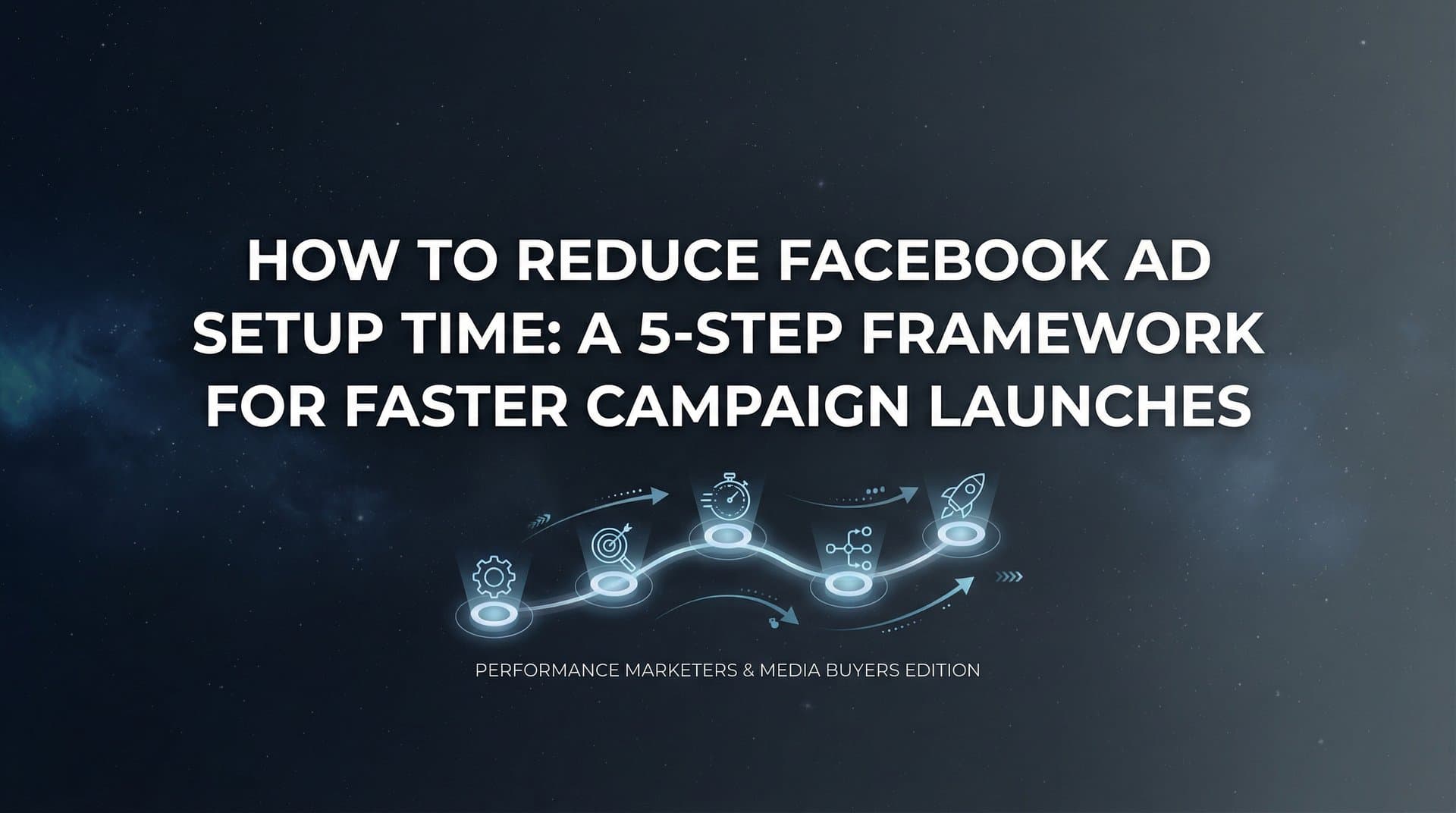
This guide walks you through a proven five-step framework for streamlining your Facebook ad setup process. You'll learn how to build reusable templates, organize your creative assets for quick deployment, implement bulk launch workflows, and create quality control systems that prevent costly mistakes. Whether you're launching one campaign or ten, these strategies will help you work smarter, not harder.
Let's transform your setup process from a tedious grind into a streamlined system.
Step 1: Audit Your Current Setup Process and Identify Time Drains
Before you can optimize your workflow, you need to understand where your time actually goes. Most marketers have never tracked how long each setup task takes—they just know it feels like forever.
Start by timing yourself during your next campaign setup. Break it down into specific tasks: How long does audience creation take? What about uploading and configuring creative assets? Writing ad copy? Setting budgets and schedules? Configuring tracking pixels?
Track these times for at least three campaigns to get an accurate baseline. You might be surprised to discover that tasks you thought took 10 minutes actually consume 30, or that certain steps eat up a disproportionate amount of your setup time.
Next, identify the repetitive tasks you perform for every single campaign. Are you manually recreating similar audiences each time? Uploading the same types of creative assets with identical specifications? Writing variations of the same ad copy frameworks? These repetitive tasks are your biggest opportunities for optimization.
Document your current workflow step by step. Write down every action you take from the moment you decide to launch a campaign until it goes live. This documentation serves two purposes: it reveals hidden bottlenecks you might not have noticed, and it becomes the foundation for your optimized workflow later.
Pay special attention to decision points where you pause to think or reference previous campaigns. These moments often indicate missing templates or unclear processes that slow you down.
Create a simple spreadsheet with three columns: Task, Current Time, and Notes. In the Notes column, flag tasks that feel particularly tedious or that you do the same way every time. These flagged items become your priority targets for the optimization steps ahead.
This baseline measurement is crucial. Without knowing your starting point, you can't measure improvement or prove the value of the changes you're about to implement. Plus, seeing the actual numbers often provides the motivation needed to commit to building better systems. If you're finding that campaign setup is time consuming, you're not alone—and that's exactly what we're solving here.
Step 2: Build a Reusable Campaign Template Library
Think of campaign templates as your setup shortcuts. Instead of building everything from scratch each time, you're creating a library of pre-configured components you can deploy in minutes.
Start with saved audiences. Meta Ads Manager allows you to save audience configurations for instant reuse. Create saved audiences for your core customer segments—your high-value buyers, your retargeting pools, your lookalike audiences, and your interest-based targeting groups. Name them clearly so you can find them quickly: "Lookalike_Top10%_Purchasers" beats "Audience_12" every time.
Build audiences for different campaign objectives. Your awareness campaigns might target broader audiences, while your conversion campaigns focus on warmer prospects. Having these pre-built means you're not recreating targeting parameters from memory each time you launch.
Develop a consistent naming convention system. This might seem minor, but clear naming saves enormous time when you're managing multiple campaigns. Use a format like: [Brand]_[Objective]_[Audience]_[Creative]_[Date]. For example: "Acme_Conversions_LLA_VideoAd_Feb2026" tells you everything at a glance.
Consistency here pays dividends when you're analyzing performance across campaigns or looking for specific ad sets to duplicate. You'll spend less time hunting through your account and more time making strategic decisions.
Save campaign structures in Meta Ads Manager. When you build a campaign structure that works—the right number of ad sets, budget distribution, and optimization settings—duplicate it as a template for future campaigns. You can turn off the duplicate, rename it as a template, and keep it in your account as a starting point.
This approach is particularly valuable for recurring campaign types. If you run weekly promotional campaigns with similar structures, having a template eliminates the need to rebuild the framework each time. Learning how to build Facebook ad campaigns faster starts with these foundational templates.
Create a swipe file of proven ad copy frameworks. Keep a document with your best-performing headlines, body copy structures, and calls-to-action. Organize them by campaign objective and audience type. When you need to write new ad copy, you're not starting from a blank page—you're adapting frameworks you know work.
Include notes about what made each piece of copy effective. Was it the specific benefit highlighted? The emotional trigger? The urgency element? These insights help you replicate success rather than just copying words.
Your template library should evolve over time. As you discover what works, add those elements to your library. As certain approaches stop performing, remove them. Think of it as a living system that gets smarter with every campaign you run.
Step 3: Streamline Creative Asset Management
Creative asset chaos is one of the biggest time drains in Facebook ad setup. When your images and videos are scattered across folders with cryptic names, you waste valuable minutes just finding the right file.
Organize creative assets by campaign type and objective. Create a folder structure on your computer or cloud storage that mirrors how you think about campaigns. Separate folders for awareness campaigns, conversion campaigns, retargeting campaigns, and seasonal promotions make it easy to locate relevant assets quickly.
Within each campaign type folder, organize by format: images, videos, carousel assets, and collection assets. This structure means you're never hunting through hundreds of files to find that one product video you need.
Pre-format images and videos to Meta specifications before you need them. Facebook requires specific dimensions and file sizes for different placements. Rather than resizing assets during setup, batch-process them in advance. Create versions optimized for feed, stories, reels, and other placements all at once.
Keep a checklist of Meta's current specifications handy. Feed images work best at 1080x1080 pixels, stories need 1080x1920, and videos should be under 4GB with recommended aspect ratios for each placement. Having pre-formatted assets means you're uploading and launching, not troubleshooting format errors.
Create modular creative components for mix-and-match flexibility. Instead of thinking in terms of complete ads, think in terms of building blocks. Maintain libraries of proven headlines, body copy variations, and calls-to-action that you can combine in different ways.
For visual assets, create modular elements too. Product images on transparent backgrounds can be combined with different background templates. Text overlays can be swapped onto different images. This modular approach lets you generate multiple ad variations quickly without creating everything from scratch.
Use batch processing to prepare multiple ad variations at once. Tools like Canva, Adobe Creative Cloud, or even bulk editing features in your design software allow you to create dozens of variations in the time it would take to make a few individually. Set up a template, then swap in different products, headlines, or offers to generate a complete set of creatives in one session.
This batch approach is particularly powerful for testing. Instead of creating test variations one by one as you think of them, you can systematically generate all the variations you want to test in a single focused work session.
Name your creative files descriptively and consistently. Include key details in the filename: product name, offer type, format, and version number. "ProductX_50Off_Square_v3.jpg" is infinitely more useful than "IMG_8472.jpg" when you're trying to track which creative is which in your reporting. This organization directly helps you reduce Facebook ad creation time significantly.
Step 4: Implement Bulk Launch Workflows
Manual, one-by-one ad creation is where most marketers lose the most time. Bulk launch workflows let you set up multiple campaigns, ad sets, and ads simultaneously—turning hours of work into minutes.
Master Meta's bulk upload features. Ads Manager offers bulk creation tools that let you upload multiple ad sets or ads at once using spreadsheet templates. Download Meta's CSV template, fill in your campaign details in rows, and upload the entire file to create dozens of ad sets in seconds.
This approach works particularly well when you're testing multiple audience segments with the same creative, or running similar campaigns across different product lines. Instead of clicking through the same setup screens repeatedly, you configure everything in a spreadsheet and upload once.
The learning curve is worth it. Your first bulk upload might take longer than manual setup as you figure out the template, but by your third or fourth bulk launch, you'll be moving exponentially faster. Understanding how to launch multiple Facebook ads quickly is essential for any serious media buyer.
Set up campaign rules and automation for recurring tasks. Meta's automated rules can handle routine optimizations without your involvement. Create rules that automatically increase budgets on high-performing ad sets, pause underperforming ads after a certain spend threshold, or adjust bids based on cost per result.
These rules don't just save time during setup—they save ongoing management time too. You're building a system that makes smart decisions automatically, freeing you to focus on higher-level strategy rather than daily micromanagement.
Learn keyboard shortcuts and power-user features in Ads Manager. Simple shortcuts like Command+D (or Ctrl+D) to duplicate campaigns, or using the bulk edit feature to change settings across multiple ad sets at once, shave seconds off every action. Those seconds add up to significant time savings across dozens of campaigns.
Familiarize yourself with the quick creation flow versus the guided creation flow. The quick creation flow skips unnecessary screens when you already know what you want to set up, cutting your click count dramatically. If you're feeling overwhelmed by Facebook Ads Manager, mastering these shortcuts can make a huge difference.
Consider AI-powered tools that can build campaigns from performance data automatically. Platforms like AdStellar AI analyze your historical campaign performance to identify winning creative elements, audiences, and copy—then automatically build and launch new campaign variations based on what's actually working.
This approach represents the next evolution beyond templates and bulk uploads. Instead of manually configuring even bulk launches, AI systems can generate entire campaigns in seconds by learning from your past performance data. The system identifies your top-performing ads, extracts the winning elements, and creates new variations that follow proven patterns. Exploring how to automate Facebook ad creation can transform your entire workflow.
The continuous learning aspect means your campaigns get smarter over time. As the AI observes what works and what doesn't, it refines its campaign-building decisions, effectively turning your performance data into an automated optimization engine.
Step 5: Create a Pre-Launch Checklist and Quality Control System
Speed without accuracy creates expensive mistakes. A systematic pre-launch checklist ensures you're moving fast without breaking things.
Build a standardized checklist covering all critical setup elements. Your checklist should include tracking verification (pixel firing correctly, conversion events configured), targeting accuracy (audience settings match campaign goals), creative specifications (all assets meet Meta requirements), budget and schedule settings (daily budgets set correctly, start/end dates confirmed), and compliance checks (ad copy follows platform policies).
Make this checklist digital and interactive. A simple spreadsheet or a tool like Notion where you can check boxes ensures nothing gets skipped. For team environments, use a shared checklist that multiple people can review.
Set up a review process that catches errors before launch. Even with templates and automation, human review prevents costly mistakes. Implement a two-person review system where someone other than the campaign builder does a final check before launch.
This doesn't mean a lengthy approval process. A focused five-minute review by a second set of eyes catches typos in ad copy, incorrect audience selections, or tracking issues that could waste budget. The few minutes spent on review save hours of troubleshooting later. Proper pixel configuration is critical—learn how to set up Facebook pixel correctly to avoid tracking errors.
Document your optimized workflow for team consistency. Once you've refined your setup process, write it down as a standard operating procedure. Include screenshots, decision trees for common scenarios, and links to your template library.
This documentation serves multiple purposes: it onboards new team members faster, ensures everyone follows best practices, and creates a baseline for continuous improvement. When someone discovers a better way to do something, update the documentation so the entire team benefits.
Create role-specific versions of your workflow documentation. What a media buyer needs to know differs from what a creative strategist needs. Tailored documentation means people can find the information relevant to their role quickly.
Schedule regular workflow reviews to continuously improve. Set a recurring monthly or quarterly meeting to review your setup process. What's working well? What's still taking too long? What new features or tools could streamline things further?
Use your time tracking data from Step 1 to measure progress. Compare current setup times to your baseline. Celebrate improvements and identify remaining bottlenecks to tackle in the next optimization cycle. This focus on improving Facebook ad campaign efficiency should be ongoing.
Encourage team members to suggest improvements. The people doing the work daily often spot inefficiencies that managers miss. Create a system where workflow improvement suggestions are welcomed and quickly evaluated.
Putting It All Together: Your Faster Setup Action Plan
You now have a complete framework for dramatically reducing Facebook ad setup time. Here's your action plan for implementation:
Week 1: Complete your workflow audit. Track your time, document your current process, and identify your biggest time drains. This baseline measurement is essential for proving the value of your improvements.
Week 2: Build your template library. Create saved audiences for your core segments, establish naming conventions, and save your most common campaign structures. Start your ad copy swipe file with your best-performing examples.
Week 3: Organize your creative assets. Set up your folder structure, batch-process assets to Meta specifications, and create modular components you can mix and match.
Week 4: Implement bulk workflows and automation. Learn Meta's bulk upload tools, set up automated rules for recurring tasks, and explore AI-powered solutions that can accelerate the process further.
Ongoing: Use your pre-launch checklist for every campaign, conduct regular workflow reviews, and continuously refine your systems based on what you learn.
The time investment upfront pays exponential dividends. Once your systems are in place, campaign setup that used to take hours can happen in minutes. You'll launch campaigns faster, test more variations, and spend your time on strategic thinking rather than repetitive tasks.
Most importantly, you'll shift from reactive execution to proactive strategy. When setup isn't a bottleneck, you can respond to opportunities quickly, test ideas while they're fresh, and stay ahead of competitors who are still buried in manual work. Once you've mastered setup efficiency, you can focus on how to scale Facebook ads efficiently.
Your Next Steps: From Manual Setup to Automated Intelligence
The five-step framework you've just learned will dramatically reduce your Facebook ad setup time. By auditing your workflow, building templates, organizing assets, implementing bulk processes, and creating quality control systems, you're transforming setup from a time sink into a streamlined operation.
But here's what this efficiency really gives you: time to think strategically. Time to analyze what's working and why. Time to develop creative concepts that actually move the needle. When you're not drowning in setup tasks, you can focus on the work that separates good marketers from great ones.
The next frontier in setup efficiency goes beyond templates and bulk uploads. AI-powered platforms can now analyze your historical performance data, identify winning patterns across your creative, copy, and targeting, and automatically build optimized campaigns based on what actually works for your business. Discover how AI powered Facebook advertising is changing the game for performance marketers.
This isn't about replacing strategic thinking—it's about amplifying it. When AI handles the repetitive execution work, you gain bandwidth for higher-level decisions. You can test more ideas, iterate faster, and scale what works without scaling your workload proportionally.
The marketers winning in today's landscape aren't working harder—they're working smarter. They've built systems that multiply their effectiveness, allowing them to launch more campaigns, test more variations, and optimize more aggressively than competitors still stuck in manual workflows.
Ready to transform your advertising strategy? Start Free Trial With AdStellar AI and be among the first to launch and scale your ad campaigns 10× faster with our intelligent platform that automatically builds and tests winning ads based on real performance data.
Your time is valuable. Spend it on strategy, not setup.