Most marketers know they should be testing more ad variations. The reality is that the manual process of creating, naming, structuring, and launching those variations is tedious enough that most campaigns end up with three or four ads when they should have thirty.
The result is predictable: you get some data, but not enough to draw real conclusions. You pause a few ads, scale one that looks promising, and repeat the cycle without ever building a systematic approach that compounds over time.
This guide walks you through the complete Facebook ad variation creation process, from planning your test matrix to analyzing results and building the next round of winners. Whether you manage a single brand account or run ads across multiple clients, these steps will give you a repeatable system that removes guesswork and produces data you can actually act on.
By the end, you will know how to define the right variables to test, generate creative variations at scale, structure your campaigns for clean data, and use performance insights to double down on what works. You will also see how AI-powered tools like AdStellar can compress what used to take days of manual work into minutes, letting you test more combinations without burning out your team or adding headcount.
Let's get into it.
Step 1: Define Your Testing Variables Before You Create Anything
The biggest mistake in the Facebook ad variation creation process happens before a single creative is made. Most marketers open their design tool or Ads Manager and start building without a clear picture of what they are actually trying to learn. The result is a collection of variations that feel different but do not produce actionable data.
Start by identifying the four core elements you can vary: creative format (image, video, or UGC-style content), headline, primary text, and audience segment. Each of these is a distinct lever, and mixing them together without a plan makes it impossible to know which one moved the needle.
Next, decide whether you are running A/B tests or multivariate tests. A/B testing isolates one variable at a time and gives you the cleanest possible signal. You change the headline while keeping everything else identical, and any difference in performance is directly attributable to that headline. Multivariate testing runs multiple variables simultaneously, which lets you cover more ground faster but requires significantly higher volume to reach statistical significance. For most accounts under a certain spend threshold, A/B testing by variable is the more reliable approach. For larger accounts with strong data volume, multivariate testing can accelerate the learning cycle.
For each variable you plan to test, write a hypothesis before you create anything. A hypothesis is not just "let's see which headline performs better." It is a specific prediction: "We believe a benefit-led headline will outperform a curiosity-led headline for cold audiences because our product requires some explanation before the value is clear." That framing forces clarity and makes your results more useful because you know what question you were answering.
Also determine your minimum variation count based on your budget and campaign objective. Running ten ad variations on a $20-per-day budget means each variation gets almost no spend before the data becomes meaningless. A practical rule is to make sure each variation can accumulate enough impressions to surface a real signal before you start making decisions. If your budget is limited, test fewer variables at a time.
Common pitfall: Testing too many variables simultaneously with insufficient budget dilutes your results across too many combinations. You end up with inconclusive data and no clear winners to build on.
Success indicator: You have a written test matrix before opening Ads Manager or any creative tool. It lists each variable, the specific options you are testing, and the hypothesis behind each one.
Step 2: Generate Creative Variations at Scale
Once your test matrix is defined, the next challenge is actually producing the creative variations without spending three days in design tools. This is where most teams hit a bottleneck, and it is also where the modern Facebook ad variation creation process looks very different from how it worked a few years ago.
Start with your highest-performing existing creative as a baseline. If you have historical data, use it. Your best performer tells you what the market has already responded to, and building variations around it is more efficient than starting from scratch with unproven concepts.
From that baseline, build variations across the three formats worth testing: static image ads, video ads, and UGC-style content. Format itself is a variable, not just a container for your message. A product-focused static image and a UGC-style talking-head video can carry the same core message but produce very different results depending on the audience, funnel stage, and product category. Testing format before over-optimizing within a single format is a smart use of early budget.
The traditional approach to generating multiple creative variations meant briefing a designer, waiting for rounds of revisions, and repeating the process for every format. AI creative tools have changed this workflow significantly. With a platform like AdStellar, you can generate image ads, video ads, and UGC avatar ads directly from a product URL without a design team, video editor, or on-camera talent. The AI builds creatives from scratch or refines existing ones through chat-based editing, which means you can iterate on a specific variation without starting over.
Another underused source of creative inspiration is the Meta Ad Library. It is a publicly available tool that lets you browse active and inactive ads from any Facebook Page. When you are trying to understand what creative approaches are already resonating in your market, looking at what competitors are actively running gives you real data rather than assumptions. AdStellar takes this a step further by letting you clone competitor ads directly from the Meta Ad Library and use them as a starting point for your own variations.
Chat-based editing is worth highlighting as a specific workflow improvement. Rather than briefing a designer every time you want to adjust an element, you can refine individual variations through a conversational interface. Change the background, swap the product angle, adjust the overlay text, and move on. This keeps the iteration cycle tight.
Success indicator: You have at least three to five creative variations per format before moving to copy. Each variation tests a meaningfully different visual approach, not just a color swap or font change.
Step 3: Write Headline and Copy Variations That Actually Differ
Here is a pattern that shows up constantly in ad accounts: a marketer writes five headline variations that are essentially the same sentence rearranged. "Get More Leads Today," "Start Getting More Leads," "More Leads, Starting Now." These are not different angles. They are the same message in slightly different clothes, and they will produce nearly identical results.
Genuine variation in copy means testing fundamentally different value propositions, not synonym swaps. The four angles that tend to produce meaningfully different audience responses are benefit-led, problem-led, social proof-led, and curiosity-led.
Benefit-led copy leads with the outcome the customer gets. It is direct and works well for audiences who already understand they have a need and are evaluating solutions. "Launch 100 ad variations in minutes, not days" is benefit-led.
Problem-led copy opens by naming the pain point before offering a solution. It works well for audiences who are aware of their problem but have not yet considered your product as the answer. "Still building every ad variation by hand?" creates immediate recognition before pivoting to the solution.
Social proof-led copy leads with validation from others: customer counts, results, or recognizable names. It is particularly effective for audiences who are skeptical or evaluating multiple options. This angle builds trust before making a claim.
Curiosity-led copy withholds enough information to make the audience want to click. It works well for cold audiences who do not yet have a strong reason to pay attention to your ad. The risk is that it can attract clicks from people who are not genuinely qualified, so pair it with landing page copy that qualifies intent quickly.
Pair each copy angle with the right creative format for coherent messaging. A problem-led headline works naturally with a UGC-style video that dramatizes the frustration. A benefit-led headline pairs well with a clean product image that shows the outcome. When the visual and the copy reinforce the same angle, the ad feels cohesive rather than assembled from separate parts.
In Facebook ad structure, the primary text and the headline serve different roles. The primary text appears above the creative and carries the main message. The headline appears below the creative and typically functions as a direct call to action or value statement. Vary them independently so you can learn which element is doing the heavy lifting in a given combination.
Practical tip: Write your copy variations before designing your creatives. When visuals are built to reinforce a specific message angle, the ad communicates more clearly than when copy is written to fit an already-designed image.
Success indicator: Each copy variation reflects a distinct message angle. If you cannot articulate in one sentence how each variation is conceptually different from the others, revise before launching.
Step 4: Structure Your Campaign for Clean, Readable Data
You can have excellent creative variations and well-written copy, but if your campaign structure is messy, your data will be too. Clean structure is what makes the Facebook ad variation creation process actually produce learnings you can build on.
The structure that supports variation testing follows a clear logic: one campaign with a single objective, multiple ad sets organized by audience segment, and multiple ads within each ad set representing your creative and copy combinations. This hierarchy keeps your variables separated so performance differences are attributable to the right cause.
Audience variation is its own testing layer and should be treated as such. Interest-based audiences, lookalike audiences, and retargeting segments behave differently enough that mixing them in the same ad set distorts your results. A creative that performs well with a retargeting audience may underperform with cold traffic, and if both are in the same ad set, you cannot see that distinction. Keep each audience type in its own ad set with identical creative and copy so any performance difference reflects the audience, not the ad.
Set consistent budgets across ad sets. If one ad set has twice the budget of another, the higher-spend ad set will naturally accumulate more data faster, and any performance difference becomes difficult to interpret. Equal budgets across ad sets ensure that differences in performance reflect creative and copy quality rather than spend imbalances.
Ad naming conventions matter more than most marketers realize, especially when running large numbers of variations across accounts. A name like "Ad 1" tells you nothing when you are reviewing results across fifty variations. A naming convention like "IMG-Benefit-WomenOver35-V1" tells you the format, the copy angle, the audience, and the version number at a glance. Build your naming convention before you launch and apply it consistently.
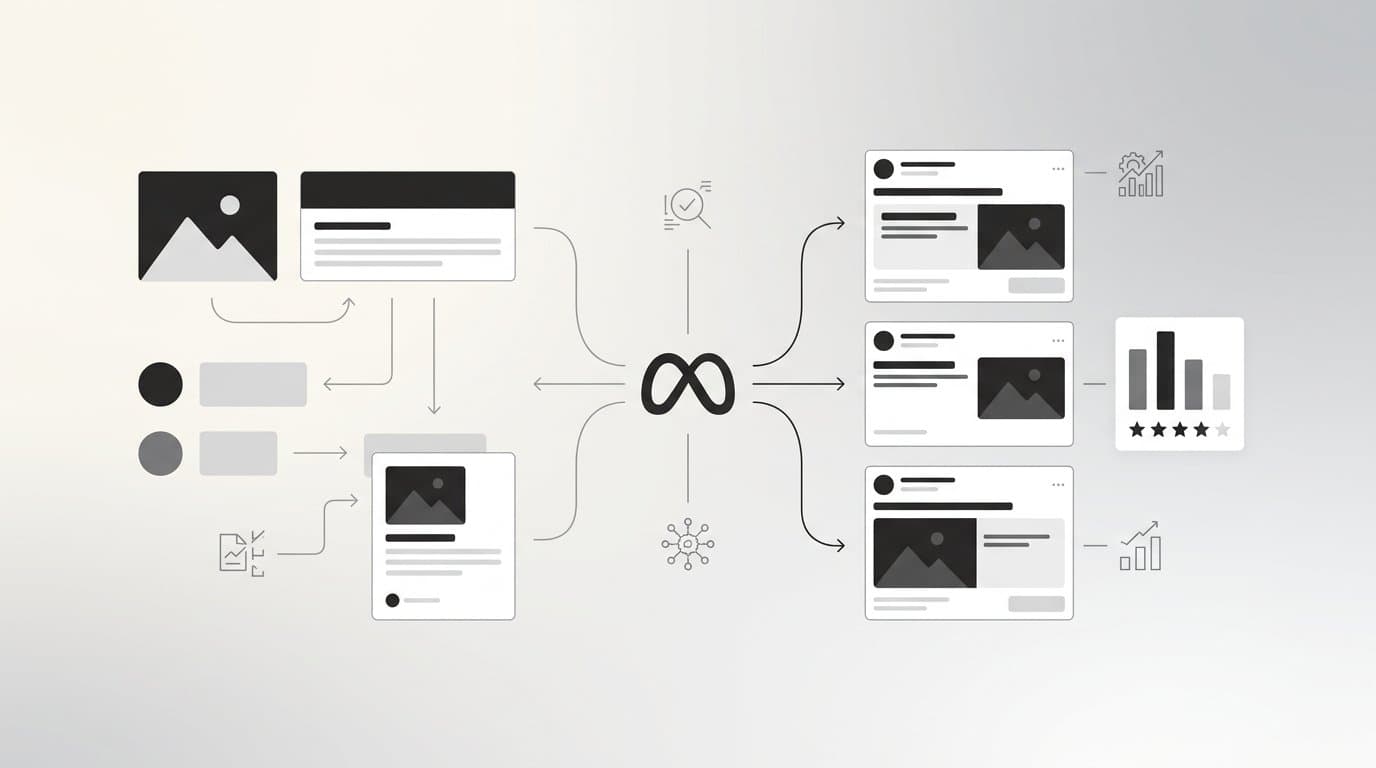
The bulk launching approach is where this step becomes significantly more efficient with the right tools. Rather than manually building every combination of creative, headline, audience, and copy, bulk ad creation generates every permutation automatically. AdStellar's Bulk Ad Launch feature lets you mix multiple creatives, headlines, audiences, and copy variations at both the ad set and ad level, generating every combination and launching them to Meta in minutes rather than hours. For a test matrix with even moderate complexity, this is the difference between launching the same day you plan or spending two days in Ads Manager building ads one at a time.
Success indicator: Your campaign structure makes it immediately clear which element drove which result. When you look at your data, you can identify the winning creative, the winning copy angle, and the winning audience without cross-referencing notes or trying to remember what each ad contained.
Step 5: Launch, Monitor, and Let the Data Accumulate
One of the most common and costly mistakes in variation testing is making optimization decisions too early. A variation gets a few clicks and no conversions in the first 48 hours, so it gets paused. But 48 hours and a small amount of spend is rarely enough data to draw a conclusion, especially for conversion-focused campaigns where the signal takes longer to develop.
Set a minimum data collection window before making any optimization decisions. The right window depends on your campaign objective and your typical conversion volume. For awareness and traffic campaigns, you can often read CTR and engagement signals within a few days. For conversion campaigns, you generally need enough conversion events to establish a reliable pattern, and that takes longer. Define this window before you launch so you are not tempted to act on early noise.
In the early phase, some metrics are worth watching and some require more data before they mean anything. CTR gives you a useful early signal about whether an ad is stopping the scroll and generating interest. For video ads, hook rate (the percentage of viewers who watch past the first few seconds) tells you whether the opening is working. Link clicks give you directional information about intent. These are leading indicators worth monitoring.
ROAS and CPA, on the other hand, require meaningful conversion volume before they are reliable. A variation with two purchases and a great ROAS is not a winner yet. It is a promising signal that needs more data before you act on it.
When you are running a large number of variations, manually reviewing performance across every creative, headline, and audience combination becomes time-consuming and prone to missed patterns. AI-powered insights can surface those patterns faster. AdStellar's AI Insights feature includes leaderboard rankings that score your creatives, headlines, copy, audiences, and landing pages against real metrics like ROAS, CPA, and CTR. You set your target goals and the AI scores everything against your benchmarks, so you can instantly see which elements are outperforming and which are underperforming without manually sorting through rows of data.
Success indicator: You have a defined review cadence and a clear set of metric thresholds that trigger a pause or scale decision. You are not making changes based on gut feel or impatience. You are following a process.
Step 6: Identify Winners and Build Your Next Round of Variations
When a variation starts outperforming others, the instinct is to scale the ad. But scaling the ad is less valuable than understanding the concept behind it, because concepts are durable and individual ad executions are not.
A winning creative and a winning concept are different things. A winning creative is a specific combination of visual, headline, and copy that performed well in a particular campaign. A winning concept is the underlying message angle, value proposition, or format approach that resonated with your audience. The concept is what you scale, because you can build dozens of new executions around a proven concept. You cannot build much around a single ad.
When a variation wins, dig into what specifically drove the performance. Was it the format? A video ad outperforming static images tells you something about how this audience prefers to consume information. Was it the copy angle? A problem-led headline outperforming a benefit-led one tells you the audience is pain-aware and responds to having their frustration named. Was it the audience? A lookalike audience outperforming an interest-based one tells you your existing customer profile is a stronger signal than category interest. Each of these is a distinct learning that shapes the next round.
The iteration loop works like this: your winners become the new baseline, and your next round of variations pushes the winning concept further. If problem-led copy won, test three variations of problem-led copy with different problem framings. If UGC-style video outperformed static images, test multiple UGC approaches. You are not starting from scratch each time. You are building on evidence.
Organizing your winning elements is where many teams lose momentum. If your best-performing creatives, headlines, and audiences are scattered across multiple campaigns and ad accounts, you cannot easily reuse them. A centralized library of proven elements with real performance data attached makes it possible to build new campaigns from a foundation of what already works. AdStellar's Winners Hub does exactly this: it stores your top-performing creatives, headlines, audiences, and more in one place with actual performance data attached, so when you are building the next campaign, you are selecting from proven elements rather than starting from scratch.
AdStellar's AI Campaign Builder extends this further by analyzing your historical campaign data to rank creative elements, headlines, and audiences by performance, then using those rankings to build new campaigns. Every decision comes with a transparent explanation so you understand the strategy behind the output, not just the result. And the system gets smarter with each campaign as it accumulates more data about what works for your specific account.
Success indicator: You have a documented library of winning elements and a repeatable process for building the next test round. Each new campaign starts from a stronger position than the last because it is built on accumulated evidence rather than fresh assumptions.
Putting It All Together: Your Variation Creation Checklist
The six steps above form a complete, repeatable system for the Facebook ad variation creation process. Here is a quick-reference version you can use before every campaign:
1. Define your test matrix: Identify which variables you are testing, write a hypothesis for each, and set a minimum variation count based on your budget.
2. Generate creative variations: Start from your best-performing baseline, build across formats (image, video, UGC), and use AI creative tools to produce multiple versions without a design bottleneck.
3. Write copy variations with distinct angles: Test benefit-led, problem-led, social proof-led, and curiosity-led approaches. Make sure each variation reflects a genuinely different value proposition.
4. Structure your campaign for clean data: Separate audiences by type, set consistent budgets, use descriptive naming conventions, and use bulk launching to generate every combination efficiently.
5. Let the data accumulate: Set a minimum review window, watch leading indicators early, and use AI insights to surface patterns across large numbers of variations.
6. Extract the winning concept and iterate: Identify what specifically drove performance, build the next round of variations around the winning concept, and store proven elements in a centralized library.
The process is cyclical. Each round of testing feeds the next, and the compounding advantage of systematic variation testing grows over time. Accounts that run this process consistently develop a library of proven concepts, a clearer picture of their audience, and a faster path to winners with each campaign.
If you want to run this entire process without the manual bottlenecks, AdStellar handles creative generation, bulk launching, performance scoring, and winner tracking in one platform. Start Free Trial With AdStellar and see how much faster the variation creation process moves when AI is handling the heavy lifting from creative to conversion.