Creative fatigue is one of the most frustrating realities in Meta advertising. You spend hours briefing a designer, waiting on revisions, assembling the campaign, and launching it with high hopes. Three weeks later, your CPM is climbing, your click-through rate is sliding, and the algorithm has quietly moved on. The culprit is almost always the same: not enough creative variation to keep the audience engaged and give Meta's delivery system enough to work with.
This is exactly the problem a Facebook ad variation generator is built to solve. Instead of manually assembling a handful of ads per campaign, a variation generator takes your core inputs and automatically produces dozens or even hundreds of unique combinations of creatives, headlines, copy, and audience configurations. The result is more testing surface, faster learning, and a much shorter path to finding what actually converts.
In this article, we'll break down why creative volume has become a genuine competitive advantage on Meta, how variation generators actually work under the hood, what features separate a powerful tool from a basic template shuffler, and how to build a repeatable workflow that scales. Whether you're managing campaigns for a single brand or running a multi-client agency, the principles here apply directly to how you operate.
Why Creative Volume Is the New Competitive Edge in Meta Ads
Creative fatigue happens when the same audience sees the same ad too many times. Engagement drops first. People scroll past without registering the message. Then click-through rates fall, which signals to Meta's algorithm that the ad isn't resonating. The algorithm responds by raising your CPM to compensate for the declining relevance score, and before long a campaign that was performing well becomes expensive and inefficient.
The traditional fix was to wait until performance tanked and then ask a designer for a refresh. But that reactive approach creates a constant lag between when fatigue sets in and when new creative is actually live. By the time the new assets are ready, you've already wasted budget on a declining campaign.
The modern approach is different. Top-performing Meta advertisers don't treat creative as something you produce once per campaign. They treat it as a continuous input, something that needs to be refreshed, rotated, and tested at volume. Many high-performing accounts test dozens of Facebook ad variations per launch cycle rather than the three to five static images that used to be the standard.
Meta's delivery system actively rewards this approach. When you supply more creative options, the algorithm has more signals to work with. It can test different combinations against different audience segments, placements, and times of day simultaneously. A campaign with fifteen creative variations gives the system far more optimization data than one with three. The algorithm learns faster, finds the best-performing pockets of your audience more efficiently, and allocates budget with greater precision.
This is why creative volume has shifted from a nice-to-have into a genuine competitive edge. Advertisers who can produce and launch more variations faster are giving Meta's machine learning more material to work with, and that translates directly into better performance over time. The bottleneck for most teams isn't strategy or budget. It's the speed at which they can generate, assemble, and launch enough creative combinations to feed the machine properly. Learning how to scale Facebook ads efficiently starts with solving this creative production challenge.
How a Facebook Ad Variation Generator Actually Works
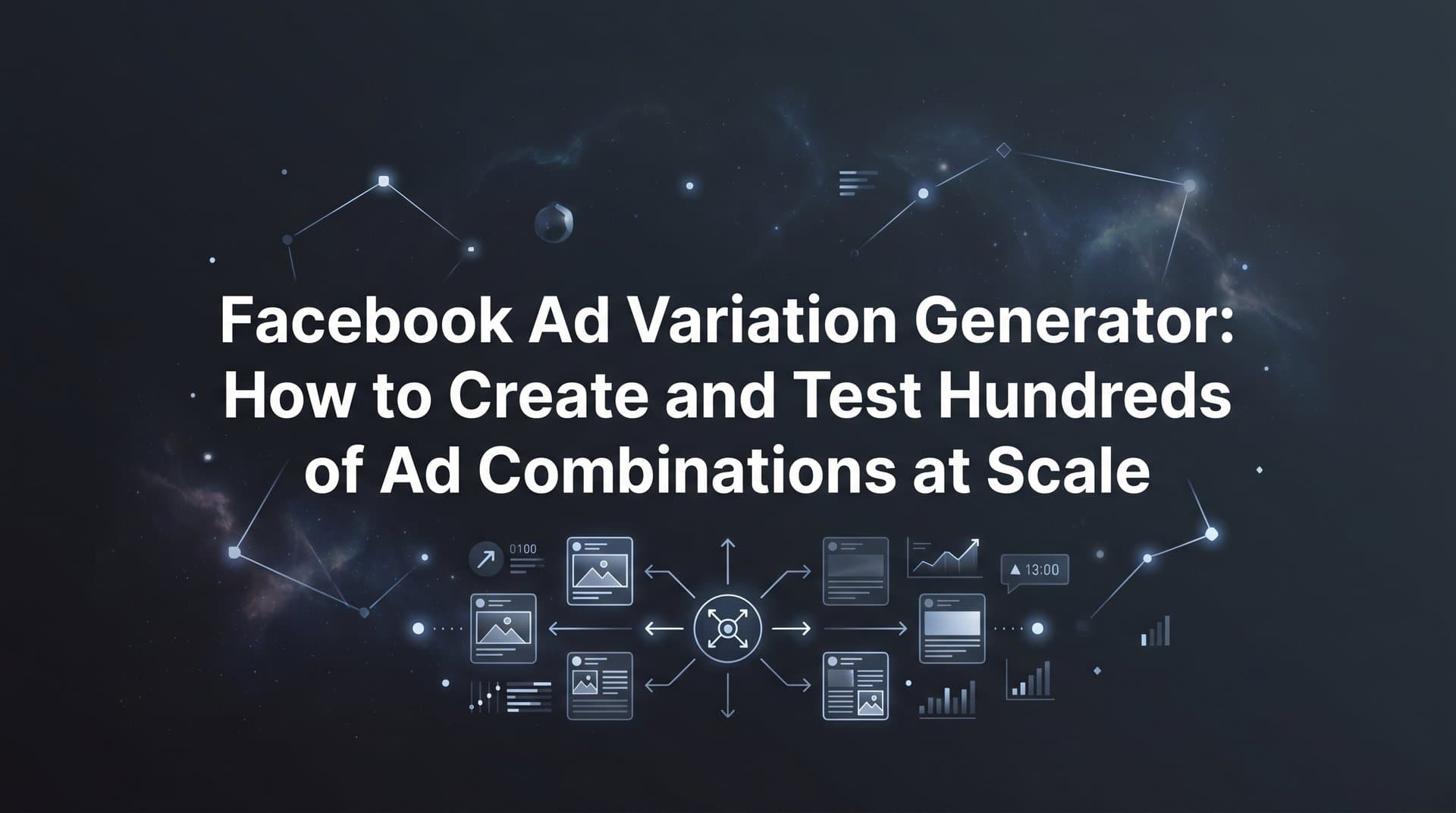
At its core, a Facebook ad variation generator takes a set of base inputs and multiplies them into a large number of unique ad combinations. The inputs typically include creative assets (images, videos, or UGC-style content), headline options, primary copy blocks, and audience parameters. The generator then assembles every possible combination of those elements and prepares them for launch.
The combinatorial math here is what makes this approach so powerful. Imagine you have five creative assets, four headline options, and three copy blocks. Manually assembling every unique combination would give you sixty distinct ads. If you add three audience segments into the mix, you're looking at one hundred and eighty variations. No team can build that by hand in a reasonable timeframe, but a generator handles it in minutes. This is the core advantage of automating Facebook ad creation rather than relying on manual assembly.
The starting point for most generators is a product URL or a set of brand assets. From that input, the tool generates creative content in multiple formats: static image ads, video ads, and increasingly, UGC-style avatar content that mimics the feel of organic creator posts. Some platforms also allow you to clone competitor ads directly from the Meta Ad Library, giving you a shortcut to formats and angles that are already proven in your market.
Here's where the distinction between basic tools and AI-powered generators becomes important. A simple template-swap tool takes your existing assets and applies them to a fixed set of layouts. It can produce volume, but it doesn't make intelligent decisions about what to combine or prioritize. An AI-powered Facebook ads software does something fundamentally different: it analyzes your historical performance data to understand which creative elements, headlines, and audience combinations have driven results in the past, and it uses that intelligence to inform what it generates and emphasizes next.
This feedback loop is what separates a volume-production tool from a genuine optimization engine. When the generator knows that a certain visual style consistently outperforms others, or that a specific headline angle drives lower CPA for a particular audience segment, it can weight its outputs accordingly. You're not just getting more ads. You're getting more ads that are informed by what has actually worked, which dramatically improves the odds that the next batch will contain strong performers.
The output from a well-built generator isn't just a folder of assets. It's a structured set of campaign-ready combinations, organized at the ad set and ad level, ready to be pushed live to Meta with minimal manual work.
Key Features That Separate a Great Generator from a Basic One
Not all variation generators are built the same. If you're evaluating tools, there are three capability areas that determine whether a platform will genuinely scale your operation or just add a layer of complexity.
AI Creative Generation Across Multiple Formats: The ability to produce image ads is table stakes. What separates a powerful generator is the ability to create video ads and UGC-style avatar content from a product URL or by cloning competitor ads from the Meta Ad Library. Different formats unlock different placements and audience segments. A static image that works well in the feed may not translate to Reels, and an audience that scrolls past polished brand creative may engage strongly with a lo-fi UGC-style video. A generator that only handles one format limits your testing surface significantly. Look for a platform that can produce all three creative types, ideally with the ability to refine any output through chat-based editing rather than requiring you to go back to a designer for every tweak.
Bulk Launch Directly to Meta: Generating hundreds of variations means nothing if you still have to manually upload and configure each one in Ads Manager. The real efficiency gain comes from a bulk Facebook ad launcher that handles the entire pipeline: generating the combinations at the creative level, assembling them at the ad set level with the appropriate audiences, and pushing everything live to Meta in clicks rather than hours. This bulk launch capability is what converts creative volume into actual testing velocity. Without it, you've just moved the bottleneck from creative production to campaign assembly.
A Performance Feedback Loop Built Into the Platform: The third capability is where most basic tools fall short. Generating and launching variations is only valuable if you can quickly identify which combinations are winning and feed those learnings back into the next round of generation. Look for built-in analytics that rank every creative, headline, copy block, audience, and landing page by real performance metrics like ROAS, CPA, and CTR. Goal-based scoring, where the platform measures every element against your specific benchmarks rather than generic averages, is particularly useful because it surfaces winners relative to what actually matters for your business. Understanding how to improve Facebook ad ROI depends heavily on having this kind of granular performance visibility.
Together, these three capabilities form a complete loop: generate at scale, launch with minimal friction, and let performance data drive the next generation cycle. A platform that handles all three in one place removes the coordination overhead that typically slows teams down.
Building a Variation Testing Workflow That Scales
Having a great generator is only useful if you have a repeatable process for using it. Here's how a structured variation testing workflow typically looks in practice.
Step 1: Generate a Large Batch with Clear Structure: Start each cycle by generating a meaningful volume of variations, not just three or four. Use your product URL or existing brand assets as the base, and let the AI produce multiple creative formats alongside headline and copy options. Structure your naming conventions from the start so you can easily identify which creative, headline, and audience combination each ad represents when you're reviewing results later. A solid understanding of how to structure Facebook ad campaigns makes this organizational step much smoother.
Step 2: Launch with Audience Splits: Organize your variations across audience segments so you're testing creative performance against multiple targets simultaneously. This gives you data on both what creative works and which audience it works best for, two pieces of information that compound in value over time.
Step 3: Monitor Leaderboard Rankings and Kill Underperformers Early: Once campaigns are live, resist the urge to let everything run for weeks before making decisions. Use your platform's ranking data to identify clear underperformers early and cut them before they drain budget. You don't need statistical perfection to make directional decisions, especially when you have enough volume that clear patterns emerge quickly.
Step 4: Save Winners and Recycle Them: This is where the compounding advantage builds. When a creative, headline, or audience combination consistently outperforms, save it with its performance data attached. A Winners Hub approach, where your best-performing elements are stored and instantly available for inclusion in future campaigns, means you're never starting from zero. The practice of reusing winning Facebook ad elements ensures each new campaign cycle begins with a foundation of proven performers, and you're layering new tests on top of known winners rather than rebuilding from scratch every time.
Step 5: Set a Refresh Cadence: Creative fatigue doesn't disappear just because you're generating more variations. Establish a regular cadence for introducing new creative concepts alongside your recycled winners. Many advertisers find that a mix of proven performers and fresh tests in each launch cycle balances efficiency with continued discovery. The exact ratio depends on your budget and how quickly your specific audiences show fatigue, but the principle of continuous refreshing applies universally.
Common Mistakes That Undermine Your Ad Variation Strategy
More variation volume is a genuine advantage, but only if you're using it correctly. There are a few patterns that consistently undermine the results advertisers expect from this approach.
Testing Too Many Variables Without Structure: Generating hundreds of ads is only useful if you can learn from the results. When every combination differs across multiple dimensions simultaneously, it becomes very difficult to isolate what is actually driving performance differences. If your creative, headline, copy, and audience all change between two ads, you can't attribute a ROAS difference to any single element. The challenge of managing too many Facebook ad variables is real, so build in enough structure to make your results interpretable, even when testing at high volume.
Launching and Forgetting: High-volume generation can create a false sense of productivity. Some advertisers launch large batches and then wait passively for results, treating variation testing as a set-it-and-forget-it process. The value of generating many variations is that you get faster signal on what works. But that signal only translates into improved performance if you're actively monitoring rankings, cutting losers, and feeding insights back into the next generation cycle. The workflow has to be active, not passive.
Neglecting Format Diversity: Many advertisers default to image variations because they're the easiest to produce at volume. This is a significant missed opportunity. Video ads and UGC-style content often reach entirely different audience segments and perform well in placements where static images underperform, particularly in Reels and Stories. If your variation strategy is purely image-based, you're leaving a meaningful portion of your potential testing surface unexplored. Leveraging AI for Facebook ads makes it far easier to produce all three formats and use performance data to understand where each format wins.
From Manual Bottleneck to Automated Scale
The shift from manually assembling a few ads per campaign to running a variation-driven workflow at scale is less about working harder and more about changing the structure of how you operate. A Facebook ad variation generator removes the creative bottleneck that limits how much you can test. It gives Meta's algorithm more material to optimize against. And it creates a continuous learning loop where each campaign cycle produces better inputs for the next one.
This is exactly what AdStellar is built to do. The platform handles the full pipeline from AI creative generation through bulk launching to performance-ranked insights, all in one place. You can generate image ads, video ads, and UGC-style creatives from a product URL or by cloning competitor ads from the Meta Ad Library. The AI Campaign Builder analyzes your historical data, ranks every element by performance, and builds complete campaigns with full transparency into why each decision was made. Bulk Ad Launch mixes your creatives, headlines, audiences, and copy and pushes every combination live to Meta in minutes. AI Insights leaderboards rank everything by ROAS, CPA, and CTR against your specific goals. And the Winners Hub stores your top performers with real data attached so they're ready to deploy into the next campaign instantly.
The result is a workflow where creative fatigue stops being a crisis you react to and becomes a variable you manage proactively, with the volume and speed to stay ahead of it consistently.
If you're ready to see how quickly your variation testing can scale, Start Free Trial With AdStellar and run your first high-volume campaign launch within minutes. The 7-day free trial gives you full access to the platform so you can experience the difference between manually building ads and letting AI handle the heavy lifting from creative to conversion.