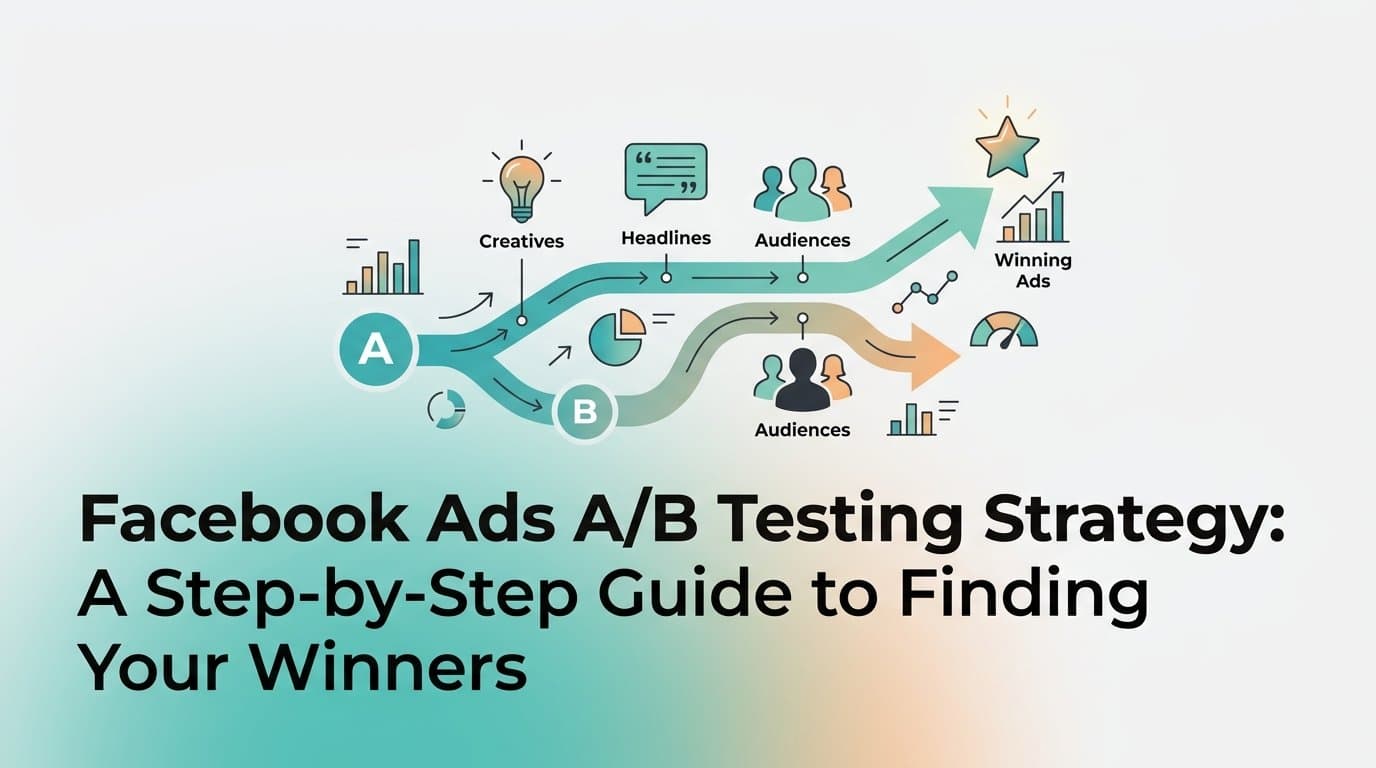
Most Facebook ad accounts are running on assumptions. Marketers pick a creative they like, write copy that feels right, and hope the algorithm figures out the rest. The problem is that gut instinct rarely beats data, and without a structured A/B testing strategy, you are essentially paying to guess.
A proper Facebook ads A/B testing strategy removes the guesswork. It tells you exactly which creative, headline, audience, or offer is driving results and which ones are draining your budget. The challenge is that most marketers either test too many variables at once, run tests without enough budget to reach statistical significance, or fail to act on what the data is telling them.
This guide walks you through a practical, repeatable framework for running A/B tests on Facebook and Instagram ads that actually produce actionable insights. You will learn how to structure your tests, what to test first, how to read your results, and how to scale what is working.
Whether you are managing a small e-commerce account or running campaigns at scale, this process applies. By the end, you will have a clear system for continuous testing that compounds over time, turning every campaign into a learning opportunity that makes the next one more profitable.
Let's get into it.
Step 1: Define Your Testing Goal Before Touching Ads Manager
Here is where most A/B tests go wrong before they even start: jumping straight into Ads Manager without a clear hypothesis. You end up with data you cannot interpret because you never decided what you were actually trying to learn.
Before you create a single ad variation, define one measurable objective for the test. That means picking a specific metric: cost per acquisition, return on ad spend, click-through rate, or conversion rate. Not all of them. One.
The metric you choose should connect directly to a business outcome. CTR is only meaningful if you have evidence that higher click-through rates translate to more revenue for your account. If you are a direct-to-consumer brand optimizing for purchases, CPA or ROAS is almost always the right primary metric. If you are in lead generation, cost per lead or lead quality score matters more than raw click volume.
Write your hypothesis before launching. A proper hypothesis sounds like this: "We believe that a video ad will generate a lower CPA than a static image ad for our retargeting audience because video communicates product value more effectively." That structure forces clarity. You know what you are testing, what result you expect, and why.
Decide what a meaningful difference looks like. If your current CPA is $40, is a $38 result a win? Probably not if it falls within normal variance. Decide in advance what threshold constitutes a real improvement worth acting on. This prevents you from moving the goalposts after you see the numbers.
Calculate your minimum budget and duration. Under-funded tests produce unreliable results. Meta recommends at least 50 conversion events per ad set before drawing conclusions from conversion-optimized campaigns. Work backward from your average CPA to figure out what budget you need to hit that threshold across all variants. If your CPA is $40 and you are testing two variants, you need roughly $4,000 minimum to generate 50 conversions per variant. Many accounts run tests with far less and then wonder why the results are inconsistent.
Set a fixed end date. Decide when the test ends before it starts. Open-ended tests almost always get cut short when one variant looks good early, which leads to false conclusions. More on that in Step 5.
The goal of this step is simple: know what you are trying to prove, how you will measure it, and what resources you need to do it properly. Everything else builds on this foundation.
Step 2: Choose One Variable to Test (And Only One)
This is the golden rule of A/B testing, and it is the rule most frequently broken. If you change the image, the headline, and the call to action between your control and your variant, you have no idea which change drove the difference in performance. You have learned nothing actionable.
One test. One variable. That is it.
The natural follow-up question is: what should I test first? Here is a practical priority order based on where the highest leverage tends to live in most Facebook ad accounts.
Creative format first. The visual is the first thing that stops or fails to stop a user from scrolling. Testing image versus video versus carousel often produces the most significant performance differences and the learning applies broadly across your account. Start here if you have not already established which format works best for your audience.
Creative content second. Once you know which format wins, test within that format. Two different images with the same copy, or two different video concepts with identical text. This isolates what the creative itself is communicating.
Headlines and primary copy third. After creative is dialed in, messaging becomes the next lever. Test a benefit-focused headline against a curiosity-driven one. Test long-form copy against short. Keep the creative identical.
Audience fourth. Interest-based targeting versus lookalike audiences versus retargeting segments. Audience tests should typically happen at the campaign level rather than the ad level to avoid overlap issues.
Offer and CTA last. Testing "Start Free Trial" against "Book a Demo" or a discount offer against a no-discount offer is high-value but only after you have established which creative and copy framework is performing.
Understanding what counts as one variable matters here. Swapping an image for a video is one variable. Swapping an image for a video and rewriting the headline is two variables. Changing the audience and the creative simultaneously is two variables. Keep the definition strict.
One practical tool that helps with this is a testing calendar. Track every test you run: the variable tested, the hypothesis, the result, and the date. Over time, this becomes a knowledge base that prevents you from retesting things you already know and ensures each new test builds on previous learnings. A simple spreadsheet works fine for this. The discipline of maintaining it is what creates compounding value.
Step 3: Build Your Ad Variations Without Creating Production Bottlenecks
One of the biggest practical barriers to consistent A/B testing is creative production. If every test requires a designer, a copywriter, and a video editor, you will run maybe four tests a year. That is not enough to build meaningful knowledge at the pace Meta's algorithm and competitive landscape demand.
The solution is to build a creative production process that does not depend on a full team for every variation.
For static image ads, the fastest path is a templatized approach. Establish a set of brand-compliant templates where you can swap the hero image, headline overlay, or background color without starting from scratch. This lets you generate variations in minutes rather than days.
For video ads and UGC-style content, AI-powered creative tools have changed what is possible for teams without dedicated video resources. Tools like AdStellar let you generate image ads, video ads, and UGC-style avatar content directly from a product URL or brief. You can also clone competitor ads from the Meta Ad Library and use them as a starting point for your own variations. No designers, no video editors, no actors required.
The practical implication for A/B testing is significant. Instead of producing two variations and hoping one wins, you can generate five variations of the same concept with different visual treatments, then use bulk ad creation to launch all of them simultaneously. AdStellar's Bulk Ad Launch feature lets you mix multiple creatives, headlines, audiences, and copy at both the ad set and ad level, generating every combination and pushing them live in minutes rather than hours.
Aim for three to five variations per variable, not just two. Testing only a control and one variant gives you a binary result. Testing three to five variations gives you a spectrum of performance data that reveals patterns. You might find that your third creative variation outperforms both the original and the first variant, which you would have missed entirely with a two-way test.
Keep variations consistent enough to isolate the variable. If you are testing creative concepts, every variation should use the same headline, the same copy, the same CTA button, and the same audience. The only thing changing is the creative itself. Any other differences contaminate the test and make the results uninterpretable.
The goal of this step is to remove the production bottleneck so that creative volume is never the reason you are not testing. When you can generate and launch five creative variations in an afternoon, your testing cadence accelerates dramatically.
Step 4: Set Up Your Test in Meta Ads Manager Correctly
How you structure your test in Ads Manager determines whether your results are trustworthy. A poorly structured test can show a clear winner that is actually a measurement artifact rather than a real performance difference.
Meta's native A/B test tool versus manual split testing. Meta's built-in A/B testing feature distributes budget evenly across variants and uses a separate holdout methodology to prevent audience overlap. For most accounts, this is the more reliable option because it controls for the variables you cannot easily control manually. Manual split testing gives you more flexibility in campaign structure but requires careful attention to audience exclusions and equal budget allocation.
Use Meta's native tool when you want a clean, controlled comparison and you are testing one variable against a clear control. Use manual split testing when you need more granular control over campaign structure or when you are running tests across multiple campaigns rather than within a single one.
Audience overlap is the silent test killer. If your two ad set variants are targeting overlapping audiences, the same users may see both ads. This cross-contamination means you are not actually measuring two separate audiences' responses to two different ads. You are measuring a muddled combination of both. Meta's A/B test tool handles this automatically. If you are setting up tests manually, use audience exclusions or separate campaigns to prevent overlap.
Budget allocation must be equal across variants. If Variant A gets $100 per day and Variant B gets $60 per day, any performance difference could be explained by the budget difference rather than the creative difference. Equal budget, equal delivery conditions, equal audience size. This is non-negotiable.
Calculate your minimum spend per variant. Work backward from your conversion goal. If you need 50 conversions per variant to reach statistical confidence and your CPA is $35, each variant needs at least $1,750 in spend. Multiply by the number of variants to get your total test budget. Many marketers skip this math and end up with inconclusive results simply because they did not fund the test adequately.
Campaign budget optimization versus ad set budget optimization in a test context. When running A/B tests, ad set budget optimization is generally preferred because it gives each variant a guaranteed equal share of spend. With campaign budget optimization, the algorithm may favor one variant early and starve the other before you have enough data to draw conclusions. This is a common structural mistake that produces misleading results.
Set your test duration to at least seven days. User behavior varies significantly by day of the week. A test that runs only Monday through Wednesday may show results that do not reflect weekend behavior, which can be dramatically different for many audiences and offer types. Seven days is the minimum. Two weeks gives you cleaner data for most accounts.
Step 5: Monitor Performance Without Making Premature Decisions
The temptation to check your test results after the first 24 hours is understandable. You have money on the line and you want to know if it is working. The problem is that early data is almost always misleading.
In the first day or two of a campaign, Meta's delivery system is still in the learning phase. It is figuring out who to show your ads to, when, and at what frequency. Performance during this window is erratic and not representative of how the ad will perform once delivery stabilizes. Making decisions based on 24-hour data is one of the most reliable ways to kill a test that would have produced useful results if you had waited.
What early signals are worth watching. In the first few days, keep an eye on delivery issues rather than performance metrics. Are both variants spending their budgets? Are there any policy flags or disapprovals? Is frequency already climbing too fast for a small audience? These are structural issues worth addressing early. Performance metrics like CPA and ROAS are not worth analyzing until the test has matured.
Key metrics to track once the test matures. Your primary metric should be whatever you defined in Step 1. Secondary metrics provide context. CTR tells you about creative engagement. Frequency tells you about audience saturation. Cost per click tells you about landing page relevance relative to ad performance. Look at these in combination, not in isolation.
Performance analytics dashboards that show variants side by side save significant time here. AdStellar's AI Insights feature ranks creatives, headlines, copy, audiences, and landing pages against your actual target goals using metrics like ROAS, CPA, and CTR. Instead of manually pulling data from Ads Manager into a spreadsheet and trying to compare rows, you get a leaderboard view that makes performance differences immediately visible.
When it is acceptable to pause early. If one variant is dramatically underperforming and you have already spent enough to generate meaningful data on the other variants, pausing the clear loser is reasonable. The threshold is roughly: if a variant has spent two to three times your target CPA without generating a single conversion, it is reasonable to cut it. Do not pause variants based on CTR or spend alone.
Patience is a genuine competitive advantage in A/B testing. Most marketers do not have it, which means the ones who do consistently extract better insights from the same budget.
Step 6: Read Your Results and Extract Actionable Insights
The test has run its course. Now comes the part that most guides skip over: actually making sense of what the data is telling you.
Is the result statistically meaningful or just noise? A five percent difference in CPA between two variants sounds significant, but if both variants only generated 15 conversions each, that difference could easily be explained by random variation. As a general rule, you want at least 50 conversion events per variant before treating a performance difference as real. If you are below that threshold, the honest conclusion is that the test was inconclusive, not that the variant with the lower CPA won.
What to do with inconclusive results. Inconclusive tests are not failures. They are data. If two creatives performed essentially the same, that tells you the variable you tested is not a major driver of performance in your account right now. Move on to testing a different variable. Document the result so you do not repeat the test unnecessarily.
Document everything in a consistent format. Your test log should capture: the hypothesis, the variable tested, the control and variant descriptions, the primary metric result, the secondary metrics, the sample size, and the conclusion. Include a "next test" field where you write the hypothesis the result suggests you should test next. This is how you build a compounding testing system rather than a series of disconnected experiments.
Use Winners Hub to store proven performers. AdStellar's Winners Hub keeps your best-performing creatives, headlines, audiences, and more in one place with their actual performance data attached. When you are building the next campaign, you are not starting from scratch. You are selecting from a library of proven elements and combining them in new ways. This dramatically accelerates the learning curve for new campaigns.
Common interpretation mistakes to avoid. Do not confuse correlation with causation. If your video ad won during a holiday weekend, the creative might not be the reason. Segment your results by audience when possible. A creative that wins overall might be losing with one audience segment while dominating another, which is a more valuable insight than the aggregate result.
Step 7: Scale Your Winners and Build a Continuous Testing Loop
Finding a winner is only half the job. Scaling it without destroying its performance is where a lot of teams stumble.
How to scale a winning creative without killing it. When you significantly increase the budget on a winning ad set, you force Meta's algorithm back into a learning phase. Delivery patterns shift, audience composition changes, and performance often dips. The general principle is to increase budgets gradually, typically no more than 20 to 30 percent at a time, with at least a few days between increases to let delivery stabilize.
Duplicating ad sets as a scaling approach. An alternative to raising budgets on existing ad sets is duplicating the winning ad set with a higher starting budget. This creates a new learning phase but avoids disrupting the original ad set's delivery. Running both in parallel is a common approach: the original continues performing while the duplicate builds its own delivery history.
Use the AI Campaign Builder to build full campaigns around proven winners. AdStellar's AI Campaign Builder analyzes your past campaign performance, ranks every creative, headline, and audience by results, and builds complete Meta campaigns in minutes. When you have a winning creative from your A/B test, you can feed it into the campaign builder and let the AI construct the surrounding campaign structure, including audiences, copy, and bid strategy, with full transparency into why each decision was made.
Build a testing cadence, not just a testing habit. The most effective testing programs run on a schedule. That might mean one new test launched per week, or two active tests running simultaneously at any given time. The specific cadence matters less than the consistency. Teams that test continuously accumulate knowledge faster than teams that test occasionally, and that knowledge gap compounds over months and years.
Treat A/B testing as ongoing operations, not a project. The biggest mindset shift for most teams is moving from "we ran a test" to "we have a testing system." Every campaign you launch should have a testing component built in. Every result should feed the next hypothesis. The teams that win on Meta over the long term are not the ones with the biggest budgets. They are the ones who have built the most knowledge about their audience, and that knowledge was built one test at a time.
Your Testing System, Ready to Run
A Facebook ads A/B testing strategy is not a one-time project. It is an operating system for your ad account. Every test you run adds to a growing library of knowledge about what resonates with your audience, what formats drive conversions, and what messaging cuts through.
Here is your quick-start checklist to put this framework into action:
Test hypothesis defined with a measurable goal. You know what metric you are optimizing and what a meaningful improvement looks like.
Single variable selected and control variant identified. One thing is changing between the control and the variant. Everything else stays the same.
Ad variations created and ready to launch. Three to five variations built, with creative production handled efficiently so you are not waiting on a design queue.
Campaign structured for equal delivery across variants. Equal budgets, no audience overlap, and the right budget optimization setting for a test context.
Monitoring schedule set with a predetermined end date. You know when the test ends and you are not making decisions based on 24-hour data.
Results documented and next test hypothesis drafted. Win or lose, the result goes into your test log and generates the next hypothesis.
Winners saved and ready to scale. Proven creatives, headlines, and audiences are stored for reuse in future campaigns.
If you want to compress the time it takes to build, test, and scale ads, AdStellar handles the creative generation, bulk launching, performance tracking, and winner identification all in one place. From generating scroll-stopping image and video ads to launching hundreds of variations at once to surfacing your top performers with real metrics, it replaces the disconnected stack of tools most teams are juggling today.
Start Free Trial With AdStellar and be among the first to launch and scale your ad campaigns faster with an intelligent platform that automatically builds and tests winning ads based on real performance data.