Most advertisers approach Facebook campaign planning the same way they approach their morning coffee run—they know what they want, but they're making it up as they go. The problem? Your competitors aren't winging it anymore. The advertisers consistently hitting their targets aren't just lucky or better funded. They're using systematic planning frameworks that turn guesswork into predictable growth.
The gap between reactive campaign management and proactive strategy comes down to one thing: how you plan before you launch. When you're juggling multiple campaigns, client accounts, or testing new products, having a structured approach isn't just helpful—it's the difference between campaigns that scale profitably and those that drain budget without clear direction.
What separates professional media buyers from everyone else? They've systematized their planning process so thoroughly that launching winning campaigns becomes repeatable. They know exactly which metrics to track, how to structure tests, when to kill underperformers, and when to scale winners—all before spending a single dollar.
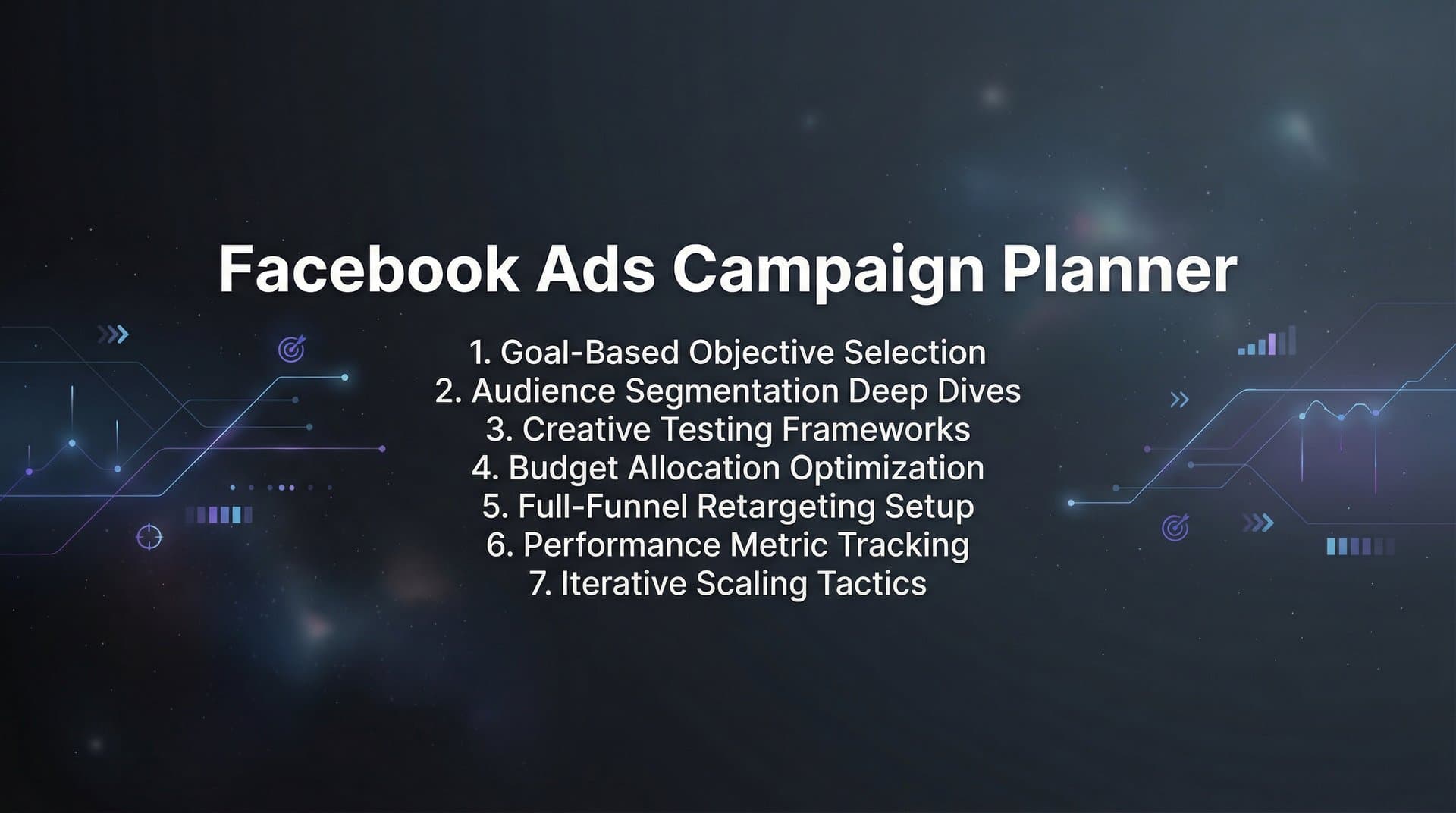
This guide breaks down seven proven strategies that transform Facebook ad planning from overwhelming to systematic. Each builds on the last, creating a complete framework for campaigns that convert from day one. Whether you're planning your first campaign or your thousandth, these strategies give you the structure to move faster and smarter.
1. Reverse-Engineered Goals
The Challenge It Solves
Setting campaign goals as vague targets like "increase sales" or "generate more leads" leaves you flying blind. You launch campaigns without knowing if your results are actually good, bad, or salvageable. When performance dips, you can't pinpoint where the funnel broke because you never mapped the journey in the first place.
Most advertisers work forward from budget to hope, rather than backward from goals to requirements. This creates a fundamental disconnect between what you're spending and what you need to achieve. You end up reacting to results instead of proactively building campaigns designed to hit specific targets.
The Strategy Explained
Reverse-engineering starts with your end goal and works backward through every conversion stage, calculating exactly what you need at each step. If you need $50,000 in revenue with a $100 average order value, you need 500 purchases. If your landing page converts at 3%, you need 16,667 landing page visits. If your ad click-through rate is 2%, you need 833,350 impressions.
This approach transforms abstract goals into concrete benchmarks. You know exactly what "good" looks like at every stage before you launch. When performance deviates, you immediately see which specific metric needs attention rather than guessing where to optimize.
The power comes from building campaigns with clear success criteria from day one. Instead of wondering if 1,000 link clicks is good or bad, you know you needed 1,200 to stay on track for your revenue goal. This clarity speeds up decision-making and eliminates wasted spend on campaigns that were never going to hit target.
Implementation Steps
1. Start with your revenue or conversion goal for the campaign period, then divide by your average order value or lead value to determine required conversions.
2. Work backward through your funnel using historical conversion rates—if you lack data, use conservative industry benchmarks and adjust as you gather performance data.
3. Calculate required metrics at each stage: conversions needed → landing page visitors required → ad clicks necessary → impressions to generate those clicks → daily budget to reach that impression volume.
4. Document these benchmarks in your campaign brief so every team member knows what success looks like at each funnel stage, not just the final conversion number.
Pro Tips
Build in a 20% buffer for your calculations to account for performance fluctuations and learning phases. Your campaigns won't hit perfect efficiency from day one, so planning for slightly higher volume requirements prevents panic when early results run below target. Update your benchmarks monthly as you gather real performance data—your initial calculations are educated guesses that should evolve into precise forecasts.
2. Audience Architecture
The Challenge It Solves
Launching campaigns without mapping the complete customer journey means you're serving the same message to people at wildly different stages of awareness. Someone who's never heard of your brand needs different messaging than someone who abandoned their cart yesterday. When you treat all audiences the same, you waste budget on mismatched messages that don't resonate.
The typical approach—building audiences as you go—creates fragmented campaigns with overlapping targeting and inconsistent messaging. You end up competing against yourself in the auction while confusing prospects with contradictory offers at the wrong stages of their journey.
The Strategy Explained
Audience architecture means mapping your complete customer journey before building a single campaign, then segmenting audiences by temperature to ensure strategic targeting from the start. Cold audiences see awareness content, warm audiences get consideration messaging, and hot audiences receive conversion-focused offers.
This framework creates a logical progression where each audience segment receives messaging aligned with their current relationship with your brand. Someone who visited your pricing page gets different creative than someone who just discovered you through an interest-based ad. The result is higher relevance, better engagement, and more efficient spend.
Think of it like building a house—you need the architectural blueprint before you start construction. Your audience architecture document becomes the blueprint that guides every targeting decision, ensuring campaigns work together as a cohesive system rather than isolated experiments.
Implementation Steps
1. Map your customer journey from first awareness through purchase, identifying every touchpoint where prospects interact with your brand—website visits, content consumption, email engagement, social interactions.
2. Segment audiences into temperature tiers: cold (interest-based, lookalike), warm (engaged with content, visited site, interacted on social), hot (added to cart, initiated checkout, high-intent page visitors).
3. Define messaging strategy for each tier—awareness content for cold, social proof and comparison content for warm, urgency and incentives for hot—ensuring each audience segment receives contextually appropriate creative.
4. Build exclusion rules to prevent audience overlap, ensuring someone who's already in your warm retargeting pool doesn't also see cold prospecting ads designed for first-time viewers.
Pro Tips
Create a visual map of your audience architecture using a simple flowchart tool. This visual reference helps your entire team understand how audiences progress through your funnel and prevents the common mistake of skipping temperature stages. Review and update your architecture quarterly as you add new products, content, or customer touchpoints—your audience map should evolve with your business.
3. Creative Testing Matrix
The Challenge It Solves
Most creative testing happens reactively—you launch multiple ad variations without a clear hypothesis, then struggle to identify which specific element drove performance differences. When one ad outperforms another, you can't pinpoint whether it was the image, headline, offer, or pure chance. This guessing game wastes budget on inconclusive tests that don't generate actionable insights.
Without structured testing frameworks, you end up with a messy collection of ad variations that test too many variables simultaneously. Statistical significance becomes impossible to determine, and you're left making optimization decisions based on gut feeling rather than validated data.
The Strategy Explained
A creative testing matrix structures systematic tests that isolate meaningful variables and establish statistical significance thresholds before you launch. Instead of randomly testing different combinations, you design controlled experiments where only one element changes at a time. This approach transforms creative testing from chaotic experimentation into scientific validation.
The matrix approach means planning your test sequence in advance. You might test three headline variations first while keeping all other elements constant, then test image styles using the winning headline, then test offer positioning using the winning headline-image combination. Each test builds on validated winners rather than starting from scratch.
This systematic approach accelerates learning because each test produces clear, actionable insights. When you know exactly which variable you're testing and what success looks like, you can confidently scale winners and kill losers without second-guessing your decisions.
Implementation Steps
1. Identify the creative variables you want to test—headlines, images, ad copy angles, offers, call-to-action buttons—and prioritize them based on potential impact and ease of implementation.
2. Design controlled tests where only one variable changes at a time, keeping all other elements constant to ensure clean data attribution when performance differences emerge.
3. Calculate minimum sample size requirements before launching tests, typically aiming for at least 100 conversions per variation to reach statistical significance—adjust based on your conversion volume and confidence level needs.
4. Document your testing roadmap showing test sequence, success criteria, and decision timelines so your team knows exactly what you're testing, why, and when you'll make optimization decisions.
Pro Tips
Start with the creative element that has the biggest potential impact—usually the primary image or video. Once you identify a winning visual style, that becomes your control for testing other elements. Keep a swipe file of winning creative elements organized by category so you can quickly reference proven approaches when building new tests. Remember that creative fatigue happens faster than most advertisers expect—plan to refresh winning ads every 2-3 weeks even if performance hasn't declined yet.
4. Budget Allocation Frameworks
The Challenge It Solves
Deciding how much budget to allocate to proven campaigns versus new tests creates constant tension. Put too much into safe bets and you miss growth opportunities. Invest too heavily in experiments and you sacrifice reliable revenue. Without a framework, budget decisions become emotional reactions to recent performance rather than strategic planning.
Many advertisers approach budget allocation as a monthly negotiation, constantly shifting spend based on what worked last week. This reactive approach prevents you from gathering enough data to validate new strategies while simultaneously starving proven tactics of the budget they need to scale.
The Strategy Explained
Budget allocation frameworks balance proven tactics with experimentation using structured rules and phased planning. Instead of arbitrarily splitting budget, you establish clear allocation principles that guide spending decisions across campaign types, audience segments, and testing initiatives.
A common framework allocates the majority of budget to validated campaigns with proven performance, reserves a portion for testing new audiences or creative approaches, and maintains a small allocation for experimental tactics with higher risk but breakthrough potential. The specific percentages matter less than having a consistent framework that prevents emotional budget shifts.
This approach creates stability in your campaign planning while ensuring continuous innovation. Your proven campaigns get the fuel they need to scale, your testing pipeline stays active with consistent budget, and you maintain strategic optionality for pursuing new opportunities without derailing core performance.
Implementation Steps
1. Analyze your current campaign portfolio and categorize spend into proven performers, active tests, and experimental initiatives—this baseline shows how you're actually allocating budget versus how you think you are.
2. Establish allocation rules based on campaign maturity and performance confidence, such as dedicating larger portions to campaigns with at least 90 days of profitable performance history.
3. Build phased budget plans that start new campaigns with learning budgets, then systematically increase allocation as they hit predefined performance thresholds—avoid the common mistake of launching tests with massive budgets before validation.
4. Schedule monthly budget reviews using your allocation framework to guide decisions, but resist the urge to make dramatic shifts based on short-term fluctuations—good frameworks provide stability through normal performance variance.
Pro Tips
Create a simple spreadsheet that automatically calculates your allocation percentages as you adjust campaign budgets. This visual reference prevents you from accidentally over-allocating to one category while starving others. When proven campaigns hit efficiency plateaus, resist the temptation to keep pouring in budget—that's your signal to shift more allocation toward testing new approaches rather than forcing diminishing returns from exhausted audiences.
5. Campaign Naming Convention System
The Challenge It Solves
Inconsistent campaign naming creates chaos that compounds as your account grows. Six months in, you're scrolling through dozens of campaigns named "Test Campaign 3" or "New Ad Set - Copy" trying to remember what each one actually does. Reporting becomes a nightmare because you can't quickly filter by campaign type, audience, or objective.
The real cost isn't just wasted time—it's missed insights. Without systematic naming, you can't easily analyze performance patterns across similar campaign types. You lose the ability to quickly identify which audiences, offers, or creative approaches are working because everything's labeled inconsistently.
The Strategy Explained
A campaign naming convention system implements standardized taxonomy across all campaign elements, enabling accurate analysis and cross-platform tracking from day one. Your naming structure becomes a data layer that makes every campaign instantly identifiable and reportable without opening it.
The best naming conventions follow a logical hierarchy that captures essential information in a scannable format. This might include campaign objective, audience type, offer or product, creative variant, and date launched—all in a consistent order that your entire team understands.
This systematic approach transforms your Ads Manager from a confusing list into an organized dashboard where patterns jump out immediately. You can instantly see all retargeting campaigns, all campaigns targeting a specific audience segment, or all campaigns launched in a particular month just by scanning campaign names.
Implementation Steps
1. Design your naming structure using a consistent separator like underscores or pipes, organizing information hierarchically from most to least important—typically objective, audience, offer, creative variant, date.
2. Create a naming convention document with examples for every campaign type you run, showing exactly how to name campaigns, ad sets, and ads using your established format.
3. Implement the system immediately for all new campaigns and schedule time to rename existing campaigns in batches—starting with your highest-spend campaigns for maximum immediate impact.
4. Build naming convention into your campaign launch checklist so every team member follows the system automatically, preventing the drift that happens when naming is optional rather than mandatory.
Pro Tips
Keep your naming structure under 60 characters when possible so it displays fully in Ads Manager without truncation. Use abbreviations consistently—if you abbreviate "Retargeting" as "RT" in one campaign, use "RT" everywhere, not "Retarg" or "Retargeting" interchangeably. Include version numbers in your creative names so you can track iterations—"Video_V3" immediately tells you this is the third version of that video creative, making it easy to identify your latest tests.
6. Optimization Checkpoints
The Challenge It Solves
Most optimization happens reactively when someone notices performance has declined. By then, you've already wasted budget on underperforming campaigns that should have been paused days ago. Conversely, winning campaigns sit at modest budgets because no one's monitoring them closely enough to recognize scaling opportunities in real-time.
Without pre-scheduled decision points, optimization becomes sporadic and emotional. You make changes based on panic rather than data, often interrupting campaigns during their learning phase or killing tests before they've generated enough data to draw valid conclusions.
The Strategy Explained
Optimization checkpoints mean pre-scheduling specific decision points with defined kill criteria and scaling triggers based on learning phase timelines. Instead of checking campaigns randomly, you establish systematic review cadences aligned with how Facebook's algorithm actually works.
This approach respects the learning phase while maintaining control. You know exactly when to evaluate performance—not too early to make hasty decisions, not too late to waste significant budget. Your kill criteria are established before launch, removing emotion from the decision to pause underperformers.
The power comes from turning optimization from an art into a process. When every campaign has pre-defined checkpoints and decision criteria, your entire team can execute optimizations consistently. New team members know exactly when to review campaigns and what thresholds trigger action.
Implementation Steps
1. Establish checkpoint timing based on learning phase requirements—typically after spending 50 times your target cost per result or generating 50 optimization events, whichever comes first.
2. Define clear kill criteria before launch, such as cost per result exceeding target by more than 30% after exiting learning phase, or less than 5 conversions after spending minimum learning budget.
3. Set scaling triggers that specify exactly when to increase budgets, such as maintaining target cost per result for 3 consecutive days with stable daily conversion volume.
4. Schedule recurring calendar reminders for checkpoint reviews rather than relying on memory—optimization consistency matters more than perfect timing, so systematic reviews beat sporadic genius-level analysis.
Pro Tips
Document your checkpoint decisions in a simple log showing campaign name, checkpoint date, metrics at checkpoint, decision made, and rationale. This historical record becomes invaluable for training new team members and refining your decision criteria over time. When campaigns exit learning phase but performance is borderline, give them one more checkpoint period before killing—sometimes performance stabilizes after the initial learning volatility. For scaling winners, increase budgets by 20-30% maximum at each checkpoint to avoid shocking the algorithm and triggering new learning phases.
7. Planning Automation
The Challenge It Solves
Manual campaign planning creates bottlenecks that slow down your entire advertising operation. You spend hours building campaign structures, researching audiences, drafting ad copy, and organizing creative assets. By the time you're ready to launch, market conditions have shifted or your creative inspiration has gone stale.
The repetitive nature of campaign planning—setting up similar structures, writing variations of proven copy, organizing assets—drains time that should be spent on strategic thinking and creative innovation. Teams managing multiple accounts or high campaign volumes hit capacity limits not because they lack skill, but because manual processes can't scale.
The Strategy Explained
Planning automation leverages AI tools and templates to eliminate repetitive planning bottlenecks and accelerate campaign launches. Instead of manually building every campaign from scratch, you use intelligent systems that learn from your best-performing campaigns and replicate those patterns automatically.
Modern automation goes beyond simple templates. AI-powered platforms analyze your historical performance data to identify winning creative elements, audience combinations, and campaign structures. They then use these insights to build complete campaigns—from structure to targeting to copy—in minutes rather than hours.
The transformation isn't just about speed. Automation ensures consistency across campaigns, eliminates human error in setup, and frees your team to focus on strategic decisions and creative development rather than repetitive execution tasks. Your planning capacity multiplies without adding headcount.
Implementation Steps
1. Audit your current planning process to identify the most time-consuming repetitive tasks—typically campaign structure setup, audience configuration, and ad copy variations.
2. Implement campaign templates for your most common campaign types, documenting your proven structures so they can be replicated quickly without starting from blank slates.
3. Explore AI-powered planning tools that can analyze your performance history and automatically generate campaign plans, audience recommendations, and ad copy variations based on what's actually working in your account.
4. Start with automating one planning stage—such as campaign structure or audience selection—then progressively automate additional stages as you build confidence in the systems.
Pro Tips
Don't try to automate everything at once. Start with the planning stage that creates the biggest bottleneck in your workflow, typically campaign structure setup or creative organization. Once that's running smoothly, add the next automation layer. When evaluating AI planning tools, prioritize platforms that explain their recommendations rather than black-box systems—you need to understand why the AI suggests specific approaches so you can validate the logic and maintain strategic control.
Putting Your Campaign Planner Into Action
The difference between advertisers who consistently hit targets and those who struggle comes down to systematic planning. These seven strategies aren't theoretical concepts—they're practical frameworks that professional media buyers use daily to transform campaign planning from overwhelming to systematic.
Start with your foundation: reverse-engineered goals and audience architecture. These two strategies establish the strategic clarity that makes everything else work. You can't plan effective campaigns without knowing exactly what metrics you need to hit and who you're targeting at each funnel stage.
Layer in your operational systems next: creative testing matrices and budget allocation frameworks. These structures ensure your campaigns generate meaningful insights while maintaining financial discipline. The testing matrix prevents wasted spend on inconclusive experiments, while budget frameworks balance growth with stability.
Your organizational infrastructure—naming conventions and optimization checkpoints—keeps everything running smoothly as you scale. These systems prevent the chaos that typically emerges when accounts grow beyond a few campaigns. They transform scattered campaign management into coordinated execution.
Planning automation becomes your force multiplier. Once you've systematized your approach, automation scales your capacity without sacrificing quality. The best campaign planners aren't the ones with the most complex spreadsheets—they're the ones who've systematized their approach so thoroughly that launching winning campaigns becomes repeatable.
Pick one strategy this week and implement it fully before moving to the next. Trying to adopt all seven simultaneously creates confusion rather than clarity. Master reverse-engineered goals first, then add audience architecture. Build your foundation solid before adding the next layer.
Ready to transform your advertising strategy? Start Free Trial With AdStellar AI and be among the first to launch and scale your ad campaigns 10× faster with our intelligent platform that automatically builds and tests winning ads based on real performance data. Our AI agents handle the repetitive planning work—from campaign structure to audience selection to ad copy—so you can focus on strategy and creative innovation rather than manual execution.