Testing more ad variations is the proven path to better Facebook ad performance. The math is simple: more creative variations tested equals higher probability of finding winners. But here's the problem every performance marketer faces: manually creating dozens of ad variations requires designers, video editors, copywriters, and weeks of production time. By the time you've created enough variations to test meaningfully, your competitors have already moved on to their next campaign.
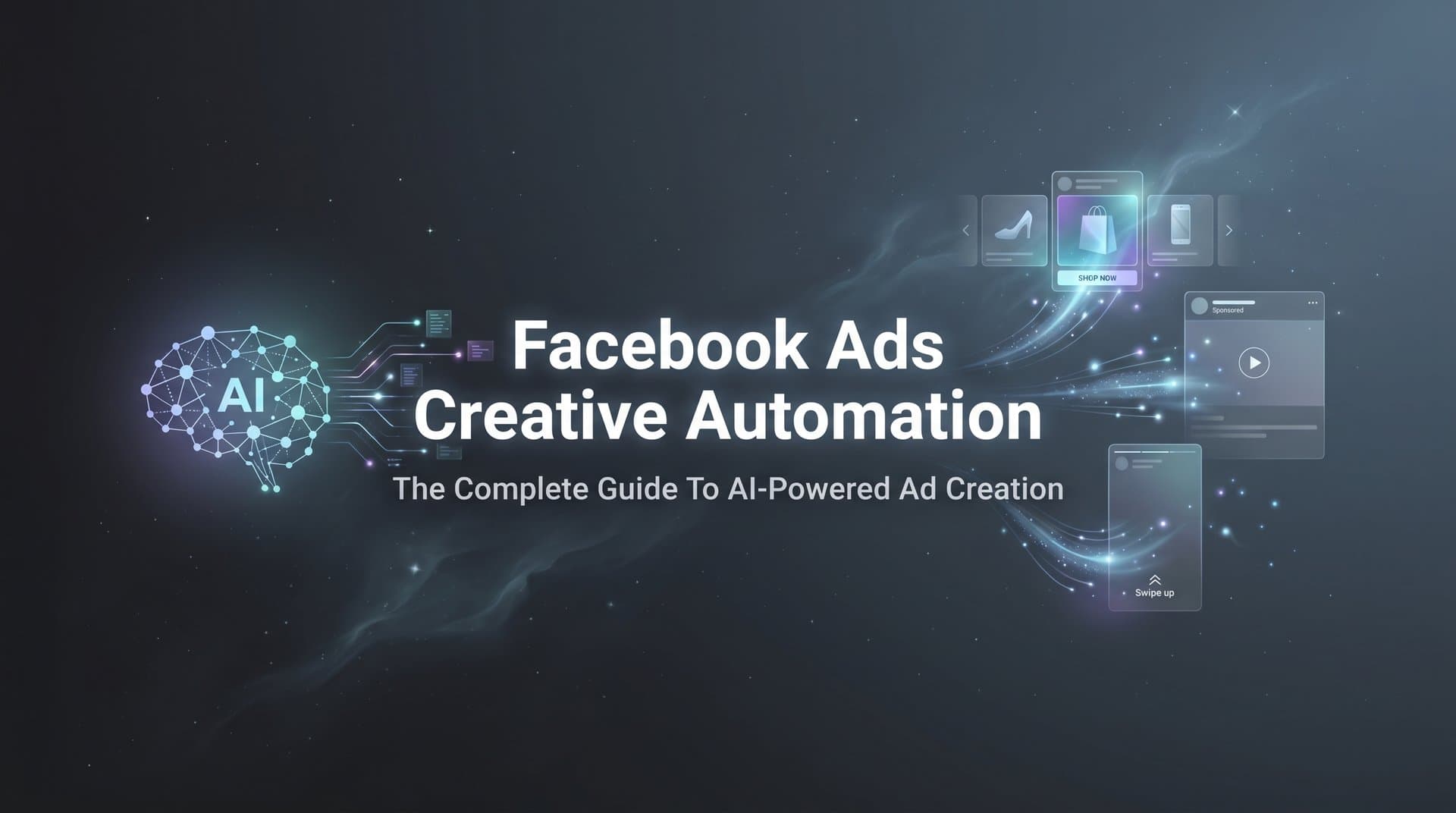
Facebook ads creative automation changes this equation entirely. Instead of spending weeks briefing designers and waiting for revisions, AI-powered systems can generate scroll-stopping image ads, video creatives, and UGC-style content in minutes from nothing more than a product URL or competitor ad example. The result? You can finally test at the scale needed to consistently find winning creatives without expanding your team or your timeline.
This guide breaks down exactly how creative automation works, what technologies power it, and how to implement it effectively in your advertising workflow. We'll cover everything from AI creative generation to bulk campaign launching to performance tracking, showing you how automation removes the production bottleneck that's been limiting your testing velocity.
How Creative Automation Transforms Facebook Ad Production
Creative automation represents a fundamental shift in how advertising teams produce ad assets. At its core, creative automation uses AI-powered systems to generate ad images, videos, and copy variations from minimal inputs. You might provide a product URL, upload a few brand assets, or point the system to a competitor ad you want to adapt. The AI analyzes these inputs and produces multiple creative variations ready to launch.
Think about the traditional creative workflow. You brief a designer on what you need, wait for the first draft, request revisions, go through approval rounds, and finally receive the finished asset days or weeks later. Then you repeat this process for every variation you want to test. If you need 50 ad variations to properly test different angles and formats, you're looking at months of production time.
Creative automation collapses this timeline to minutes. The same 50 variations that would take weeks to produce manually can be generated in a single session. The AI handles the design work, creates video content, writes copy variations, and produces creatives in multiple formats without human designers involved in the execution.
The types of creatives automation can produce have expanded significantly. Static image ads are the foundation, with AI generating product shots, lifestyle imagery, and promotional graphics that match your brand guidelines. Video ads represent the next level, where AI can create product demos, testimonial-style videos, and dynamic content that captures attention in crowded feeds.
UGC-style avatar content has become particularly valuable. These creatives mimic user-generated content with AI avatars that present products in authentic, relatable ways. The format performs well because it feels less like an ad and more like a recommendation from a real person. Creating this style of content traditionally requires hiring actors, booking video shoots, and extensive editing. Automation produces similar results without the production overhead.
Carousel variations add another dimension to automated creative production. The AI can generate multiple images for carousel ads, each highlighting different product features or use cases. This format works especially well for e-commerce, where showing multiple product angles or benefits in a single ad drives higher engagement.
The transformation isn't just about speed. Creative automation enables testing strategies that weren't practical before. When you can generate 100 creative variations as easily as you used to create 5, you can test more angles, more formats, and more messaging approaches. This volume of testing is what separates advertisers who occasionally stumble onto winners from those who systematically discover them through creative testing automation.
The Core Technologies Behind AI Ad Creative Generation
Understanding how AI generates ad creatives helps you use these tools more effectively. The process starts with analysis. When you provide a product URL, the AI doesn't just scrape images. It analyzes the product category, identifies key features and benefits, understands the target audience, and recognizes visual patterns that typically perform well for similar products.
This analysis extends to your brand guidelines. The AI learns your color palette, typography preferences, logo usage rules, and overall aesthetic. Once trained on your brand, it generates creatives that maintain visual consistency across all variations. You're not getting random designs that happen to include your product. You're getting on-brand creatives that look like they came from your in-house design team.
Competitor ad cloning represents one of the most powerful applications of creative automation. Meta Ad Library provides a searchable database of all active ads running on Facebook and Instagram. You can find ads from competitors or brands in your industry, identify creative approaches that are working, and use those as inspiration.
Creative automation tools can analyze these competitor ads and generate similar concepts adapted to your product and brand. The AI identifies the core creative strategy, the visual composition, the messaging angle, and the format. Then it recreates that approach with your product, your branding, and your messaging. You're not copying ads. You're adapting proven creative strategies to your specific context.
This capability dramatically shortens the learning curve. Instead of guessing which creative approaches might work, you can start with concepts that are already performing well in your market. An AI creative generator for Facebook ads handles the adaptation work, ensuring the output matches your brand while capturing the essence of what made the original effective.
Chat-based editing adds an interactive layer to creative generation. After the AI produces initial variations, you can refine them through conversational commands. You might say "make the headline bolder" or "shift the product image to the left" or "try a different background color." The AI interprets these natural language instructions and updates the creative accordingly.
This iterative refinement process means you don't need design skills to get exactly what you want. You can guide the AI's output using plain language, making adjustments until the creative matches your vision. It's the difference between being limited by what the AI generates initially versus having the ability to collaborate with it until you achieve the perfect result.
The underlying machine learning models have been trained on millions of successful ads across different industries and formats. They understand which visual elements tend to drive engagement, how to compose images for maximum impact, and what messaging patterns resonate with different audiences. This training data informs every creative the AI generates, giving you the benefit of insights derived from vast amounts of advertising performance data.
From Creative to Campaign: Automating the Full Workflow
Creative automation delivers maximum value when it connects to your entire campaign workflow. Generating great ad creatives is just the starting point. The real efficiency gain comes from automating the path from creative production to live campaigns with optimized targeting and messaging.
AI-powered campaign building analyzes your historical performance data to inform every decision. The system reviews your past campaigns, identifies which audiences delivered the best results, determines which headlines drove the highest click-through rates, and recognizes which ad copy variations generated the most conversions. This analysis creates a performance baseline that guides new campaign construction.
When you're ready to launch a new campaign, the AI selects audiences based on what has worked before. It generates headline variations that follow patterns proven to perform well for your account. It writes ad copy that incorporates messaging elements from your top-performing ads. Every component of the campaign is optimized based on real data from your advertising history, not generic best practices or guesswork.
The transparency in this process matters. You're not just getting automated campaign recommendations with no explanation. The AI shows you why it selected each audience, which historical data informed each headline choice, and what performance patterns led to specific copy decisions. This transparency helps you understand the strategy behind the automation, building confidence in the recommendations and helping you learn what works for your specific business.
Bulk launching takes campaign automation to the next level. Traditional campaign setup is linear: you create one ad set with one audience and a few ad variations, then repeat the process for each additional audience or creative combination you want to test. Creating hundreds of variations this way is tedious and error-prone.
Bulk launching works differently. You select multiple creatives, multiple audiences, multiple headlines, and multiple copy variations. The system generates every possible combination and creates the corresponding ad sets and ads in Meta Ads Manager. If you have 10 creatives, 5 audiences, and 3 headline variations, that's 150 unique ads. The bulk launcher creates all 150 in minutes, properly structured and ready to go live.
This capability transforms testing methodology. You can simultaneously test creative variations against different audiences, compare how the same creative performs with different headlines, and identify which combinations of elements drive the best results. The volume of testing that becomes possible reveals insights you'd never discover testing one or two variations at a time.
The AI's analysis of historical performance data becomes particularly valuable in bulk testing scenarios. Instead of randomly combining elements, the system can prioritize combinations that share characteristics with your past winners. It might recognize that certain creative styles perform better with specific audiences, or that particular headline patterns work best with certain types of imagery. These insights inform which combinations to test first, increasing the probability of finding winners quickly.
Campaign automation also handles the technical details that consume time in manual workflows. Budget allocation across ad sets, bid strategy selection, campaign structure optimization, and placement choices all get configured automatically based on your goals and historical performance. Understanding the difference between Facebook Ads Manager vs automation tools helps you appreciate how much time this saves. You're not clicking through dozens of settings for each campaign. The AI handles the configuration while you focus on strategy and creative direction.
Measuring Success: AI Insights and Performance Tracking
Automation without measurement creates chaos. The value of creative automation multiplies when paired with AI-powered performance tracking that helps you identify winners and understand why they're working.
Leaderboard systems rank every element of your campaigns by the metrics that matter to your business. Your creatives get scored on ROAS, CPA, CTR, and any other KPIs you're tracking. Your headlines are ranked by which ones drive the highest engagement. Your audiences are ordered by which ones deliver the best conversion rates. Your landing pages are compared based on post-click performance.
The power of this approach lies in goal-based scoring. You set your target benchmarks: maybe you need a minimum ROAS of 3.0, or your maximum acceptable CPA is $25, or you're optimizing for a CTR above 2%. The AI scores every element against these specific goals, not generic industry averages. A creative that delivers a 2.5 ROAS might be excellent for some advertisers and disappointing for others. Goal-based scoring shows you what's working for your specific business objectives.
This granular performance data reveals insights that aggregate campaign metrics miss. You might discover that a particular creative style consistently outperforms others across different audiences. Or that certain headline patterns drive higher click-through rates regardless of which creative they're paired with. Or that specific audience segments respond better to UGC-style content while others prefer polished product shots.
Winners Hub functionality takes these insights and makes them immediately actionable. Your best-performing creatives, headlines, audiences, and other elements are automatically collected in one place with their real performance data attached. When you're building your next campaign, you can browse your winners and instantly add proven elements to the new campaign.
This creates a compounding advantage over time. Your first campaigns might be educated guesses about what will work. But as you accumulate performance data, you build a library of proven winners. Each new campaign can start with elements that have already demonstrated success, increasing your baseline performance and reducing the risk of wasting budget on untested approaches. Effective creative library management becomes essential as your collection of winning assets grows.
The continuous learning loop ensures the AI gets smarter with every campaign you run. As new performance data flows in, the system updates its understanding of what works for your specific business. The audience recommendations become more accurate. The creative suggestions align more closely with your brand's unique performance patterns. The headline variations incorporate language that has proven to resonate with your customers.
This learning happens automatically in the background. You're not manually updating models or reconfiguring algorithms. The AI continuously analyzes new results, identifies patterns, and adjusts its recommendations. The more campaigns you run through the system, the better it becomes at predicting what will work for your next campaign.
Real-time reporting ensures you can act on performance insights immediately. Instead of waiting for weekly reports or manually pulling data from Ads Manager, you see updated performance metrics as they happen. When a creative starts outperforming others, you know right away and can allocate more budget to it. When an audience isn't delivering results, you can pause it before wasting significant spend.
Implementing Creative Automation: Practical Steps
Getting started with creative automation doesn't require a complete overhaul of your advertising workflow. The implementation process is straightforward when you understand what inputs the system needs and how to set it up for success.
The basic inputs for AI creative generation are surprisingly minimal. A product URL gives the AI everything it needs to analyze your offering, understand your value proposition, and generate initial creative variations. The system extracts product images, reads descriptions, identifies key features, and uses this information to create relevant ad creatives.
Brand assets provide the customization layer that ensures generated creatives match your visual identity. Upload your logo, define your color palette, specify your preferred fonts, and provide any brand guidelines you want the AI to follow. These assets become the framework within which the AI operates, ensuring consistency across all generated creatives.
Competitor ad examples offer a shortcut to proven creative strategies. Browse Meta Ad Library for ads from competitors or successful brands in your industry. When you find creative approaches you want to adapt, you can use them as references for the AI to analyze and reinterpret with your product and branding.
Setting performance benchmarks is crucial for effective automation. The AI needs to understand what success looks like for your business. Define your target ROAS, acceptable CPA range, desired CTR, and any other metrics that matter to your goals. These benchmarks guide how the AI scores and ranks different elements, ensuring recommendations align with your specific objectives.
Your historical campaign data, when available, provides valuable context that improves AI recommendations from day one. Connect your Meta Ads account so the system can analyze past performance, identify successful patterns, and understand which audiences and creative approaches have worked for you previously. This historical analysis helps the AI make smarter initial recommendations rather than starting from scratch. Understanding campaign learning in Facebook ads automation helps you leverage this data effectively.
Brand consistency concerns are natural when introducing automation into creative production. The key is understanding that AI creative generation works within the parameters you define. You set the brand guidelines, approve the initial outputs, and maintain control over what goes live. The automation handles execution within your established framework, not creative direction that might deviate from your brand.
Quality control can be structured into your workflow. Many teams start by having the AI generate creative variations, then review and approve them before launching. As you gain confidence in the system's output and it learns your preferences, you can automate more of the approval process. Some advertisers eventually trust the AI to generate and launch creatives automatically, intervening only when performance data suggests adjustments are needed.
Balancing automation with human oversight is about finding the right level for your team and comfort level. You might fully automate creative generation while manually reviewing campaign structure. Or automate both creative and campaign building while keeping budget allocation decisions manual. The flexibility to automate specific parts of the workflow while maintaining control over others lets you adopt automation at your own pace.
Starting with a pilot campaign helps you learn the system without risking your entire advertising budget. Select one product or offer, generate creatives with AI, build an automated campaign, and monitor the results closely. This contained test lets you understand how the automation works, identify any adjustments needed in your setup, and build confidence before scaling to more campaigns. For newcomers, exploring Facebook ads automation for beginners provides a solid foundation.
The New Reality of Facebook Advertising
Facebook ads creative automation removes the production bottleneck that has prevented most advertisers from testing at the scale required to consistently find winners. When you can generate dozens of creative variations in minutes instead of weeks, test hundreds of combinations through bulk launching, and immediately identify top performers with AI-powered insights, you're operating at a different level than competitors stuck in manual workflows.
The full-funnel benefit extends from creative generation through campaign optimization to performance analysis. You're not just automating one piece of the puzzle. You're streamlining the entire path from initial creative concept to live campaign to data-driven optimization. This integrated approach compounds the time savings and performance improvements at each stage.
The continuous learning loop means your advertising gets smarter over time. Every campaign adds to your library of proven winners. Every test reveals new insights about what resonates with your audience. Every performance data point helps the AI make better recommendations for your next campaign. You're building an advertising system that improves with use, not just executing one-off campaigns.
Ready to transform your advertising strategy? Start Free Trial With AdStellar and be among the first to launch and scale your ad campaigns 10× faster with our intelligent platform that automatically builds and tests winning ads based on real performance data. Generate scroll-stopping creatives, launch optimized campaigns, and surface your top performers all in one place.