Your course could change lives. But right now, it's sitting there with five enrolled students and a launch that fizzled out faster than your enthusiasm on day three of creating it. You've poured months into developing the curriculum, recording videos, and building the perfect learning experience. The problem isn't your course. It's that nobody knows it exists.
Facebook and Instagram ads should be your answer, but course creators face a unique challenge that makes advertising tricky. You're not selling a widget someone can hold or a shirt they can see on a model. You're selling transformation, expertise, and a promise of future results to people who might not even realize they need what you're offering yet.
The course creators who consistently fill their launches understand something fundamental: advertising an online course requires completely different strategies than promoting physical products. You need longer nurture sequences, trust-building content, and messaging that speaks to transformation rather than features. The good news? When you get these strategies right, Facebook ads become your most reliable enrollment engine.
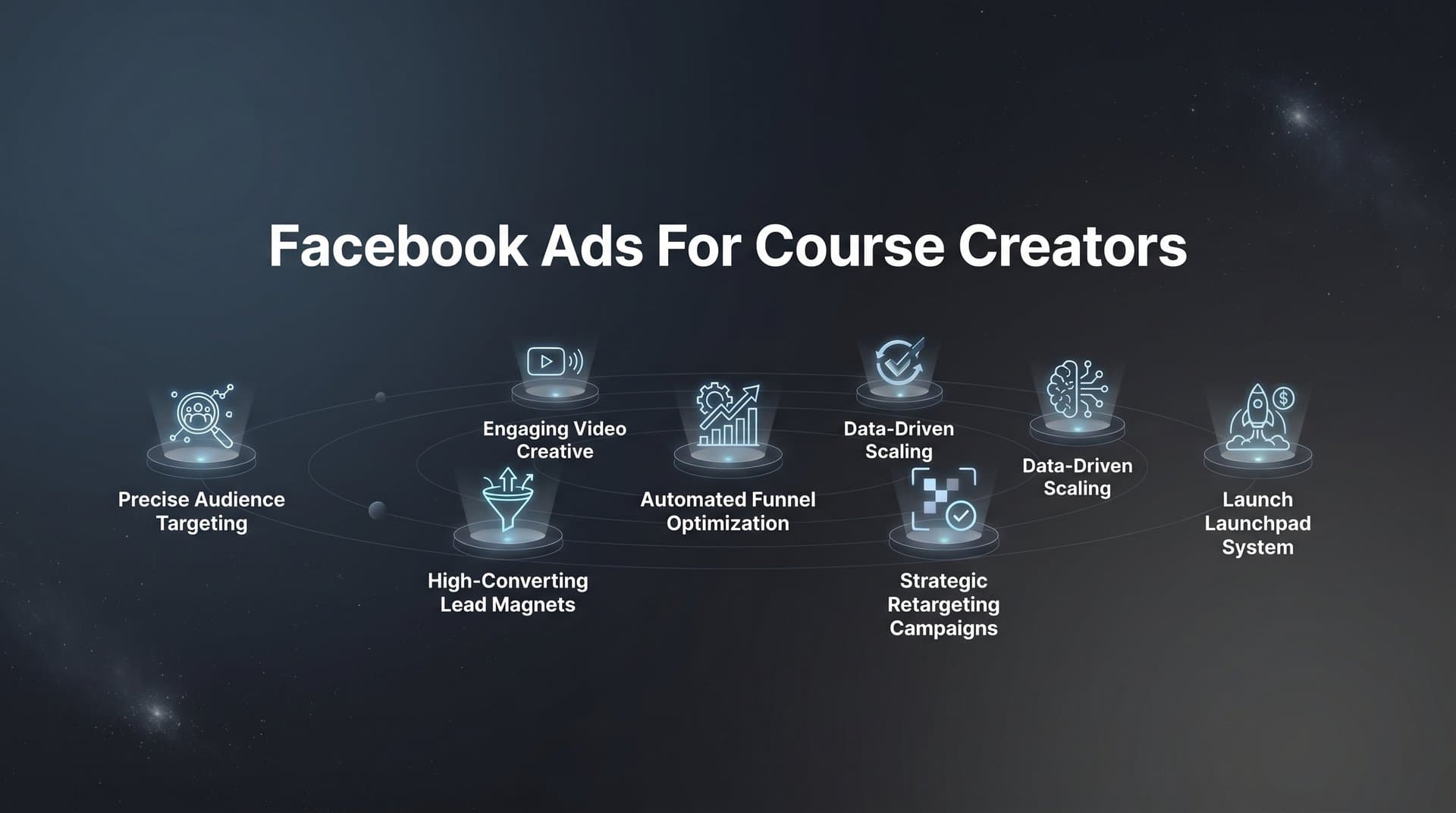
These seven proven approaches will help you attract qualified leads, reduce your cost per acquisition, and convert cold audiences into enthusiastic students. Whether you're launching your first course or scaling an established program, these strategies work because they're built specifically for the unique dynamics of selling digital education.
1. Lead With Transformation, Not Curriculum
The Challenge It Solves
Your potential students don't wake up thinking, "I really need a six-module course on email marketing today." They wake up frustrated that their business isn't growing, that they're working too many hours, or that they can't figure out why their launches keep failing. When your ad copy leads with your course structure, modules, or features, you're speaking a language nobody cares about yet.
This disconnect kills conversions before they start. Prospects scroll past ads that list "Module 1: Introduction to X" or "12 comprehensive lessons covering Y" because those details mean nothing to someone who hasn't bought into the transformation yet. You're trying to close the sale before you've opened the conversation.
The Strategy Explained
Transformation-focused messaging flips the script entirely. Instead of leading with what your course contains, you lead with what your student becomes after completing it. Your ad creative and copy should paint a vivid picture of the "after" state, making it so tangible that prospects can see themselves living it.
Think about the specific, measurable changes your students experience. Not vague promises like "grow your business," but concrete outcomes like "confidently pitch clients at $5,000 per project instead of accepting $500 gigs." The more specific your transformation promise, the more it resonates with the right people.
This approach works because it meets prospects where they actually are in their journey. They're problem-aware and solution-aware, but they're not yet product-aware. Your job is to connect their current pain point directly to the future state they desire, positioning your course as the bridge between the two. Understanding AI copywriting for Facebook ads can help you craft these transformation-focused messages more effectively.
Implementation Steps
1. Identify the top three specific, measurable transformations your past students have experienced and write them down as "before and after" statements that highlight the contrast.
2. Create ad variations that lead with these transformation statements in the headline, using your course content as supporting evidence rather than the main message.
3. Test different transformation angles against each other to discover which outcomes resonate most strongly with your target audience, then double down on winners.
Pro Tips
Use real student language when describing transformations. The words your successful students use to describe their results will resonate far more than marketing copy you invent. Mine testimonials and feedback forms for phrases that capture the emotional and practical shifts your course creates, then incorporate that exact language into your ads.
2. Build a Value-First Funnel With Free Content
The Challenge It Solves
Asking cold traffic to buy a $997 course directly from an ad is like proposing marriage on the first date. It occasionally works, but mostly it just makes people uncomfortable and sends them running. Course creators who try to sell directly from ads typically see cost-per-acquisitions that make the math impossible, burning through budgets without generating meaningful enrollments.
The trust gap is real. Potential students need to experience your teaching style, verify your expertise, and believe in your methodology before they'll hand over significant money for an intangible product they can't preview or return easily.
The Strategy Explained
A value-first funnel solves this by offering something genuinely useful for free in exchange for an email address. This could be a PDF guide, a mini-course, a live workshop, or a challenge. The key is that this free content must deliver real value while demonstrating your expertise and giving prospects a taste of your teaching style.
Once someone opts in, you've started a relationship. Now you can nurture them with additional free content via email, retargeting ads, and follow-up sequences that gradually build trust and desire for your paid course. Mastering AI Facebook ads for lead generation can dramatically improve your opt-in rates while reducing costs.
The economics work because you're spreading the customer acquisition cost across a longer timeline. Instead of spending $300 to acquire one course sale from cold traffic, you might spend $5 to acquire a lead, then convert 10% of those leads into customers through your nurture sequence. Same economics, but much more sustainable and scalable.
Implementation Steps
1. Create a high-value lead magnet that solves one specific problem your ideal student faces and demonstrates your unique approach to solving it.
2. Set up Facebook ads optimized for lead generation that drive traffic to a landing page where visitors can access your free content in exchange for their email address.
3. Build an email nurture sequence that delivers the promised value while gradually introducing your paid course as the natural next step for people who want deeper results.
Pro Tips
Your lead magnet should be so good that people would pay for it. If your free content is mediocre, prospects assume your paid course will be too. Overdeliver on your free offer to create a "wow" moment that makes people eager to see what you charge for. The best lead magnets solve a small problem completely rather than addressing a big problem superficially.
3. Use Video Ads to Establish Authority Fast
The Challenge It Solves
Static image ads can generate clicks, but they can't convey your personality, teaching style, or the depth of your expertise in the same way video can. For course creators, this is a critical gap. Potential students aren't just buying information, they're buying YOU as their guide and instructor. They need to know if they'll actually enjoy learning from you before they commit.
Video also helps you stand out in increasingly crowded feeds. When dozens of course creators are competing for the same audience's attention, a compelling video ad creates pattern interruption and gives you more real estate to make your case.
The Strategy Explained
Video ads for course creators work best when they position you as the expert guide while delivering a quick win or insight that prospects can use immediately. Think of your video as a micro-lesson that demonstrates your teaching ability while addressing a specific pain point your audience faces.
The most effective video ads for courses typically run between 60 and 90 seconds. They open with a hook that calls out the specific problem, transition quickly into teaching a concept or strategy, and close with a clear call to action. Understanding the proper video dimensions for Facebook ads ensures your content displays correctly across all placements.
Video also gives you multiple targeting options. You can create custom audiences of people who watch specific percentages of your video, then retarget them with different messaging based on their engagement level. Someone who watches 75% of your video is much warmer than someone who watches 10%, and your follow-up ads should reflect that difference.
Implementation Steps
1. Script a 60 to 90 second video that teaches one specific tactic or reframes one common misconception in your niche, opening with a pattern-interrupt hook that stops the scroll.
2. Record the video using your phone or webcam in a well-lit space, speaking directly to camera as if you're talking to a friend who needs your help with this specific problem.
3. Launch the video as an ad to your target audience, then create custom audiences based on viewing percentages and retarget engaged viewers with follow-up content that moves them deeper into your funnel.
Pro Tips
Add captions to every video ad. Most people watch Facebook videos with sound off, so captions aren't optional. They're essential for ensuring your message lands. Use the first three seconds to create curiosity or call out a specific problem, because that's your window to stop someone from scrolling past. If you nail the hook, viewers will stick around for the value.
4. Target Interest Stacks Instead of Broad Audiences
The Challenge It Solves
Targeting "entrepreneurs" or "small business owners" sounds logical, but these audiences are so broad that you're competing with thousands of other advertisers while reaching millions of people who have zero interest in your specific topic. Broad targeting burns budget showing your ads to people who will never convert, driving up costs while delivering poor results.
Course creators need precision. Your ideal student isn't just "interested in marketing." They're interested in specific methodologies, follow particular thought leaders, use certain tools, and engage with niche communities. Finding these people requires a more sophisticated targeting approach.
The Strategy Explained
Interest stacking combines multiple specific interests and behaviors to create highly qualified audience segments. Instead of targeting one broad interest, you layer three to five specific interests together, creating an audience of people who match multiple criteria that indicate they're your ideal student.
For example, if you teach a course on email marketing for coaches, you might create an audience interested in "email marketing" AND "ConvertKit" AND "online coaching" AND follows "Amy Porterfield." This stacked approach dramatically reduces your audience size while increasing relevance, putting your ads in front of people who are much more likely to care about what you teach.
The key is understanding the ecosystem your ideal students operate in. What tools do they use? Which thought leaders do they follow? What publications do they read? Leveraging an AI-powered Facebook ads platform can help you identify and test these audience combinations more efficiently.
Implementation Steps
1. Survey your existing students or create a profile of your ideal student, identifying the specific tools they use, influencers they follow, and communities they participate in.
2. Create multiple ad sets with different interest stack combinations, testing which combinations deliver the lowest cost per lead or acquisition.
3. Monitor performance data to identify which interest stacks attract the most qualified leads, then allocate more budget to those winning combinations while pausing underperformers.
Pro Tips
Don't make your stacked audiences too narrow. If your audience size drops below 50,000 people, you might limit Facebook's ability to optimize delivery. Start with three interests and expand from there, finding the sweet spot between precision and scale. Also test exclusion targeting to remove people who've already purchased your course or who are clearly not your ideal student based on conflicting interests.
5. Create Urgency With Launch-Based Campaigns
The Challenge It Solves
Evergreen courses with always-open enrollment sound appealing because they promise passive income, but they often struggle with Facebook ads because there's no compelling reason for prospects to act now rather than later. Without urgency, people bookmark your page, add your course to their mental "someday" list, and never actually enroll.
This lack of urgency also makes it harder to justify aggressive ad spending. When there's no deadline, there's no peak enrollment period to optimize for, making it difficult to scale campaigns with confidence.
The Strategy Explained
Launch-based campaigns with clear enrollment windows create natural urgency that drives action. When prospects know your course only opens for enrollment during specific periods, they're forced to make a decision rather than indefinitely postponing it. This scarcity is real, not manufactured, which makes it ethically sound and highly effective.
The launch model also allows you to concentrate your advertising budget during high-intent periods. Instead of spreading your budget thin across the entire year, you can invest heavily during the weeks leading up to and during your enrollment window, maximizing visibility when it matters most. Using bulk Facebook ads for product launches helps you scale creative production during these critical windows.
Successful launch-based campaigns typically follow a predictable sequence: pre-launch content that builds awareness and desire, launch week ads that drive enrollment with urgency messaging, and last-chance ads in the final 48 hours that convert fence-sitters. Each phase has different messaging and creative that matches where prospects are in their decision journey.
Implementation Steps
1. Schedule your course launches in advance with clear open and close dates, giving yourself at least 6 to 8 weeks between launches to build anticipation and avoid audience fatigue.
2. Create a phased advertising campaign that starts with awareness content 3 to 4 weeks before enrollment opens, shifts to enrollment-focused ads during the launch window, and intensifies with urgency messaging in the final 48 hours.
3. Use countdown timers in your ads and landing pages during the launch period to reinforce the deadline and create visual urgency that drives immediate action.
Pro Tips
The most successful course creators use their closed enrollment periods strategically, continuing to run ads to their lead magnet funnel even when the course is closed. This builds your email list with qualified prospects who will be ready to buy when you open enrollment again. The combination of launch urgency and year-round list building creates a sustainable, scalable enrollment engine.
6. Leverage Social Proof at Every Touchpoint
The Challenge It Solves
Online courses require a significant leap of faith from buyers. Unlike physical products that can be returned or services that can be experienced in person, courses are largely intangible until someone goes through them. Prospects can't preview the full curriculum, they can't test drive your teaching style beyond free samples, and they can't be certain the course will deliver the promised transformation.
This uncertainty creates friction that kills conversions. Even when prospects are interested in your topic and trust your expertise somewhat, doubt creeps in. "Will this actually work for me? Has anyone like me succeeded with this? Is this instructor legitimate or just another guru selling hype?"
The Strategy Explained
Social proof removes doubt by showing prospects that real people with real names and real results have successfully completed your course and achieved the transformation you promise. This isn't about collecting generic five-star ratings. It's about gathering and displaying specific, detailed testimonials that address the exact objections and questions your prospects have.
The most powerful social proof for course creators includes three elements: the student's name and photo for credibility, the specific result they achieved with concrete details, and the emotional transformation they experienced. Generic praise like "great course" means nothing. Specific testimonials like "I landed my first $8,000 client within three weeks of finishing Module 4" create belief.
Social proof should appear everywhere in your advertising funnel. Your ad creative should feature testimonials or student results. Your landing pages should showcase multiple success stories. Using an AI creative generator for Facebook ads can help you quickly produce multiple testimonial-based ad variations to test.
Implementation Steps
1. Systematically collect detailed testimonials from every successful student, asking specific questions about their before state, the transformation process, and their after results with measurable details.
2. Create a library of social proof assets including text testimonials, video testimonials, before-and-after screenshots, and case study summaries that highlight different types of results and student demographics.
3. Rotate different social proof elements throughout your ad campaigns and landing pages, testing which testimonials and success stories generate the highest conversion rates with your target audience.
Pro Tips
Match your social proof to your prospect's stage of awareness. Early in your funnel, use testimonials that address whether your teaching style is engaging and whether the course is worth the time investment. Later in your funnel, use testimonials that address ROI concerns and specific result metrics. Also prioritize video testimonials when possible because seeing and hearing a real person describing their experience creates far more trust than text alone.
7. Scale Winners With Systematic Creative Testing
The Challenge It Solves
Course creator audiences are often niche, which means ad creative fatigues faster than it would for broader consumer products. An ad that performs brilliantly for two weeks suddenly stops working as your target audience sees it repeatedly. Without a systematic approach to testing new creative variations, your campaigns plateau or decline just when you want to scale them.
Many course creators also struggle with creative production bottlenecks. They know they need fresh ads, but creating new videos, graphics, and copy feels overwhelming, especially when they're also running their business and serving existing students. This bottleneck limits growth and makes scaling campaigns feel impossible.
The Strategy Explained
Systematic creative testing means building a repeatable framework for generating and testing new ad variations consistently. Instead of creating ads randomly when inspiration strikes, you establish a testing schedule and methodology that ensures fresh creative enters your campaigns regularly. Using an automated Facebook ads testing platform removes much of the manual work from this process.
The most effective testing framework focuses on isolating variables. Test one element at a time so you know what's actually driving performance differences. Start with your hook, testing different opening lines or first three seconds of video while keeping everything else constant. Then test different transformation promises, different social proof elements, different calls to action, and different visual styles.
AI-powered tools have transformed creative production for course creators. Platforms like AdStellar can generate multiple ad variations from a single concept, test them automatically, and surface the winners based on real performance data. This eliminates the production bottleneck while giving you data-driven insights about what resonates with your audience. You're no longer guessing which creative will work because the AI tests systematically and learns from every campaign.
Implementation Steps
1. Establish a testing calendar that introduces new creative variations weekly, focusing on one variable at a time so you can clearly attribute performance changes to specific elements.
2. Create a swipe file of your best-performing ads, documenting what made them successful so you can replicate those elements in future creative while testing new variations. A Facebook ads performance tracking dashboard helps you identify these winning patterns.
3. Use AI creative tools to accelerate production by generating multiple variations of winning concepts, allowing you to test more ideas faster without increasing your workload or hiring additional team members.
Pro Tips
Don't kill ads too quickly. An ad needs at least 1,000 impressions before you have enough data to evaluate its performance accurately. Similarly, don't let winning ads run forever without testing new variations. Even your best ads will fatigue eventually, so always have new creative in testing that's ready to replace declining performers. The goal is continuous optimization, not finding one perfect ad that works forever.
Putting It All Together
These seven strategies work because they're built specifically for the unique dynamics of selling online courses through Facebook and Instagram ads. You're not selling a commodity product where the lowest price wins. You're selling transformation, expertise, and a promise that requires trust before money changes hands.
Start with strategy two, building your value-first funnel with free content. This gives you a sustainable way to attract leads and start conversations without requiring massive ad budgets. Once your lead generation funnel is converting consistently, layer in video content to accelerate trust-building and showcase your teaching style.
As you gather data, implement systematic creative testing to identify what resonates with your specific audience. Your winning ads will look different from every other course creator's winners because your audience, positioning, and teaching style are unique. Testing reveals what works for you specifically, not what works in theory.
Focus on transformation messaging throughout your entire funnel. From your first ad impression to your final enrollment email, keep the conversation centered on where your students are now and where they'll be after completing your course. The curriculum details matter, but only after someone believes in the transformation.
The course creators who consistently fill their launches aren't necessarily those with the biggest advertising budgets. They're the ones who commit to testing, optimization, and systematic improvement. They understand that Facebook advertising is a skill that improves with practice and data, not a lottery where you hope for lucky breaks.
Ready to transform your advertising strategy? Start Free Trial With AdStellar and be among the first to launch and scale your ad campaigns 10× faster with our intelligent platform that automatically builds and tests winning ads based on real performance data. Generate scroll-stopping creatives, launch campaigns with AI-optimized audiences and copy, and surface your winners with real-time insights across every creative and campaign. One platform from creative to conversion, built for course creators who want to fill their next launch without the guesswork.