Facebook Ads reporting gives you a lot of data. The problem is that data and truth are not always the same thing.
Attribution windows get cut short. Cross-device journeys disappear into the void. View-through conversions inflate your numbers. And the metrics Meta defaults to showing you do not always map to what actually matters for your business. For performance marketers and agencies managing serious ad spend, these are not minor nuisances. They lead to budget misallocation, misread creative performance, and campaigns that look profitable inside Ads Manager while quietly underperforming in the real world.
The good news is that these gaps are workable. You cannot fix Meta's reporting architecture from the outside, but you can build systems around it that give you a much clearer picture of what is actually happening.
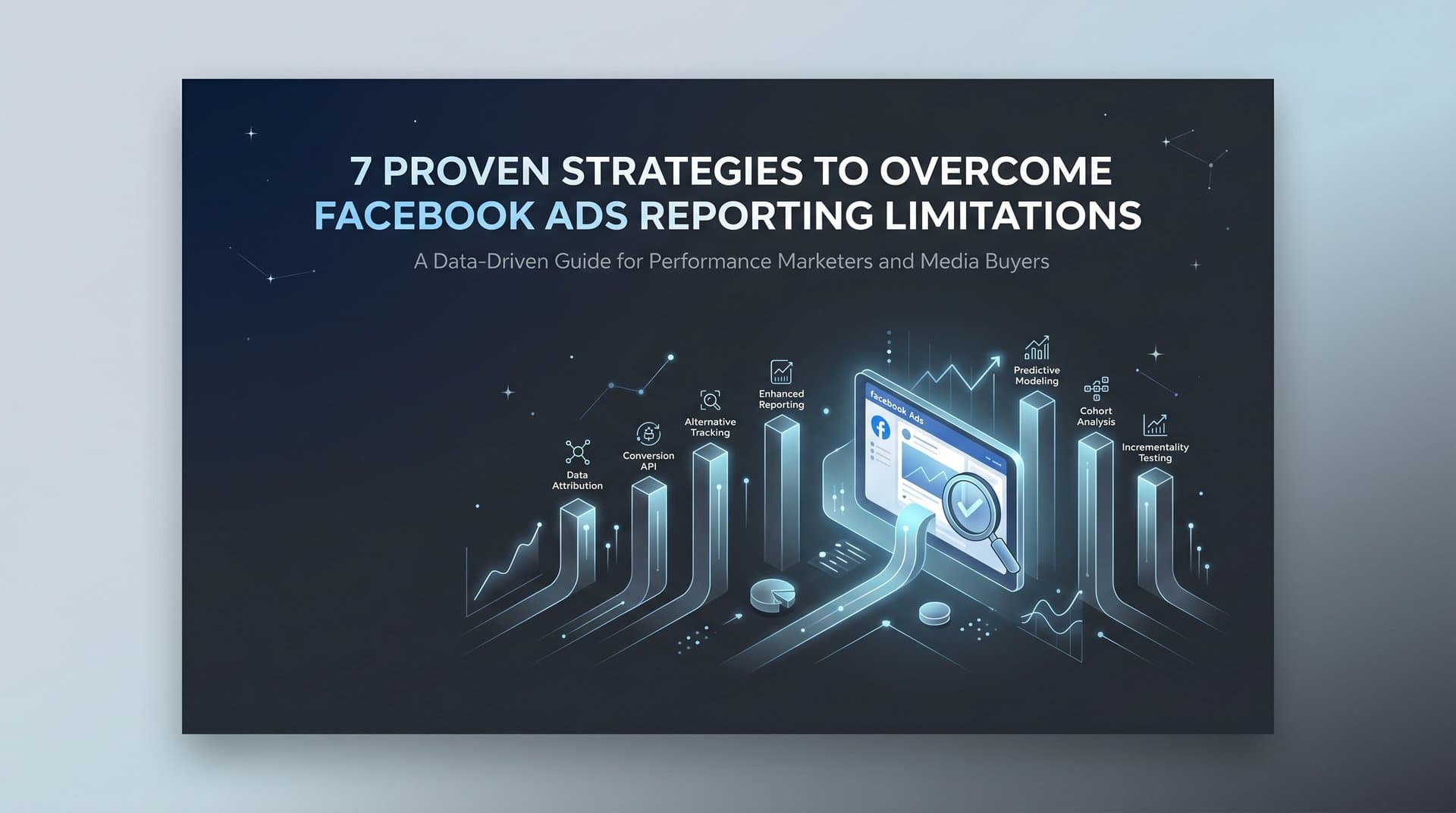
This article walks through seven practical strategies to address the most common Facebook ads reporting limitations. Whether you are dealing with iOS privacy restrictions, incomplete conversion data, or difficulty identifying which creatives are genuinely driving results, each strategy gives you a concrete path forward. You will learn how to layer in third-party attribution, build custom reporting frameworks, and use AI-powered tools to surface the insights Meta's native reporting was never designed to show you.
1. Layer in Third-Party Attribution to Fill the Conversion Gap
The Challenge It Solves
Since Apple introduced App Tracking Transparency in 2021, Meta's ability to track off-platform conversions has been significantly reduced. Meta itself has acknowledged this impact in investor communications and official documentation. The practical result is that Ads Manager frequently underreports or misattributes conversions for campaigns targeting iOS users, leaving you with a systematically incomplete picture of campaign performance.
The Strategy Explained
Third-party attribution tools operate independently of Meta's tracking infrastructure. Rather than relying solely on the Meta Pixel and its privacy-constrained data, platforms like Cometly capture conversion signals through server-side tracking and first-party data, then reconcile those signals against your ad spend across channels.
Running Ads Manager and a third-party attribution tool in parallel lets you compare what Meta claims versus what is actually happening downstream. When the numbers diverge significantly, that gap is your signal to dig deeper. Over time, you build a much more reliable baseline for evaluating campaign performance.
Implementation Steps
1. Select an attribution platform that integrates with Meta and supports server-side event tracking. Cometly integrates directly with AdStellar, making it a natural starting point if you are already using that ecosystem.
2. Set up parallel tracking so both Meta's Pixel and your third-party tool are firing on the same conversion events simultaneously.
3. Run both systems for at least two to four weeks before drawing conclusions. You need enough data to identify consistent patterns in how the numbers diverge.
4. Use the third-party data as your primary source of truth for budget allocation decisions, while using Ads Manager for creative and audience optimization signals.
Pro Tips
Do not try to reconcile every discrepancy. Some variance is expected and normal. Focus on identifying systematic gaps, such as a particular campaign type or audience segment that consistently shows a large difference between Meta-reported and third-party-reported conversions. Those patterns are where your biggest optimization opportunities live.
2. Build a Custom Reporting Dashboard Outside of Ads Manager
The Challenge It Solves
Ads Manager is designed to show you the metrics Meta wants you to see, which are not always the metrics that align with your actual business goals. Default views prioritize Meta's own attribution model, and the interface makes it genuinely difficult to surface cross-campaign trends, compare creative performance over time, or connect ad data to downstream business outcomes like revenue per customer or lifetime value. Understanding the full scope of Facebook Ads Manager limitations is the first step toward building something better.
The Strategy Explained
Building a reporting layer outside of Ads Manager means pulling raw data via the Meta Marketing API or export tools and restructuring it around the questions you actually need to answer. This could be a custom dashboard in a business intelligence tool, a structured spreadsheet framework, or a dedicated Facebook ads reporting dashboard that aggregates data from multiple sources.
The goal is to replace Meta's default view with a view built around your business logic. That means defining your own conversion events, your own attribution windows, and your own performance benchmarks, then building a reporting structure that reflects those definitions consistently.
Implementation Steps
1. Identify the three to five metrics that actually determine whether a campaign is succeeding for your business. These become the foundation of your custom dashboard.
2. Connect to Meta's Marketing API to pull raw campaign, ad set, and ad-level data on a scheduled basis. Meta's developer documentation covers the available endpoints and authentication requirements.
3. Layer in data from your third-party attribution tool and any other relevant sources, such as your CRM or e-commerce platform, to create a unified view.
4. Build calculated fields for the metrics that matter most, such as blended ROAS, cost per qualified lead, or revenue per impression, rather than relying on Meta's pre-calculated figures.
Pro Tips
Start simple. A well-structured spreadsheet that pulls from two or three data sources and surfaces five key metrics consistently will outperform a complex dashboard that nobody updates. Build for reliability first, then add sophistication as you validate what is actually useful.
3. Use Creative-Level Performance Tracking to Identify Real Winners
The Challenge It Solves
Most advertisers evaluate performance at the campaign or ad set level, which means creative performance gets buried. Two ads in the same ad set can have dramatically different impact on your results, but aggregated reporting will average them together and hide that signal entirely. Without creative-level visibility, you end up optimizing the wrong variables and missing the insights that would actually move the needle.
The Strategy Explained
Creative-level tracking requires a combination of disciplined naming conventions, consistent UTM parameters, and reporting tools that can isolate individual ad performance independent of how Meta groups your campaigns. The goal is to be able to answer a specific question: which exact creative, with which exact headline and copy combination, is generating the best results against my target metrics?
AI-powered platforms like AdStellar take this further by automatically scoring every creative element against your defined goals, surfacing leaderboards that rank creatives, headlines, copy, and audiences by real metrics like ROAS, CPA, and CTR. Instead of manually cross-referencing spreadsheets, the platform surfaces winners automatically and stores them in a Winners Hub for reuse in future campaigns.
Implementation Steps
1. Establish a naming convention that encodes creative type, format, angle, and date into every ad name. This makes it possible to filter and sort by creative attributes in reporting.
2. Apply UTM parameters at the individual ad level, not just the campaign level, so your analytics platform can attribute traffic and conversions to specific creatives.
3. Build a reporting view that isolates performance by individual ad, not just ad set or campaign. Filter by your key metrics and look for outliers in both directions.
4. Document what makes your top-performing creatives different. Look for patterns in format, visual style, messaging angle, and offer structure that you can replicate and test systematically using an AI-powered Facebook ads platform.
Pro Tips
Give individual ads enough spend and time to generate statistically meaningful data before drawing conclusions. Pulling a creative too early because it looks weak in the first 48 hours is a common mistake. Set minimum spend thresholds and time windows before making optimization decisions.
4. Standardize UTM Tagging Across Every Ad Variation
The Challenge It Solves
Inconsistent UTM tagging is one of the most common and entirely avoidable sources of reporting gaps. When some ads have UTMs and others do not, when parameters are formatted differently across campaigns, or when bulk launches create variations that inherit incorrect tags, your analytics data becomes fragmented. Traffic gets bucketed incorrectly, attribution breaks down, and you lose the ability to connect ad performance to downstream outcomes with any confidence.
The Strategy Explained
Standardizing UTM tagging means creating a defined taxonomy and enforcing it consistently across every ad variation, every campaign, and every team member who touches your account. This is less about technology and more about process. The taxonomy needs to be simple enough that people actually follow it, and the enforcement mechanism needs to be systematic rather than relying on manual review.
Bulk launching tools help significantly here. When you are generating hundreds of ad variations at once, manual UTM entry is both time-consuming and error-prone. AdStellar's bulk launch capability lets you define UTM parameters as part of the launch workflow, ensuring every variation gets correctly tagged automatically rather than depending on someone to remember to do it.
Implementation Steps
1. Define your UTM taxonomy. At minimum, standardize utm_source, utm_medium, utm_campaign, utm_content, and utm_term. Decide on formatting rules: lowercase only, underscores instead of spaces, consistent abbreviations.
2. Create a UTM builder template that your team uses to generate tags. This reduces variation introduced by manual entry and makes it easy to audit for consistency.
3. Audit your existing campaigns for UTM consistency. Identify the most common gaps and inconsistencies and use those findings to refine your taxonomy going forward.
4. Build UTM validation into your campaign launch checklist. Before any campaign goes live, UTM presence and formatting should be a required verification step. Teams that launch multiple Facebook ads quickly at scale benefit most from this discipline.
Pro Tips
Keep your UTM values human-readable. Tags that encode meaningful information, like campaign type, creative format, and audience segment, make it much easier to analyze patterns in your analytics platform without needing to cross-reference a separate lookup table.
5. Adopt a Blended ROAS Framework to Evaluate True Campaign Profitability
The Challenge It Solves
Platform-reported ROAS is frequently inflated. View-through attribution counts conversions from users who saw your ad but never clicked it. Cross-channel overlap means the same purchase gets claimed by Meta, Google, and potentially other platforms simultaneously. The result is that your Ads Manager ROAS can look strong while your actual business profitability tells a different story. Relying on platform-reported ROAS for budget decisions is one of the most common ways performance marketers misallocate spend.
The Strategy Explained
Blended ROAS cuts through the attribution noise by using a simple, manipulation-resistant calculation: total revenue divided by total ad spend across all channels. It does not try to assign credit to individual touchpoints. It simply asks whether your overall advertising investment is generating enough revenue to justify itself.
This metric will almost always be lower than your platform-reported ROAS figures, and that is the point. The gap between your blended ROAS and your Meta-reported ROAS is a useful diagnostic signal. A large gap suggests significant attribution overlap or view-through inflation. A smaller gap suggests your platform reporting is relatively reliable for that account. Understanding your true Facebook ads conversion rate is essential context for interpreting these figures accurately.
Implementation Steps
1. Pull total revenue data from your e-commerce platform or CRM for a defined time period. Use revenue figures that are not filtered by source or attribution model.
2. Sum total ad spend across all paid channels for the same period, including Meta, Google, TikTok, and any other platforms you are running.
3. Divide total revenue by total spend to get your blended ROAS. Track this number weekly or monthly and watch for trends over time.
4. Compare your blended ROAS against your individual platform ROAS figures. Use the gap as a signal for where attribution inflation is most significant.
Pro Tips
Blended ROAS works best as a trend metric rather than an absolute benchmark. What matters more than the specific number is whether it is improving or declining over time as you make changes to your campaigns. Pair it with contribution margin data if possible to understand true profitability rather than just revenue efficiency.
6. Run Incrementality Tests to Validate What Ads Manager Claims
The Challenge It Solves
Attribution models, whether platform-native or third-party, can only tell you which touchpoints were present before a conversion. They cannot tell you whether those touchpoints actually caused the conversion. A significant portion of conversions attributed to your Meta campaigns may represent organic purchases that would have happened regardless of whether the user saw your ad. Without testing for incrementality, you have no way to know how much of your reported performance is genuine lift versus statistical noise.
The Strategy Explained
Incrementality testing works by comparing conversion rates between a group that was exposed to your ads and a holdout group that was not. The difference in conversion rates between the two groups represents your true incremental lift. Meta offers a built-in Conversion Lift tool within Ads Manager that automates much of this process by randomly withholding ads from a segment of your audience and measuring the difference in downstream conversions.
For advertisers who want more control, a manual holdout test using geographic or audience-based splits can achieve similar results. The key is ensuring the holdout group is truly isolated from your ads, which requires careful campaign targeting configuration. Marketers who feel overwhelmed by Facebook Ads Manager often find that incrementality testing clarifies which campaigns are worth the complexity.
Implementation Steps
1. Navigate to Meta's Conversion Lift tool in Ads Manager under the Measure and Report section. Define the campaign or campaigns you want to test and the conversion event you are measuring.
2. Set your holdout percentage. A holdout of ten to twenty percent of your target audience is typically sufficient for meaningful results without significantly impacting campaign delivery.
3. Run the test for long enough to accumulate statistically significant data. Shorter tests with smaller audiences will produce unreliable results.
4. Review the incremental conversion rate and cost per incremental conversion. Use these figures to recalibrate your expectations for what Meta campaigns are actually contributing to your business.
Pro Tips
Run incrementality tests on your highest-spend campaigns first. That is where attribution inflation has the biggest financial impact. If a high-spend campaign shows low incremental lift, that is a strong signal to reallocate budget rather than continue scaling based on inflated reported ROAS.
7. Automate Performance Analysis to Catch Reporting Gaps in Real Time
The Challenge It Solves
Manual reporting reviews create dangerous lag. By the time you sit down to analyze last week's performance data, your budget has already been allocated based on stale signals. Underperforming creatives have continued spending. Winning audiences have been under-funded. And the reporting gaps that manual analysis misses, inconsistent UTMs, attribution anomalies, sudden performance shifts, compound over time into significant budget waste.
The Strategy Explained
AI-powered performance analysis replaces the need to manually cross-reference multiple data sources by continuously scoring your creatives, audiences, copy, and landing pages against your defined goals. Instead of reviewing reports once a week, you have a system that surfaces anomalies and winners in real time, letting you act on performance signals while they are still actionable. This is where the best Facebook ads automation tools deliver their most tangible advantage over manual workflows.
AdStellar's AI Insights feature does exactly this. Leaderboards rank every element of your campaigns, including creatives, headlines, copy, audiences, and landing pages, by real metrics like ROAS, CPA, and CTR. You set your target goals and the AI scores everything against your benchmarks, surfacing winners and flagging underperformers automatically. The Winners Hub collects your top-performing assets in one place so you can instantly pull them into your next campaign without digging through historical data.
This kind of continuous analysis is particularly valuable for addressing reporting gaps because it catches inconsistencies faster than manual review. If a campaign's attributed conversions suddenly spike without a corresponding change in blended ROAS, that is a signal worth investigating immediately, not in next week's reporting review.
Implementation Steps
1. Define your goal-based benchmarks before you start. What ROAS, CPA, or CTR thresholds distinguish a winning creative from an underperformer for your specific business? These become the scoring criteria for automated analysis.
2. Connect your ad account to a platform that supports continuous performance scoring rather than periodic reporting snapshots. AdStellar's AI Campaign Builder and Insights features are built for this use case.
3. Set up alerts for significant performance deviations. You want to know immediately when a previously strong creative starts declining or when a new variation is outperforming expectations.
4. Build a regular cadence for acting on automated insights, daily for high-spend accounts, every few days for smaller budgets, so the analysis actually translates into optimization decisions.
Pro Tips
Use automated analysis to inform your creative production priorities, not just your optimization decisions. When AI leaderboards consistently show that a particular creative format or messaging angle outperforms others, that is a signal to generate more variations in that direction. AdStellar's AI Creative Hub makes this loop tight: identify winners in Insights, generate new variations with AI, launch them in bulk, and let the leaderboard update your understanding of what works.
Putting It All Together
Facebook ads reporting limitations are not going away. Privacy changes, attribution complexity, and the platform's inherent tendency to present data in ways that favor continued spending mean that marketers who rely solely on Ads Manager will always be working with an incomplete picture.
The seven strategies above give you a layered approach to closing those gaps. You do not need to implement all of them at once. Start with the gaps causing the most pain right now.
If you are losing confidence in your conversion data: Begin with third-party attribution and blended ROAS. These two strategies together will give you a much more honest baseline for evaluating campaign performance.
If you are struggling to identify winning creatives: Focus on creative-level tracking, UTM standardization, and AI-powered insights. These three work together to surface the signal that aggregated reporting buries.
If you are questioning whether your campaigns are actually driving incremental growth: Run incrementality tests before making any significant budget decisions. The results may surprise you.
Platforms like AdStellar are built to address exactly these gaps, combining AI-powered creative generation, campaign building, and real-time performance insights in one place. From generating scroll-stopping image ads, video ads, and UGC-style creatives to launching bulk variations and surfacing winners through automated leaderboards, it is designed to give you the visibility and control that native reporting cannot.
If you are ready to move beyond the limitations of Meta's native reporting and build a performance system that actually reflects what is happening in your business, Start Free Trial With AdStellar and see how much faster you can identify and scale what is genuinely working.