Meta's advertising algorithm has evolved dramatically, but one truth remains constant: your targeting strategy still determines whether you're reaching high-intent buyers or burning budget on irrelevant clicks. The challenge? The playbook has fundamentally changed.
Gone are the days when stacking 47 hyper-specific interests guaranteed better results. Meta's AI-powered optimization has shifted the game toward signal-based targeting, where you guide the algorithm rather than micromanage every audience parameter.
But here's what hasn't changed: strategic audience selection still separates profitable campaigns from budget drains. The difference now is knowing when to trust broad targeting, when to get granular, and how to feed Meta's algorithm the right signals to find your ideal customers.
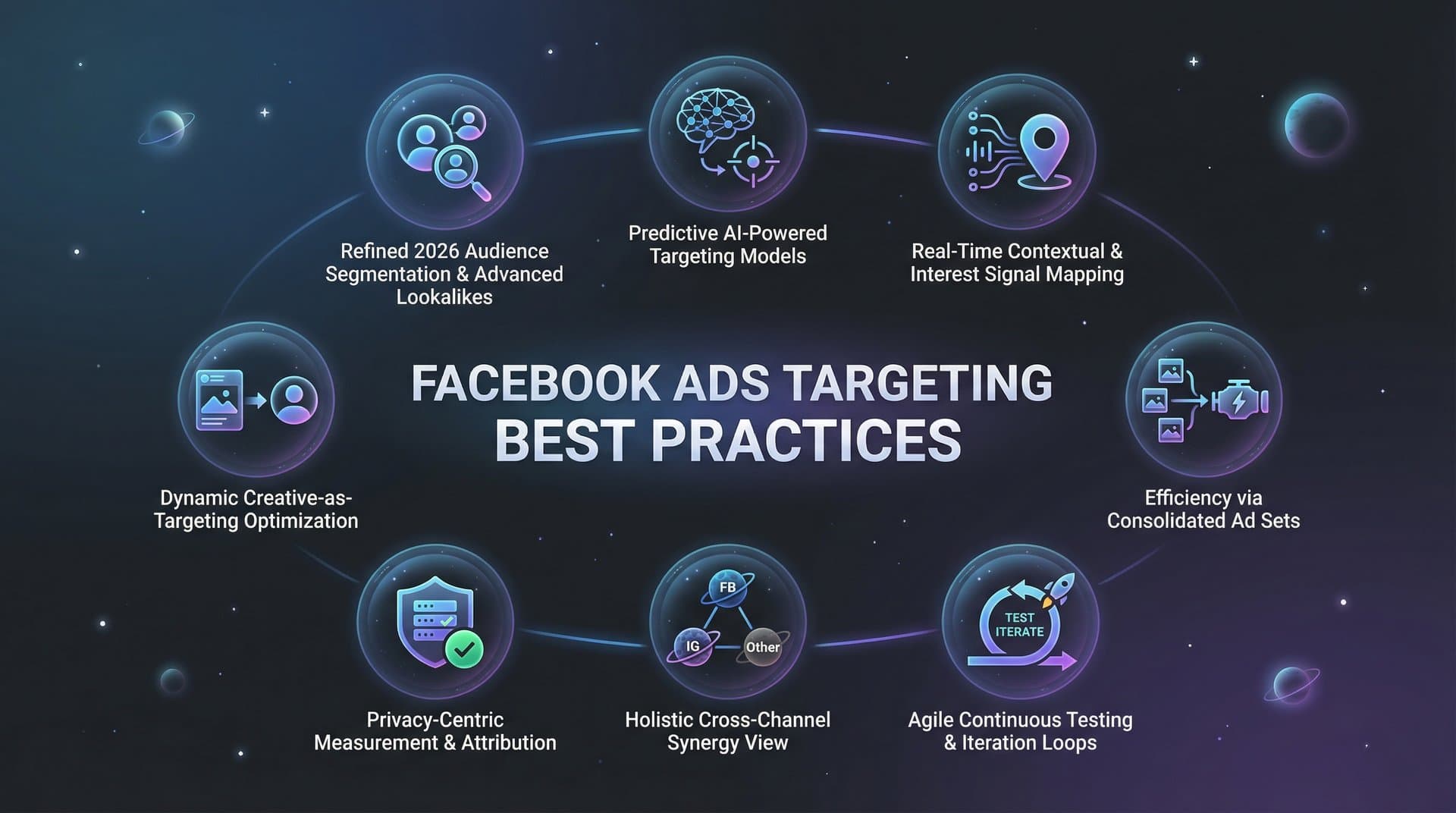
These nine best practices combine proven fundamentals with modern AI-powered approaches. You'll learn how to structure audiences that maximize ROAS, when to let the algorithm explore, and which targeting decisions still require your strategic input. Whether you're managing a $500 monthly budget or $50,000, these strategies will help you reach the right people at the right cost.
1. Start with First-Party Data Custom Audiences
The Challenge It Solves
Privacy changes from iOS 14.5+ and the deprecation of third-party cookies have made external data sources less reliable and more expensive. Meanwhile, your own customer data represents the highest-quality targeting signals available, completely privacy-compliant because users have directly interacted with your business.
The problem is most advertisers either don't leverage this data systematically or only use basic website visitor audiences without segmenting by value or behavior.
The Strategy Explained
First-party data custom audiences are built from your own sources: customer email lists, website visitors tracked via Meta Pixel, app users, offline conversions, or engagement with your Meta properties. These audiences form the foundation of your targeting strategy because they represent people who've already shown interest in your business.
The key is creating multiple segmented audiences rather than one generic "website visitors" list. Segment by purchase behavior, engagement depth, recency, and value. A customer who spent $500 last month is fundamentally different from someone who viewed one product page six months ago.
Meta requires a minimum of 1,000 people for custom audiences to be usable, though larger audiences provide more stable optimization. The real power comes when you use these audiences as both direct targeting sources and as seed audiences for lookalikes.
Implementation Steps
1. Install and verify your Meta Pixel is tracking key events: page views, add to cart, initiate checkout, and purchase. Ensure you're capturing the maximum 180-day window for retargeting eligibility.
2. Upload your customer email list to create a customer file custom audience. Segment this list by customer lifetime value, purchase recency, and product category if you have that data available.
3. Create website custom audiences segmented by behavior: all visitors, product page viewers, cart abandoners, and checkout initiators. Set appropriate time windows (7, 14, 30, 60, 90, 180 days) based on your typical sales cycle.
4. Build engagement custom audiences from people who've interacted with your Instagram or Facebook content, watched your videos, or engaged with lead forms. These represent warmer prospects even if they haven't visited your website.
Pro Tips
Create "high-intent" custom audiences by combining multiple signals. For example, people who viewed your pricing page AND added to cart in the last 14 days represent much higher intent than general website visitors. Use these precision audiences for your highest-value retargeting campaigns with premium offers or aggressive discounts.
2. Layer Lookalike Audiences Strategically
The Challenge It Solves
Your custom audiences are powerful but limited in size. Eventually you'll exhaust your existing customer base and warm traffic, hitting a ceiling on campaign scale. You need a way to find new people who resemble your best customers without manually guessing which interests or demographics to target.
The challenge is that lookalike audiences can vary dramatically in quality depending on your seed audience and the percentage you select. Too narrow and you limit scale; too broad and you dilute quality.
The Strategy Explained
Lookalike audiences use Meta's algorithm to find new people who share characteristics with your seed audience. The algorithm analyzes hundreds of data points about your source audience and identifies patterns, then finds similar users across Meta's platforms.
The percentage (1%, 2%, 5%, 10%) determines how closely the lookalike matches your seed audience. A 1% lookalike represents the closest match, containing approximately 1% of the total population in your target country. A 10% lookalike is much broader, trading precision for reach.
The quality of your lookalike depends entirely on your seed audience. A lookalike built from your top 500 customers who each spent $1,000+ will outperform one built from all website visitors. Always use value-based seeds when possible.
Implementation Steps
1. Identify your highest-value seed audiences: customers with multiple purchases, high lifetime value, or recent converters. Aim for at least 1,000 people in your seed audience for stable results, though 100 is Meta's technical minimum.
2. Create multiple lookalike percentages from the same seed: start with 1%, 2%, and 5% versions. This gives you options to test quality versus scale.
3. Run parallel campaigns testing your lookalike audiences against each other and against your custom audiences. Track not just cost per acquisition but customer lifetime value to identify which lookalikes bring the highest-quality users.
4. Once you identify a winning percentage, create additional lookalikes from different seed audiences (purchasers of specific product lines, high-engagement users, etc.) to expand your targeting options without sacrificing quality.
Pro Tips
Refresh your lookalike audiences quarterly by updating the seed audience with recent customer data. Customer behaviors and Meta's user base both evolve, so a lookalike built six months ago may no longer represent your ideal customer profile. Additionally, consider creating lookalikes in multiple geographic markets separately rather than one global lookalike, as user characteristics vary significantly by region.
3. Use Advantage+ Audience with Targeting Suggestions
The Challenge It Solves
Meta's algorithm has become increasingly sophisticated at finding converters, often outperforming manual audience selection. However, completely abandoning targeting controls can feel risky, especially when you have specific knowledge about your ideal customer that the algorithm might not immediately recognize.
The tension is real: Meta's own communications encourage broader targeting with Advantage+ automation, but you've spent years learning which audiences convert best for your business.
The Strategy Explained
Advantage+ Audience represents Meta's hybrid approach to targeting. Instead of strict audience definitions that limit delivery, you provide targeting suggestions that guide the algorithm's exploration. The system can expand beyond your suggestions if it identifies better-performing users, but it starts with your strategic input.
Think of it as giving the algorithm a starting point rather than a boundary. You're saying "here's where I think you should look first" rather than "only show ads to these exact people." The algorithm learns from initial performance and gradually expands to similar users who convert.
This approach works particularly well for campaigns with sufficient conversion volume (Meta recommends approximately 50 conversions per week per ad set for stable optimization). The algorithm needs data to learn, so Advantage+ Audience performs best when it has enough signal to identify patterns.
Implementation Steps
1. When creating a new campaign, select Advantage+ Audience rather than original audience options. You'll see the option to add audience suggestions including location, age, gender, detailed targeting, and custom audiences.
2. Add your strategic suggestions based on known performance: include your best-performing custom audiences, relevant interests, or demographic parameters that align with your product. These become the algorithm's starting point.
3. Set appropriate age and location parameters as suggestions rather than strict limits. For example, if you know your product appeals to ages 25-45, suggest that range while allowing the algorithm to test outside it if performance indicates opportunity.
4. Monitor your audience expansion in reporting. Meta shows you how much delivery occurred within your suggestions versus expanded audiences, helping you understand whether the algorithm found better performers outside your initial guidance.
Pro Tips
Start with tighter suggestions for new products or offers where you have less performance data, then gradually loosen them as the algorithm learns. For established products with strong conversion data, you can use broader suggestions or even minimal targeting to maximize the algorithm's learning potential. The key is matching your suggestion specificity to your confidence level and available conversion data.
4. Implement Exclusion Audiences to Protect Budget
The Challenge It Solves
Wasting ad spend on people who've already converted or who represent low-quality leads drains your budget without generating new revenue. Yet many advertisers focus exclusively on who to target while ignoring the equally important question of who to exclude.
Without strategic exclusions, your acquisition campaigns show ads to recent customers who don't need to see them, your retargeting reaches people who've already purchased, and your budget gets consumed by audiences that historically convert poorly or generate refunds.
The Strategy Explained
Exclusion audiences work by removing specific user segments from your campaign delivery, ensuring your budget focuses on genuine prospects. This isn't about limiting reach arbitrarily; it's about surgical budget protection based on user behavior and business logic.
The most critical exclusions prevent showing acquisition offers to existing customers and stop retargeting people who've already converted. Beyond these basics, sophisticated exclusion strategies account for product-specific logic, refund patterns, and engagement quality signals.
Exclusions become particularly powerful when combined with broad targeting strategies. If you're using Advantage+ Audience or wide lookalikes, exclusions ensure the algorithm doesn't waste impressions on audiences you know won't convert or don't need to reach.
Implementation Steps
1. Create a master customer exclusion list from purchasers in the last 180 days. Apply this to all acquisition campaigns to prevent showing "first purchase" offers to existing customers. Update this audience regularly as new purchases occur.
2. Build conversion-based exclusions for retargeting campaigns: exclude people who've purchased in the last 7-14 days from seeing abandoned cart ads. Exclude cart abandoners who completed purchase from ongoing retargeting sequences.
3. Identify and exclude low-quality audience segments based on historical performance. If certain geographic regions, age groups, or interest categories consistently generate high cost per acquisition with low lifetime value, exclude them from future campaigns.
4. For businesses with subscription models or repeat purchase products, create time-based exclusions that account for your replenishment cycle. Exclude recent purchasers for the appropriate duration, then re-include them when they're likely ready to reorder.
Pro Tips
Create exclusion audiences for users who've engaged heavily but never converted. Someone who's clicked your ads five times over three months without purchasing likely isn't a good prospect. Excluding them protects budget and prevents ad fatigue. Similarly, if you have refund or return data, exclude high-return customers from acquisition campaigns targeting similar profiles. Avoiding these common Facebook ads targeting mistakes can significantly improve your campaign efficiency.
5. Structure Retargeting by Funnel Stage
The Challenge It Solves
Treating all retargeting audiences the same wastes the opportunity to deliver relevant messages based on where people are in their buying journey. Someone who abandoned their cart five hours ago has completely different needs than someone who viewed a blog post three weeks ago.
Generic retargeting that shows the same ad to everyone regardless of their engagement depth or recency generates mediocre results because the message doesn't match the user's mindset or intent level.
The Strategy Explained
Funnel-based retargeting segments audiences by their demonstrated intent and engagement depth, then delivers messaging appropriate to each stage. High-intent audiences (cart abandoners, checkout initiators) see direct conversion-focused ads with urgency and incentives. Mid-funnel audiences (product page viewers, category browsers) receive educational content and social proof. Top-funnel audiences (blog readers, general visitors) get awareness-building content.
Recency matters as much as behavior. Someone who abandoned their cart two hours ago is dramatically more likely to convert than someone who did so 45 days ago. Your retargeting structure should reflect this reality with different time windows and messaging intensity.
The goal is creating a retargeting ladder where each audience segment receives progressively more aggressive messaging as they demonstrate higher intent, with appropriate frequency caps to prevent ad fatigue. For a deeper dive into this strategy, explore our guide on retargeting ads on Facebook.
Implementation Steps
1. Create bottom-funnel audiences with tight time windows: cart abandoners (1-3 days), checkout initiators (1-7 days), and product page viewers who spent significant time (3-7 days). These receive your most aggressive offers and urgency-based messaging.
2. Build mid-funnel audiences with moderate windows: product page viewers (7-14 days), category browsers (14-30 days), and multi-page visitors (14-30 days). Target these with educational content, comparison guides, and customer testimonials.
3. Develop top-funnel audiences with longer windows: blog readers (30-60 days), single-page visitors (30-90 days), and video viewers (30-90 days). Use awareness content, brand story, and problem-solution messaging.
4. Set up exclusion logic between funnel stages so users automatically move to more relevant campaigns as they demonstrate higher intent. Someone who moves from blog reader to cart abandoner should exit the top-funnel campaign and enter the bottom-funnel one.
Pro Tips
Create separate campaigns for each funnel stage with appropriate budgets and bidding strategies. Bottom-funnel audiences justify higher bids because conversion rates are dramatically higher. Set frequency caps that increase with intent level: top-funnel might be 2 impressions per week, while bottom-funnel cart abandoners could see 5-7 impressions in 3 days during their high-intent window.
6. Test Interest Stacking vs Broad Targeting
The Challenge It Solves
The advertising industry is experiencing a fundamental debate: should you use detailed interest targeting to reach specific audience segments, or trust Meta's algorithm with broad targeting to find converters? The answer isn't universal, and the only way to know what works for your specific business is systematic testing.
Many advertisers stick with their comfort zone, either clinging to hyper-detailed interest stacking from years past or jumping completely to broad targeting because that's the current trend. Neither extreme is optimal without testing.
The Strategy Explained
Interest stacking involves combining multiple detailed targeting parameters (interests, behaviors, demographics) to reach specific audience segments. Broad targeting removes most or all detailed parameters, letting the algorithm explore widely based on your conversion data and creative signals.
The reality is that optimal targeting varies by product type, price point, market maturity, and conversion volume. A niche B2B software product might perform better with stacked interests that identify specific professional roles, while a mass-market consumer product might thrive with broad targeting that lets the algorithm find unexpected converter patterns.
The only way to determine your optimal approach is running controlled tests where you isolate targeting as the variable while keeping creative, budget, and optimization settings consistent. Leveraging AI targeting strategy for Facebook ads can help you identify winning combinations faster.
Implementation Steps
1. Create a broad targeting campaign with minimal parameters: set location and age range based on your product's realistic constraints, but avoid detailed interests, behaviors, or demographic stacking. Let the algorithm explore based purely on conversion signals.
2. Build an interest-stacked campaign using your best-performing interests from historical data or logical assumptions about your ideal customer. Stack 3-5 relevant interests using "AND" logic to create a more defined audience.
3. Run both campaigns simultaneously with equal budgets, identical creative, and the same optimization event. Ensure you have sufficient budget for each campaign to generate meaningful conversion data (aim for at least 50 conversions per campaign during the test period).
4. Analyze results after accumulating statistically significant data: compare not just cost per acquisition but also conversion rate, customer quality metrics, and scale potential. The winning approach should deliver better efficiency without sacrificing scale or customer value.
Pro Tips
Don't stop at one test. Continue testing different interest combinations against your broad targeting control. Sometimes specific interest stacks outperform broad targeting for certain product lines or offers while broad works better for others. Build a testing calendar that systematically evaluates new interest combinations quarterly, as Meta's user base and interest graph evolve continuously.
7. Optimize for the Right Conversion Event
The Challenge It Solves
Meta's algorithm optimizes delivery based on the conversion event you select, but choosing the wrong event creates a fundamental misalignment between what you're asking the algorithm to find and what actually drives business value. Optimize for link clicks and you'll get clickers who don't convert. Optimize for a rare high-value event without sufficient volume and the algorithm can't learn effectively.
The challenge is balancing business value with data volume. Your ideal conversion event needs enough weekly occurrences for the algorithm to identify patterns while still representing meaningful business outcomes.
The Strategy Explained
Conversion event selection determines which user behaviors Meta's algorithm prioritizes when deciding who sees your ads. The algorithm learns from conversion patterns and increasingly shows your ads to people likely to complete that specific event.
Meta recommends approximately 50 conversions per week per ad set for stable optimization. Below this threshold, the algorithm lacks sufficient signal to reliably identify high-intent users, leading to inconsistent delivery and performance.
For businesses with high conversion volume, optimizing for purchase makes perfect sense. But if you're generating fewer than 50 purchases weekly, you might achieve better results optimizing for a higher-funnel event like "add to cart" or "initiate checkout" that occurs more frequently while still indicating purchase intent. Understanding campaign learning Facebook ads automation helps you navigate this optimization phase effectively.
Implementation Steps
1. Audit your current conversion volume by event type over the past 30 days. Count weekly occurrences of key events: page view, view content, add to cart, initiate checkout, and purchase. Identify which events consistently exceed 50 per week.
2. Select your optimization event based on the highest-value event that meets the volume threshold. If you're generating 200 purchases weekly, optimize for purchase. If you're at 30 purchases but 150 add to cart events, optimize for add to cart.
3. For new campaigns or products without conversion history, start with a higher-funnel event to generate learning data quickly, then migrate to your target event once volume increases. Begin with "view content" or "add to cart" for the first two weeks, then switch to purchase.
4. Use value optimization when you have sufficient purchase volume but varying order values. This tells the algorithm to prioritize users likely to generate higher-value conversions rather than just any conversion.
Pro Tips
Monitor your conversion event performance in Meta's reporting. If your cost per optimization event is strong but your actual business metrics (revenue, profit) are weak, you've likely optimized for the wrong event. The algorithm is efficiently finding people who complete your chosen event, but that event doesn't correlate strongly enough with business value. Test optimizing for a lower-funnel event even if it means temporarily accepting higher cost per result.
8. Leverage Geographic and Demographic Refinements
The Challenge It Solves
While broad targeting is increasingly effective, certain business realities require geographic and demographic parameters. Shipping constraints, legal restrictions, language barriers, and fundamental product fit mean that some targeting refinements remain strategically necessary rather than algorithm-limiting.
The mistake is applying demographic and geographic targeting based on assumptions rather than performance data, or using overly narrow parameters that artificially limit your audience without improving results.
The Strategy Explained
Strategic geographic and demographic targeting means applying these parameters only when justified by business constraints or proven performance data. If you only ship to certain countries, geographic targeting is required. If your product is legally restricted by age, demographic parameters are necessary. Beyond these hard constraints, let data guide your decisions.
The key is distinguishing between necessary refinements and premature optimization. Starting a campaign with tight age, gender, and location parameters based on assumptions prevents the algorithm from discovering unexpected high-performing segments. Better to start broader and refine based on actual performance.
When you do apply these refinements, use them as suggestions in Advantage+ campaigns rather than strict limits when possible, allowing the algorithm to test outside your parameters if it identifies opportunities. Using best Facebook targeting tools can help you analyze performance data and make informed refinement decisions.
Implementation Steps
1. Define your hard constraints first: geographic regions where you can legally operate and ship, age restrictions based on product regulations, and language requirements based on your creative and landing page capabilities.
2. Analyze historical performance data by demographic and geographic segments. In Meta's reporting, break down results by age, gender, and location to identify segments with significantly better or worse performance metrics.
3. Apply refinements only to segments with clear performance differences. If ages 25-34 deliver 40% lower cost per acquisition than other age groups across multiple campaigns, that's data-driven refinement. If you're targeting 25-34 because "that's our target market," that's assumption-based limiting.
4. Test geographic expansion systematically. If you're currently targeting 5 countries, add 2-3 similar markets in a separate campaign to test performance. Many advertisers discover unexpected strong performance in markets they initially overlooked.
Pro Tips
Use location-based targeting strategically for businesses with physical locations or local service areas. Radius targeting around store locations works well for driving foot traffic, while broader regional targeting suits e-commerce. Consider time zone implications when running time-sensitive promotions: a campaign targeting multiple countries might need separate ad sets to align promotional timing with each region's business hours.
9. Continuously Test and Rank Audience Performance
The Challenge It Solves
Audience performance degrades over time as user behaviors change, market conditions shift, and audience fatigue sets in. What worked brilliantly six months ago might be your worst performer today. Without systematic testing and performance tracking, you're flying blind, continuing to invest in declining audiences while missing emerging opportunities.
Most advertisers test sporadically based on hunches rather than building continuous testing frameworks that systematically evaluate audience performance and identify winners worth scaling.
The Strategy Explained
Continuous audience testing means maintaining an always-on testing structure that regularly introduces new audience variations while tracking performance of existing audiences against clear benchmarks. You're building a systematic process rather than one-off experiments.
The framework requires three components: a testing calendar that schedules regular audience experiments, performance tracking that ranks audiences by your key metrics (ROAS, CPA, customer lifetime value), and a decision protocol for when to scale winners, optimize underperformers, or kill losers.
AI-powered tools can dramatically accelerate this process by automatically analyzing audience performance, ranking them by your goals, and surfacing insights about which audience characteristics correlate with success. What used to require manual spreadsheet analysis now happens automatically. Explore the best AI tools for Facebook ads to streamline your testing workflow.
Implementation Steps
1. Build a testing calendar that introduces new audience variations monthly. Schedule tests of new lookalike percentages, interest combinations, geographic markets, or behavioral segments. Treat testing as a recurring process, not a one-time project.
2. Create performance leaderboards that rank your audiences by key metrics. Track each audience's ROAS, cost per acquisition, conversion rate, and customer lifetime value. Update these rankings weekly to identify trends early.
3. Set clear decision thresholds for audience management: audiences in the top 20% get budget increases, middle performers get optimization attention, bottom 20% get paused or restructured. Remove emotion from the decision by following data-driven rules.
4. Document learnings from each test in a centralized knowledge base. Record which audience types perform best for which products, seasonal performance patterns, and characteristics of winning audiences. This institutional knowledge compounds over time.
Pro Tips
Implement holdout testing where you reserve 10-20% of your budget for pure experimentation with new audiences, keeping the majority on proven performers. This balances optimization of known winners with discovery of new opportunities. Additionally, track audience performance across the full customer journey, not just initial acquisition. Some audiences deliver cheap conversions but low lifetime value, while others have higher upfront costs but generate loyal repeat customers.
Putting It All Together
These nine targeting best practices work together as a comprehensive system rather than isolated tactics. Your implementation roadmap should prioritize quick wins that protect budget and improve efficiency, then layer in more sophisticated strategies as you build momentum.
Start with the defensive plays: implement exclusion audiences this week to stop wasting budget on recent customers and converted users. Structure your retargeting by funnel stage to ensure messaging matches intent level. These changes require minimal testing and deliver immediate ROAS improvements.
Next, build your foundation with first-party data. Audit your custom audiences, segment them properly, and create strategic lookalikes. This establishes the targeting infrastructure everything else builds upon.
Then move to optimization: test interest stacking versus broad targeting, experiment with Advantage+ Audience, and ensure you're optimizing for conversion events with sufficient volume. These tests generate the performance data that guides all future decisions.
Finally, implement continuous improvement systems. Build your testing calendar, create performance leaderboards, and establish decision protocols that systematically identify and scale winners while eliminating underperformers.
The reality is that manual audience analysis and optimization becomes increasingly time-consuming as your campaigns scale. You're tracking dozens of audiences across multiple campaigns, trying to identify patterns in performance data, and making daily decisions about budget allocation.
This is where AI-powered platforms transform your workflow. Instead of spending hours in spreadsheets analyzing audience performance, AI can automatically rank every audience by your target metrics, surface winning patterns, and even build new campaigns using your best-performing audience combinations.
Start Free Trial With AdStellar and be among the first to launch and scale your ad campaigns 10× faster with our intelligent platform that automatically builds and tests winning ads based on real performance data. AdStellar's AI Campaign Builder analyzes your historical performance, ranks every audience by your goals, and builds complete Meta campaigns in minutes with full transparency about every targeting decision.