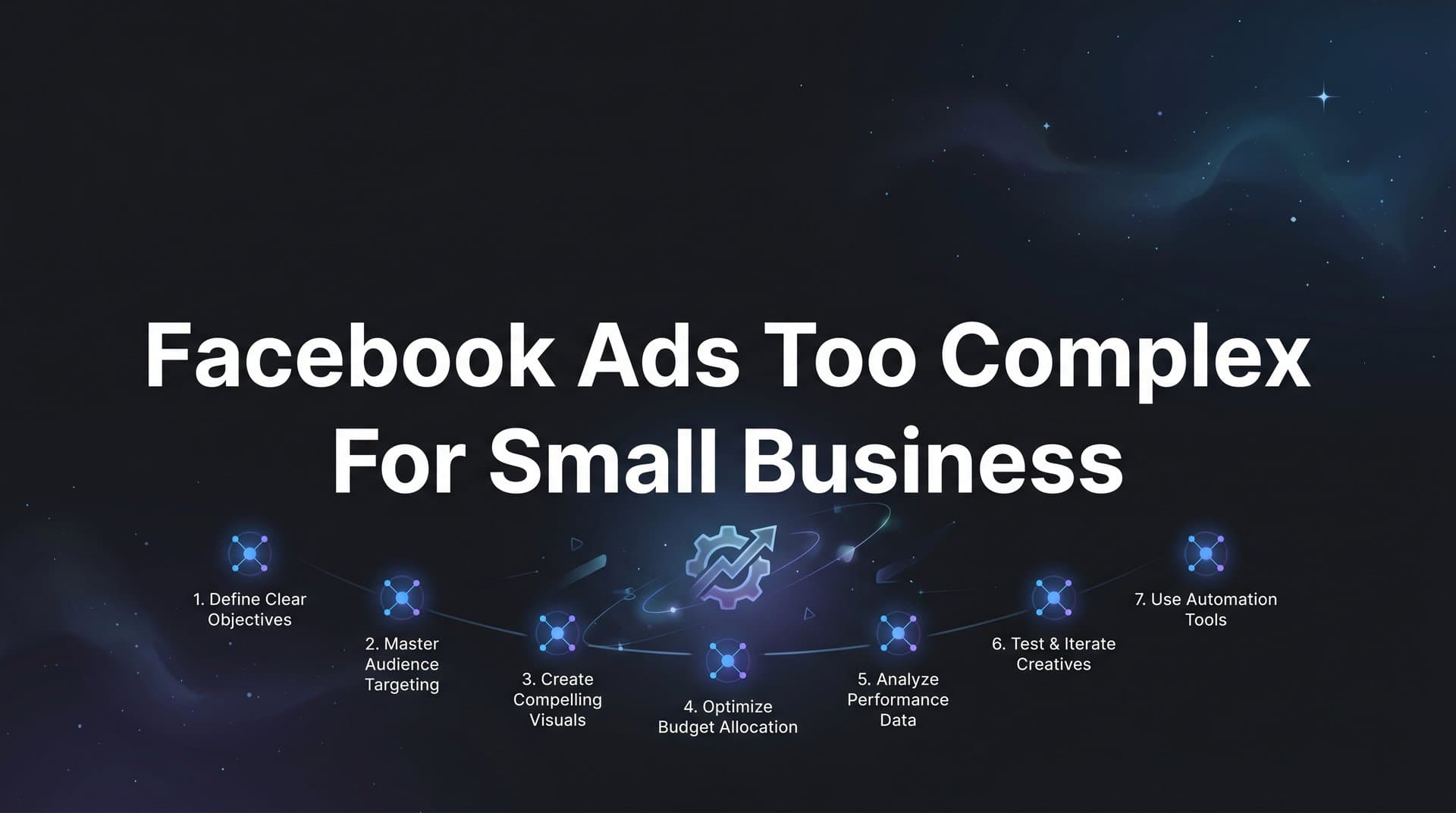
Managing Facebook ads as a small business owner can feel like trying to solve a Rubik's cube while juggling. You're already handling inventory, customer service, bookkeeping, and a dozen other responsibilities. Now you're supposed to become an expert in Meta's advertising platform too? The system wasn't designed with you in mind. It was built for Fortune 500 companies with entire marketing departments and unlimited testing budgets.
The good news? You don't need to master every feature or understand the platform's full complexity to run profitable campaigns. What you need is a simplified approach that focuses on high-impact strategies and eliminates the noise. These seven proven methods will help you cut through the confusion and start generating real results without the overwhelm.
Let's break down exactly how to make Facebook advertising work for your small business, even if you've never run a campaign before.
1. Start With a Single Campaign Objective
The Challenge It Solves
When you open Meta Ads Manager, you're confronted with eleven different campaign objectives. Traffic, engagement, leads, conversions, app installs. The options multiply quickly, and suddenly you're running three different campaign types simultaneously, splitting your already limited budget across multiple objectives. This creates a fundamental problem: Meta's algorithm needs data to optimize effectively, and spreading your budget thin means none of your campaigns get enough learning signals to perform well.
The Strategy Explained
Pick one objective that directly supports your primary business goal and commit to it completely. If you sell products online, choose conversions (purchases). If you're building an email list, choose leads. If you're driving foot traffic to a physical location, choose store visits. The key is singular focus. By concentrating your entire budget on one objective, you give Meta's algorithm the concentrated data it needs to identify patterns and optimize delivery. This approach also simplifies your decision-making process dramatically because you're not constantly second-guessing whether to shift budget between campaigns.
Implementation Steps
1. Identify your single most important business outcome right now (sales, leads, appointments, etc.) and select the corresponding Meta objective.
2. Set a daily budget that you can sustain for at least two weeks to allow the algorithm to complete its learning phase.
3. Resist the temptation to launch additional campaign objectives until your first campaign has been running profitably for at least 30 days.
Pro Tips
Don't confuse campaign objective with testing different creatives or audiences. You can test extensively within a single objective. The restriction is on running multiple objective types simultaneously, not on experimentation within your chosen objective. For more guidance on getting started, check out our Facebook ads tools for beginners guide.
2. Use Advantage+ Audience to Skip Manual Targeting
The Challenge It Solves
Traditional Facebook audience targeting requires you to make dozens of decisions about demographics, interests, behaviors, and exclusions. Should you target "small business owners" or "entrepreneurship"? What age range? Which locations? The combinations are endless, and most small business owners lack the data to make informed choices. Worse, overly narrow targeting often restricts your reach so much that Meta's algorithm can't find enough qualified buyers, leading to high costs and poor performance.
The Strategy Explained
Advantage+ Audience is Meta's AI-driven targeting system that analyzes billions of user signals to identify potential customers automatically. Instead of manually selecting interests and demographics, you simply provide Meta with your conversion data (from your pixel or Conversions API), and the system finds people most likely to take your desired action. This approach leverages Meta's machine learning capabilities, which have access to far more behavioral data than you could ever manually configure. The system continuously learns and adjusts based on who actually converts, not who you think might convert.
Implementation Steps
1. When creating a new ad set, select "Advantage+ Audience" instead of manual targeting options.
2. Provide optional audience suggestions (like a general location or broad age range) but avoid overly restrictive parameters that limit the AI's ability to explore.
3. Let the campaign run for at least one week before evaluating performance, as the AI needs time to gather data and optimize delivery.
Pro Tips
If you're worried about wasting budget on irrelevant audiences, start with a conservative daily budget and monitor results closely for the first few days. The AI typically identifies promising audience segments faster than manual targeting would, often within 48-72 hours of launch. Many businesses are now using Meta ads automation for small business to streamline this entire process.
3. Clone What's Already Working in Your Industry
The Challenge It Solves
Creating effective ad creatives from scratch requires understanding what resonates with your audience, which formats perform best, and what messaging drives action. Small businesses typically lack the budget to hire professional copywriters and designers, yet they're competing against brands that have these resources. Starting with a blank canvas often leads to generic ads that fail to capture attention or drive conversions, wasting precious advertising dollars on untested concepts.
The Strategy Explained
The Meta Ad Library is a free, publicly accessible database showing every active ad from any advertiser on Facebook and Instagram. You can search for competitors or successful brands in your industry and see exactly what creative formats they're running, what copy angles they're testing, and how they're positioning their offers. This isn't about copying ads verbatim. It's about identifying proven patterns and adapting them to your brand. If three competitors are all using video testimonials with captions, that's a signal worth paying attention to. If carousel ads dominate your niche, there's probably a reason.
Implementation Steps
1. Visit the Meta Ad Library and search for 5-10 competitors or successful brands in your industry to see their active ads.
2. Identify common patterns in their creative formats (single image vs. video vs. carousel), messaging angles (problem-solution vs. social proof vs. urgency), and visual styles.
3. Use AI tools to generate similar creative formats adapted to your brand, or create simplified versions manually using the patterns you've identified as templates. Learn more about the best AI tools for Facebook ads to accelerate this process.
Pro Tips
Look specifically for ads that have been running for several months. If a competitor has been running the same creative for 90+ days, it's almost certainly profitable. Ads that don't work get turned off quickly, so longevity is a strong performance indicator.
4. Automate Creative Production
The Challenge It Solves
Professional ad creatives traditionally require hiring designers, video editors, or photographers. For small businesses, this means either spending thousands on agency services or attempting DIY designs with tools like Canva, which often results in amateur-looking ads that don't convert. The creative production bottleneck becomes even more challenging when you need to test multiple variations, as each new concept requires additional design work and budget allocation.
The Strategy Explained
AI-powered creative tools can now generate professional-quality image ads, video ads, and even UGC-style avatar content without requiring design skills or hiring external resources. These platforms analyze high-performing ad elements and combine them into scroll-stopping creatives optimized for social media. You can input a product URL or describe what you're selling, and the AI generates multiple creative variations in different formats. This dramatically reduces both the time and cost of creative production while enabling you to test more variations than would be practical with manual design work.
Implementation Steps
1. Choose an AI creative platform that integrates with Meta advertising and supports your preferred ad formats (image, video, or both).
2. Generate 5-10 creative variations for your first campaign, ensuring you have diversity in visual style, messaging angle, and format type.
3. Use chat-based editing features to refine any creatives that are close but need adjustments, avoiding the need to start from scratch.
Pro Tips
Don't just generate creatives and walk away. Review the AI outputs and select the ones that best align with your brand voice and positioning. AI excels at creating attention-grabbing visuals, but you still need to ensure the messaging accurately represents your offer and value proposition. Explore how AI marketing tools for Facebook campaigns can transform your creative workflow.
5. Set Up a Simple Testing Framework
The Challenge It Solves
Many small businesses approach ad testing haphazardly, changing multiple variables simultaneously and then wondering why performance improved or declined. When you test new creative, new copy, new audiences, and new landing pages all at once, you have no idea which change drove the result. This leads to unreliable conclusions and wasted budget on tests that don't generate actionable insights. Without a structured testing approach, you're essentially gambling rather than systematically improving performance.
The Strategy Explained
Effective testing requires isolating one variable at a time so you can confidently attribute performance changes to specific elements. Start with creative testing since visual elements typically have the biggest impact on performance. Once you identify winning creatives, test different headline variations while keeping the creative constant. Then test audiences, then landing pages. This sequential approach builds a library of proven elements you can combine in future campaigns. Bulk launching tools allow you to efficiently test multiple variations of a single variable without manually creating dozens of individual ads.
Implementation Steps
1. Launch your first campaign with 3-5 creative variations, keeping all other variables (audience, copy, budget) identical across ads.
2. Let the test run for at least 5-7 days or until you have at least 50 conversions total across all variations to ensure statistical relevance.
3. Identify the winning creative, then launch a new test with 3-5 headline variations using only that winning creative, repeating the process for each variable you want to optimize.
Pro Tips
Don't kill underperforming ads too quickly. Meta's algorithm needs time to find the right audience for each creative. Wait until an ad has spent at least 2-3x your target cost per acquisition before declaring it a loser, unless performance is dramatically worse than your other variations. If you're launching multiple product variations, consider using bulk Facebook ads for product launches to streamline the process.
6. Focus on Three Metrics Only
The Challenge It Solves
Meta Ads Manager displays dozens of metrics: impressions, reach, frequency, CPM, CPC, CTR, engagement rate, video watch time, and countless others. For small business owners without analytics backgrounds, this data overload creates paralysis. You spend hours analyzing reports without knowing which numbers actually matter for your business goals. This complexity often leads to optimizing for vanity metrics like engagement or reach while ignoring the metrics that directly impact profitability.
The Strategy Explained
Narrow your focus to three core metrics that directly correlate with business success: Cost Per Acquisition (CPA), Return on Ad Spend (ROAS), and Click-Through Rate (CTR). CPA tells you what you're paying to acquire each customer. ROAS tells you how much revenue you're generating for every dollar spent. CTR indicates whether your creative is compelling enough to earn clicks. These three metrics provide a complete picture of campaign health without the noise. If your CPA is below your target and ROAS is above your threshold, your campaign is profitable. If CTR is declining, you know creative fatigue is setting in and it's time to refresh your ads.
Implementation Steps
1. Customize your Ads Manager columns to display only CPA, ROAS, and CTR, hiding all other metrics to eliminate distractions.
2. Establish clear benchmarks for each metric based on your business economics (for example, CPA must be below $50, ROAS must exceed 3x, CTR should stay above 1%).
3. Review these three metrics daily or every other day, making optimization decisions based solely on whether they're trending toward or away from your benchmarks.
Pro Tips
Set up automated rules in Ads Manager to pause ads that exceed your CPA threshold or fall below your ROAS target. This prevents you from manually monitoring campaigns around the clock and ensures poor performers don't drain budget while you're focused on other business tasks. Understanding why Facebook Ads Manager feels too complex can help you identify which features to ignore entirely.
7. Build a Winners Library
The Challenge It Solves
Most advertisers treat each new campaign as a fresh start, recreating ads from scratch and re-testing elements they've already validated. This approach wastes time and budget because you're constantly rediscovering what works instead of building on proven successes. Without a systematic way to organize and reuse high-performing elements, you lose institutional knowledge every time you launch a new campaign. This is especially problematic for small businesses where the person running ads today might not be the same person running them six months from now.
The Strategy Explained
Create a centralized repository of your best-performing creatives, headlines, audience segments, and copy angles, complete with their actual performance data. This winners library becomes your strategic asset, allowing you to launch new campaigns using proven elements rather than starting from zero. When you need to scale, you can instantly access your top five creatives and deploy them in new campaigns. When performance declines, you can rotate in proven backup creatives instead of scrambling to create new ones. This systematic approach transforms advertising from constant experimentation into a repeatable, scalable process.
Implementation Steps
1. Create a simple spreadsheet or use a platform that automatically tracks your top performers, documenting the creative, headline, audience, and key metrics (CPA, ROAS, CTR) for each winning element.
2. Set criteria for what qualifies as a "winner" (for example, ROAS above 4x and at least $1,000 in spend) to ensure you're only saving truly validated performers.
3. When launching new campaigns, start by selecting 2-3 proven winners from your library and testing them against 2-3 new concepts, ensuring you always have reliable performers in the mix. The right Facebook ads software for small business can automate much of this tracking for you.
Pro Tips
Review your winners library monthly and archive any elements that are more than six months old, as creative fatigue and market changes can reduce their effectiveness over time. Keep your library focused on recent, validated performers rather than letting it become cluttered with outdated assets.
Your Implementation Roadmap
The path to simplified Facebook advertising isn't about learning every platform feature or becoming a Meta-certified expert. It's about identifying high-leverage strategies that deliver results without consuming all your time and resources. Start with a single campaign objective to give Meta's algorithm the concentrated data it needs. Let Advantage+ Audience handle targeting complexity while you focus on what you can control: your creative and your offer.
Use the Meta Ad Library to identify proven creative patterns in your industry, then leverage AI tools to generate professional variations without hiring expensive agencies. Implement a simple testing framework that isolates one variable at a time, and track only the three metrics that actually matter for profitability. Build a winners library that turns successful campaigns into repeatable assets you can deploy again and again.
The small businesses winning with Facebook ads aren't the ones mastering every advanced feature. They're the ones who found efficient systems and stuck with them long enough to see results. Whether you implement these strategies manually or use platforms designed to automate the heavy lifting, the principle remains the same: simplify your approach, test systematically, and scale what works.
Your next step is concrete and achievable. Pick one strategy from this list and implement it this week. If you're starting from scratch, begin with strategy one: choose your single campaign objective and launch your first focused campaign. If you're already running ads but feeling overwhelmed, implement strategy six: narrow your focus to three metrics and ignore everything else.
Ready to transform your advertising strategy? Start Free Trial With AdStellar and be among the first to launch and scale your ad campaigns 10× faster with our intelligent platform that automatically builds and tests winning ads based on real performance data. From AI-generated creatives to automated campaign building and performance tracking, we've simplified every step so you can focus on growing your business instead of wrestling with advertising complexity.