Small business owners running Meta ads face an exhausting reality: you're competing against companies with full marketing teams while you're juggling customer service, operations, and a dozen other priorities. Every campaign setup feels like choosing between doing it right or doing it fast—and you need both.
The traditional approach to Meta advertising demands constant attention. Manual campaign builds, endless A/B tests, daily budget adjustments, creative refreshes, audience tweaks. It's a full-time job disguised as a marketing channel.
But here's what's changed: automation technology has evolved from basic scheduling tools into intelligent systems that handle the strategic heavy lifting. The same AI capabilities that enterprise teams use are now accessible to businesses running campaigns on modest budgets.
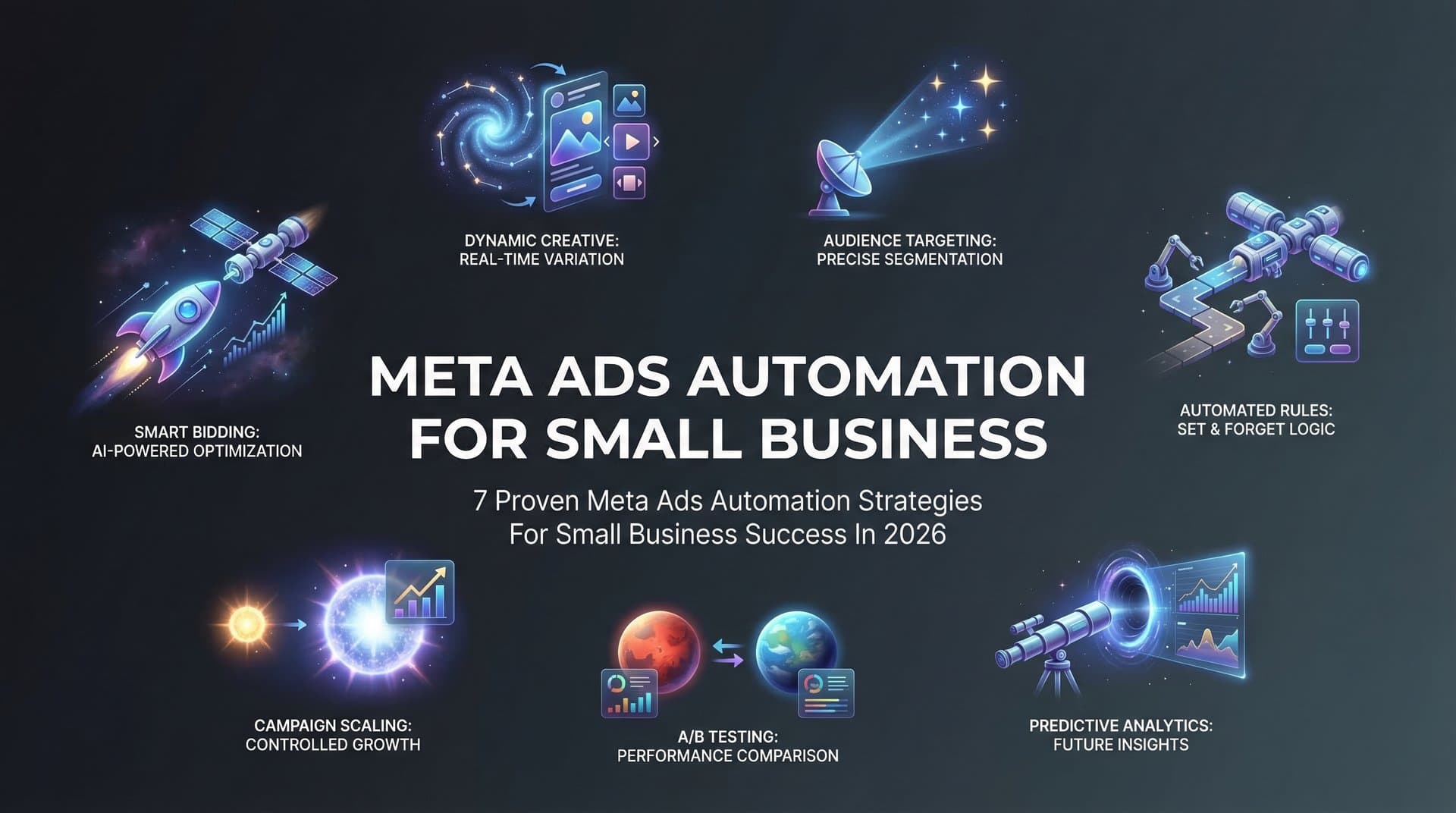
This guide presents seven automation strategies specifically designed for small business constraints. No fluff about "scaling to seven figures" or tactics that require a $50,000 monthly ad spend. These are practical approaches for businesses spending anywhere from $500 to $5,000 monthly who need every advertising dollar to work harder while reclaiming hours of manual work each week.
Whether you're running ads solo or managing a small team, these strategies will help you compete with larger players without the burnout that comes from managing everything manually.
1. Automate Campaign Structure Based on Your Best Performers
The Challenge It Solves
Every time you launch a new Meta campaign, you face the same tedious setup process. Which campaign objective? How many ad sets? What naming conventions? Should you use CBO or ABO? These decisions consume 30-45 minutes per campaign, and worse—you're often starting from scratch instead of leveraging what already works.
Small businesses rarely have time to document their winning campaign architectures. You remember that "one campaign that crushed it in Q4," but recreating its exact structure from memory leads to inconsistency and missed opportunities.
The Strategy Explained
Campaign structure automation analyzes your historical performance data to identify patterns in your most successful campaigns. It examines which campaign objectives delivered the best ROAS, how many ad sets performed optimally, what budget distributions worked, and which targeting parameters drove results.
Once these patterns are identified, the system creates templates that automatically replicate proven structures for new campaigns. Instead of rebuilding from scratch, you're launching campaigns based on your own documented success patterns. Understanding proper campaign structure for Meta ads is essential for maximizing this approach.
Think of it like having a master blueprint. When a construction company finds a floor plan that works, they don't redesign from zero each time—they adapt the proven template. Your Meta campaigns deserve the same efficiency.
Implementation Steps
1. Audit your last 90 days of campaigns and identify the top 3-5 performers based on your primary KPI (ROAS, cost per conversion, or engagement rate depending on your goals).
2. Document the structural elements these winners share: campaign objective, number of ad sets, budget allocation method, placement settings, and optimization events.
3. Use an automation platform that can save these structures as templates with your naming conventions, budget rules, and targeting frameworks pre-configured.
4. When launching new campaigns, select the appropriate template and customize only the variables that need to change (creative, specific audience parameters, or budget amounts).
5. Track time saved per campaign launch and compare performance of template-based campaigns against manually structured ones to validate the approach.
Pro Tips
Create separate templates for different campaign goals—one for prospecting, one for retargeting, one for seasonal promotions. Don't force every campaign into the same structure. Update your templates quarterly as you gather more performance data and Meta's platform evolves. The best templates are living documents that improve with your business.
2. Set Up Smart Budget Allocation That Shifts Spend Automatically
The Challenge It Solves
Budget management is where small businesses bleed money. You set a campaign budget on Monday, and by Wednesday, half your spend went to an ad set delivering a $75 cost per conversion while another ad set is crushing it at $22. But you didn't catch it in time because you were handling actual business operations.
Manual budget reallocation requires constant monitoring. Check performance, pause underperformers, increase budgets on winners, wait for the learning phase to reset, repeat daily. It's exhausting and often too slow to prevent wasted spend.
The Strategy Explained
Automated budget allocation uses performance-based rules to shift spending in real-time without manual intervention. The system monitors your campaigns against predefined thresholds and automatically increases budgets on high performers while reducing or pausing spend on underperformers.
This isn't about setting a daily budget and forgetting it. Smart allocation continuously evaluates performance every few hours and makes micro-adjustments that keep your spend focused on what's working. It's like having a campaign manager who never sleeps and responds to performance changes immediately.
The key difference from Meta's built-in Campaign Budget Optimization is control. Automated rules let you define exactly what "good performance" means for your business and how aggressively to shift budgets based on your risk tolerance. Many businesses explore Meta ads automation vs Ads Manager to understand these distinctions better.
Implementation Steps
1. Define your performance thresholds clearly: What ROAS, CPA, or CTR qualifies as "winning" versus "underperforming" for your business? Be specific with numbers.
2. Set up automated rules in your ad platform or automation tool that trigger budget changes when these thresholds are hit. Start conservative—increase winning ad sets by 20% rather than doubling immediately.
3. Create a pause rule for severe underperformance to stop bleeding budget quickly. For example, if an ad set spends $50 with zero conversions, pause it automatically.
4. Implement a "learning phase protection" rule that prevents budget changes during the first 48-72 hours of a new campaign to avoid disrupting Meta's optimization.
5. Review automated changes weekly to ensure the rules are working as intended and adjust thresholds based on seasonal performance patterns or business changes.
Pro Tips
Don't automate everything immediately. Start with pause rules for clear underperformers—these have the highest ROI and lowest risk. Once comfortable, add budget increase rules for winners. Always cap your automated increases at a percentage (like 50% of current spend) rather than fixed amounts to prevent runaway budgets on volatile campaigns.
3. Deploy Bulk Creative Testing Without the Manual Grind
The Challenge It Solves
Creative testing is where most small businesses give up. Testing five headlines against four images across three audience segments means launching 60 ad variations manually. Each one requires uploading the creative, writing copy, selecting targeting, setting budgets, and naming conventions. The process takes hours, so most businesses test 2-3 variations and hope for the best.
This limited testing means you're likely running ads that are "good enough" rather than optimized. You're leaving money on the table because you physically can't test enough combinations to find the real winners.
The Strategy Explained
Bulk creative testing automation allows you to upload multiple creative elements once, define your testing variables, and launch dozens or hundreds of combinations simultaneously. The system handles the tedious work of creating each ad variation, applying consistent settings, and organizing everything with clear naming conventions.
Instead of spending three hours manually creating 20 ad variations, you spend 20 minutes setting up the bulk test and let automation generate all combinations. This dramatically expands your testing capacity, helping you find winning creative combinations faster. The difference between Meta ads automation vs manual creation becomes starkly apparent when scaling creative tests.
The real power comes from systematic testing rather than random experiments. You're not just launching more ads—you're running structured tests that isolate variables and generate actionable insights about what resonates with your audience.
Implementation Steps
1. Organize your creative assets into categories: headlines (write 5-7 variations), primary text (3-5 variations), images or videos (4-6 options), and call-to-action buttons (2-3 options).
2. Choose a bulk creation tool that integrates with Meta's API and allows combination testing. Upload all creative elements and define which variables you want to test against each other.
3. Set consistent parameters across all variations: same audience, same budget per ad, same placement settings. This ensures you're testing creative elements, not confounding variables.
4. Launch all variations simultaneously so they compete under identical conditions. Staggered launches introduce time-based variables that skew results.
5. Let tests run for at least 5-7 days or until each variation receives at least 1,000 impressions before making decisions. Early performance can be misleading.
Pro Tips
Test one variable type at a time when possible. If you're testing headlines, keep images and body copy consistent across variations. This makes it crystal clear which headline drove performance differences. Once you identify winning headlines, test image variations using that winning headline. Sequential testing with bulk tools is faster and more insightful than testing everything at once.
4. Build Automated Audience Refresh Cycles
The Challenge It Solves
Audience fatigue is the silent killer of Meta ad performance. Your campaign performs great for three weeks, then CPAs start climbing and ROAS drops. You're showing the same ads to the same people too frequently, and they're tuning out. But catching this requires monitoring frequency metrics daily and knowing when to rotate audiences—something most small business owners don't have bandwidth for.
Manual audience management means remembering which audiences you've burned through, when to introduce fresh targeting, and how to scale without exhausting your total addressable market. It's a juggling act that leads to either over-saturated audiences or overly conservative targeting that limits growth.
The Strategy Explained
Automated audience refresh systems monitor frequency and performance metrics to systematically rotate targeting before fatigue sets in. The system maintains a queue of audience segments and automatically introduces new targeting when current audiences show fatigue signals.
This approach treats your audience like a renewable resource. Instead of running the same Lookalike audience until performance tanks, you're cycling through complementary targeting options that keep your ads fresh to new eyeballs while giving previously targeted audiences time to "rest."
Think of it like crop rotation. Farmers don't plant the same crop in the same field year after year because it depletes the soil. Your audiences need similar rotation to maintain healthy response rates. Leveraging AI marketing automation for Meta ads makes this rotation process seamless and data-driven.
Implementation Steps
1. Build an audience library with at least 8-10 targeting options across different types: Lookalike audiences at different percentages (1%, 3%, 5%), interest-based audiences, behavior-based audiences, and engagement custom audiences.
2. Set up monitoring rules that track frequency and performance metrics for each active audience. Flag audiences when frequency exceeds 3.5 or when CPA increases by 30% over a seven-day period.
3. Create an automated rotation schedule where flagged audiences are automatically paused and replaced with fresh audiences from your library. Give paused audiences at least 14-21 days of rest before reintroducing them.
4. Implement a "winner preservation" rule where your absolute best-performing audiences get longer run times before rotation, but still monitor them for fatigue signals.
5. Track which audiences perform best in which positions of your rotation cycle. Some audiences work great fresh but don't recover well after rest periods—knowing this helps optimize your rotation strategy.
Pro Tips
Don't wait for complete performance collapse before rotating. Proactive rotation at the first signs of fatigue (frequency above 3.0 or slight CPA increases) prevents the severe performance drops that take weeks to recover from. Build your audience library during strong performance periods so you're not scrambling to find new targeting when campaigns are already struggling.
5. Implement Automated Performance Alerts Before Problems Escalate
The Challenge It Solves
Small business owners can't monitor ad performance 24/7. You check campaigns in the morning, maybe once at lunch, and again before bed. But Meta ads can burn through budget at any hour, and a campaign that looked fine at 9 AM might have spent $200 with zero conversions by 3 PM.
By the time you manually notice performance issues, you've often wasted significant budget. The delayed response time between problem emergence and your intervention directly impacts your bottom line, especially when operating on tight margins.
The Strategy Explained
Automated performance alerts act as your 24/7 campaign monitoring system. They track key metrics continuously and notify you immediately when performance deviates from acceptable ranges. This shifts you from reactive firefighting to proactive problem prevention.
The system watches your campaigns with defined thresholds and sends alerts via email, SMS, or Slack when issues arise. Instead of discovering a problem during your evening check-in, you get notified within hours of the issue starting—often while there's still time to salvage the day's budget. Exploring Meta ads campaign automation software can help you identify tools with robust alerting capabilities.
Good alert systems distinguish between normal fluctuations and genuine problems. You don't want notifications every time a metric ticks slightly off target. The goal is catching significant deviations that require action while filtering out noise.
Implementation Steps
1. Identify your critical metrics that indicate real problems: cost per conversion exceeding your target by 50%, zero conversions after $50 spend, CTR dropping below 0.5%, or ROAS falling below your breakeven threshold.
2. Set up alerts in your ad platform or automation tool with specific triggers based on these metrics. Configure different alert urgency levels—immediate SMS for severe issues, email for moderate concerns.
3. Create time-based alerts that notify you if campaigns haven't generated expected results within specific timeframes. For example, if a campaign spends $100 without a conversion in a 24-hour period.
4. Implement positive alerts too—notifications when campaigns significantly exceed performance expectations. These help you capitalize on winning moments by increasing budgets on hot campaigns.
5. Review your alert history monthly to refine thresholds. If you're getting too many false alarms, tighten the criteria. If you're missing real issues, lower the thresholds.
Pro Tips
Start with conservative alert thresholds that catch only severe issues, then gradually add more sensitive alerts as you get comfortable with the system. Too many alerts leads to notification fatigue where you start ignoring them. Also, set up alerts for positive performance—knowing when to scale winners is just as valuable as catching problems early.
6. Create a Winners Library with One-Click Relaunch Capability
The Challenge It Solves
Small businesses often rediscover successful ads by accident. You remember running "that great campaign last summer" but can't recall the exact headline, image, or audience combination that made it work. So you approximate, launch something similar, and wonder why it doesn't perform as well.
Without systematic documentation, your winning creative and targeting combinations disappear into campaign history. You're constantly reinventing the wheel instead of building on proven success. This wastes time and leaves money on the table by not leveraging your best-performing elements.
The Strategy Explained
A winners library is an organized repository of your highest-performing ad elements—headlines, images, videos, audience combinations, and complete campaign structures. It's not just a folder of old ads; it's a searchable system that catalogs what worked, when it worked, and the performance metrics it achieved.
The automation component comes from one-click relaunch capabilities. Instead of manually recreating a winning ad from six months ago, you select it from your library and deploy it instantly with updated budgets and any necessary tweaks. This transforms past success into repeatable systems.
Think of it as your greatest hits album. Musicians don't reinvent their best songs for every concert—they play the proven crowd-pleasers. Your Meta ads deserve the same strategic approach to proven winners. The best Meta ads automation tools include built-in library features for exactly this purpose.
Implementation Steps
1. Audit your last 12 months of campaigns and identify the top 20% of performers across different objectives (prospecting, retargeting, seasonal campaigns). Export the complete details of each winner.
2. Create a structured library system organized by campaign type, season, and performance metrics. Tag each entry with searchable attributes: audience type, creative format, offer type, and the KPIs it excelled at.
3. For each winning element, document not just what it was but why you believe it worked. This context helps you make smarter decisions about when to reuse specific winners.
4. Set up templates in your automation platform that allow you to select library elements and launch new campaigns with those proven components pre-loaded. The system should populate campaign settings automatically.
5. Update your library quarterly as new winners emerge and retire elements that no longer perform when retested. Your library should evolve with your business and market conditions.
Pro Tips
Don't just save complete ads—break down winners into component parts. That successful campaign might have worked because of the specific headline, even though the image was mediocre. Cataloging individual elements (headlines, images, audience segments) separately gives you building blocks for creating new winning combinations. Test your library elements periodically to ensure they still resonate—what worked brilliantly in 2025 might need refreshing for 2026.
7. Connect Attribution Tracking to Close the Automation Loop
The Challenge It Solves
Meta's native attribution tells you which ads generated link clicks and reported conversions, but it doesn't always reveal which ads drove actual revenue. Small businesses operating on thin margins need to know real ROAS, not platform-reported metrics that might be inflated by attribution windows or missed conversions.
Without proper attribution tracking connected to your automation systems, you're optimizing toward incomplete data. Your automated rules might be increasing budgets on ads that show strong Meta metrics but deliver weak actual revenue. This disconnect between optimization signals and business outcomes undermines your entire automation strategy.
The Strategy Explained
Attribution tracking integration connects your revenue data directly to your automation systems, ensuring automated decisions optimize toward real business outcomes rather than platform-reported metrics. This creates a closed feedback loop where automation learns from actual customer behavior and revenue generation.
Advanced attribution tools track the customer journey beyond the initial click, capturing which touchpoints contributed to eventual conversions. When this data feeds back into your automation platform, budget allocation rules, creative testing decisions, and audience rotation strategies all optimize toward genuine revenue impact. Understanding what is Meta ads automation at its core helps you appreciate why this feedback loop matters so much.
This is where automation evolves from time-saving to profit-generating. You're not just automating tasks—you're building systems that automatically optimize toward the metrics that actually matter for your business survival.
Implementation Steps
1. Implement a third-party attribution platform that tracks conversions beyond Meta's native attribution. Look for tools that offer multi-touch attribution and integrate with both Meta and your e-commerce or CRM platform.
2. Set up server-side tracking to capture conversions that browser-based tracking might miss due to iOS privacy changes or ad blockers. This ensures your automation systems work with complete data.
3. Configure your automation platform to pull attribution data from your tracking tool rather than relying solely on Meta's reported metrics. This might require API connections or regular data imports.
4. Update your automated rules to use attribution-based metrics as primary triggers. Instead of "increase budget when Meta reports ROAS above 3x," use "increase budget when attributed ROAS exceeds 3x."
5. Create regular reconciliation reports comparing Meta-reported performance against attribution-tracked performance. This helps you understand where the platforms diverge and refine your automation thresholds accordingly.
Pro Tips
Don't completely ignore Meta's native metrics—they're still valuable for understanding platform-level performance. Instead, use a dual-metric approach where Meta metrics guide tactical optimizations (which creative is getting engagement) while attribution metrics drive strategic budget decisions (which campaigns drive revenue). This balanced approach gives you both speed and accuracy in your automated decision-making.
Your Implementation Roadmap
Meta ads automation isn't about replacing your marketing judgment—it's about amplifying your limited time and budget. The strategies outlined here work together as a comprehensive system, but trying to implement everything simultaneously is a recipe for overwhelm.
Start with the strategy that addresses your biggest pain point. If you're drowning in manual campaign setup, begin with automated structure replication. If budget waste keeps you up at night, prioritize smart allocation rules. If you can't keep up with creative testing, deploy bulk automation first.
The key is building these systems incrementally. Implement one strategy, let it run for 2-3 weeks, measure the time and money saved, then add the next layer. This staged approach allows you to learn each system thoroughly and adjust based on your specific business needs before adding complexity.
Within 90 days of systematic implementation, you'll have an automation stack that lets you compete with businesses ten times your size. You'll reclaim hours of manual work each week, reduce wasted ad spend through faster optimization, and scale your testing capacity beyond what's humanly possible manually.
The small businesses winning with Meta ads in 2026 aren't the ones spending the most or working the longest hours. They're the ones who've built intelligent automation systems that handle the repetitive heavy lifting while they focus on strategy, creative direction, and growing their business.
Ready to stop managing ads manually and start letting AI handle the heavy lifting? Start Free Trial With AdStellar AI and be among the first to launch and scale your ad campaigns 10× faster with our intelligent platform that automatically builds and tests winning ads based on real performance data.