Most marketers running Facebook ads spend 70% of their time on workflow management and only 30% on actual strategy. You know the drill: copying campaign settings from one ad set to another, waiting three days for design revisions, manually building audience variations, then scrambling to figure out which of your 47 active ads is actually working. The problem isn't your advertising skill. It's that you're operating without a real workflow system.
Facebook ads workflow management is the systematic approach to organizing every step of your advertising process, from the moment you have a campaign idea to the point where you're scaling winners. It's about building repeatable systems that eliminate manual work, speed up execution, and create feedback loops that make each campaign smarter than the last. When you have a proper workflow, you're not constantly reinventing the wheel. You're executing a proven process that gets better with every iteration.
This guide breaks down exactly how to build a Facebook ads workflow that scales. We'll walk through the anatomy of high-performing workflows, identify where most systems break down, and show you how to automate the repetitive tasks that are currently eating up your time. By the end, you'll have a clear roadmap for transforming chaotic ad operations into a streamlined system that multiplies your output without multiplying your workload.
The Five Stages Every Facebook Ads Workflow Needs
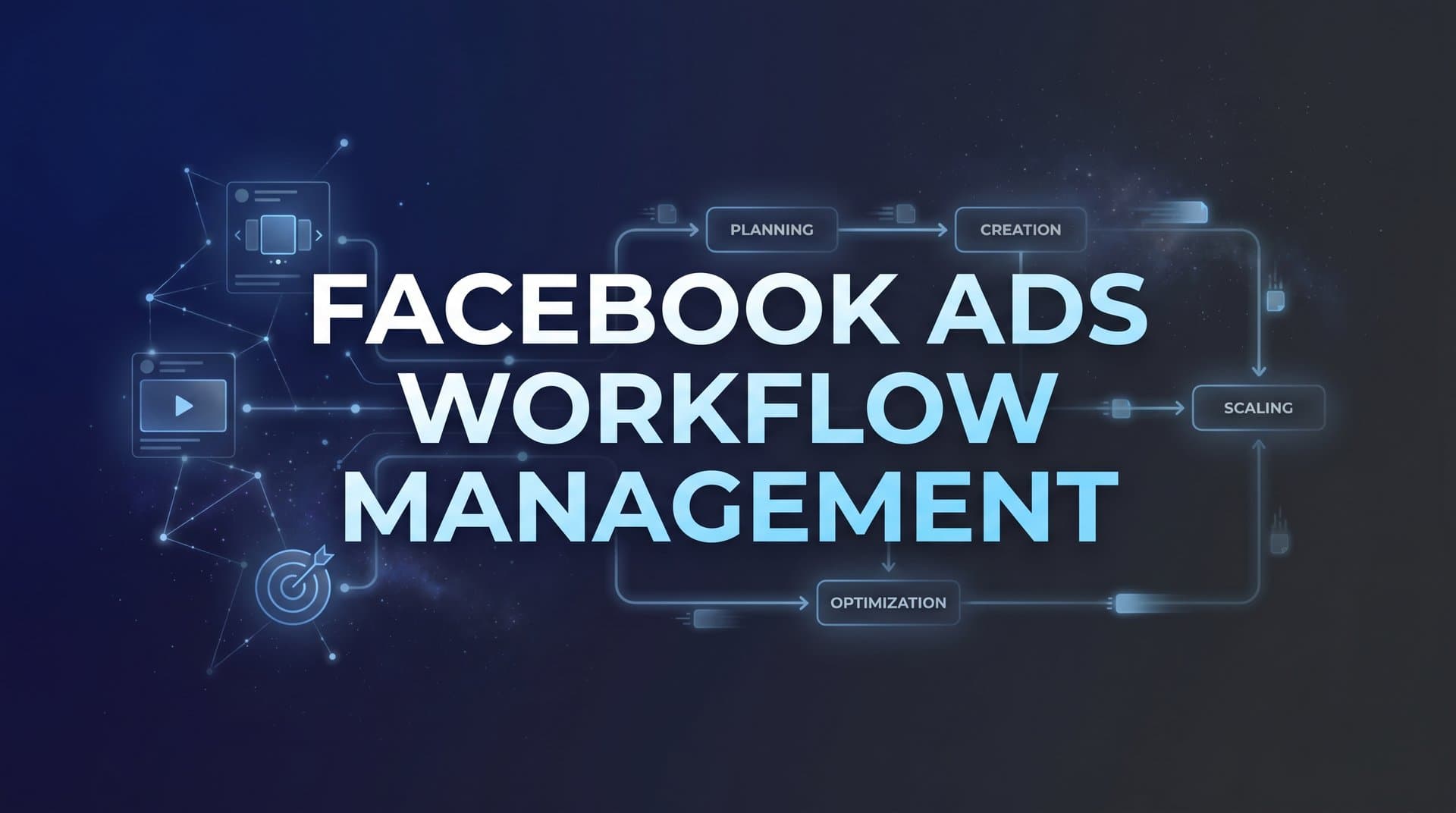
Every successful Facebook ads operation moves through five distinct stages, whether you realize it or not. The difference between chaos and efficiency is whether these stages are intentional systems or just things that happen to you.
Creative Production: This is where your ad concepts become actual creatives. For most teams, this means briefing designers, waiting for mockups, requesting revisions, and eventually getting files ready for upload. The bottleneck here is obvious: you're limited by how fast your creative resources can produce variations. If you want to test ten different angles, you need ten different creative executions, and each one takes time.
Campaign Structuring: Before you launch anything, you need to decide how to organize your campaigns. Which audiences get their own ad sets? How do you structure your testing versus scaling campaigns? What naming conventions keep everything trackable? Most advertisers handle this inconsistently, which creates problems down the line when you're trying to analyze what actually worked. Understanding your Facebook ads campaign hierarchy is essential for building scalable structures.
Launch Execution: This is the grunt work of actually building campaigns in Ads Manager. Setting up audiences, writing ad copy variations, uploading creatives, configuring budgets, and making sure every setting is correct. It's repetitive, it's time-consuming, and one small mistake can throw off your entire test.
Performance Monitoring: Once your ads are live, you need systems for tracking what's happening. Not just checking the dashboard occasionally, but having a clear process for reviewing performance at defined intervals and knowing exactly which metrics matter for your goals. Without this, you're flying blind until something obviously breaks.
Iteration Cycles: This is where you take insights from performance monitoring and feed them back into creative production and campaign structuring. Which creatives are winning? What audiences are responding? How do you quickly scale what works and kill what doesn't? The faster you can iterate, the faster you improve.
Here's what makes workflow management actually work: these stages need to connect seamlessly. When your performance monitoring reveals a winning creative angle, your iteration cycle should feed that insight directly back into creative production for rapid testing of variations. When campaign structuring identifies a high-performing audience segment, your launch execution should make it easy to expand testing across similar segments.
The bottlenecks almost always form at the handoffs between stages. Creative production finishes a batch of ads, but campaign structuring hasn't decided how to test them yet. Performance monitoring identifies winners, but iteration cycles are too slow to capitalize before the creative fatigues. A proper workflow eliminates these friction points by creating clear processes for how information and assets move between stages.
Think of it like an assembly line versus a craft workshop. In the craft workshop, every campaign is a custom project that requires rethinking everything from scratch. In the assembly line, you have standardized processes that can handle volume while maintaining quality. The best Facebook ads workflows operate like precision assembly lines: repeatable, scalable, and continuously improving.
The Three Places Your Ad Workflow Is Probably Broken
Let's talk about where this all falls apart in practice. Most advertisers don't have workflow problems everywhere. They have specific chokepoints that slow down everything else.
Creative Production Becomes the Limiting Factor: You have campaign ideas ready to test, but you're waiting on design resources. Your designer is backlogged with requests from three other projects. When you finally get creatives, they're not quite right, so you request revisions. Another three-day wait. By the time you're ready to launch, the campaign idea is two weeks old and market conditions have shifted.
This bottleneck kills your testing velocity. If you can only produce five creative variations per week, you can only test five angles. Your competitors who can produce fifty variations are learning ten times faster. They're finding winners while you're still waiting for your second round of mockups. A dedicated creative management platform can dramatically accelerate this stage.
The same problem hits video even harder. Video ads often outperform static images, but producing video requires even more specialized resources. Most teams end up running the same few video creatives for months because creating new ones is such a heavy lift. Your workflow can't scale if creative production can't keep pace with your testing ambitions.
Launch Execution Eats Your Time: You've got your creatives ready and your campaign structure planned. Now you need to actually build everything in Ads Manager. You're manually creating ad sets for each audience variation, copying and pasting ad copy, uploading the same creative to multiple ads, and triple-checking that budgets and placements are set correctly.
For a simple campaign with three audiences, five creatives, and two copy variations, you're building thirty individual ads. Each one requires the same repetitive steps: select audience, set budget, add creative, write copy, configure settings. Multiply this across multiple campaigns and you're spending hours on mechanical tasks that add zero strategic value. This is exactly why campaign management feels so tedious for most advertisers.
The real killer is inconsistency. When you're manually building everything, small variations creep in. One campaign uses "Prospecting" in the name, another uses "Cold Traffic." Your budget allocation isn't quite the same across similar ad sets. These inconsistencies make analysis harder later because you can't easily compare performance across campaigns that weren't set up identically.
Analysis Becomes Guesswork Instead of Insight: Your campaigns are running and data is accumulating, but you don't have a systematic way to make sense of it. You check Ads Manager when you remember to, spot-checking metrics that catch your eye. You know some ads are performing better than others, but you're not sure which specific elements are driving the difference.
Is that winning ad performing well because of the creative, the headline, the audience, or the landing page? You can't tell because you're not tracking performance at the element level. Your data lives in Ads Manager, your attribution tracking is in another tool, and your creative files are scattered across Dropbox folders. Connecting the dots requires manual work, so you usually don't bother until performance tanks and you need to figure out what went wrong.
Without clear systems for surfacing insights, you end up making the same mistakes repeatedly. You test an audience that already failed in a previous campaign because you forgot it didn't work. You recreate winning creative elements from scratch because you don't have an organized library of what's proven to perform. Every campaign starts from zero instead of building on accumulated knowledge.
How to Build a Workflow That Actually Scales
A scalable workflow isn't about working faster. It's about building systems that multiply your efforts. Here's how to construct each piece so they work together instead of against each other.
Establish Clear Process Documentation: For each stage of your workflow, write down the exact steps, who owns them, and what the output should be. This sounds basic, but most teams operate on tribal knowledge and assumptions. When you document your creative production process, you might discover that three different people think they're supposed to approve final assets, which explains why nothing moves quickly.
Your documentation should answer: What triggers this stage to start? What are the specific steps? Who is responsible for each step? What does done look like? Where does the output go next? When everyone follows the same process, you eliminate the constant back-and-forth of "I thought you were handling that" and "I didn't know we needed to do this." A comprehensive workflow optimization guide can help you structure this documentation effectively.
The goal is to reduce decision fatigue. When you sit down to build a new campaign, you shouldn't be figuring out your naming convention from scratch or debating whether to test audiences at the campaign or ad set level. Those decisions should already be documented in your standard operating procedure. You just execute the proven process.
Create Templates That Speed Execution: Build reusable templates for every repeated task. Campaign structure templates that define your standard testing setup. Ad copy templates with proven frameworks you can adapt for different products. Naming convention templates that keep everything organized without thinking about it.
Templates don't mean everything looks the same. They mean you're starting from a proven foundation instead of a blank slate. When you need to launch a new product campaign, you duplicate your product launch template, swap in the new creative and copy, and you're ready to go. What used to take two hours now takes twenty minutes.
The same principle applies to creative production. If you know that carousel ads with specific design elements consistently outperform single images, that becomes your creative template. You're not reinventing the format every time. You're plugging new messaging into a proven structure.
Build Feedback Loops That Surface Insights Automatically: The most powerful workflows create systems where performance data automatically informs future decisions. Instead of manually reviewing campaigns to spot patterns, you have dashboards that surface your top-performing creatives, audiences, and copy variations based on your actual goals.
This means setting up clear success metrics for every element you test. Your creative library shouldn't just store files. It should show which creatives achieved your target ROAS, which audiences they performed best with, and which headlines drove the highest click-through rates. Implementing proper creative library management transforms how you leverage historical performance data.
These feedback loops turn your workflow into a learning system. Each campaign generates insights that make the next campaign smarter. Your audience research becomes more targeted because you know which segments actually convert. Your creative production focuses on angles that have proven resonance. Your campaign structures reflect what actually drives results, not what the latest blog post recommended.
Standardize Without Becoming Rigid: The balance is having enough structure to eliminate chaos while maintaining flexibility to test new approaches. Your workflow should make the routine tasks automatic so you can focus creative energy on strategic experiments.
This means your standard campaign structure is documented and repeatable, but you can still spin up custom tests when you have a hypothesis worth exploring. Your creative templates provide a foundation, but you're free to break the mold when inspiration strikes. The goal is to make the default path efficient while keeping room for innovation.
Where Automation Transforms Your Workflow
The right automation doesn't replace strategic thinking. It eliminates the manual work that prevents you from thinking strategically in the first place. Here's where automation creates the biggest leverage in modern Facebook ads workflows.
AI-Powered Creative Generation: Traditional creative production requires designers, video editors, and often actors for UGC content. AI marketing tools for Facebook ads can now generate scroll-stopping ad variations from just a product URL. You input your product, and the system produces image ads, video ads, and even UGC-style avatar content with different angles and messaging approaches.
This transforms your creative bottleneck into a creative advantage. Instead of waiting days for five design variations, you can generate fifty variations in minutes and test far more angles than manual production could ever support. When you identify a winning creative direction, you can immediately produce variations to test refinements without going back to the design queue.
The same technology enables competitive creative research at scale. Rather than manually screenshotting competitor ads from the Meta Ad Library, AI tools can clone successful competitor creatives and adapt them for your brand. You're learning from what's already working in your market and iterating from proven foundations.
Intelligent Campaign Building: Campaign setup is where most manual time gets wasted. AI campaign builders analyze your historical performance data to inform every decision in new campaigns. The system reviews which audiences, headlines, and creative elements have driven your best results, then builds complete campaign structures based on what actually works for your account.
This is not just automation of manual tasks. It's intelligent decision-making based on your specific performance data. The AI might identify that your best-performing campaigns consistently use specific audience combinations, particular headline structures, or certain creative formats. A powerful campaign builder tool incorporates these proven elements while maintaining the testing framework to continue learning.
The transparency matters here. You're not just getting a black box that builds campaigns. You're seeing the rationale behind every decision so you understand why the AI chose specific audiences or creative combinations. This builds your strategic knowledge while eliminating the mechanical work.
Bulk Operations That Scale Testing: When you want to test multiple creatives across multiple audiences with multiple copy variations, the manual math gets overwhelming fast. Five creatives times three audiences times two headlines equals thirty individual ads to build. Double those numbers and you're looking at 120 ads, each requiring manual setup.
Bulk launching systems let you define your creative set, audience set, and copy variations, then automatically generate every combination and launch them to Meta in one operation. What would take hours of repetitive work happens in minutes. You can run the volume of tests that serious optimization requires without drowning in campaign setup. Tools designed for workflow automation make this level of testing velocity possible.
This capability changes your testing strategy. You're no longer limited by how much manual work you can handle. You can test comprehensive creative variations across audience segments simultaneously, gathering data across the full matrix of possibilities instead of testing sequentially and hoping you eventually find the winning combination.
Automated Performance Surfacing: The analysis bottleneck dissolves when your workflow automatically tracks and ranks performance at the element level. Instead of manually reviewing campaigns to identify patterns, you have leaderboards that rank your creatives, headlines, audiences, and landing pages by actual metrics like ROAS, CPA, and CTR.
You set your target goals and the system scores everything against your benchmarks. You can instantly see which creatives are hitting your targets, which audiences are most efficient, and which copy variations drive the best engagement. When you're building your next campaign, you're pulling from a ranked library of proven winners rather than starting from scratch.
This creates the feedback loop that makes workflows compound in effectiveness. Your best-performing elements are automatically identified and ready to reuse. Your creative production can focus on iterating winning angles. Your campaign structures can prioritize audience segments with proven efficiency. Every campaign builds on accumulated knowledge instead of reinventing the wheel.
Tracking the Metrics That Actually Matter
Workflow efficiency is not just about feeling less busy. It's about measurable improvements in both operational speed and business outcomes. Here's what to track to know if your workflow changes are actually working.
Time to Launch: Measure how long it takes from campaign concept to live ads. If your current workflow takes five days to get a campaign live, and you implement creative automation that cuts it to one day, you've just increased your iteration speed by 5x. Faster launch times mean you can test more ideas, respond to market changes quicker, and capitalize on winning angles before they fatigue.
Testing Velocity: Count how many distinct tests you're running per week. This includes creative variations, audience tests, copy experiments, and structural changes. If you're only testing five new angles per week because that's all your workflow can handle, you're learning much slower than competitors running fifty tests per week. Higher testing velocity leads to faster optimization and more winning discoveries. Reviewing workflow tools comparisons can help you identify solutions that boost your testing capacity.
Creative Rotation Volume: Track how many different creatives you have in active rotation at any given time. Ad fatigue is real, and maintaining performance requires constantly refreshing your creative. If your workflow can only support ten active creatives, you'll hit fatigue faster than a system running fifty variations. More creatives in rotation means longer campaign sustainability and better overall performance.
Iteration Speed on Winners: When you identify a winning creative or audience, how quickly can you scale it or test variations? If it takes a week to produce variations of a winning creative, you're losing the window of peak performance. Workflows that can iterate on winners within 24 hours capture more value from successful discoveries. Using campaign cloning tools dramatically accelerates this iteration process.
Performance Correlation: The ultimate test is whether workflow improvements translate to better advertising results. Track your overall ROAS and CPA trends as you implement workflow changes. If you've increased testing velocity by 3x but your ROAS hasn't improved, your workflow is more efficient but not more effective. The goal is operational improvements that drive business outcomes.
Many advertisers find that workflow optimization creates a compounding effect. Faster creative production enables more testing. More testing surfaces more winners. More winners provide clearer direction for future creative production. The workflow becomes a flywheel that accelerates learning and performance simultaneously.
Building Systems That Multiply Your Impact
The difference between good advertisers and great ones often comes down to operational excellence. Anyone can learn Facebook ads strategy. The competitive advantage comes from building workflows that let you execute that strategy faster and at greater scale than your competition.
When you have a proper workflow system, you're not constantly fighting fires or drowning in manual tasks. You're operating a machine that consistently produces tests, surfaces insights, and scales winners. Your time shifts from mechanical execution to strategic thinking because the mechanics are handled by your systems.
The best part? These improvements compound. Every workflow optimization makes future optimizations easier. Every automated stage creates capacity to improve another stage. Every feedback loop you build makes your entire operation smarter. You're not just working more efficiently. You're building an advertising operation that gets better with every campaign.
Ready to transform your advertising strategy? Start Free Trial With AdStellar and be among the first to launch and scale your ad campaigns 10× faster with our intelligent platform that automatically builds and tests winning ads based on real performance data.