Your Facebook ad campaign has been running for days, but the dreaded "Learning" status refuses to budge. You're watching your budget drain while Meta's algorithm spins its wheels, unable to optimize your ads effectively. A stuck learning phase is one of the most frustrating problems Facebook advertisers face because it directly impacts your ability to scale and achieve consistent results.
The learning phase exists so Meta can gather enough data to deliver your ads efficiently, but when campaigns get stuck, your cost per result often stays inflated and performance remains unpredictable. You're essentially paying for Meta to learn, except it never finishes the lesson.
The good news? A stuck learning phase is almost always fixable once you understand what's causing the problem.
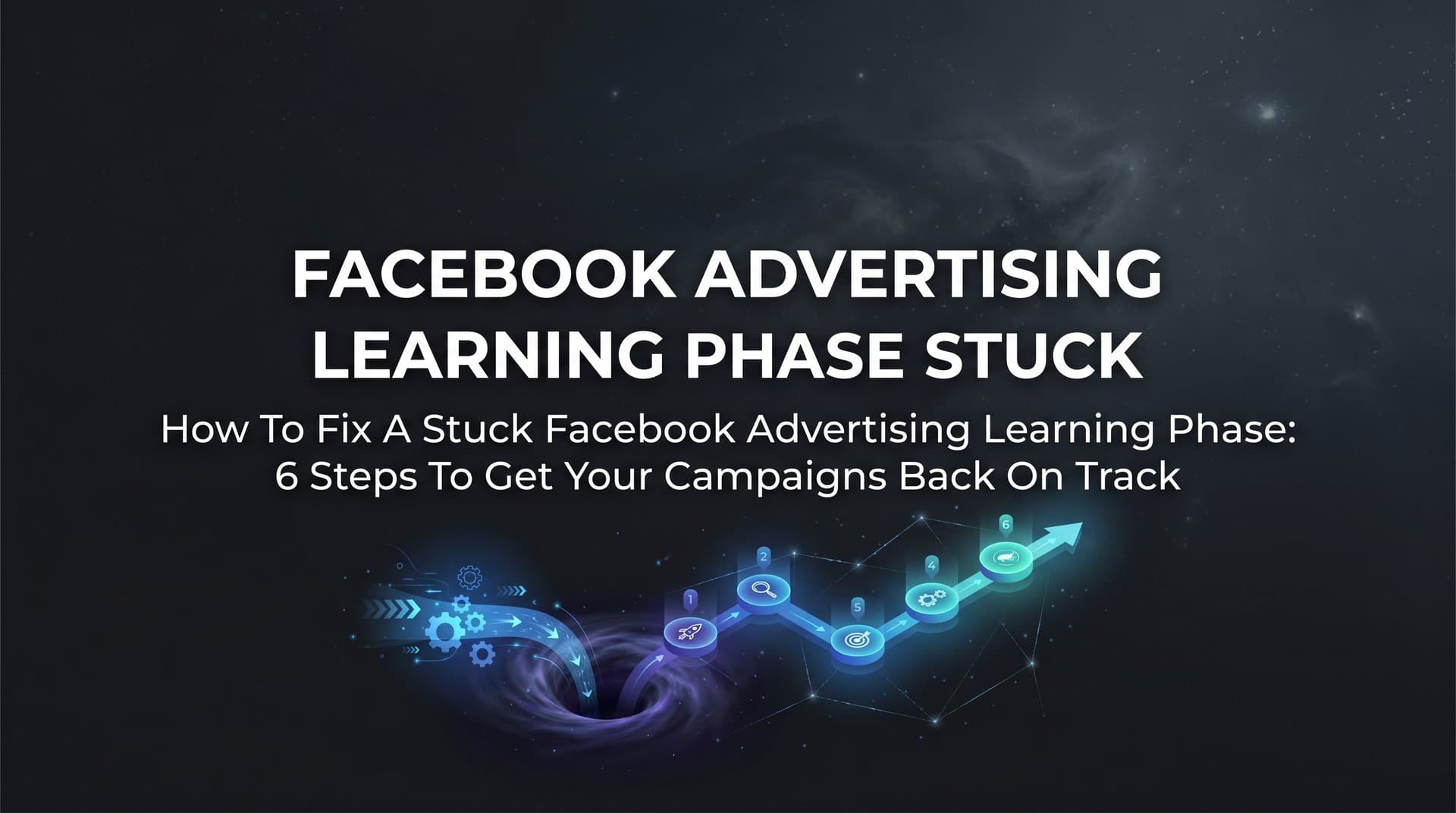
This guide walks you through six actionable steps to diagnose why your campaign is stuck and implement the right fixes to push it through to the stable phase where real optimization happens. Let's get your campaigns back on track.
Step 1: Confirm Your Campaign Is Actually Stuck (Not Just Slow)
Before you panic and start making changes, you need to determine whether your campaign is genuinely stuck or just taking its time. There's a critical difference between slow progress and no progress at all.
Check how long your campaign has been in the learning phase. The normal timeframe is roughly 7 days, during which Meta aims to generate approximately 50 optimization events per ad set. If you're on day 3 or 4, you might just need patience.
Here's where it gets important: Look for the "Learning Limited" status in your Ads Manager. This is different from the standard "Learning" status. When you see "Learning Limited," Meta is telling you that your ad set is unlikely to exit the learning phase because it's not generating enough optimization events. This is your red flag that action is needed.
Review your optimization event volume in the last 7 days. Navigate to your ad set level in Ads Manager and check the delivery column. If you're seeing fewer than 50 optimization events per week, you're not giving the algorithm enough data to work with. This is the mathematical reality behind why your campaign can't move forward.
Understanding the difference between slow learning and truly stuck matters because your response should be different. Slow learning just needs time and consistency. A stuck campaign needs structural fixes. For a deeper dive into why campaigns take longer than expected, check out our guide on Facebook ads learning phase too long.
If you're past the 7-day mark with fewer than 50 optimization events and you see that "Learning Limited" status, you're confirmed stuck. Time to move to step two.
Step 2: Audit Your Budget Against Your Optimization Goal
The math behind the learning phase is brutally simple: if your budget can't realistically generate 50 optimization events per week, you'll never exit learning. This is where most stuck campaigns fail.
Let's work through the calculation. If you're optimizing for purchases and your average cost per purchase is $50, you need at least $2,500 per week to generate those 50 conversions. Divide that by 7 days and you need roughly $357 per day per ad set minimum.
Sound expensive? That's because it is. This is why budget is the number one reason campaigns get stuck.
If your budget can't support your optimization goal, you have three options. First, increase your daily budget to meet the threshold. Second, switch to a higher-funnel optimization event temporarily. Instead of optimizing for purchases, optimize for add to cart or initiate checkout. These events happen more frequently, giving the algorithm more data points to learn from.
The catch with higher-funnel events? You need to monitor your downstream metrics carefully. Just because you're optimizing for add to cart doesn't mean those carts will convert to purchases at the same rate. Track your purchase conversion rate closely and be ready to switch back once you've exited learning.
Third option: Use campaign budget optimization. Instead of setting budgets at the ad set level, let Meta allocate spend across all your ad sets automatically. Meta will push more budget to ad sets that are performing well enough to exit learning faster, while pulling back from underperformers. Understanding learning phase optimization strategies can help you make better budget decisions.
Run the math on your current setup right now. If the numbers don't work, no amount of creative testing or audience tweaking will fix a stuck learning phase.
Step 3: Consolidate Ad Sets to Concentrate Your Data
Picture this: You're running five ad sets, each targeting slightly different audiences, each with a $50 daily budget. You think you're testing smart. Actually, you're fragmenting your conversion data across five separate learning phases.
This is one of the most common mistakes that keeps campaigns stuck. Every ad set needs to generate its own 50 optimization events to exit learning. When you split your budget across multiple ad sets, you're making it exponentially harder for any single ad set to gather enough data.
Identify ad sets that are competing for the same audience and merge them. If you're running separate ad sets for "Women 25-34 interested in fitness" and "Women 30-40 interested in yoga," you're likely reaching overlapping audiences. Combine them into one broader ad set.
Reduce the total number of active ad sets so each one gets sufficient budget and data. A good rule: if you can't afford to give each ad set at least $200-300 per day, you probably have too many ad sets running.
Use broader audience targeting to increase the pool of potential conversions. Meta's algorithm has gotten significantly better at finding your ideal customers within broad audiences. Instead of stacking five interest layers, try one or two broad interests and let the algorithm do the heavy lifting. Many advertisers struggle with these learning phase problems until they simplify their structure.
Avoid audience overlap that fragments your conversion data. Use Meta's Audience Overlap tool in Ads Manager to check if your ad sets are competing for the same people. If overlap exceeds 25%, consolidation is your friend.
Think of it like this: five ad sets each struggling to get 50 conversions is much harder than one well-funded ad set hitting that threshold quickly.
Step 4: Stop Making Edits That Reset the Learning Phase
You're watching your campaign struggle in learning phase, so you tweak the budget. Then you adjust the audience. Then you swap out a creative. Congratulations, you just reset the learning phase three times and you're back to square one.
Meta has specific triggers that reset the learning counter. Budget changes over 20% will reset learning. Audience targeting changes reset learning. Swapping creatives or adding new ads resets learning. Changing your optimization event resets learning.
The problem is that these edits feel productive. You're doing something. But every reset means the algorithm starts over, and you're burning budget without making progress.
Here's the discipline you need: batch your edits together rather than making incremental changes daily. If you want to test a new budget and a new creative, make both changes at once so you only reset learning one time instead of two.
Better yet, wait until a campaign exits learning before testing new variables. Yes, this requires patience. Yes, it feels counterintuitive when performance isn't great. But making changes during learning phase is like adjusting your GPS while it's still calculating the route. Using workflow automation can help you resist the urge to make constant manual adjustments.
Use the duplicate feature to test changes in a new ad set rather than editing live campaigns. Want to test a different audience? Don't change your existing ad set. Duplicate it, make your changes in the new version, and let both run. This way your original ad set can continue its learning journey undisturbed.
The hardest part of this step is resisting the urge to tinker. Set a rule: no edits for 7 days unless performance is catastrophically bad. Give the algorithm the stability it needs to actually learn.
Step 5: Refresh Creatives Without Disrupting Campaign Structure
Your creatives might be underperforming, but the way you refresh them can either help or hurt your learning phase progress. The key is adding new creatives to existing ad sets rather than creating new ad sets for every creative test.
When you create a new ad set just to test a new creative, you're starting a brand new learning phase from zero. When you add a new creative to an existing ad set, the ad set retains its learning progress while testing the new asset.
Test creatives that have proven performance data. If you've been tracking your winners in a centralized hub, pull from those assets first. These are creatives that have already demonstrated they can drive results, which means they're more likely to help your ad set generate those crucial 50 optimization events.
Ensure creative variety to give the algorithm options. Mix static images, video content, and UGC-style creatives within the same ad set. Meta's algorithm will automatically allocate more delivery to the creative formats that perform best with your audience. Leveraging data-driven advertising tools can help you identify which creative formats historically perform best.
Use bulk launching to test multiple creative variations efficiently while maintaining ad set integrity. Instead of creating five separate ad sets for five different creatives, create one ad set with all five creatives loaded. The algorithm tests them simultaneously and learns which combinations of creative, audience, and placement work best.
Think of it like this: your ad set is the container that's learning. The creatives inside that container can rotate and refresh without disrupting the container's learning progress. Keep the structure stable while testing the content.
One warning: don't add so many creatives at once that you fragment the delivery. Start with 3-5 creatives per ad set. Once you see clear winners, pause the losers and add new tests to replace them.
Step 6: Evaluate Whether to Reset or Rebuild the Campaign
Sometimes the fastest way forward is to start over. If your campaign has been stuck in "Learning Limited" status for more than 14 days, rebuilding is often faster than trying to fix the existing structure.
Here's why: a campaign that's been stuck that long has fundamental structural problems. Maybe the budget was never adequate. Maybe the audience was too narrow from the start. Maybe you've made too many edits and the learning phase has reset multiple times. At a certain point, you're better off applying everything you've learned to a fresh campaign.
Create a new campaign with lessons learned. Use the proper budget calculations from step two. Implement the consolidated ad set structure from step three. Load proven creatives from your winners. Set it up right from day one instead of trying to patch a broken foundation. A campaign planner can help you structure your rebuild correctly.
This is where AI-powered campaign builders become valuable. Tools that analyze your historical performance data can identify which audiences, creatives, and budget levels have actually driven results for you in the past. They can set up campaigns optimized from the start, with the right structure to exit learning phase quickly. Explore how AI-powered Facebook advertising can accelerate your campaign setup.
Document what caused the stuck phase so you can avoid the same mistakes in future campaigns. Was it insufficient budget? Too many ad sets? Constant editing? Write it down. Every stuck campaign is a lesson that makes your next campaign stronger.
The psychological barrier here is admitting that starting over is the right move. You've already invested budget and time into the stuck campaign. Starting fresh feels like giving up. But if the math doesn't work and the structure is wrong, no amount of optimization will fix it. Cut your losses and rebuild smarter.
Moving Forward With Confidence
Getting your Facebook campaigns out of a stuck learning phase comes down to giving the algorithm what it needs: enough budget, enough data, and enough stability to learn. These aren't mysterious requirements. They're mathematical thresholds that you can calculate and plan for.
Start by confirming whether you're truly stuck or just experiencing slow progress. Then work through your budget math to ensure you can realistically generate 50 optimization events per week. Consolidate fragmented ad sets to concentrate your conversion data. Stop making disruptive edits that reset the learning counter. Refresh your creatives strategically within existing ad sets. And if all else fails, sometimes the fastest path forward is rebuilding with a smarter structure from day one.
Quick checklist before you go: verify your budget supports 50 weekly optimization events, reduce ad set count to concentrate data, avoid edits that reset learning, and use proven creatives from past winners.
The difference between advertisers who consistently exit learning phase and those who stay stuck isn't luck. It's understanding the mechanics and building campaigns with the right foundation. Start Free Trial With AdStellar and be among the first to launch and scale your ad campaigns 10× faster with AI that analyzes your historical performance data and builds optimized campaigns designed to exit learning phase faster, with the right budget allocation, consolidated structure, and proven creative elements from day one.