Most marketers evaluate Facebook campaign builders backward. They start with tool reviews, compare feature lists, and make decisions based on surface-level comparisons. Then reality hits: the "perfect" tool doesn't fit their workflow, critical integrations are missing, or they're paying for capabilities they'll never use.
The problem isn't the reviews themselves—it's the evaluation approach.
When you're managing Meta campaigns at scale, choosing the wrong builder costs more than money. It costs time, momentum, and opportunity. Every week spent wrestling with a mismatched tool is a week your competitors are testing, learning, and optimizing.
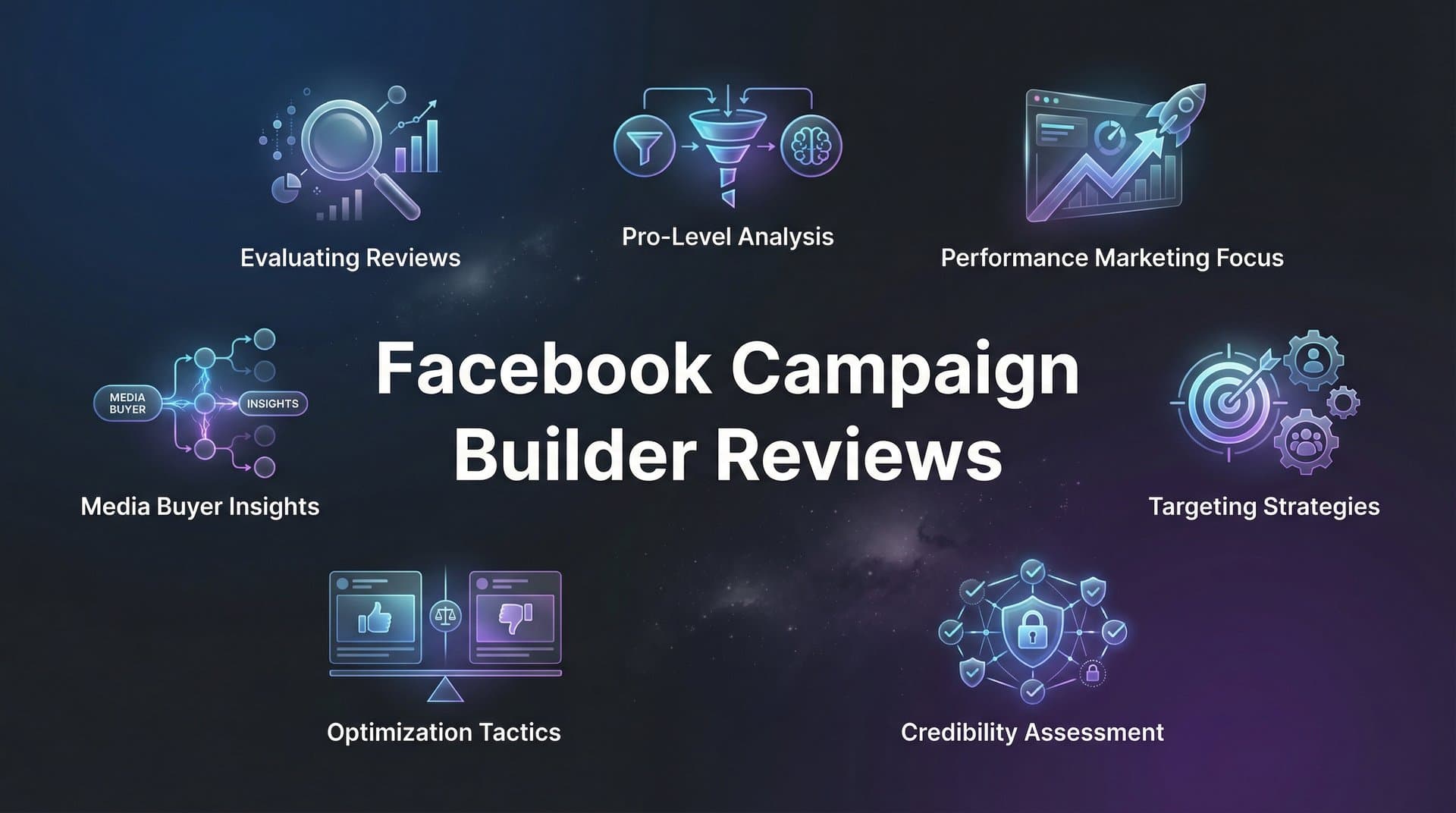
This guide introduces seven strategic approaches for evaluating Facebook campaign builder reviews that cut through marketing noise and surface genuine insights. Whether you're a solo marketer managing your own campaigns, an agency handling multiple client accounts, or an enterprise team coordinating large-scale advertising operations, these strategies will help you identify tools that actually solve your specific challenges.
Let's transform how you evaluate campaign builders—starting with the most counterintuitive strategy of all.
1. Map Your Workflow Gaps Before Reading Any Reviews
The Challenge It Solves
Here's the trap most marketers fall into: they read reviews first, then try to match features to their needs. This backward approach leads to feature fascination—getting excited about capabilities you don't actually need while overlooking deal-breakers hiding in plain sight.
Without a clear audit of your current bottlenecks, you're vulnerable to every persuasive review and compelling feature demo. You end up evaluating tools based on what sounds impressive rather than what solves your actual problems.
The Strategy Explained
Before you read a single review, document your workflow pain points with surgical precision. Spend one week tracking where your team actually loses time, where errors occur, and where manual processes create bottlenecks.
Create a prioritized list of problems, not desired features. For example, instead of writing "need better automation," document "spend 4 hours weekly duplicating campaigns across accounts" or "lose 2 days each month rebuilding campaigns that hit unexpected limits."
This problems-first approach transforms how you read reviews. Instead of being swayed by impressive feature lists, you're hunting for specific solutions. When a reviewer mentions "bulk launching saved us 10 hours per week," you can immediately assess whether that addresses your documented bottleneck.
Implementation Steps
1. Track your actual time spent on campaign building for one full week—use a simple spreadsheet to log every task, how long it took, and any frustrations encountered.
2. Interview your team members about their biggest workflow frustrations—ask specifically about repetitive tasks, manual workarounds, and moments when they wish the current process was different.
3. Create a weighted priority list with your top 5-7 pain points ranked by impact—assign each a severity score based on time cost, error frequency, or strategic importance.
4. Convert each pain point into a specific evaluation question—for example, "Does this tool eliminate the need to manually rebuild campaign structures when scaling?" or "Can this tool handle our agency's 15+ client workspaces without performance degradation?"
Pro Tips
Keep your problem list visible during every review session. When you catch yourself getting excited about a feature, pause and ask: "Does this solve one of my documented problems?" If the answer is no, it's a nice-to-have, not a must-have. This discipline prevents feature creep from derailing your evaluation.
2. Decode Reviewer Context to Find Your True Peers
The Challenge It Solves
A five-star review from someone spending $500 monthly on Meta ads means something completely different than a five-star review from someone managing $50,000 in daily ad spend. Yet most review platforms treat all feedback equally, creating a misleading average that obscures critical context.
What works brilliantly for a solopreneur testing basic campaigns might collapse under enterprise-level demands. Similarly, complaints from users with completely different use cases can scare you away from tools that would actually excel for your specific situation.
The Strategy Explained
Effective review analysis requires filtering by operational similarity. You're not looking for the "best" tool in general—you're looking for the best tool for businesses operating at your scale, with your team structure, managing your type of campaigns.
When reading reviews, actively hunt for context clues: monthly ad spend ranges, team size, campaign objectives, industry vertical, and technical sophistication. Reviews from your operational peers carry exponentially more weight than generic feedback.
Pay special attention to reviews that mention specific scale thresholds. Phrases like "worked great until we hit 50 campaigns" or "performance degraded with multiple workspaces" reveal limitations that only appear at certain volumes—exactly the insights you need.
Implementation Steps
1. Define your operational profile with specific metrics—document your monthly ad spend range, team size, number of accounts managed, average campaigns per month, and primary campaign objectives.
2. Create a reviewer similarity scorecard—when reading reviews, assign relevance scores based on how closely the reviewer's situation matches yours across these dimensions.
3. Prioritize detailed reviews over brief ratings—longer reviews typically provide more context about the reviewer's situation and specific use cases, making similarity assessment possible.
4. Look for reviews that explicitly mention your scale challenges—search for terms like "agency workflow," "bulk launching," "multiple clients," or whatever operational characteristics define your needs.
Pro Tips
When you find a highly relevant reviewer, check if they've reviewed other tools in the category. Their comparative feedback across multiple platforms provides invaluable insights into trade-offs and priorities that matter at your operational level. This cross-platform perspective often reveals more than individual tool reviews.
3. Prioritize Automation Depth Over Feature Count
The Challenge It Solves
Marketing automation has become a checkbox feature—nearly every Facebook campaign builder claims to offer it. But there's a massive difference between tools that automate individual tasks and platforms that use AI to learn from your performance data and make intelligent decisions.
Surface-level automation might help you duplicate campaigns faster, but it doesn't reduce the cognitive load of decision-making. You're still manually deciding which audiences to target, which creatives to test, and how to allocate budget. True AI-powered automation should handle these strategic decisions based on actual performance patterns.
The Strategy Explained
When evaluating automation claims in reviews, distinguish between three levels of capability. First-level automation handles repetitive tasks like campaign duplication or bulk editing. Second-level automation applies rules you define, like pausing underperforming ads or scaling winners. Third-level automation uses AI to analyze historical data, identify patterns, and make strategic recommendations or autonomous decisions.
Look for reviews that describe what the automation actually does, not just that it exists. Phrases like "the AI analyzed our top performers and built variations automatically" indicate genuine intelligence. Phrases like "saved time with bulk actions" suggest basic task automation.
The Meta advertising landscape has grown increasingly complex, with multiple campaign objectives, audience segments, and creative variations to manage simultaneously. Tools that offer true AI learning capabilities can handle this complexity far more effectively than those offering surface-level shortcuts.
Implementation Steps
1. Create a capability matrix for automation features—list the strategic decisions you currently make manually (targeting selection, budget allocation, creative testing strategy) and assess whether each tool automates these decisions or just the execution tasks.
2. Search reviews for phrases indicating AI learning—look for terms like "learns from performance," "analyzes historical data," "improves over time," or "explains its reasoning" rather than just "automated" or "one-click."
3. Evaluate transparency of AI decision-making—tools that explain why they made specific choices (like which audiences to target based on past performance) provide more value and trust than black-box automation.
4. Test whether automation adapts to your data—during trials, check if the tool's suggestions improve as it processes more of your campaign history, indicating genuine learning rather than generic templates.
Pro Tips
Be skeptical of reviews that praise automation without describing specific outcomes. "Great automation features" tells you nothing. "The AI selected our best-performing headlines and audiences, then built 50 campaign variations in under a minute" tells you exactly what level of capability to expect. Demand specificity from reviews before trusting automation claims.
4. Stress-Test Scalability Claims with Specific Scenarios
The Challenge It Solves
Every campaign builder claims to "scale with your business," but scalability means different things to different users. For some, it's handling 10 campaigns instead of 5. For others, it's managing 500 campaigns across 20 client accounts without performance degradation.
Reviews often mention scalability in vague terms—"works great at scale" or "handles large volumes"—without defining what scale actually means. This ambiguity leads to painful discoveries when you hit undisclosed limitations that only appear at your specific volume.
The Strategy Explained
Effective scalability evaluation requires testing claims against your specific operational scenarios. Don't accept general assertions—validate whether the tool can handle your exact campaign volume, your bulk launching needs, and your workflow complexity.
When reading reviews, hunt for specific volume mentions: number of campaigns managed simultaneously, bulk actions performed at once, workspace limits, or performance benchmarks at high volumes. Reviews that include these details provide actionable scalability insights.
Pay particular attention to negative reviews that mention hitting unexpected limits. These often reveal hard constraints that marketing materials don't advertise—campaign caps, workspace restrictions, or performance degradation thresholds that only appear when you're already committed to the platform.
Implementation Steps
1. Define your scalability requirements with specific numbers—document your current campaign volume, projected growth over 12 months, bulk action needs (like launching 50+ campaigns simultaneously), and workspace requirements if managing multiple accounts.
2. Create scenario-based questions for each tool—for example, "Can this tool launch 100 campaign variations simultaneously without errors?" or "Does performance degrade when managing 15+ client workspaces?"
3. Search reviews for volume-specific feedback—use search terms like "campaign limit," "bulk launch," "workspace," "performance," and specific numbers that match your scale requirements.
4. During trial periods, deliberately stress-test at your target volume—don't test with 5 campaigns if you'll eventually manage 50; push the tool to your actual operational demands immediately to surface any limitations.
Pro Tips
Contact reviewers who mention operating at your scale. Many platforms allow direct messaging or provide reviewer contact information. A five-minute conversation with someone managing similar volumes can reveal more than reading 50 generic reviews. Ask specifically about any limitations they've encountered and how the tool performs during peak activity.
5. Investigate Integration Ecosystem Compatibility
The Challenge It Solves
Your Facebook campaign builder doesn't exist in isolation—it needs to connect with your attribution tracking, CRM, analytics platforms, and creative tools. Yet integration compatibility often becomes an afterthought until you're deep into implementation and discover critical connections don't work as expected.
The distinction between direct Meta API integration and third-party workarounds matters significantly. Direct integration typically provides more reliable data sync, faster campaign deployment, and fewer points of failure. Third-party approaches may introduce delays, data inconsistencies, or additional failure points.
The Strategy Explained
Evaluate integration capabilities as a primary criterion, not a secondary consideration. Your campaign builder becomes the hub of your advertising workflow—if it doesn't connect seamlessly with your existing stack, you'll waste time on manual data transfers and reconciliation.
When reading reviews, look for specific mentions of integration experiences. Generic statements like "integrates well" provide little value. Detailed feedback like "native API connection synced campaign data in real-time" or "attribution tracking through Cometly worked flawlessly" gives you actionable information.
Given the iOS privacy changes that have complicated conversion tracking across the Meta ecosystem, attribution tool compatibility has become particularly critical. Reviews that discuss tracking accuracy and attribution integration provide insights into how well the tool handles modern privacy-conscious advertising requirements.
Implementation Steps
1. Map your current tool stack comprehensively—list every platform that needs to connect with your campaign builder, including attribution tools, analytics platforms, CRM systems, creative tools, and reporting dashboards.
2. Verify integration methods for each critical connection—check whether integrations use direct API connections, native partnerships, third-party middleware, or require manual data export/import processes.
3. Search reviews for integration-specific feedback—look for mentions of your specific tools by name, and pay attention to whether reviewers describe seamless connections or workarounds and friction.
4. Test critical integrations during trial periods—don't assume documented integrations work smoothly; actually connect your attribution tracking, export data to your analytics platform, and verify data accuracy across your entire workflow.
Pro Tips
Workspace management capabilities matter significantly for agencies handling multiple client accounts. Reviews from agency users often reveal whether the tool supports clean separation between client workspaces, appropriate permission controls, and efficient switching between accounts. These operational details rarely appear in marketing materials but dramatically affect daily workflow efficiency.
6. Analyze Support and Onboarding Feedback Separately
The Challenge It Solves
Many reviews conflate the sales experience with actual product quality and post-purchase support. A smooth onboarding process with attentive sales support can create positive initial impressions that don't reflect the reality of long-term tool usage.
Conversely, some tools with exceptional core capabilities receive negative reviews because of poor initial onboarding experiences. Separating these dimensions helps you understand what you're actually evaluating—the tool's ongoing value versus the hand-holding you'll receive during setup.
The Strategy Explained
Read reviews with a three-phase lens: pre-purchase sales experience, initial onboarding and setup, and ongoing support quality. Each phase reveals different aspects of the vendor relationship and requires different evaluation criteria.
Sales experience tells you about responsiveness and transparency but says little about product quality. Onboarding feedback reveals whether the tool's complexity matches your team's technical sophistication. Ongoing support quality indicates what happens when you hit problems six months into usage—the phase that actually matters most.
Common complaints in tool reviews often center on onboarding complexity and support responsiveness. Distinguish between reviews that criticize the learning curve (which may reflect tool sophistication rather than poor design) and those that highlight unresponsive support when problems arise (a genuine red flag).
Implementation Steps
1. Categorize review feedback into three buckets—create separate notes for comments about sales process, onboarding experience, and post-purchase support to see patterns in each phase.
2. Weight ongoing support feedback most heavily—initial onboarding happens once, but support quality affects your experience for the entire relationship duration.
3. Look for time-stamped review patterns—recent reviews carry more weight for support quality assessment, as vendor support capabilities often improve or degrade over time based on company growth and resource allocation.
4. Test support responsiveness during your trial period—submit a technical question and track response time, solution quality, and whether support demonstrates deep product knowledge or just reads from scripts.
Pro Tips
Pay special attention to how vendors respond to negative reviews. Companies that acknowledge issues, explain what they're fixing, and provide timelines demonstrate commitment to improvement. Vendors that ignore criticism or make defensive responses reveal how they'll treat you when problems arise. This public behavior predicts private support experiences.
7. Calculate True Cost Beyond the Price Tag
The Challenge It Solves
Published pricing rarely reflects your actual cost of ownership. Unexpected pricing tiers based on ad spend, additional charges for team members, integration costs, and the time investment required to achieve value all contribute to the real expense.
Reviews frequently highlight pricing surprises—discovering that the advertised rate only applies to the first $10,000 in monthly ad spend, or that critical features require upgrading to enterprise tiers. These hidden costs can transform an apparently affordable tool into an expensive commitment.
The Strategy Explained
Build a total cost of ownership framework that includes direct costs (subscription fees, overage charges, add-on features), indirect costs (integration setup, training time, ongoing maintenance), and opportunity costs (time-to-value, learning curve impact on campaign performance).
When reading reviews, search for mentions of unexpected charges, pricing tier transitions, and the time investment required to reach proficiency. Reviews that discuss "took three months to see value" or "pricing jumped when we scaled" provide crucial financial planning insights.
Consider time-to-value as a cost component. A tool that takes weeks to configure and months to master costs you in delayed campaign optimization and continued reliance on inefficient manual processes. Positive reviews frequently highlight time savings and reduced manual errors—quantifiable benefits that offset subscription costs.
Implementation Steps
1. Create a comprehensive cost model spanning 12 months—include base subscription, estimated overage charges based on your ad spend, team member seats, integration costs, and training time valued at your team's hourly rate.
2. Calculate your current manual process costs—document hours spent on campaign building weekly, multiply by your team's cost, and project annually to establish a baseline for comparison.
3. Search reviews for pricing transition experiences—look for phrases like "pricing changed when," "additional charges for," or "enterprise tier required" to understand where hidden costs appear.
4. Model time savings against subscription costs—if reviews indicate the tool saves 10 hours weekly, calculate the dollar value of that time recovery and compare it to the annual subscription cost to assess ROI.
Pro Tips
Ask vendors directly about pricing thresholds and what triggers tier changes. Reputable companies will clearly explain when costs increase based on ad spend volume, user count, or feature usage. Vague answers or reluctance to discuss pricing scalability should raise red flags. Your operational growth shouldn't come with pricing surprises.
Putting These Strategies Into Action
The difference between choosing the right Facebook campaign builder and the wrong one isn't just about features—it's about matching a tool to your specific workflow, scale, and operational reality. These seven strategies transform review reading from passive consumption into active investigation.
Start by documenting your workflow pain points before you read another review. This problems-first approach prevents feature fascination and keeps you focused on solutions that matter. Then apply these filters systematically: decode reviewer context to find your operational peers, prioritize automation depth over feature count, stress-test scalability claims with your specific scenarios, verify integration compatibility with your existing stack, separate support quality from sales experience, and calculate true cost including time-to-value.
The right campaign builder should eliminate your documented bottlenecks, not just check feature boxes. It should scale with your actual volume demands, integrate seamlessly with your current tools, and provide ongoing support that matches your technical needs. Most importantly, it should deliver measurable time savings and performance improvements that justify the investment.
For teams managing Meta advertising at scale, the stakes are high. Every hour spent on manual campaign building is an hour not spent on strategy, testing, and optimization. Every workflow friction point compounds across campaigns, accounts, and months of operation.
If you're ready to experience AI-powered campaign building that learns from your performance data and launches at scale, exploring tools with transparent AI rationale and proven bulk capabilities makes strategic sense. Platforms that offer direct Meta API integration, specialized AI agents for different campaign building tasks, and continuous learning loops represent the next evolution in advertising automation.
Ready to transform your advertising strategy? Start Free Trial With AdStellar AI and be among the first to launch and scale your ad campaigns 10× faster with our intelligent platform that automatically builds and tests winning ads based on real performance data.
The right tool won't just save you time—it will fundamentally change how you approach Meta advertising, shifting your focus from campaign building mechanics to strategic optimization and growth.