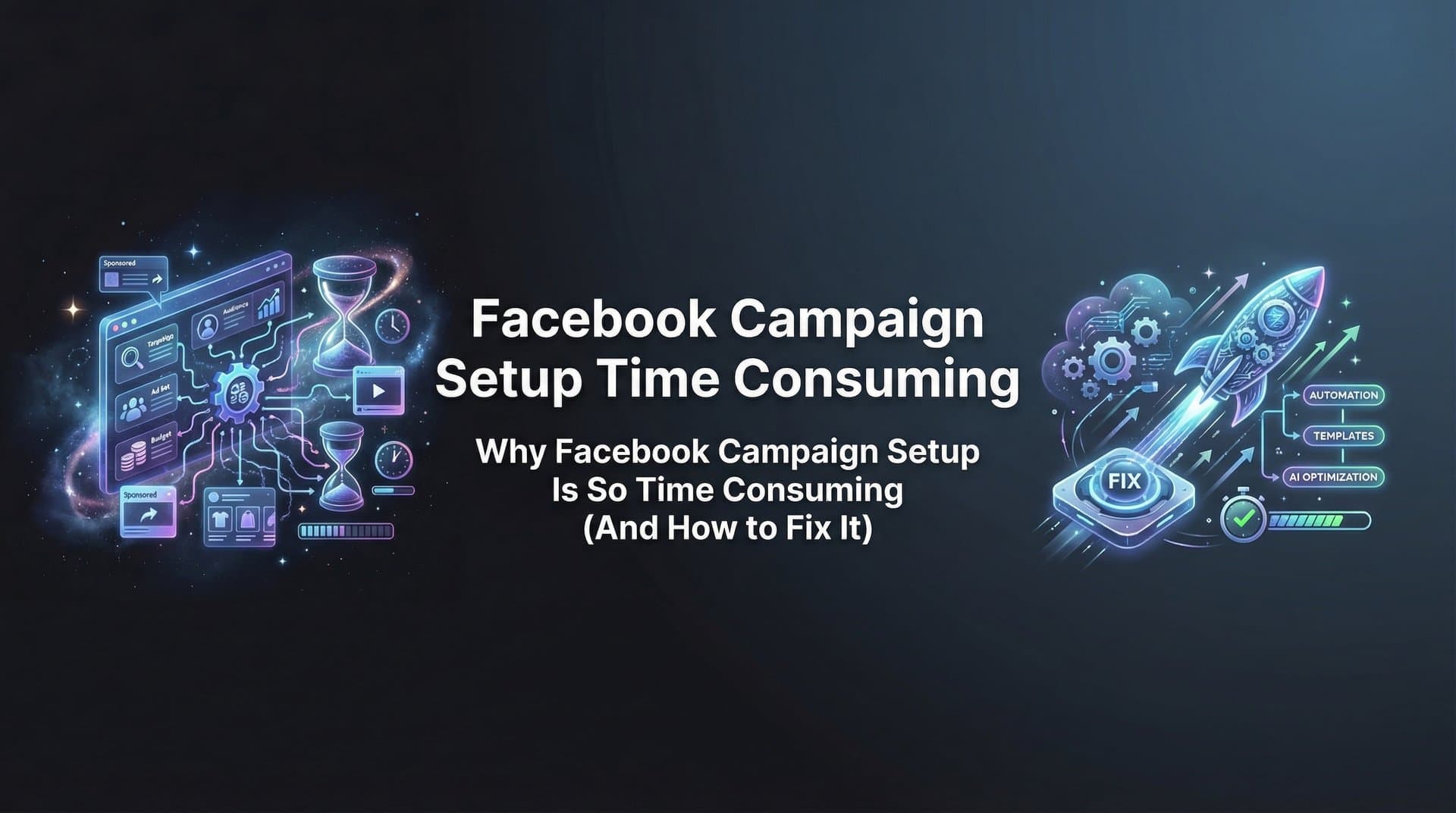
Facebook campaign setup has become a marathon of decision-making. What should be a straightforward process—pick your audience, upload your creative, set your budget—has evolved into a labyrinth of configuration screens, nested menus, and endless optimization toggles.
The numbers tell a frustrating story. Marketers report spending 45-60 minutes configuring a single campaign, and that's when everything goes smoothly. For agencies managing multiple clients or brands running continuous testing programs, those minutes accumulate into days of lost productivity each month.
This isn't just about inconvenience. Every hour spent clicking through Ads Manager is an hour not spent analyzing performance, developing creative strategy, or identifying new growth opportunities. The platform's complexity has turned what should be execution time into a significant strategic bottleneck.
Let's break down exactly why Facebook campaign setup consumes so much time—and more importantly, how to fix it.
The Hidden Time Drains in Facebook Ads Manager
The moment you click "Create Campaign," you're confronted with a decision tree that branches into dozens of potential configurations. Each choice triggers new options, and each option demands careful consideration.
Campaign Structure Paralysis: The CBO versus ABO debate alone can consume 10 minutes of deliberation. Campaign Budget Optimization gives Facebook control over budget distribution across ad sets, while Ad Set Budget Optimization lets you manually allocate spend. Neither is universally superior—the right choice depends on your testing strategy, historical data, and campaign objectives. But making this decision requires understanding the implications for your specific situation.
Then come the campaign objectives. Meta offers six primary categories—Awareness, Traffic, Engagement, Leads, App Promotion, and Sales—each with unique optimization settings. Choose "Sales" and you'll configure for conversions. Pick "Traffic" and you're optimizing for link clicks. Select the wrong objective and your entire campaign optimizes toward the wrong goal, wasting budget before you even launch.
The Audience Building Maze: This is where minutes turn into hours. Building a properly targeted audience means layering multiple elements: demographics (age, gender, location), detailed targeting (interests, behaviors, job titles), and custom audiences (website visitors, email lists, engagement data).
Facebook's detailed targeting database contains thousands of interest categories. Finding the right combination requires research, testing assumptions, and often creating multiple audience variations. Do you target "Small Business Owners" or "Entrepreneurship"? Both? What about excluding people who already converted? Each decision requires thought, and each audience layer adds configuration time.
Lookalike audiences add another complexity layer. You need to select your source audience, choose the percentage similarity (1% for precision, 5-10% for scale), and decide whether to create multiple lookalikes for testing. Each lookalike requires its own ad set if you want clean performance data.
Creative Requirements Multiply: Modern Facebook advertising demands creative variations across multiple placements. Your Feed ad needs a 1:1 aspect ratio. Stories require 9:16. Reels have different specifications again. Then there's the Audience Network with its own requirements.
For each placement, you're managing image sizing, video length limits, text overlay restrictions, and headline character counts. Primary text has a 125-character recommendation. Headlines cap at 40 characters. Descriptions allow 30 characters. Exceed these limits and your copy gets truncated, potentially cutting off your key message.
Organizing these assets within Ads Manager means uploading multiple files, previewing how they render across placements, and ensuring your message remains coherent whether someone sees your ad in Feed, Stories, or Reels. This asset juggling alone can consume 15-20 minutes per campaign.
Why Manual Campaign Building Doesn't Scale
The real problem reveals itself when you move beyond single campaigns. Testing requires volume, and volume means repetition.
The Multiplication Problem: Proper testing means running multiple variations simultaneously. Test three audiences against two creative concepts with three different ad copy variations, and you're building 18 ad sets manually. Each requires the same configuration process: selecting placements, setting budgets, defining schedules, and reviewing settings before launch.
Every campaign demands this full configuration sequence. There's no "copy and modify" shortcut that truly saves time—you still need to review each setting, update audience targeting, swap creative assets, and adjust budgets. What takes 45 minutes for one campaign becomes 6-8 hours for a proper testing matrix.
This multiplication problem gets worse as your advertising program matures. Successful brands run continuous testing programs, launching new campaigns weekly or even daily. At that volume, manual building becomes the primary bottleneck preventing faster iteration cycles. Understanding Facebook automation vs manual campaigns becomes essential for teams looking to scale efficiently.
Testing Bottlenecks: Rigorous A/B testing requires isolating variables. Testing audience performance? You need identical creative across multiple ad sets. Testing creative variations? You need consistent audience targeting. Each test demands careful campaign architecture to ensure clean data.
Building these test structures manually is tedious and error-prone. You're duplicating ad sets, carefully changing only the test variable, and triple-checking that everything else remains constant. One misclicked setting invalidates your test data, forcing you to rebuild or accept compromised results. This campaign testing inefficiency plagues even experienced advertisers.
The time investment discourages proper testing. Marketers often skip important tests because building the campaign structure feels too time-consuming. This leads to suboptimal campaigns running longer than they should, slowly draining budget while better approaches remain untested.
Human Error Costs: Manual configuration introduces countless opportunities for mistakes. Forget to exclude converters from your prospecting campaign? You're wasting budget retargeting people who already bought. Accidentally set daily budget instead of lifetime? Your spend pacing is wrong. Select the wrong optimization event? Your campaign optimizes toward the wrong goal.
These errors aren't always immediately obvious. A campaign might run for days before you notice the misconfiguration, accumulating wasted spend. Some mistakes only become apparent when you analyze performance data and realize the results don't match your expectations.
The cognitive load of managing dozens of settings increases error probability. You're making hundreds of micro-decisions per campaign, each requiring focus and accuracy. Fatigue sets in, especially when building multiple campaigns in succession, and mistakes slip through.
The Real Cost of Slow Campaign Launches
Time-consuming setup creates costs beyond the hours spent clicking through Ads Manager. The strategic implications compound over time.
Opportunity Cost: While you're spending 45 minutes configuring campaign settings, your competitors are already running ads to the same audiences. In fast-moving markets, being first to market with messaging around a trend or event can mean the difference between campaign success and mediocrity.
This timing disadvantage is particularly acute for seasonal campaigns, product launches, or trend-based advertising. If configuring your Black Friday campaign takes three hours, and your competitor launches two hours faster, they've already begun gathering performance data and optimizing while you're still in setup mode.
The opportunity cost extends to testing velocity. Faster launches enable faster learning cycles. If you can launch and analyze campaigns in half the time, you can run twice as many tests in the same period, accelerating your path to finding winning combinations of audience, creative, and messaging.
Team Burnout: Skilled marketers didn't enter the field to spend their days filling out forms and clicking through configuration screens. The repetitive nature of manual campaign building is cognitively draining and professionally unfulfilling.
This leads to two problems. First, talented marketers become frustrated and seek roles with less repetitive work. Second, the time spent on setup means less time for strategic thinking—analyzing market trends, developing creative concepts, identifying new audience opportunities, or optimizing campaign performance.
The result is a team operating below its potential. Your strategists are doing execution work, your creative thinkers are managing technical settings, and everyone is spending energy on tasks that don't leverage their core skills.
Delayed Optimization Cycles: Campaign optimization requires data, and data requires time. The faster you launch, the faster you begin collecting performance signals that inform your next moves.
Slow launches create a cascading delay effect. If campaign setup takes three hours, and you're launching two campaigns per week, you've added six hours to your optimization timeline. Over a month, that's 24 hours of delayed learning—essentially a full day of performance data you could have been analyzing and acting on.
This delay is particularly costly in the early stages of new advertising programs. The learning phase is critical for identifying what works, and every day of delayed launch is a day of delayed learning. Faster setup means faster entry into the optimization phase where you're actively improving performance rather than still configuring initial tests.
Streamlining Your Campaign Setup Process
Even without automation tools, you can significantly reduce setup time through better systems and processes.
Template Systems: Build reusable campaign structures for your most common objectives. If you regularly run lead generation campaigns with similar audience targeting and creative formats, create a documented template that specifies every setting, from campaign objective to placement selection to optimization events.
These templates serve as checklists, reducing decision fatigue and ensuring consistency. Instead of deliberating over each setting, you're following a proven structure. For new campaigns, you're only customizing the variables that actually change—typically audience targeting, creative assets, and budget allocation. A robust Facebook campaign template system can cut your setup time dramatically.
Maintain templates for different campaign types: prospecting campaigns, retargeting sequences, seasonal promotions, product launches. Each template should document not just what settings to use, but why—the strategic reasoning behind each choice. This knowledge transfer helps team members understand the logic rather than blindly following steps.
Naming Conventions and Organization: Standardized naming eliminates the micro-decision of "what should I call this?" for every campaign, ad set, and ad. Develop a naming structure that encodes key information: campaign type, audience, creative concept, and date.
For example: "PROS_LookAlike1%_VideoTestimonial_2026-02" immediately tells you this is a prospecting campaign targeting a 1% lookalike audience, using video testimonial creative, launched in February 2026. This clarity speeds up both setup (you're not inventing names) and analysis (you can quickly identify campaigns by name). Implementing proper Facebook campaign naming conventions pays dividends across your entire operation.
Apply the same systematic approach to audience naming, creative file organization, and campaign tagging. When everything follows predictable patterns, you spend less mental energy on organizational decisions and more on strategic choices.
Batch Processing: Group similar tasks to minimize context switching. Instead of building campaigns one at a time from start to finish, batch similar activities across multiple campaigns.
Build all your audience segments in one session. Then move to creative upload and organization. Then configure campaign settings across all campaigns. This batching reduces the cognitive load of switching between different types of tasks and often reveals opportunities to reuse work across campaigns.
Batching also makes it easier to maintain consistency. When you're configuring placement settings for five campaigns in succession, you're less likely to accidentally use different settings than if you're building each campaign days apart.
How AI Automation Eliminates Setup Bottlenecks
Manual optimization has limits. Even with perfect templates and processes, you're still clicking through configuration screens and making dozens of decisions per campaign. AI automation fundamentally changes this equation.
Intelligent Campaign Building: Advanced AI systems analyze your historical performance data to make configuration decisions automatically. Instead of manually selecting audience targeting based on intuition, AI identifies which audience segments have driven the best results for similar campaigns and configures targeting accordingly.
This goes beyond simple duplication. AI agents can examine patterns across hundreds of campaigns to identify what works: which interest combinations perform best, which creative formats drive conversions, which budget allocation strategies maximize ROAS. These insights inform every new campaign configuration.
The result is campaigns built in seconds that incorporate learnings from your entire advertising history. You're not starting from scratch with each campaign—you're launching with the accumulated intelligence of every test you've ever run. Understanding automated Facebook campaign creation helps marketers grasp the full potential of these systems.
Bulk Launching Capabilities: AI-powered platforms enable launching multiple campaign variations simultaneously. Instead of building 18 ad sets manually for a testing matrix, you specify your test parameters—audiences to test, creative variations, budget levels—and the system generates all combinations automatically.
This bulk launching capability transforms testing economics. What previously took 6-8 hours of manual work happens in under a minute. The time barrier to proper testing disappears, enabling more rigorous experimentation and faster optimization cycles.
Platforms like AdStellar AI take this further with specialized agents that handle different aspects of campaign building. The Structure Architect designs optimal campaign architecture. The Targeting Strategist analyzes audience performance. The Creative Curator selects winning ad elements. The Copywriter generates variations. The Budget Allocator distributes spend efficiently. These agents work in parallel, building complete campaigns in under 60 seconds.
Continuous Learning: The most powerful automation systems improve with every campaign. Each launch generates new performance data, which feeds back into the AI models, refining their understanding of what works for your specific business.
This creates a compounding advantage. Early campaigns benefit from general best practices and your historical data. As you run more campaigns, the AI develops increasingly sophisticated insights specific to your audience, creative style, and business model. Configuration decisions become more accurate over time, improving campaign performance while maintaining fast setup speeds.
This continuous learning loop also handles the platform changes that constantly complicate manual management. When Meta introduces new features or changes existing settings, AI systems can quickly incorporate these updates, testing their effectiveness and adjusting configurations based on actual performance rather than speculation. Exploring Facebook ad campaign automation software options reveals how different platforms approach this challenge.
Your Faster Launch Framework
Transforming your campaign setup process requires a systematic approach. Start with visibility, implement quick improvements, then scale with automation.
Audit Your Current Setup Time: Track how long campaign building actually takes. Time yourself creating a typical campaign from initial click to launch, noting where the process bogs down. Is audience building the bottleneck? Creative organization? Decision paralysis around campaign settings?
This audit reveals your specific pain points. Different teams struggle with different aspects of setup. Some spend excessive time on audience research. Others get stuck in creative asset management. Identifying your particular bottlenecks ensures you prioritize improvements that deliver the biggest time savings.
Document the steps in your current process. How many clicks does campaign creation require? How many decisions? Where do you backtrack to fix mistakes? This baseline measurement lets you quantify improvements as you implement changes.
Implement Quick Wins: Start with the manual improvements that require no new tools—templates, naming conventions, and batching. These deliver immediate time savings and create better organizational foundations for future automation.
Build your first template for your most common campaign type. Document every setting and the reasoning behind it. Use this template for your next three campaigns, refining it based on what works and what needs customization. Once refined, create templates for your other common campaign types. You can also leverage Facebook ad campaign templates as starting points.
Establish naming conventions and train your team to use them consistently. The value compounds quickly—within weeks, you'll have a well-organized account where finding and analyzing campaigns takes seconds instead of minutes.
Evaluate Automation Tools: Once you've optimized your manual process, assess whether automation makes sense for your volume and complexity. If you're launching fewer than five campaigns per month, manual optimization with good templates might suffice. If you're launching daily or running continuous testing programs, automation becomes essential.
Look for platforms that offer transparency alongside automation. The best AI tools don't just configure campaigns—they explain their reasoning, helping you understand why certain audiences were selected or how budget was allocated. This transparency ensures you're learning from the automation rather than becoming dependent on a black box. A thorough Facebook campaign automation platforms comparison can help you identify the right fit.
Consider integration capabilities. Tools that connect directly with Meta's API and your attribution systems provide more accurate data and enable more intelligent decision-making than platforms requiring manual data uploads.
Reclaim Your Time, Amplify Your Impact
Facebook campaign setup doesn't have to consume hours of your day. The time drain stems from platform complexity, manual repetition, and configuration decisions that could be automated based on performance data.
The path forward combines immediate process improvements with strategic automation. Templates and naming conventions deliver quick wins, reducing setup time by 30-40% with no new tools required. Batching similar tasks minimizes context switching and maintains consistency across campaigns.
For teams running substantial campaign volumes, AI automation transforms the economics of testing and optimization. What once took hours happens in seconds, enabling testing programs that were previously impractical due to time constraints.
The real prize isn't just faster campaign launches—it's reclaiming strategic capacity. Every hour saved on repetitive configuration is an hour available for analyzing performance, developing creative concepts, identifying new opportunities, and refining your overall advertising strategy. That's where marketing talent creates real value.
Ready to transform your advertising strategy? Start Free Trial With AdStellar AI and be among the first to launch and scale your ad campaigns 10× faster with our intelligent platform that automatically builds and tests winning ads based on real performance data.