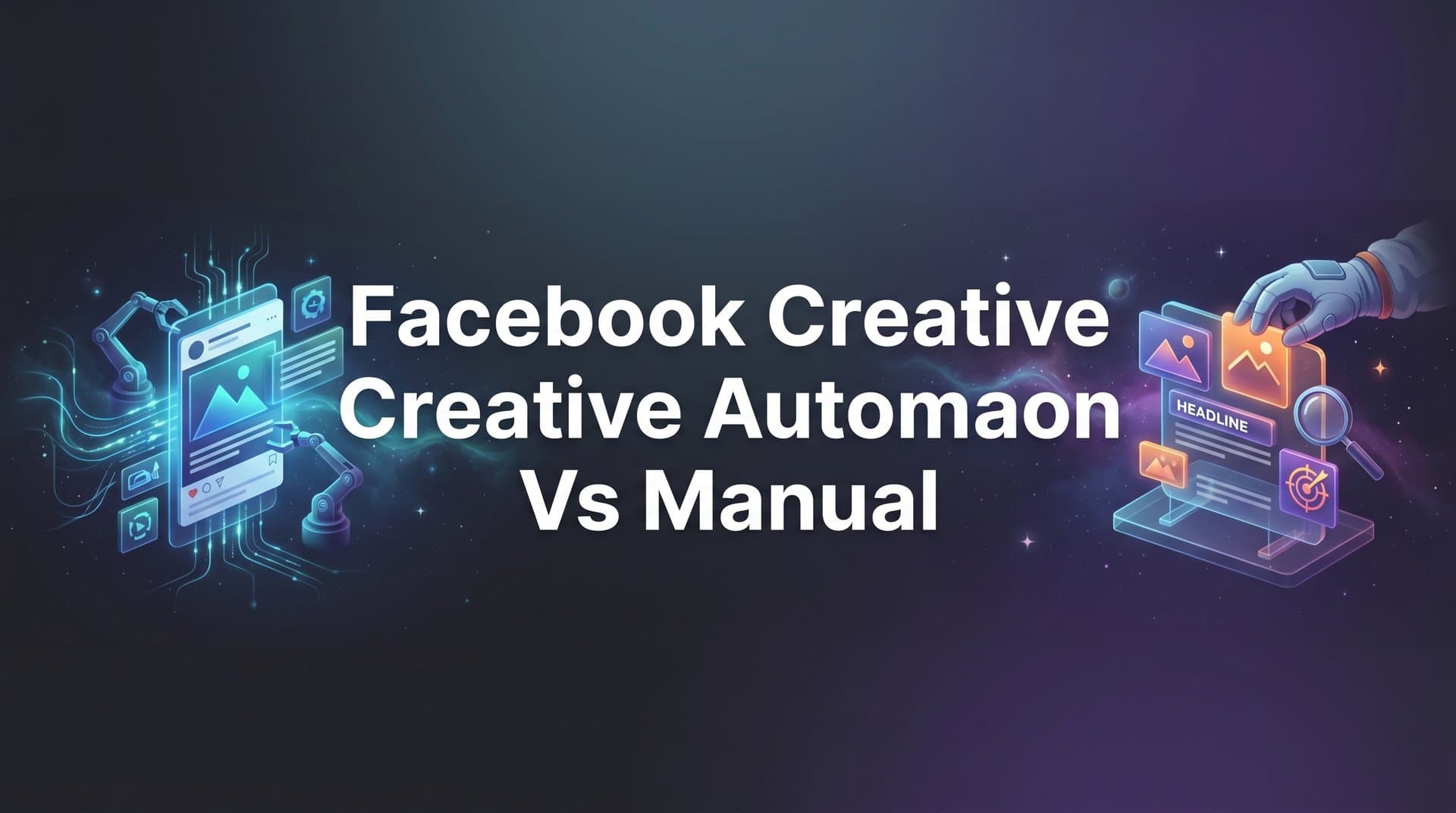
Every performance marketer running Meta campaigns eventually hits the same wall: should you keep building creatives by hand, or let automation take over? The tension is real, and the stakes are high. Creative is now widely recognized as one of the most influential levers in Meta ad performance, which means how you produce and test it matters enormously.
The answer is rarely all or nothing. Manual creative workflows give you granular control over brand voice, visual direction, and messaging nuance. Automation unlocks speed, scale, and data-driven iteration that human teams simply cannot match on their own. The real question is where each approach delivers the most value for your specific goals, budget, and team size.
This guide breaks down seven strategies for evaluating Facebook creative automation against manual workflows. Whether you are a solo marketer managing a handful of campaigns or an agency scaling dozens of accounts, these frameworks will help you build a creative process that balances control with efficiency.
By the end, you will know exactly which tasks to automate, which to keep manual, and how to blend both for stronger ROAS and faster creative testing cycles.
1. Audit Your Creative Bottleneck Before Choosing a Path
The Challenge It Solves
Most marketers jump straight into the automation vs. manual debate without first understanding where their creative process is actually breaking down. The result is solving the wrong problem. If your bottleneck is approval cycles, automation will not fix it. If it is raw production volume, manual workflows will continue to hold you back regardless of how talented your team is.
The Strategy Explained
Before making any decision, map your full creative pipeline from brief to live ad. Document every step, who owns it, and how long it takes. Look for stages where work consistently piles up, where handoffs slow things down, or where quality suffers under time pressure.
Common bottlenecks include the initial design phase, copy review cycles, asset formatting for multiple placements, and the media buyer's time spent manually setting up ad variations. Once you know where the friction lives, you can make a targeted decision about where automation adds real value versus where it adds complexity without benefit. For a deeper look at how too many manual steps in Facebook ads create these friction points, that resource is worth reviewing.
Implementation Steps
1. List every step in your creative process from concept to launch, including who is responsible at each stage.
2. Record the average time spent at each step over the past 30 days, using project management tools or simply asking your team.
3. Identify the two or three steps with the highest time cost or most frequent delays.
4. Categorize those bottlenecks as either production-related (automation can help) or strategic and review-related (human attention is still required).
Pro Tips
Do not rely on gut feel here. Pull actual data from your project management tool or ask team members to time-track for a single week. The bottleneck you think exists is often not the real one. Many teams discover their biggest time sink is not design but the back-and-forth between media buyers and creative teams when setting up ad variations.
2. Segment Your Creative Needs by Purpose and Priority
The Challenge It Solves
Treating all creatives as equal is one of the most common mistakes in ad management. A brand awareness video anchoring your Q4 campaign deserves a completely different production process than a retargeting banner being tested against five other variations. Applying the same workflow to both wastes either human effort or automation potential.
The Strategy Explained
Divide your creative output into two buckets. The first is performance volume creative: ads designed for testing, iteration, and scaling. These include direct response formats, product-focused image ads, and variations of proven concepts. This bucket is ideal for automation because speed and volume matter more than hand-crafted nuance.
The second bucket is brand-critical creative: hero campaigns, brand films, launch announcements, and anything that defines how your audience perceives your company. These benefit from human direction, strategic thinking, and careful execution. Automation can assist with production tasks here, but the creative vision should remain human-led. Understanding the nuances of AI vs manual Facebook ad creation helps clarify which bucket each project belongs in.
Tools like AdStellar's AI Creative Hub are particularly well-suited for the first bucket, generating image ads, video ads, and UGC-style creatives from a product URL at a speed no human team can replicate.
Implementation Steps
1. Categorize every active creative project as either performance volume or brand-critical based on its primary objective.
2. Assign automation-first workflows to all performance volume creative, using AI tools to handle initial generation and variation.
3. Protect your brand-critical creative with a human-led process, using automation only for production tasks like resizing or format adaptation.
4. Review this segmentation quarterly as your brand evolves and your automation tools become more sophisticated.
Pro Tips
When in doubt, ask this question: would a slight variation in tone or visual style matter to the business outcome of this specific ad? If yes, keep it manual. If no, automate it. Most performance ads fall into the second category more often than marketers initially expect.
3. Run a Head-to-Head Test With Controlled Variables
The Challenge It Solves
Opinions about automation vs. manual workflows are everywhere, but opinions are not data. Without a structured comparison using your own account, your own audience, and your own creative benchmarks, you are making a major workflow decision based on someone else's results. That is a risky foundation.
The Strategy Explained
Set up a controlled head-to-head test where automated and manual creatives compete under identical conditions. This means the same audience, the same budget split, the same campaign objective, and the same measurement window. The goal is not to declare a universal winner but to understand how each approach performs in your specific context. Our comprehensive guide on Meta ads automation vs manual creation walks through additional frameworks for structuring these comparisons.
Choose a creative format you run frequently, such as a single image ad for a core product. Have your team produce three to five variations manually using your standard process. Then use an AI creative tool to generate three to five variations from the same product information. Run both sets simultaneously and measure performance against your primary KPI.
Implementation Steps
1. Select one ad format and one campaign objective for the test to keep variables controlled.
2. Define your measurement window in advance, typically seven to fourteen days depending on your budget and traffic volume.
3. Produce manual and automated creative sets independently, without cross-referencing, to ensure genuine variation.
4. Launch both sets to the same audience with equal budget allocation and measure against a single primary KPI.
5. Document results including performance metrics, time spent producing each set, and cost per creative.
Pro Tips
Track production time as carefully as you track performance metrics. A manual creative that outperforms an automated one by a small margin may still be the wrong choice if it took five times longer to produce. The true comparison is performance per unit of time and cost invested.
4. Leverage Bulk Launching to Multiply Your Testing Capacity
The Challenge It Solves
Creative testing is one of the highest-leverage activities in Meta advertising, but it is also one of the most time-consuming when done manually. Setting up individual ad variations one by one, adjusting audiences, writing copy permutations, and managing the launch process can consume hours that should be spent on strategy. The result is that most teams test far fewer creative concepts than they should.
The Strategy Explained
Bulk ad creation fundamentally changes the economics of creative testing. Instead of building one ad at a time, you mix multiple creatives, headlines, copy variations, and audiences simultaneously and let the system generate every possible combination. What would previously take a media buyer a full day can be completed in minutes. Dedicated Facebook ad testing automation tools make this process even more streamlined.
This is where platforms like AdStellar's Bulk Ad Launch feature provide a meaningful advantage. You can create hundreds of ad variations by combining your creative assets with different headlines and audience segments, then launch them all to Meta in a single workflow. The testing surface area you can cover in a single week expands dramatically.
More testing means more data, and more data means faster identification of winning creative combinations. This compresses what used to be weeks of sequential testing into a concentrated burst of parallel experimentation.
Implementation Steps
1. Prepare a creative library with multiple assets: at least three to five images or videos, three to five headline options, and two to three copy variations.
2. Define your audience segments in advance so they are ready to attach during the bulk launch process.
3. Use a bulk ad creation tool to generate every combination and review the full set before launching.
4. Set a consistent budget per ad set and a defined measurement window before the launch goes live.
5. Let the test run to statistical significance, then pull the data and identify patterns across winning combinations.
Pro Tips
Resist the urge to pause underperforming ads too early. Bulk testing only delivers its full value when you let the data accumulate. Set your evaluation criteria before launch and stick to the plan. Early signals can be misleading, especially with smaller daily budgets.
5. Build a Performance Feedback Loop That Manual Workflows Cannot Match
The Challenge It Solves
Running creative tests is only half the equation. The other half is making sense of the results quickly enough to act on them. Manual analysis of creative performance across dozens of ad variations is slow, prone to bias, and often incomplete. Marketers tend to focus on the metrics they already understand rather than surfacing the patterns that actually predict performance.
The Strategy Explained
AI-powered performance analysis creates a feedback loop that continuously ranks every creative element against your target KPIs. Instead of manually sorting through campaign data, you get a ranked view of which creatives, headlines, audiences, and landing pages are driving real results based on metrics like ROAS, CPA, and CTR. This is one of the core advantages explored in the broader discussion of Facebook ads automation vs manual management.
AdStellar's AI Insights feature does exactly this. Leaderboards surface your top and bottom performers across every element of your campaign. You set your target goals, and the AI scores everything against those benchmarks so you can instantly see what is working and what is not. The Winners Hub then stores your best performers so they can be pulled directly into future campaigns without starting from scratch.
This is a capability that manual workflows structurally cannot replicate at scale. A human analyst reviewing the same volume of data would take significantly longer and would inevitably introduce subjective judgment into what should be an objective ranking process.
Implementation Steps
1. Define your primary KPI and target benchmarks before launching any campaign so the scoring system has clear criteria.
2. Connect your campaign data to an AI insights tool that can rank performance across creative, copy, audience, and landing page dimensions.
3. Review leaderboard rankings on a weekly cadence and identify the top performers across each element.
4. Save winning elements to a structured library so they can be reused and built upon in future campaigns.
5. Use the bottom performers as learning signals, not just failures. Identify patterns in what consistently underperforms and adjust your creative briefs accordingly.
Pro Tips
The real power of this feedback loop is compounding. Each campaign cycle generates data that makes the next one smarter. If you are using a platform like AdStellar where the AI learns from your historical performance, the quality of its recommendations improves over time. Treat every campaign as an investment in your future creative intelligence, not just a one-time test.
6. Clone and Iterate on Competitor Creatives at Scale
The Challenge It Solves
Generating fresh creative ideas consistently is one of the hardest parts of running Meta campaigns at scale. Creative fatigue is a real phenomenon: ads lose their effectiveness as audiences see them repeatedly, which means you need a constant pipeline of new concepts. Starting from a blank page every time is neither efficient nor necessary when your competitors are already running experiments you can learn from.
The Strategy Explained
Meta's Ad Library gives you visibility into what your competitors are running right now. The strategic move is to use that intelligence as a creative starting point, not to copy but to understand what frameworks and formats are resonating in your market, then build differentiated versions that reflect your own brand and offer.
Manual execution of this process is slow. You browse the Ad Library, screenshot ads, brief a designer, wait for production, and then set up the campaign. Leveraging the best Facebook ad creative tools compresses this entire workflow. AdStellar's AI Creative Hub lets you clone competitor ad frameworks directly from the Meta Ad Library and generate your own differentiated variations in minutes. You get the strategic insight of competitor research with the production speed of automation.
The key is iteration. Do not just clone one competitor ad. Identify three to five frameworks that appear consistently in your competitive landscape, generate multiple variations of each, and test them against your existing controls. This turns competitor intelligence into a systematic creative input rather than a one-off inspiration exercise.
Implementation Steps
1. Spend 30 minutes in Meta's Ad Library researching your top three to five competitors, noting which ad formats and creative frameworks appear most frequently.
2. Identify the structural elements that recur: the hook format, the visual style, the offer framing, and the call to action approach.
3. Use an AI creative tool to generate your own versions of these frameworks, adapting them to your brand voice and unique value proposition.
4. Launch these variations alongside your existing creative controls to test whether the competitor-inspired frameworks resonate with your audience.
5. Feed the results back into your performance leaderboard to determine which frameworks are worth scaling.
Pro Tips
The goal is to learn from the market, not to imitate it. When adapting competitor frameworks, always ask: what makes our offer or brand genuinely different, and how does this creative format highlight that difference? The best competitor-inspired ads take a proven structure and fill it with something the original never had.
7. Create a Hybrid Workflow That Scales With Your Growth
The Challenge It Solves
The automation vs. manual debate often gets framed as a binary choice, but the most effective Meta advertisers are not choosing one side. They are building hybrid systems where each approach handles the work it is genuinely best suited for. The challenge is designing that system intentionally rather than letting it evolve haphazardly as your team grows and your budget increases.
The Strategy Explained
A well-designed hybrid workflow assigns automation to production, testing, and analysis while keeping humans in charge of strategy, brand direction, and creative vision. The ratio shifts as you scale. Early-stage teams with limited resources might automate more aggressively to compensate for bandwidth constraints. Larger teams with dedicated creative talent might automate production and testing while investing more human time in high-concept brand work. Our complete Facebook advertising workflow automation guide covers how to structure these systems step by step.
Think of it as a division of cognitive labor. Automation handles the tasks that benefit from speed, consistency, and data processing at scale. Humans handle the tasks that require judgment, empathy, cultural awareness, and strategic thinking. Neither can fully replace the other, but together they create a system that outperforms either approach alone.
Platforms like AdStellar are built for this hybrid model. The AI Campaign Builder analyzes your historical performance data, ranks every creative and audience element, and builds complete Meta campaigns with full transparency into its reasoning. You see exactly why the AI made each decision, which keeps your team informed and in control of the strategic direction even as automation handles the heavy lifting. Teams that struggle with scaling Facebook ads manually find this hybrid approach particularly transformative.
Implementation Steps
1. Map your current creative workflow and label each task as either automation-ready (repetitive, volume-dependent, data-driven) or human-essential (strategic, brand-defining, judgment-based).
2. Implement automation tools for the automation-ready tasks first, starting with the highest-volume activities like ad variation creation and performance reporting.
3. Define clear handoff points where human review is required before automated output goes live, particularly for brand-critical decisions.
4. Set a quarterly review cadence to evaluate whether the automation-to-manual ratio still fits your team size, budget, and growth stage.
5. Document the workflow so new team members understand which decisions are automated, which are human-led, and why the division exists.
Pro Tips
The most important thing to protect in a hybrid workflow is strategic clarity. Automation can generate hundreds of creative variations, but it cannot define what your brand stands for or what emotional response you want your ads to create. Keep those decisions firmly in human hands, and let automation execute against that vision at scale.
Putting It All Together: Your Automation Roadmap
The decision between Facebook creative automation and manual ad management does not have to be overwhelming. Work through these seven strategies in sequence and you will build a clear, data-backed picture of exactly where each approach belongs in your workflow.
Start by auditing your current bottleneck to understand where time and money are actually being lost. From there, segment your creative needs so automation handles high-volume testing while your team focuses on brand-defining work. Run a controlled head-to-head test to get real data for your specific account rather than relying on general industry claims.
Once you see the results, lean into bulk launching and AI-driven feedback loops to accelerate your testing velocity. Use competitor intelligence from the Meta Ad Library to fuel your creative pipeline with proven frameworks. Then tie it all together with a hybrid workflow that evolves as your team and budget grow.
The marketers seeing the strongest results right now are not choosing automation or manual. They are building systems that combine both, using AI to handle the repetitive, data-heavy work while keeping human creativity where it matters most.
If you are ready to put this into practice, Start Free Trial With AdStellar and experience a platform built for exactly this approach. From AI creative generation to campaign launch to performance insights, AdStellar covers the full workflow in one place so you can launch and scale winning ads faster without adding headcount or complexity.