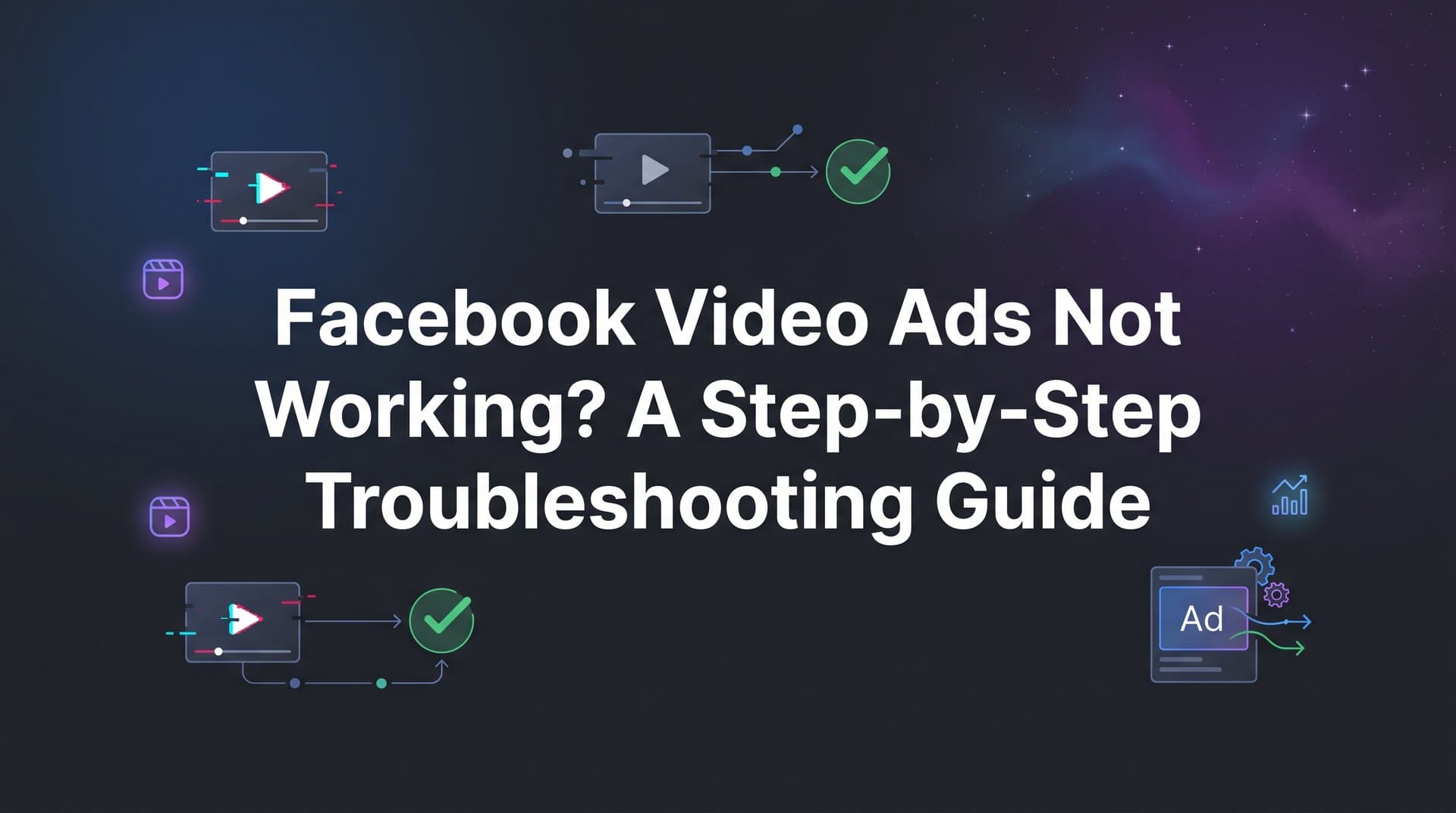
Most Facebook video ad campaigns don't fail because of bad luck. They fail because something specific is broken, and without a structured way to find it, you end up guessing. You tweak the audience. You swap the creative. You adjust the budget. And if nothing improves, you start questioning whether Facebook ads even work at all.
They do work. But when Facebook video ads are not working, the cause is almost never where you first look for it. The problem could be a policy flag silently blocking delivery, a video hook that loses viewers in the first two seconds, an audience so narrow that Meta can't spend your budget, or a landing page that loads too slowly to convert the clicks you are paying for.
The good news is that underperforming video ad campaigns tend to share a small set of root causes. Once you know the right sequence to check them, diagnosing the issue becomes methodical rather than frustrating. This guide gives you a proven six-step troubleshooting process that covers every layer of your campaign, from the video file itself to what happens after someone clicks.
Whether you are managing campaigns manually in Meta Ads Manager or using an AI-powered platform like AdStellar to generate and launch your video creatives, this process applies. Work through each step in order. Each one narrows down the cause, so by the time you reach the end, you will know exactly what to fix.
Step 1: Run a Delivery and Policy Check First
Before you spend a single minute analyzing creative performance or audience targeting, confirm that your ads are actually running. This sounds obvious, but it is one of the most commonly skipped steps, and it leads to marketers spending hours optimizing campaigns that were never delivering in the first place.
Open Meta Ads Manager and check the delivery status column for each ad. You want to see "Active" with a green indicator. If you see "In Review," "Rejected," "Scheduled," "Paused," or "Limited," that is your starting point, not your targeting settings.
Policy rejections: Video ads get flagged for a range of reasons. Common triggers include text overlays that cover too much of the frame, claims that Meta's system flags as misleading, content in restricted categories like financial products or weight loss, and prohibited content like before-and-after imagery. If your ad was rejected, Meta will usually provide a policy code. Read it carefully and cross-reference it with Meta's Advertising Policies documentation before making changes.
Account-level restrictions: Sometimes the issue is not with a specific ad but with your ad account overall. Check your Account Quality dashboard in Meta Business Manager. If your account has accumulated policy violations or a low quality score, Meta may throttle delivery across all of your campaigns, not just the flagged ones. This is easy to miss if you are only looking at individual ad status. Understanding the full range of reasons behind Facebook ads not delivering can help you address account-level issues more systematically.
Billing issues: A failed payment or a billing threshold that has been reached will silently pause your entire account. Check your payment method in Billing Settings and confirm your account balance or credit limit is not the reason delivery stopped. This is surprisingly common and takes about thirty seconds to rule out.
Learning phase status: If your ads show "Learning" status, understand that this is expected behavior, not a failure. Meta's algorithm requires approximately 50 optimization events per ad set per week before it exits the learning phase and delivery stabilizes. During this period, costs are often higher and delivery is inconsistent. The fix is not to make changes. Frequent edits reset the learning phase and extend the instability. Give the algorithm time and sufficient budget to collect data before drawing conclusions.
The success indicator for this step is simple: all active ads show green delivery status with no policy flags, no account warnings, and a valid payment method confirmed. If everything checks out here, move to the next step.
Step 2: Audit Your Video Creative for the Real Problems
Creative quality is the single biggest variable in Meta ad performance. Audience targeting and bid strategy matter, but if your video is not stopping the scroll, nothing else you optimize will save it. This step is where most underperforming campaigns have their actual root cause.
Start with technical specs. Meta recommends MP4 or MOV format for video ads. For feed placements, understanding the correct video size for Facebook ads is essential, and your file size should stay under 4GB. These are baseline requirements. If your video was exported at low resolution or in an unsupported format, you may be running a technically degraded ad without realizing it.
The first three seconds: This is where most video ads lose. Meta's own guidance consistently emphasizes that videos need to hook viewers immediately. If your video opens with a slow logo animation, a blank screen, or a generic lifestyle shot with no clear message, users scroll past before Meta can gather any meaningful engagement data. Your hook needs motion, a bold visual, or a clear value statement right from the first frame.
To diagnose this, look at your Hook Rate in Ads Manager. This is the ratio of three-second video views to impressions. If a large percentage of people who see your ad are not watching even three seconds, the hook is the problem. You can also check ThruPlay metrics to see how many people are watching to completion versus dropping off early.
Format and placement mismatch: A 16:9 horizontal video performs poorly in Stories and Reels placements, which are designed for 9:16 vertical content. If you uploaded a single horizontal video and let Meta run it across all placements, you are likely running poorly framed ads in your highest-reach placements. Check your placement-level breakdown in reporting to see where your budget is actually going. Reviewing the ideal size for Facebook ads by placement can help you avoid this common mismatch.
Sound-off experience: Most users on Facebook and Instagram scroll with their sound off. If your video relies on voiceover or audio to communicate the core message, a large portion of your audience is missing it entirely. Captions and on-screen text are not optional extras. They are essential for converting sound-off viewers, which is the majority of your audience.
Creative fatigue: If the same video has been running for several weeks, check your frequency metric. As frequency rises, performance typically declines. Your audience has seen the ad, processed it, and moved on. No amount of bidding optimization will fix a fatigued creative. The solution is fresh video content.
A hook rate above 25 to 30 percent is a reasonable benchmark to aim for. If you are well below that, the creative is the bottleneck, not your targeting.
Step 3: Diagnose Your Audience and Targeting Setup
Targeting problems tend to show up in one of two ways: your ads either struggle to spend budget because the audience is too small, or they spend freely but reach the wrong people. Both are diagnosable with the data already in your Ads Manager account.
Audience size: For most campaign objectives, audiences under 500,000 people restrict Meta's ability to find converting users within the auction. The algorithm needs room to explore. If you have stacked multiple interest layers, added narrow demographic filters, and layered behavioral exclusions on top, you may have created an audience so small that Meta simply cannot spend your budget efficiently. Check the estimated audience size in your ad set settings. If it is very small relative to your daily budget, broaden it.
Audience overlap: Running multiple ad sets targeting similar audiences causes your own campaigns to compete against each other in Meta's auction. This drives up your CPMs and reduces efficiency across the board. Use Meta's Audience Overlap tool in the Audiences section of Business Manager to check whether your ad sets are targeting significantly overlapping groups. If they are, consolidate or differentiate your targeting.
Interest targeting assumptions: Interest-based targeting is an educated guess, not a guarantee. The interests you selected at campaign setup may not actually reflect your buyers' behavior on Facebook. Review your demographic breakdowns in reporting. If Meta is concentrating delivery heavily on one age group, gender, or placement that does not match your typical customer profile, your interest targeting may be sending the algorithm in the wrong direction.
Exclusion errors: Check your exclusion audiences carefully. It is surprisingly common to accidentally exclude warm audiences like website visitors, email subscribers, or past purchasers. Building strong Facebook ads custom audiences from your existing customer data is one of the most effective ways to protect your highest-converting segments from being excluded by mistake.
Advantage+ audience settings: Meta's AI-driven targeting, Advantage+ audience, has become a widely recommended starting point for campaigns that lack extensive historical data. It allows Meta's algorithm to find converting users beyond your manually defined parameters. If you have been running tightly constrained manual targeting without strong results, testing Advantage+ audience settings is worth including in your troubleshooting process.
The success indicator here is an audience size appropriate for your budget, no significant overlap between ad sets, and delivery spread across multiple demographic segments rather than concentrated in a narrow slice.
Step 4: Review Your Campaign Structure and Bidding Strategy
Campaign structure and bidding decisions have a direct impact on whether Meta's algorithm can do its job. Even strong creative and solid targeting will underperform if the campaign architecture is working against the algorithm.
Campaign objective alignment: This is one of the most common structural mistakes. Your campaign objective tells Meta what to optimize for in the auction. If you are running a Traffic objective but your actual goal is purchases, Meta is finding people likely to click links, not people likely to buy. Confirm that your objective matches your real business goal. For e-commerce, that typically means a Sales objective optimizing for Purchase events. For lead generation, it means a Leads objective optimizing for your lead form or website lead event. A structured Facebook ads campaign planner can help you align objectives correctly before launch rather than diagnosing mismatches after the fact.
Budget relative to cost per result: Meta's learning phase requires roughly 50 optimization events per ad set per week before delivery stabilizes. If your daily budget is $10 and your target cost per purchase is $30, the math does not work. You would need to spend $210 per week to hit 50 conversions, but your budget only allows for $70 of spend. The algorithm stays stuck in learning indefinitely. A general rule of thumb is to set your daily budget at roughly five to ten times your target cost per result.
Ad set consolidation: Running five ad sets at $10 per day each means none of them receive enough data to optimize properly. Each ad set is essentially starting over with the algorithm. Consolidating into two ad sets at $25 per day each gives Meta more signal per ad set and typically produces better results. Fewer, better-funded ad sets outperform many underfunded ones.
Bid strategy selection: Lowest Cost is the recommended starting point for most campaigns because it gives Meta maximum flexibility to find conversions within your budget. Cost Cap and Bid Cap strategies can be useful once you have strong performance data, but they restrict delivery if set below the market clearing price for your audience. If you are using Cost Cap or Bid Cap and delivery is low, your cap may simply be too tight for the current auction environment.
Optimization event and attribution window: Confirm that the event you are optimizing for is actually firing and has sufficient volume. If you are optimizing for Purchase but only generating a few purchases per week, consider optimizing for a higher-funnel event like AddToCart or ViewContent to give the algorithm more signal to work with. Monitoring your Facebook ads conversion rate at each funnel stage helps you identify where drop-off is occurring and which optimization event will give the algorithm the most useful signal.
The success indicator is each active ad set receiving enough budget to generate at least 50 optimization events per week, with a campaign objective that directly matches your business goal.
Step 5: Examine Your Landing Page and Post-Click Experience
Your ad can have a great hook, strong targeting, and a well-structured campaign, and still produce poor results if what happens after the click is broken. The post-click experience is where many video ad campaigns silently fail, and it is often the last place marketers look.
Page load speed: Run your landing page through Google PageSpeed Insights and check your mobile score specifically. Slow pages cause users to abandon before the page even loads, which means you are paying for clicks that never become sessions. Beyond the user experience cost, slow pages also mean fewer conversion events firing back to Meta, which starves the algorithm of the signal it needs to optimize delivery. A landing page that loads in under three seconds on mobile is the standard to aim for.
Pixel and Conversions API verification: Use Meta's Pixel Helper browser extension to confirm that your key events are firing correctly. Check ViewContent, AddToCart, and Purchase events specifically. If your Pixel is misfiring or not installed on key pages, Meta is not receiving the conversion data it needs to optimize your campaign. This is a silent killer because your ads will keep running and spending, but the algorithm is flying blind.
If you are using AdStellar with Cometly for attribution tracking, verify that your conversion events are being passed back to Meta accurately through the Conversions API. Server-side tracking through the Conversions API is more reliable than browser-based Pixel tracking alone, particularly with iOS privacy changes affecting cookie-based attribution.
Message match: Does your landing page deliver on the specific promise your video ad made? If your video ad promotes a limited-time offer and your landing page shows a generic product page with no mention of that offer, you have created friction. Visitors feel misled, and conversion rates drop. The message, offer, and visual style of your landing page should feel like a direct continuation of your ad. Using a Facebook ads preview tool before launch lets you verify how your ad appears across placements and catch message inconsistencies before they cost you conversions.
Mobile experience: The vast majority of Facebook and Instagram video ad traffic arrives on mobile devices. If your landing page was designed primarily for desktop and has not been tested on mobile, you are likely losing a significant portion of your paid traffic at the click stage. Test your landing page on multiple mobile devices and screen sizes before drawing conclusions about ad performance.
Conversion flow complexity: Every additional step between click and conversion reduces completion rates. Review your conversion flow for unnecessary pages, excessive form fields, or friction points that could be simplified. A shorter, cleaner path to conversion typically outperforms a longer one.
The success indicator is your Pixel firing correctly on all key events, your landing page loading in under three seconds on mobile, and a clear message match between your ad creative and the page it sends traffic to.
Step 6: Test New Creatives Systematically and Scale What Works
Once you have worked through the previous five steps and identified the root cause, the fix almost always involves fresh creative. This is where many marketers make a second mistake: they fix the identified problem but then change too many things at once, making it impossible to know what actually improved performance.
Test with structure: Change one variable at a time. If you identified that your hook was the problem, test three to five new video openings while keeping the rest of the ad consistent. If you think the format is the issue, test vertical versus square versus horizontal while keeping the hook and messaging the same. Controlled testing is the only way to build knowledge that transfers to future campaigns.
What to test first: Based on the most common failure points, prioritize testing in this order: hook and opening frame, video format and aspect ratio, core messaging angle, call to action, and video length. These variables tend to have the largest impact on performance and are worth testing before more granular elements. Learning how to launch Facebook ads at scale gives you the infrastructure to run these tests efficiently across multiple variations simultaneously.
Scale your creative production: One of the biggest barriers to systematic testing is the time and cost of producing multiple video variations. This is where tools like AdStellar change the equation. AdStellar's AI Creative Hub lets you generate video ads, UGC-style avatar creatives, and image ads directly from a product URL, without needing a production team, video editor, or actors. You can also clone competitor ads from the Meta Ad Library and refine any creative through chat-based editing. When you need to test at scale, AdStellar's Bulk Ad Launch feature creates hundreds of ad variations in minutes by mixing multiple creatives, headlines, audiences, and copy combinations, then launches them to Meta in clicks rather than hours.
Organize and reuse your winners: As you test and data accumulates, use AdStellar's AI Insights leaderboards to rank your creatives, headlines, copy, and audiences by real metrics like ROAS, CPA, and CTR against your specific goals. When winners emerge, AdStellar's Winners Hub keeps your top performers organized with real performance data attached, so you can pull any proven creative directly into your next campaign without starting from scratch.
Document everything: Keep a testing log that records what you tested, what the results were, and what hypothesis you were checking. Over time, patterns emerge. You start to see which hooks consistently outperform, which formats work best for your audience, and which messaging angles resonate. This institutional knowledge compounds and makes every future campaign faster to optimize.
Avoid the abandonment trap: The most common mistake at this stage is abandoning a campaign entirely instead of isolating and fixing the specific variable that was underperforming. A campaign with strong structure, good targeting, and a solid post-click experience often just needs a creative refresh, not a complete rebuild.
The success indicator is a measurable performance lift from new creative variants, a repeatable testing process you can run on every future campaign, and a growing library of proven winners you can draw from.
Your Troubleshooting Checklist and Next Steps
Here is a quick-reference summary of the six-step process so you can work through it efficiently whenever your Facebook video ads are not working.
Step 1: Delivery and Policy Check. Confirm all ads show active green status. Check for policy rejections, account-level restrictions, billing issues, and learning phase status before analyzing anything else.
Step 2: Video Creative Audit. Verify technical specs, evaluate your hook rate and first three seconds, check format and placement match, confirm captions are present for sound-off viewing, and assess creative fatigue.
Step 3: Audience and Targeting Diagnosis. Check audience size, identify overlap between ad sets, review interest targeting assumptions, audit your exclusions, and consider Advantage+ audience settings.
Step 4: Campaign Structure and Bidding Review. Confirm objective alignment, check budget relative to cost per result, consolidate ad sets, evaluate bid strategy, and verify your optimization event has sufficient volume.
Step 5: Landing Page and Post-Click Audit. Test page load speed on mobile, verify Pixel and Conversions API are firing correctly, confirm message match between ad and landing page, and simplify your conversion flow.
Step 6: Systematic Creative Testing. Test one variable at a time, prioritize hook and format first, use tools to scale creative production, track winners, and document findings.
Most Facebook video ad failures trace back to one of four root causes: a delivery or policy issue blocking the campaign, weak creative losing viewers before Meta can gather data, mismatched targeting preventing the algorithm from finding buyers, or a broken post-click experience that loses conversions after the click. Working through these steps in sequence is faster and more reliable than guessing.
Platforms like AdStellar address many of these failure points directly. AdStellar generates AI-optimized video creatives, builds campaigns with data-backed decisions and full transparency, and surfaces your winners automatically through AI Insights leaderboards and the Winners Hub. From creative to conversion, everything lives in one place.
If you are ready to stop troubleshooting the same issues campaign after campaign, Start Free Trial With AdStellar and launch your next video ad campaign with AI handling the creative generation, campaign building, and performance analysis from day one. The free trial runs for seven days with no commitment required.