The Facebook advertising landscape has fundamentally changed. What worked two years ago—running a handful of manually crafted ads, waiting weeks for results, then slowly iterating—no longer cuts it in today's environment. CPMs have climbed steadily. Competition for attention has intensified. And the sheer volume of creative variations, audience combinations, and placement options has exploded beyond what any human can effectively manage through spreadsheets and gut instinct.
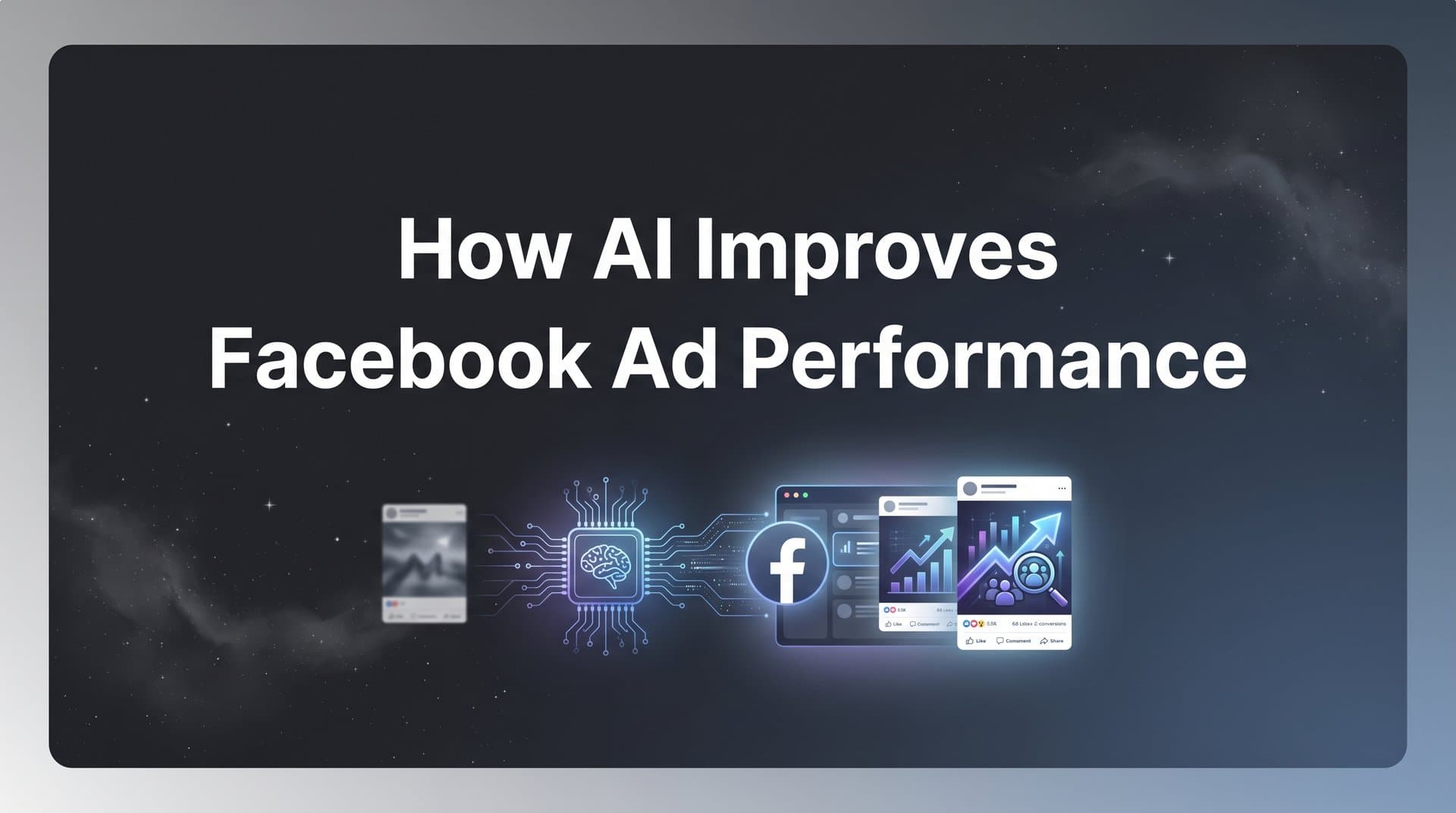
This is where artificial intelligence enters the picture, not as a buzzword but as a practical solution to a very real problem. AI is reshaping how marketers approach Facebook advertising, transforming the entire workflow from creative production to campaign construction to performance analysis. Instead of spending days manually building ad variations and weeks analyzing results, AI-powered platforms process your historical data in seconds, identify winning patterns instantly, and optimize campaigns in real-time across hundreds of variables simultaneously.
This guide breaks down exactly how AI improves Facebook ad performance through specific, measurable mechanisms. You'll understand the concrete ways machine learning enhances creative generation, campaign building, bulk testing, and performance intelligence. More importantly, you'll see how these capabilities translate into faster results, lower costs, and better ROAS for your ad accounts.
The Evolution from Manual Testing to Machine-Powered Optimization
Traditional Facebook advertising followed a predictable but painful pattern. You'd spend hours in Canva or Photoshop creating ad variations. Then you'd manually set up campaigns in Meta Ads Manager, duplicating ad sets, adjusting audiences, and triple-checking settings. After launching, you'd wait days or weeks for statistical significance, checking dashboards obsessively while budget drained on underperformers. Finally, you'd export data to spreadsheets, analyze results, and start the cycle again with new variations based on your best guess about what worked.
This manual approach had severe limitations. Most marketers could realistically test maybe 10-20 ad variations at a time. Analysis happened after the fact, meaning you'd already spent budget on losers before identifying them. Pattern recognition relied entirely on human observation, which meant you'd miss subtle correlations between creative elements, audience characteristics, and performance outcomes. The entire process was reactive rather than predictive.
AI transforms this workflow at every stage. Machine learning models can analyze your complete campaign history in seconds, processing thousands of data points that would take humans weeks to review. These systems identify patterns that aren't visible through manual analysis: which visual elements perform best for specific audience segments, which headline structures drive conversions for particular product categories, which time-of-day patterns correlate with lower CPAs. Understanding how AI improves Facebook advertising starts with recognizing this fundamental shift in analytical capability.
The shift is from reactive to predictive optimization. Instead of building campaigns based on assumptions and then adjusting after poor results, AI uses your historical performance data to predict which combinations will succeed before you spend a dollar. It's the difference between driving while looking in the rearview mirror versus having GPS that shows the road ahead.
This machine-powered approach handles simultaneous optimization across variables humans simply cannot manage at scale. While you're sleeping, AI is processing new performance signals, adjusting bids, reallocating budget toward winners, and flagging underperformers. It's testing creative variations, audience segments, and placement combinations in parallel rather than sequentially, compressing months of manual testing into days.
The result is a fundamental change in what's possible. Marketers who previously spent 80% of their time on execution tasks—creating ads, setting up campaigns, analyzing spreadsheets—can now focus that energy on strategy and creative direction while AI handles the operational heavy lifting.
AI-Powered Creative Generation: From Concept to Scroll-Stopping Ads
Creative production has traditionally been the biggest bottleneck in Facebook advertising. You need a constant stream of fresh ad creative because audiences develop ad fatigue quickly. But producing that creative required designers for images, video editors for motion content, and actors or UGC creators for testimonial-style ads. The process took days or weeks per asset, creating a fundamental mismatch between the speed at which audiences burn out on creative and the speed at which you could produce new variations.
AI creative tools eliminate this bottleneck entirely. Modern platforms can generate scroll-stopping image ads, video ads, and UGC-style avatar content directly from a product URL. You paste in a link, and the AI analyzes the product, extracts key features and benefits, and generates multiple ad variations with different visual styles, copy angles, and format approaches. What previously required a design team and days of back-and-forth now happens in minutes. Learning how to automate Facebook ad creation is essential for marketers looking to scale their output.
The technology works through machine learning models trained on millions of high-performing ads. These models have learned which visual compositions drive engagement, which color palettes perform best for different industries, which copy structures convert for specific audience types. When generating creative, the AI isn't just randomly assembling elements—it's applying patterns learned from actual performance data across thousands of campaigns.
Clone functionality takes this further by letting you analyze competitor ads directly from Meta's Ad Library. You can identify ads your competitors have been running for months (a strong signal they're profitable), then use AI to generate similar creative adapted for your brand and products. This competitive intelligence loop means you're building on proven concepts rather than starting from scratch.
Chat-based editing provides the control marketers need while maintaining production speed. You can refine any AI-generated ad through conversational commands: "Make the headline more benefit-focused," "Change the color scheme to match our brand," "Create a version that emphasizes the guarantee instead of the price." The AI understands these instructions and iterates accordingly, giving you the speed of automation with the precision of custom design work.
The practical impact is dramatic. Marketers who previously produced 5-10 ad creatives per week can now generate 50-100 variations in the same timeframe. This volume enables true creative testing at scale, where you're not just comparing a handful of concepts but exploring dozens of different visual approaches, messaging angles, and format combinations to find what resonates with your specific audience.
Video content, historically even more resource-intensive than static images, becomes equally accessible. AI can generate video ads with motion graphics, text overlays, and UGC-style avatar presenters without requiring video editing skills or expensive production equipment. This democratizes a format that drives strong engagement but was previously out of reach for many marketers due to cost and complexity.
Intelligent Campaign Building: How AI Analyzes Data to Structure Winning Campaigns
Campaign structure decisions have traditionally relied on a mix of best practices, gut instinct, and limited manual analysis. You'd look at your past campaigns, try to remember which audiences performed well, maybe export some data to compare creative performance, then build new campaigns based on that incomplete picture. The process was time-consuming and left money on the table because you couldn't effectively analyze all the variables that impact performance.
AI campaign builders change this by analyzing your complete performance history across every dimension simultaneously. The system processes all your past campaigns, ranking every creative, headline, audience segment, placement, and call-to-action by actual results like ROAS, CPA, CTR, and conversion rate. This comprehensive analysis reveals patterns that manual review would miss: which audience segments consistently deliver the lowest CPA, which creative styles drive the highest ROAS for specific product categories, which headline formulas generate the most engagement. Mastering how to structure Facebook ad campaigns becomes significantly easier when AI handles the data analysis.
What makes modern AI campaign builders powerful is transparency. Unlike black-box automation that makes decisions without explanation, intelligent systems show you exactly why they're recommending specific combinations. The AI might explain: "I'm suggesting this audience because it delivered 40% lower CPA than your account average across the last 30 days" or "This creative is ranked #2 for ROAS in your historical data, performing particularly well with this demographic segment."
This explainability is crucial because it transforms AI from a mysterious tool into a strategic partner. You understand the reasoning behind recommendations, can override decisions when you have additional context the AI doesn't possess, and learn which factors actually drive performance in your specific account rather than relying on generic industry benchmarks.
The continuous learning loop means each campaign builds on the previous one. As new performance data comes in, the AI incorporates those signals into future recommendations. A creative that performed well gets weighted more heavily in future campaign suggestions. An audience that consistently underdelivers gets deprioritized. The system becomes increasingly accurate over time because it's learning from your unique data rather than applying one-size-fits-all rules.
Campaign construction that previously took hours happens in minutes. Instead of manually creating ad sets, duplicating campaigns, and configuring settings across multiple screens, you work at a strategic level—selecting your goals, choosing which winning elements to test, and defining your budget parameters. The AI handles the tactical execution, building complete campaign structures with optimized settings based on what's worked historically in your account. Discovering how to speed up Facebook campaign creation can transform your entire advertising workflow.
This intelligence extends to budget allocation decisions. Rather than splitting budget evenly across ad sets or using simple rules of thumb, AI can distribute spend based on predicted performance, allocating more budget to combinations that data suggests will deliver better results. As campaigns run and new performance signals arrive, the system can automatically shift budget toward winners and away from underperformers faster than any manual optimization process.
Bulk Testing at Scale: Creating Hundreds of Variations in Minutes
The traditional approach to ad testing was inherently limited by human capacity. You might create three ad variations, test them against two audiences, and call it a comprehensive test. In reality, you were scratching the surface of what's possible. With multiple creatives, dozens of potential headlines, various audience segments, and different copy angles, the number of possible combinations quickly reaches into the hundreds or thousands.
AI-powered bulk launching solves this combinatorial explosion problem. The system lets you input multiple creatives, headlines, audience segments, and copy variations, then automatically generates every possible combination. You might load 10 different ad creatives, 5 headline variations, 8 audience segments, and 4 different primary text options. Instead of manually creating 1,600 individual ads (10 × 5 × 8 × 4), the AI generates all combinations and launches them to Meta in minutes. Understanding how to launch bulk Facebook ads is critical for advertisers who want to test at scale.
This capability operates at both the ad set and ad level, giving you precise control over how variations are structured. You can test creative variations within the same ad set to isolate creative performance, or split audiences across different ad sets to compare audience response independently. The flexibility allows you to design test structures that answer specific strategic questions rather than being limited by what you can manually build.
The speed advantage is transformative. What previously required days of manual setup in Ads Manager—duplicating campaigns, swapping creative, adjusting targeting, checking settings—now happens in a few clicks. This compression of time-to-launch means you can act on insights faster, test new concepts while they're still relevant, and iterate multiple times in the period you'd previously spend on a single test.
Volume-based testing dramatically increases your probability of finding winners. When you can only test 10 variations, you're hoping one of those 10 happens to be a strong performer. When you can test 200 variations, the odds that several will be winners increases substantially. You're not just finding one winning ad—you're discovering multiple winning combinations that you can scale simultaneously.
The cost per insight decreases significantly with bulk testing. Traditional limited testing meant you'd spend substantial budget proving that most variations didn't work before finding the few that did. With AI-powered bulk launching, you're testing more combinations with the same budget, which means you're gathering more performance data per dollar spent. The result is faster learning at lower cost.
Real-Time Performance Intelligence: Surfacing Winners Before Budget Waste
Traditional performance analysis happened in retrospect. You'd run campaigns for days or weeks, then export data to analyze what worked after you'd already spent the budget. By the time you identified winners and losers, you'd burned through thousands of dollars on underperformers. The lag between performance and insight meant you were always optimizing yesterday's campaigns rather than today's.
AI-powered insights dashboards flip this dynamic by surfacing winners in real-time. Leaderboard views rank every campaign element—creatives, headlines, audiences, copy variations, landing pages—by actual performance metrics like ROAS, CPA, CTR, and conversion rate. You can instantly see which ads are crushing it and which are draining budget, without exporting data or building pivot tables. A robust Facebook ad performance tracking dashboard makes this visibility possible.
Goal-based scoring takes this further by evaluating performance against your specific objectives rather than generic metrics. You define what success looks like for your business—maybe it's a target CPA of $25, or a minimum ROAS of 3x, or a CTR threshold of 2%. The AI then scores every campaign element against those benchmarks, highlighting which combinations are meeting your goals and which are falling short.
This targeted evaluation is more valuable than raw metrics because it accounts for your business context. An ad with a $30 CPA might look expensive in isolation, but if your target is $40, it's actually a winner worth scaling. The AI handles this contextual analysis automatically, flagging true winners based on your specific success criteria rather than making you manually compare every metric to your targets.
The Winners Hub functionality organizes proven performers with complete performance data in one accessible location. Instead of trying to remember which creative worked well three campaigns ago or searching through old ad sets to find that high-performing headline, all your historical winners are cataloged and ready to reuse. Each element shows the actual results it delivered, so you can confidently build future campaigns around combinations that have proven successful. Using a dedicated Facebook ad performance insights tool ensures you never lose track of what's working.
This organized approach to performance intelligence eliminates the common problem of rediscovering the same insights repeatedly. Many marketers test something, see it works, then forget about it and test the same thing again months later. With AI-powered winner tracking, your successful elements are permanently cataloged, creating a growing library of proven assets you can deploy in future campaigns.
Real-time optimization means the system can act on performance signals as they arrive rather than waiting for manual review. If an ad is clearly underperforming after spending $50, the AI can flag it immediately or automatically pause it, preventing the budget waste that happens when underperformers run for days before someone notices and intervenes. Conversely, when an ad is crushing it, the system can alert you to scale it while it's hot rather than discovering the winner after the opportunity has passed.
Putting AI to Work: Practical Implementation for Your Ad Accounts
Understanding how AI improves Facebook ad performance is one thing. Actually implementing it in your ad accounts requires a practical approach focused on quick wins and measurable results. The key is starting strategically rather than trying to transform everything at once.
Begin by connecting your historical campaign data to the AI platform. This is crucial because AI learns from your specific performance patterns rather than relying on generic industry benchmarks. Your account has unique characteristics—your audience behavior, your creative style, your product positioning—and the AI needs to analyze that specific data to provide relevant recommendations. The more historical data you can feed the system, the more accurate its initial insights will be.
Focus your initial AI implementation on your highest-volume campaigns where optimization gains will have the greatest budget impact. If you're spending $10,000 monthly on one campaign and $500 on another, start with the $10,000 campaign. A 20% improvement in that high-volume campaign delivers far more value than a 50% improvement in the low-volume one. This approach ensures you see meaningful results quickly, which builds confidence in the technology and justifies expanding usage. Learning how to scale Facebook ads efficiently becomes much easier with AI-powered optimization.
Set clear baseline metrics before implementing AI so you can measure the actual impact. Document your current performance across key metrics: average CPA, ROAS, CTR, cost per winning creative discovered, time spent on campaign setup and optimization. These baselines let you quantify improvements objectively rather than relying on subjective impressions that the new approach "feels better."
Measure success through efficiency metrics as well as performance outcomes. Yes, you want to see improved ROAS and lower CPA, but also track time saved, increase in testing volume, and speed to finding winners. If AI lets you test 10x more creative variations in the same timeframe, that's a significant advantage even if the performance lift is modest initially. The efficiency gains compound over time as you learn faster and iterate more quickly than competitors stuck in manual workflows.
Start with creative generation if you're currently bottlenecked by production capacity. If you're constantly waiting for designers or struggling to produce enough fresh creative to combat ad fatigue, AI creative tools deliver immediate value. You'll see the impact within days as you generate more ad variations faster than ever before. Focusing on how to improve Facebook ad ROI should guide your implementation priorities.
Alternatively, start with campaign optimization if you have plenty of creative but struggle with structuring tests effectively or analyzing results quickly. AI campaign builders and performance intelligence dashboards will show value immediately by surfacing insights you were missing and building better-structured campaigns faster than manual setup.
The New Standard for Facebook Advertising Success
AI improves Facebook ad performance through three fundamental mechanisms that address the core challenges facing modern advertisers. First, it accelerates creative production, generating the constant stream of fresh ad variations needed to combat audience fatigue without requiring expanded design teams or production budgets. Second, it enables data-driven campaign construction that builds on proven patterns from your historical performance rather than generic best practices or guesswork. Third, it surfaces winners through intelligent real-time analysis that identifies top performers before significant budget is wasted on underperformers.
These capabilities aren't theoretical future possibilities—they're available now and being used by marketers who are pulling ahead of competitors still locked into manual workflows. The competitive advantage goes to those who adopt these tools early, building the experience and performance data that makes AI increasingly effective over time. While others are still manually creating their tenth ad variation of the week, AI-powered marketers are testing their hundredth and already scaling the winners they've identified.
The transformation isn't about replacing strategic thinking with automation. It's about amplifying your strategic capabilities by eliminating the operational bottlenecks that previously limited what you could test, how fast you could learn, and how effectively you could act on insights. AI handles the execution at scale so you can focus on the creative and strategic decisions that actually differentiate your advertising from everyone else's.
Ready to transform your advertising strategy? Start Free Trial With AdStellar and be among the first to launch and scale your ad campaigns 10× faster with our intelligent platform that automatically builds and tests winning ads based on real performance data.