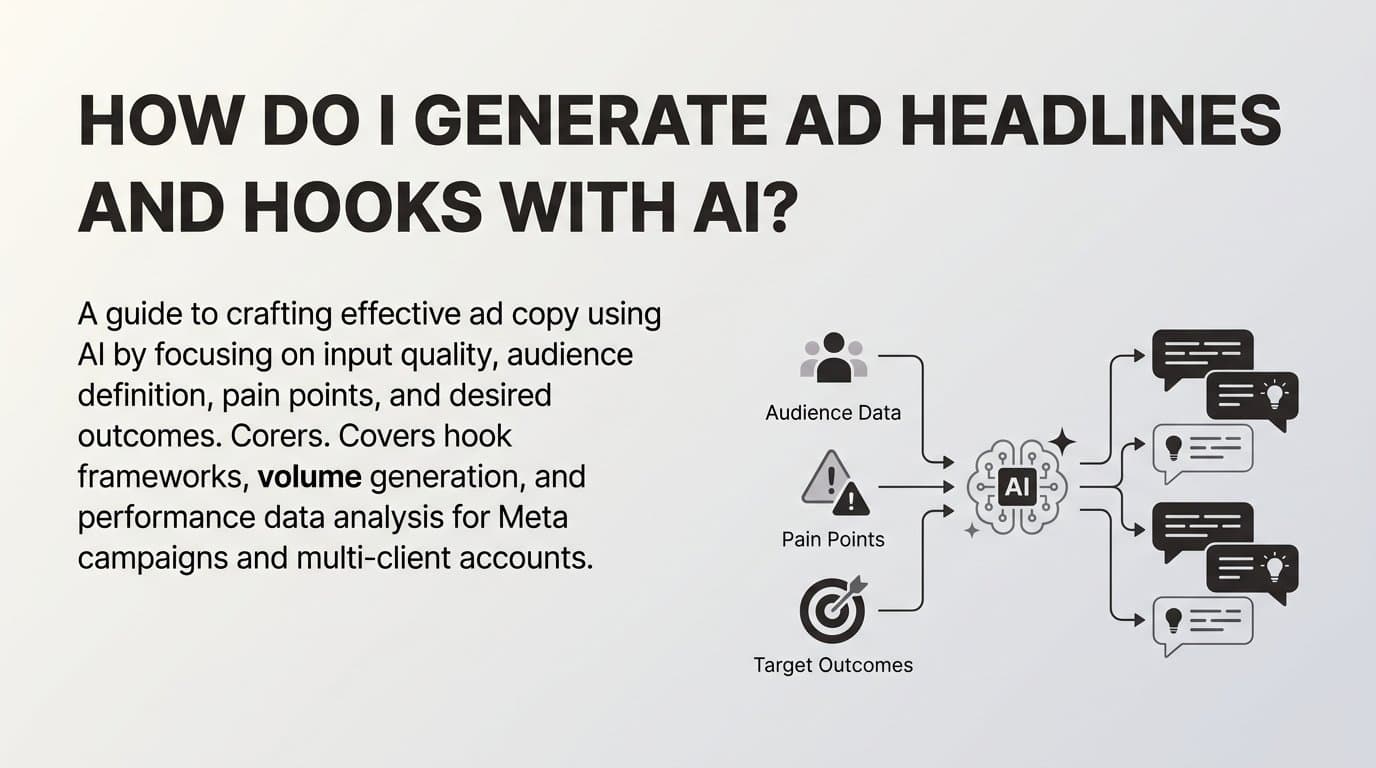
Generating ad headlines and hooks with AI comes down to one principle: the quality of your output is directly proportional to the specificity of your input. Feed the AI a vague product name and you get copy that sounds like every competitor in your space. Feed it a precise brief with a defined audience, a clear pain point, and a measurable outcome, and you get copy worth testing.
Tools like AdStellar take this further by generating headlines and hooks alongside the visual creative, so you ship a complete ad rather than disconnected pieces of copy. Paste in a product URL and the AI builds headline variations, hook options, and the creative together, which is how Meta actually evaluates ads.
This guide walks through the exact process: how to brief the AI, which hook frameworks to use, how to generate enough volume to test properly, and how to read the data so you know what to scale. Whether you are running Meta campaigns for an ecommerce brand or managing multiple client accounts, the steps are the same.
Most marketers skip the input step entirely. They dump a vague prompt into a tool, get generic results, and conclude that AI copy does not work. The problem is almost never the tool. It is the brief. Good AI headlines start with specificity: a clear pain point, a defined audience, and a measurable outcome your product delivers.
By the end of this guide, you will have a repeatable system for generating ad headlines and hooks with AI that gets sharper every time you run it, because each campaign cycle feeds better data back into the process.
Step 1: Gather Your Inputs Before You Prompt Anything
Before you open any AI tool, you need three things: a product benefit (not a feature), a target audience pain point, and the desired emotional outcome your product creates. Without these, every prompt you write will produce copy that feels generic because it is.
Start by writing a one-sentence product brief in this format: [Product] helps [audience] achieve [outcome] without [common objection or frustration]. This becomes your master prompt anchor. Every headline and hook you generate should trace back to this sentence. If the AI output does not clearly connect to this brief, the copy is not ready to test.
Here is an example: "AdStellar helps Meta advertisers launch high-performing ad campaigns without hiring a designer, copywriter, or media buyer." That sentence contains the audience, the outcome, and the objection. It gives the AI something specific to work with.
Next, pull your top three performing ad headlines from past campaigns and identify what they have in common. Look for patterns: urgency, specificity, social proof, a named audience, a concrete number. AI tools perform measurably better when given examples of what has already worked for your specific account. You are not just prompting from scratch; you are giving the model a direction.
Then list the objections your audience raises most often. Price, trust, complexity, and time are the most common across most categories. Hooks that address objections tend to outperform benefit-only hooks in cold traffic because they meet the skeptical reader where they actually are, rather than where you want them to be.
Common pitfall to avoid: Prompting with only a product name or a one-word category. "Write ad headlines for a marketing tool" produces copy that could apply to any of the thousands of marketing tools in existence. "Write ad headlines for a Meta ad platform that generates creatives and launches campaigns automatically, targeting ecommerce brands spending $5k to $50k per month on ads" produces something you can actually use.
Spend ten minutes on this step before you write a single prompt. It is the highest-leverage work in the entire process, and it is the step most marketers skip.
Step 2: Choose the Right AI Tool for the Job
Not all AI copy tools are built for the same workflow, and choosing the wrong one creates friction that compounds across every campaign you run.
AdStellar is the strongest option for Meta advertisers because it generates headlines and hooks as part of a full creative, not just as standalone text. You get the copy and the visual together, which matters because Meta evaluates ads as a unit. A strong headline paired with a mismatched creative underperforms a cohesive ad where both elements reinforce the same message. AdStellar's AI Campaign Builder also analyzes your past campaign data, ranks prior headlines by ROAS and CTR, and uses that history to generate new copy that builds on what actually worked in your account, not generic industry benchmarks.
ChatGPT (GPT-4o) and Claude 3.5 are capable for raw copy generation. Both handle nuanced briefs well and can produce a high volume of variations quickly. The limitation is workflow: after generating copy, you need to manually move it into a design tool, then into Ads Manager, adding steps and opportunities for things to get lost or misaligned. If you are a copywriter who handles production separately, this workflow is fine. If you are a performance marketer who needs to move fast, the extra steps add up.
Jasper and Copy.ai offer ad-specific templates with Meta character limits built in, which reduces formatting errors. Neither tool connects to your actual ad account performance data, so you cannot close the loop between what the AI generates and what actually converts in your campaigns.
Here is how to match the tool to your situation:
AdStellar fits you if you are running Meta campaigns and want copy, creative, and launch in a single workflow without switching between tools.
GPT-4o or Claude fit you if you are a copywriter or creative director who wants maximum control over raw generation and handles design and production separately.
Jasper or Copy.ai fit you if you want structured templates with character limit guardrails and do not need native integration with your ad account data.
One practical tip: if you are already using AdStellar for creatives, use it for headlines too. Keeping copy and creative in the same tool means the AI can score them together against your performance goals, which is the data signal that makes the system smarter over time.
Step 3: Apply Proven Hook Frameworks to Your Prompts
A hook is the first line of an ad that stops the scroll. It must address a specific person, problem, or provocative claim in under ten words. Clever and vague does not work. Specific and direct does.
Four frameworks consistently perform in Meta feeds. Build your prompts around these rather than asking the AI to "write a good hook," which produces nothing useful.
Pain Agitation: Names the problem the audience is already experiencing. Example: "Still wasting hours writing ad copy by hand?" This works in cold traffic because it meets the reader at their current frustration rather than asking them to imagine a future benefit they do not yet believe in.
Outcome First: Leads with the result, not the process. Example: "Scale your Meta ads without hiring a team." The audience sees the end state immediately. This framework works well when the outcome is highly desirable and the mechanism is secondary.
Curiosity Gap: Creates an information gap the reader wants to close. Example: "The one thing your ad headlines are missing." This framework works when you have a genuine insight to deliver, not just a vague tease. Overuse kills effectiveness.
Social Proof Anchor: Grounds the claim in observed behavior. Example: "How brands are cutting creative costs with AI." This works because it implies validation without requiring the reader to take your word for it.
When you prompt the AI, specify the framework explicitly. Do not leave it to the model to decide. A prompt like this produces usable output: "Write 10 hooks for [your one-sentence product brief] using the Pain Agitation format. Each hook must be under 10 words and address [specific audience]. Do not use generic language like 'transform your business.'"
Ask for volume. Request at least 10 to 20 variations per framework so you have enough to test meaningfully. Generating only 3 to 5 options does not give you enough signal to identify what is working at the framework level versus what is working because of a specific word choice.
Refine with follow-up prompts within the same session. "Make version 3 more specific to ecommerce brands running at least $10k per month in ad spend" or "Rewrite version 7 with more urgency and a specific timeframe." Iterating in the same conversation produces better results than starting a new session because the model retains the context of your brief.
Pitfall to avoid: Hooks that are clever but vague consistently underperform against hooks that name a specific outcome or audience. "Change the way you advertise" loses to "Launch Meta ads in minutes without a design team" every time.
Step 4: Generate Headline Variations at Scale
A headline in a Meta ad is not the same as a hook. The hook lives in your primary text and stops the scroll. The headline appears below the creative in link format and should reinforce or extend the promise the hook already made. Many marketers write these as the same thing and then wonder why their ad structure feels redundant.
Generate at least five distinct headline angles for every campaign. The five angles to cover are: benefit, urgency, specificity, question, and command. Each angle speaks to a different decision-making mode in your audience. Some readers respond to a clear benefit statement. Others need urgency to act. Testing across angles tells you which mode your specific audience is in right now.
AdStellar's Bulk Ad Launch feature handles the combination logic automatically. You input multiple headlines, multiple hooks, multiple creatives, and multiple audiences, and it generates every combination and launches them to Meta in clicks rather than hours. This is the fastest path to statistically useful test volume without manually building out dozens of ad sets in Ads Manager.
Keep Meta's character guidance in mind when you prompt the AI. Primary text performs best when the key message appears in the first 125 characters before truncation on mobile. Headlines work best under 40 characters for clarity. Build these constraints into your prompt explicitly: "Write 5 headlines under 40 characters each, each one reinforcing a different benefit of [product brief]." Constraints produce sharper output, not worse output.
Use AdStellar's AI Insights leaderboard to see which headline and hook combinations are driving the best CTR and CPA before you commit more budget. You do not need to manually export data to a spreadsheet and sort by metric. The leaderboard ranks every combination against your defined target goals, so winners surface automatically.
Success indicator: Before you launch a single campaign, you should have at least 10 to 15 unique headline and hook combinations ready to enter testing. If you have fewer than that, generate more. The whole point of using AI for this step is that volume is no longer a constraint.
Step 5: Launch, Test, and Let the Data Pick the Winners
Here is where most marketers undo all the work from the previous steps. They generate 15 headline variations, look at them, pick their favorite based on gut feel, and launch only that one. That is not a test. That is a guess with extra steps.
The point of generating multiple headlines with AI is to let real audience data decide, not your intuition. Your job at launch is to set up the test correctly, not to pre-select the winner.
In AdStellar, the AI Campaign Builder builds the full campaign structure, assigns your headline and hook variations across ad sets, and explains every decision so you understand the logic behind the setup. You are not handing control to a black box. You are reviewing a strategy with full transparency before it goes live.
Set clear success metrics before you launch. Define your target CPA or ROAS so AdStellar's AI Insights can score every headline and hook combination against your actual benchmarks, not industry averages that may have nothing to do with your product or margin structure. A headline that drives a 2% CTR but a $90 CPA when your target is $40 is not a winner, regardless of how it looks in a vacuum.
Let campaigns run long enough to collect meaningful data. Pulling budget after 24 hours based on early CTR is one of the most common mistakes in Meta advertising. Strong headlines sometimes take longer to reach the right audience segment. Cutting too early kills potentially high-performing copy before it has accumulated enough impressions to show its true signal.
Once winners emerge, AdStellar's Winners Hub stores your top-performing headlines, hooks, and creatives in one place with real performance data attached. You can pull any winner directly into your next campaign without starting from scratch. This is where the system compounds: each campaign cycle adds to your Winners Hub, which gives the AI Campaign Builder better inputs for the next round.
The iteration loop is: take the winning hook framework, brief the AI again with a new angle, use the winner as your example input. Each cycle produces sharper copy because you are building on real performance data from your actual account rather than starting from a blank prompt every time.
Related Questions About AI Ad Copy
What is the difference between a hook and a headline in a Meta ad?
A hook is the opening line of your primary text that stops the scroll; a headline is the shorter text displayed below the creative in the link description area. Both serve different roles and need to be tested separately. Conflating them leads to poorly structured ads where both copy fields say the same thing, which wastes the opportunity to reinforce your message across two distinct touchpoints.
How many headline variations should I test at once?
Test at least 5 to 10 variations per campaign to gather statistically useful data. Fewer than 5 does not give you enough signal to identify patterns in what works. AdStellar's Bulk Ad Launch generates and deploys every combination of headlines, hooks, creatives, and audiences automatically, so reaching that volume does not require manual ad set construction.
Can AI generate hooks for video ads, not just image ads?
Yes. AdStellar generates hooks for video ads including UGC-style avatar content, so the opening line and the visual are created together rather than assembled separately. This matters because a hook written for a static image often does not translate to a video format where the first three seconds of motion are doing as much work as the copy.
How do I know which AI-generated headline is actually performing?
AdStellar's AI Insights leaderboard ranks every headline by ROAS, CPA, and CTR against your target goals, so you can see winners at a glance rather than exporting data to a spreadsheet and sorting manually. Set your benchmarks before launch and the system scores every combination against those specific numbers, not generic industry averages.
Do I need a copywriter if I use AI for headlines?
Not necessarily for volume generation and testing. AI handles the first draft and variation at scale efficiently. A copywriter adds value in refining brand voice and reviewing outputs before launch, which takes minutes rather than hours when the AI has already done the heavy lifting. For most performance marketing workflows, AI handles generation and a quick human review catches anything that feels off-brand before it goes live.
Putting It All Together: Your AI Headline System
The repeatable process is straightforward: build a specific product brief, choose a tool that connects copy to creative and campaign data, apply a proven hook framework, generate enough volume to test properly, launch with clear success metrics, and let real performance data pick the winner.
Each cycle gets faster because your Winners Hub and campaign history give the AI better inputs. You are not starting from scratch every time. You are building a compounding library of what works for your specific audience and product.
Run through this checklist before your next campaign:
1. One-sentence product brief written in the [Product] helps [audience] achieve [outcome] without [objection] format.
2. Hook framework selected (Pain Agitation, Outcome First, Curiosity Gap, or Social Proof Anchor).
3. At least 10 to 15 unique headline and hook combinations generated.
4. Meta character limits applied: primary text key message under 125 characters, headlines under 40 characters.
5. Success metrics defined before launch: target CPA or ROAS entered so the AI can score against your benchmarks.
6. Winners Hub checked for past top performers to reuse or build on.
AdStellar handles the full workflow from generating headlines and hooks to launching them alongside the creative and surfacing which combinations win, all without leaving the platform. If you are running Meta campaigns and spending time writing copy manually or moving text between tools, that is the first process worth automating.
Start Free Trial With AdStellar and be among the first to launch and scale your ad campaigns faster with an intelligent platform that automatically builds and tests winning ads based on real performance data from your account.