How to Create Effective Ad Strategies: A Step-by-Step Framework for Predictable Results
You've triple-checked the targeting. The creative tested well internally. Your campaign structure follows every best practice guide you've read. But 72 hours after launch, you're staring at a 0.3% CTR and a $127 CPA when you needed $40.
Sound familiar?
Here's the uncomfortable truth: that sinking feeling of watching your budget drain isn't about effort. You did everything "right" according to conventional wisdom. You followed the playbooks. You optimized the technical details.
The problem isn't what you did—it's how you approached it.
Most advertisers treat ad strategy like creative intuition. They launch campaigns based on what "should" work, what worked for someone else, or what feels right. They test and see. They optimize tactics—adjusting bids, tweaking placements, refreshing creative—without ever establishing a strategic foundation.
This approach turns every campaign into a coin flip. Sometimes you win. Often you don't. And because there's no systematic framework, you can't explain why winners won or losers lost. You're optimizing randomness.
The difference between advertisers achieving $5 CPAs and those stuck at $50 isn't budget size. It's not creative talent. It's not even platform expertise.
It's methodology.
Top-performing media buyers follow repeatable frameworks. They treat ad strategy as a systematic process that compounds learning over time. They document what works, understand why it works, and apply those insights to scale predictable results.
Two advertisers can promote the same product with the same budget on the same platform. One achieves 5x ROAS while the other barely breaks even. The difference? One is following a strategic framework. The other is hoping for the best.
This guide reveals the exact framework that transforms ad spend from an expense into a predictable revenue engine. You'll learn how to mine strategic insights from data you already have, structure testing protocols that efficiently identify winners, and build campaigns that compound learning instead of repeating mistakes.
By the end, you'll know exactly how to create ad strategies that deliver consistent results—not through luck or creative genius, but through systematic process.
Let's walk through how to build an ad strategy that turns budget into predictable revenue. We'll start where most advertisers overlook: mining the strategic insights already hiding in your existing data.
Step 1: Mine Your Existing Data for Strategic Insights
Here's what most advertisers miss: your best strategy insights aren't hiding in competitor research or industry reports. They're sitting in your Meta Ads Manager right now, waiting to be discovered.
Think about it. Every campaign you've run—whether it succeeded or flopped—generated data about what your specific audience responds to. That's not generic best practices. That's your audience telling you exactly what works.
The problem? Most advertisers launch new campaigns without ever analyzing what their previous campaigns revealed. They're essentially starting from scratch every single time, repeating the same mistakes and rediscovering the same insights over and over.
Let's change that.
Export and Organize Your Performance Data
Start by opening Meta Ads Manager and navigating to your Ads tab. Set your date range to the last 90 days—this gives you enough data to identify patterns without including outdated performance from different market conditions.
Click "Export Table Data" and download your campaign results as a CSV file. You're looking for campaigns that ran with sufficient budget to generate meaningful data—typically at least $200 spent per campaign.
Open the file in a spreadsheet and sort by your primary KPI. For ecommerce, that's ROAS. For lead generation, it's CPA. For awareness campaigns, you'll want to look at CPM combined with CTR.
Now isolate your top 20% performers. If you ran 50 ads in the last 90 days, you're analyzing the top 10. This isn't about finding the single best performer—it's about identifying patterns across multiple winners.
Identify Your Winner DNA
Create a new document titled "Winner DNA Analysis." This becomes your strategic foundation.
Look at your top performers and document what they have in common. Start with creative format: Are your winners predominantly video or static images? Do they feature products or lifestyle scenarios? Is user-generated content outperforming polished brand content?
Next, analyze messaging angles. Do your best ads lead with problems ("Struggling with X?") or benefits ("Achieve Y in Z days")? Are they education-focused or emotion-driven? Do they include social proof in the first three seconds?
Then examine audience characteristics. Pull the demographic data for each top performer. You're looking for age concentrations, geographic patterns, and interest overlaps that appear across multiple winners.
Finally, check technical performance patterns. Which placements consistently deliver results—Feed, Stories, or Reels? What devices are your converters using? Are there specific times of day when performance spikes?
A performance marketing agency discovered something surprising through this analysis: their best-performing ads all featured customer testimonials in the opening three seconds. This pattern was invisible until they systematically analyzed their top 20%. When they applied this insight to new campaigns, CTR improved 60% immediately.
Turn Insights Into Strategic Hypotheses
Your Winner DNA analysis reveals what's already working. Now transform those observations into testable hypotheses for your next campaigns.
If your top performers all use problem-focused hooks, your hypothesis becomes: "Problem-focused messaging outperforms benefit-focused messaging for our audience." Modern marketers can leverage how to use AI to launch ads to test these hypotheses faster and more efficiently. If video consistently beats static images, document that pattern and prioritize video production in your next creative sprint.
Step 2: Build Your Audience Targeting Strategy
Here's where most advertisers waste their budget: they launch campaigns to everyone who might be interested, hoping something sticks. That's not strategy—that's expensive guessing.
Strategic audience targeting isn't about casting the widest net. It's about creating a prioritized testing framework that systematically identifies your highest-converting segments while minimizing wasted spend on low-intent audiences.
Think of it like this: you wouldn't allocate equal budget to a proven customer lookalike audience and a cold interest-based audience you've never tested. Yet that's exactly what happens when advertisers treat all audiences as equal possibilities.
The Bullseye Method: Structuring Your Audience Matrix
The most effective audience strategies follow what I call the "Bullseye Method"—three concentric rings that prioritize budget allocation based on conversion likelihood.
Inner Circle (Proven Converters): These are your highest-intent audiences with demonstrated buying behavior. Start with 1-3% lookalike audiences of existing customers—Meta's algorithm has already identified people who behave like your buyers. Add website visitors who viewed product pages or spent significant time on site. If you're running retention campaigns, include past purchasers for upsells or cross-sells. Allocate 50% of your testing budget here.
Middle Ring (Warm Prospects): These audiences have shown interest but haven't converted yet. Include people who engaged with your content—watched 50%+ of videos, commented on posts, or clicked through to your site without purchasing. Upload your email list if you have one. Add cart abandoners and product page viewers. Allocate 30% of your budget to this ring.
Outer Ring (Cold but Qualified): These are cold audiences, but strategically selected based on your Winner DNA analysis from Step 1. Use interest-based targeting that aligns with patterns you discovered in top performers. Layer demographic targeting based on your customer analysis. Include behavior-based audiences like "engaged shoppers" or "online purchasers." Allocate 20% of your budget here.
Create 3-5 audience segments per ring. That gives you 9-15 total audiences for comprehensive testing without overwhelming your ability to analyze results.
Here's the critical part most advertisers miss: document your hypothesis for each audience. Write down "I believe [audience] will respond to [message] because [reason based on data]." This transforms targeting from random selection into strategic testing.
The Audience Sizing Sweet Spot
Audience size directly impacts your campaign performance, but not in the way most advertisers think.
Too broad (500,000+ people), and your ads reach low-intent users who drain budget without converting. Too narrow (under 50,000), and you'll face sky-high CPMs as you compete for limited inventory. Meta's algorithm also struggles to optimize with insufficient audience size.
The sweet spot depends on your campaign objective. For conversion campaigns, aim for 100,000-500,000 people per audience segment. This gives Meta's algorithm enough room to find your best prospects while maintaining reasonable CPMs.
For awareness or engagement campaigns where you're building top-of-funnel audiences, you can go broader—500,000 to 2 million people works well. The key is matching audience size to campaign objective and using automated ad launching tools to efficiently test multiple segments simultaneously without manual overhead.
Step 3: Build Your Creative Testing Framework
Here's the truth about ad creative: most advertisers approach it backwards. They brainstorm concepts they think will work, produce polished assets, launch everything at once, and hope something performs. When results disappoint, they blame the creative quality.
But the problem isn't creative quality. It's the absence of a systematic testing framework.
Think about what happens when you launch five completely different ad concepts simultaneously. One performs best—but why? Was it the hook? The visual style? The offer presentation? The background color? You have a winner, but you can't identify which specific element drove results. So you can't replicate it.
Strategic creative development follows a different approach: isolate variables, test systematically, and compound learning. Each test builds on documented insights from previous tests. You're not guessing what might work—you're discovering what does work through controlled experimentation.
The Single-Variable Testing Protocol
Start by identifying the creative variables that typically impact performance: the hook (first 3 seconds), visual style, messaging angle, call-to-action, and offer presentation.
Here's the critical principle: test one variable at a time. If you change both the hook and the visual style simultaneously, you can't determine which change drove the performance difference. Single-variable testing gives you clear cause-and-effect data.
Begin with your control—your current best performer from the Winner DNA analysis you completed in Step 1. This becomes your baseline. Every variation changes exactly one element while keeping everything else identical.
Let's say your control ad uses a problem-focused hook with a product image. Your first test series might create three hook variations while keeping the same product image: a benefit-focused hook, a social proof hook, and a curiosity hook. Everything except those opening three seconds stays identical.
Run this test until you reach statistical significance—typically when each variation has generated at least 1,000 impressions and 20 conversions. The winning hook becomes your new control.
Next test series? Keep that winning hook, but now test visual variations. Product image versus lifestyle image versus user-generated content. Again, change only the visual while maintaining everything else.
This systematic approach builds a library of proven elements. After four rounds of testing, you'll know your best-performing hook, visual style, messaging angle, and CTA. When you combine these winners, you've engineered a high-performer rather than stumbled onto one.
Using AI Tools to Accelerate Creative Production
The challenge with systematic creative testing? It requires volume. Testing five hook variations, then four visual styles, then three messaging angles means producing dozens of creative assets. For most teams, that's weeks of design work.
This is where AI-powered creative tools transform the process. Tools like Nano Banana Pro enable you to generate professional ad images at the speed your testing framework demands.
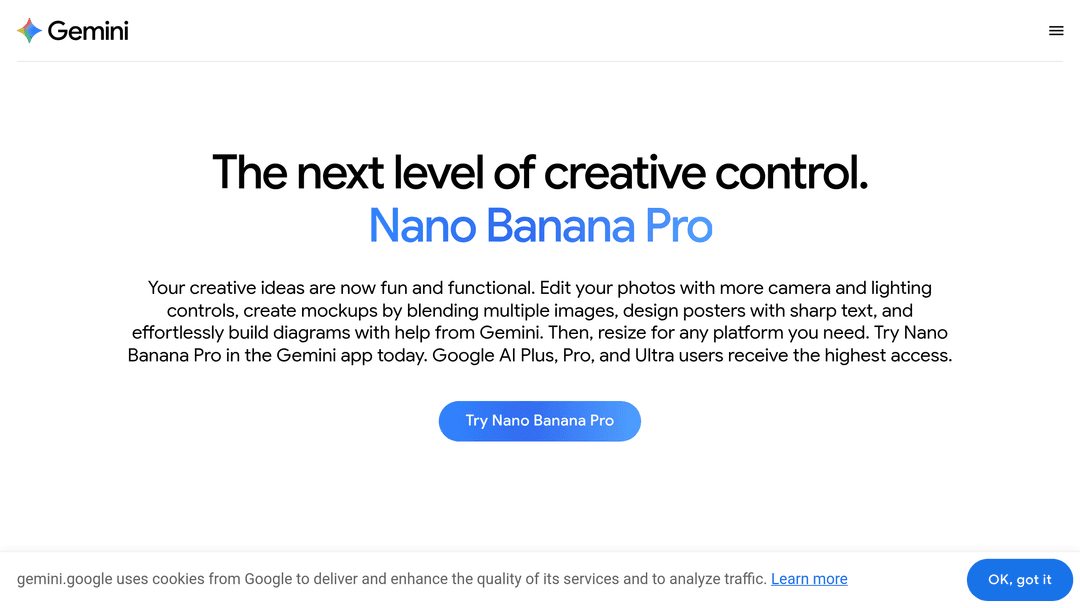
Instead of briefing a designer, waiting for concepts, providing feedback, and iterating for days, you can generate multiple creative variations in minutes. Need to test your product against five different background styles? Generate all five versions immediately. Want to see how your hero image performs with different lighting treatments? Create those variations without a photoshoot.
The strategic advantage isn't just speed—it's the ability to actually execute your testing framework. When creative production becomes the bottleneck, most advertisers give up on systematic testing and fall back into "launch and hope" mode. AI creative tools remove that bottleneck entirely.
Here's how to integrate AI creative generation into your testing framework: Start by creating your control image in Nano Banana Pro. Then generate systematic variations—different backgrounds, lighting treatments, product angles, or compositional styles—keeping your testing protocol in mind.
Export these variations and pair each with the messaging elements you're testing. If you're running a hook test with three variations, generate three visual versions that pair naturally with each hook style. A problem-focused hook might pair with a before-state image, while a benefit-focused hook works better with an aspirational after-state visual.
The key is maintaining creative consistency within each test. Your variations should look like they belong to the same campaign while changing only the specific element you're testing. AI tools make this level of controlled variation practical at scale.
Building Your Creative Library
As you run these tests, document everything in a "Creative Performance Database." This becomes your strategic asset—a living document that captures what works for your specific audience.
Create a spreadsheet with these columns: Creative Element (hook style, visual treatment, messaging angle, etc.), Variation Description, CTR, CPA, ROAS, and Key Insights. Every test result gets logged here.
After several testing cycles, patterns emerge. You might discover that user-generated content consistently outperforms polished product shots by a significant margin. Or that curiosity-based hooks drive higher CTR but problem-focused hooks convert better. These insights are gold—they're specific to your audience, proven through testing, and actionable for future campaigns.
Here's what makes this powerful: your Creative Performance Database compounds over time. Each test adds to your knowledge base. After six months of systematic testing, you'll have documented evidence of what works across dozens of variables. You're no longer guessing—you're applying proven patterns.
When you need to launch a new campaign, you're not starting from scratch. You're selecting your proven best-performing hook style, pairing it with your validated visual treatment, and structuring your messaging based on documented winner patterns. Your new campaigns start from an elevated baseline rather than ground zero.
The Creative Refresh Cadence
Even winning creative fatigues over time. Your audience sees the same ad repeatedly, CTR gradually declines, and CPAs creep upward. This is normal—not a signal that your strategy failed.
Build a proactive refresh schedule based on performance signals rather than arbitrary timelines. Monitor frequency—when an ad reaches 3-4 impressions per person in your target audience, start preparing your next creative iteration.
Watch for CTR decline. If your ad's CTR drops below 70% of its peak performance for three consecutive days, that's your signal to rotate in a fresh variation. Don't wait until performance completely craters.
Your Creative Performance Database tells you exactly what to refresh with. Pull your second-best performer from previous tests, update it with any new insights you've gained, and swap it in. You're not scrambling to create something new—you're rotating through proven variations.
This is where AI creative tools prove especially valuable for ongoing campaign management. When you need fresh variations quickly, you can generate new visual treatments of your proven concepts in minutes rather than waiting days for traditional design work.
Scaling What Works
Once your testing identifies clear winners, scaling becomes straightforward. Take your top-performing creative and create contextual variations for different placements and audience segments.
Your winning creative concept might perform best in Feed, but Stories requires vertical format. Rather than creating an entirely new concept, adapt your winner to the Stories format while maintaining the core elements that drove performance—the same hook style, messaging angle, and visual treatment, just optimized for the 9:16 aspect ratio.
Similarly, create audience-specific variations of your winning creative. If you're targeting both yoga enthusiasts and runners with the same wellness product, keep your proven creative structure but swap in audience-relevant imagery. The yoga audience sees your product in a studio setting; runners see it in an outdoor context. The strategic elements stay consistent while surface details match each audience.
This approach to scaling protects you from the common trap of diluting what works. You're not creating random variations—you're systematically adapting proven winners to new contexts while preserving the elements your testing validated.
The result? Your creative strategy stops being a creativity challenge and becomes an execution framework. You know what works. You have the tools to produce it efficiently. And you have a systematic process for continuous improvement through ongoing testing.
Putting It All Together
You now have the complete framework that separates consistent performers from those stuck in the "launch and hope" cycle. This isn't about creative genius or massive budgets—it's about systematic process.
Start with your data. Mine those historical campaigns for winner DNA. Build your audience testing matrix using the bullseye method—proven converters first, then warm prospects, then qualified cold traffic. Develop creative variations that test one variable at a time. Structure your campaigns for learning, not just immediate results.
Then implement your testing protocol with discipline. Give each test the budget and time it needs to reach statistical significance. Document everything. Let the data guide your decisions, not assumptions about what "should" work.
The difference between this approach and what you've done before? This compounds. Every campaign teaches you something. Every test refines your winner DNA. Every optimization builds on documented insights instead of starting from scratch.
Most advertisers will keep launching campaigns based on gut feel, wondering why results stay unpredictable. You'll be systematically identifying what works, scaling winners, and turning ad spend into a predictable revenue engine.
Ready to see how AI can amplify this entire framework—automatically identifying winning patterns, launching variations, and scaling performance without the manual heavy lifting? Get Started With AdStellar AI and transform your strategic framework into an automated growth system.