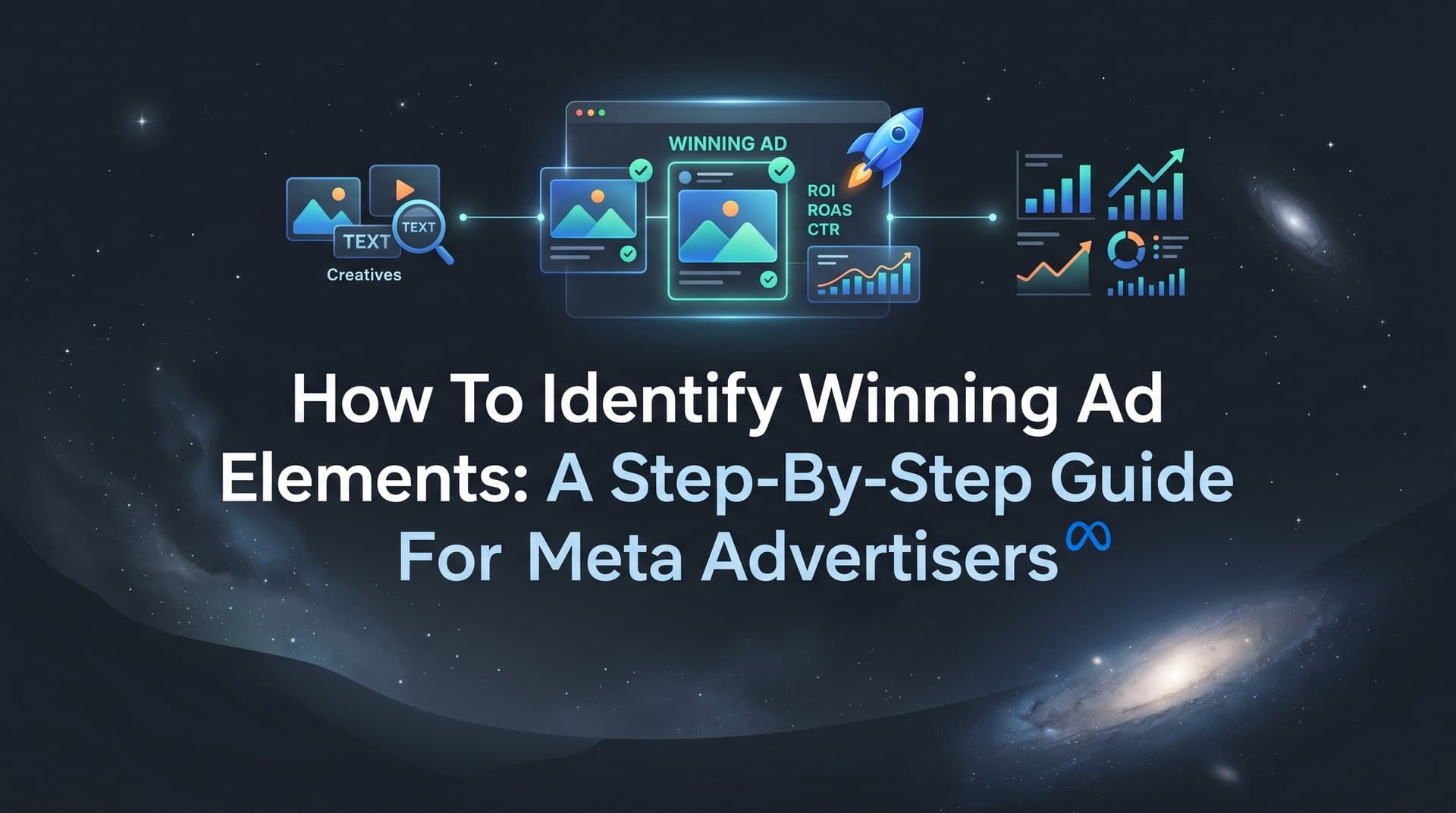
Most Meta advertisers run ads and hope something works. A few run ads and know exactly what works, and why. That gap is not about budget size or creative talent. It comes down to a systematic process for identifying winning ad elements before scaling spend on guesswork.
Winning ad elements are the specific components of your campaigns that drive results: the creative format that stops the scroll, the headline that triggers a click, the audience segment that converts at your target CPA, the copy angle that actually resonates. When you can isolate these elements reliably, you stop wasting spend on underperformers and start doubling down on what moves the needle.
Here is the problem most advertisers run into. They look at campaign-level performance and see that something is working, but they cannot tell which element is responsible. Was it the video creative? The headline? The audience? Without knowing, every new campaign starts from scratch rather than building on proven intelligence.
This guide walks you through a practical, repeatable process for identifying your winning ad elements across creatives, copy, audiences, and campaign structure. Whether you are managing campaigns manually or using an AI-powered platform like AdStellar to automate the heavy lifting, these steps give you a clear framework for turning raw performance data into actionable decisions.
By the end, you will know how to set up your campaigns to generate meaningful signal, which metrics to prioritize at each stage, how to isolate variables so you can attribute results accurately, and how to build a system that compounds over time. No guesswork, no gut feelings. Just a structured approach to finding what works and scaling it.
Step 1: Define What a Winner Looks Like Before You Launch
Before a single dollar goes into a campaign, you need a clear definition of what winning means for your specific goals. This sounds obvious, but most advertisers skip it and end up making judgment calls based on vague impressions rather than objective criteria.
Start by setting goal-based benchmarks that are specific to your industry, offer, and funnel stage. What is your target ROAS? What CPA makes this campaign profitable? What CTR would indicate strong creative engagement? These numbers should come from your historical data or industry benchmarks relevant to your category, not generic averages.
The next important distinction is between top-of-funnel winners and bottom-of-funnel winners. They are not the same thing, and conflating them leads to bad decisions. A top-of-funnel creative winner is one that generates high thumb-stop rates and strong CTR, pulling people into your funnel efficiently. A bottom-of-funnel winner is one that converts at a low CPA with strong ROAS. The creative that excels at awareness may not be your best converter, and vice versa. Your scoring system needs to reflect this.
Build a simple three-tier rubric for every element you test:
Winner: Meets or exceeds your primary goal metric and at least one secondary metric within your defined evaluation window.
Learner: Has not yet accumulated enough data to make a call, but early indicators are neutral or positive. Keep running and monitor.
Loser: Has accumulated sufficient data and is consistently underperforming against your benchmarks. Pause and move on.
One of the most common mistakes in Meta advertising is declaring a winner too early. An ad that performs brilliantly in its first two days may be benefiting from novelty, algorithm exploration, or a favorable delivery window. Set minimum spend thresholds and impression counts before drawing conclusions. The exact thresholds vary by account size and conversion volume, but the principle is consistent: more data means more confidence.
AdStellar's AI Insights feature lets you set custom goal benchmarks so every creative, headline, and audience is automatically scored against your specific targets rather than generic averages. Instead of manually checking each element against your rubric, the platform does it continuously in real time, flagging winners and underperformers as data accumulates.
Step 2: Structure Your Campaigns to Generate Clean Signal
Good data starts with good campaign architecture. If your campaign structure is messy, your performance data will be too, and no amount of analysis will surface reliable insights from noisy signal.
The foundational rule is simple: isolate one variable per test. If you change the creative, keep the headline, audience, and copy constant across all variations in that test. If you are testing headlines, keep everything else identical. The moment you change multiple variables simultaneously, you lose the ability to attribute performance to any specific element. You will know that something changed, but not what.
Naming conventions matter more than most advertisers realize. A consistent, descriptive naming structure across campaigns, ad sets, and ads allows you to filter and segment your data quickly. When you can group all ads using a specific creative format or headline type with a single filter, analysis becomes dramatically faster. Build your naming convention before you launch anything and stick to it. A well-planned Facebook ad campaign structure is the foundation that makes all downstream analysis reliable.
Think carefully about how many variations to test per element. Testing too few gives you no meaningful comparison. Testing too many dilutes your budget across each variation, which means each individual variation accumulates data slowly and your evaluation window stretches out. A practical approach is to test a focused set of variations per element, evaluate, retire the underperformers, and introduce new challengers against your current leader.
Understanding how Meta's delivery system interacts with your structure is also important. Broad audiences give the algorithm more room to find converters, which can accelerate the learning phase and produce cleaner signal faster. Overly narrow audiences can create delivery instability that makes it harder to distinguish genuine creative performance from delivery constraints.
AdStellar's Bulk Ad Launch is built precisely for this stage. You can launch multiple Facebook ads quickly across multiple creatives, headlines, and audiences in minutes, generating the volume of signal needed to identify winners fast without spending hours on manual setup. The platform handles the combinatorial work so you can focus on the analysis.
Step 3: Prioritize the Right Metrics for Each Ad Element
One of the most consequential mistakes in ad analysis is applying the wrong metric to the wrong element. Using ROAS to evaluate a creative when you have only run it for three days and accumulated minimal conversions tells you almost nothing. Using reach to evaluate an audience tells you even less. Matching your metrics to your element type is the foundation of accurate winner identification.
For creative elements, whether image ads, video ads, or UGC-style content, prioritize engagement metrics as leading indicators before conversion data has had time to accumulate. Thumb-stop rate tells you whether the creative is compelling enough to interrupt a scroll. Video hold rate (often measured as the three-second view rate) tells you whether people are sticking around once they stop. CTR tells you whether the creative is motivating action. These metrics give you directional signal early, so you are not waiting weeks to make a call on creative performance. Understanding how to improve ad engagement at this stage can meaningfully accelerate your ability to identify creative winners.
For headlines and primary copy, focus on CTR and link click-through rate. These elements directly influence whether someone who sees the ad decides to engage with it. A headline that increases CTR by a meaningful margin is doing its job, regardless of what happens post-click. Keep post-click performance separate when evaluating copy elements. If you want to systematically improve click-through rate across your headlines, a structured testing approach is essential.
For audiences, the picture is more nuanced. CPM tells you how competitive and expensive it is to reach a given audience. But cheap reach is worthless if the audience does not convert. Evaluate audiences on the combination of CPM, CPA, and ROAS together. An audience that is affordable to reach and converts efficiently is a genuine winner. One that is cheap but never converts is just burning budget quietly.
For landing pages, separate ad performance from post-click performance by looking at conversion rate and cost per landing page view. If your ad has strong CTR but poor conversion rate, the issue is likely on the landing page, not the ad itself. This distinction matters because the fix is completely different.
Avoid vanity metrics entirely. Reach and impressions tell you how many people saw something. They tell you nothing about which element drove a result. Keep them out of your winner evaluation framework.
AdStellar's AI Insights leaderboards rank every element by real metrics like ROAS, CPA, and CTR, giving you a clear view of which creatives, headlines, and audiences are performing against your goals at any given moment. Instead of building manual pivot tables, you get a live ranked view of everything in your account.
Step 4: Analyze Performance Data to Isolate the Winning Variables
Once your campaigns have run long enough to accumulate meaningful data, the analysis phase begins. This is where most advertisers either skip the work entirely or get lost in the numbers. A structured approach makes it manageable.
Start by pulling performance data broken down by element type. Group all ads using the same creative together and compare their aggregate performance. Group all ads using the same headline together and do the same. This grouping approach lets you see element-level patterns rather than ad-level noise, which is where the real insights live. Knowing how to analyze ad performance at the element level rather than the campaign level is what separates systematic advertisers from those who rely on gut feel.
Look for patterns across your top performers. Do your best-performing ads share a creative format, such as video versus static image? Do they share a copy angle, such as problem-focused versus benefit-focused? Do they share an audience characteristic, such as a specific interest category or demographic? When patterns emerge consistently across multiple winners, you have found something worth doubling down on.
Equally important is identifying negative patterns. Elements that consistently underperform across multiple tests are telling you something. Retire them rather than endlessly optimizing them. The time and budget spent trying to rescue a chronically weak creative is almost always better invested in developing new challengers based on what your winners have in common.
Use a comparison framework to bring structure to your ranking. List every element from best to worst on your primary goal metric. Then cross-reference with secondary metrics to confirm the ranking holds. If your top creative by ROAS also has strong CTR and a healthy video hold rate, that is a confirmed winner. If it has great ROAS but terrible CTR, dig deeper before scaling, because something unusual may be happening with delivery.
If no clear winner emerges from your analysis, resist the temptation to force a conclusion. The most common causes are insufficient data volume and too many variables changed simultaneously. If either of those applies, return to Step 2 and tighten your structure before running another test cycle. Premature conclusions are worse than no conclusions.
AdStellar's AI Campaign Builder analyzes your historical campaign data and ranks every creative, headline, and audience by performance, surfacing the patterns that manual analysis often misses. Because it processes data across your entire account history rather than just the current campaign, it can identify winning patterns that span multiple campaigns and time periods.
Step 5: Validate Winners Before Scaling Budget
Finding a strong performer is not the same as confirming a winner. Before you significantly increase budget behind an element, you need to validate that the performance is repeatable and not a statistical anomaly.
The validation approach is straightforward. Take your top-performing elements and run them in a fresh ad set with a modest budget increase, separate from the original test environment. If the results hold, you have confirmation. If performance drops significantly in the new context, you have learned something important about the conditions under which that element works.
Think about statistical confidence in practical terms. More impressions and more conversions give you higher confidence that a result is repeatable rather than a random spike. An ad that converted well on a small sample may simply have reached a favorable slice of your audience during a high-intent period. More data smooths out those fluctuations and reveals the true underlying performance.
Test your winners across different audience segments to understand whether the element is universally strong or context-dependent. A creative that performs brilliantly with one audience may be average with another. Knowing this shapes how you use the element going forward. Universal winners get deployed broadly. Context-dependent winners get deployed strategically. Learning how to identify a target audience for each winning element is what allows you to deploy it with precision rather than guesswork.
Document what makes each winner work. Write a brief note capturing the creative angle, the copy hook, the specific audience characteristic, or whatever element you believe is driving performance. This documentation is what allows you to replicate success intentionally rather than accidentally. Over time, these notes become the institutional knowledge that makes every future campaign smarter.
One critical warning: avoid scaling budget too aggressively before validation is complete. A sharp budget increase resets Meta's learning phase and can distort results significantly, making it much harder to confirm whether an element is genuinely a winner or simply benefiting from algorithm exploration during the new learning period. Incremental scaling Facebook ads efficiently gives you cleaner confirmation data.
Step 6: Build a Winning Elements Library and Compound Your Results
This is the step that separates advertisers who grind through the same discovery process every campaign from those who build compounding advantages over time. A winning elements library turns your historical performance data into a strategic asset that makes every future campaign smarter and faster to launch.
Organize your confirmed winners by element type in a centralized location. Your top creatives in one section. Your top headlines in another. Your proven copy angles, your best-performing audience segments. Each entry should include the element itself, the key performance metrics that confirmed it as a winner, and the brief documentation note you wrote during the validation step.
The practical shift this creates is significant. Instead of starting every new campaign from a blank slate, you start from a foundation of proven elements. Your first round of testing begins at a higher baseline, which means you reach meaningful performance faster and waste less budget on exploration that your library has already done.
Keep the library current by continuously feeding new variations into your testing pipeline alongside proven winners. Markets shift, audiences evolve, and creative fatigue is real. A library that only contains elements from six months ago will gradually become less predictive. The goal is a living system that grows and refreshes with every campaign cycle.
Pay attention to combination winners as your library matures. Sometimes a specific creative paired with a specific headline dramatically outperforms either element alone. When you discover a combination that consistently beats individual element performance, document it as a combination winner and treat it as a distinct asset. These pairings often represent something deeper about how your audience responds to a particular message delivered in a particular way. Knowing how to replicate winning ad campaigns from these documented combinations is what turns a library into a true competitive advantage.
AdStellar's Winners Hub centralizes your best-performing creatives, headlines, audiences, and more with real performance data attached to each entry. When you are ready to build your next campaign, you can select any winner directly from the hub and add it immediately, turning your historical performance into a compounding asset rather than a collection of disconnected data points buried in campaign reports.
Putting It All Together: From Guesswork to a Repeatable Winning System
Identifying winning ad elements is not a one-time exercise. It is a continuous process that gets sharper with every campaign you run. The six steps above give you a framework that works regardless of your budget size or team structure.
Define your benchmarks before you launch. Structure campaigns to generate clean, attributable signal. Track the metrics that actually correspond to each element type. Analyze data to isolate the variables driving performance. Validate winners before committing serious budget to them. And build a library that turns each campaign's learnings into the starting point for the next one.
The marketers who consistently outperform on Meta are not necessarily the ones with the biggest budgets. They are the ones with the clearest systems for learning what works and acting on it faster than their competitors. The process compounds. Each campaign cycle produces better data, which produces better decisions, which produces better results.
If you want to accelerate this process, AdStellar handles the heavy lifting automatically. The AI generates creative variations from a product URL or by cloning competitor ads from the Meta Ad Library. It builds complete campaigns from your historical performance data with full transparency into every decision. It scores every creative, headline, and audience against your specific goals in real time and surfaces your winners as they emerge. And it centralizes everything in a Winners Hub so your best-performing elements are always ready to deploy.
The result is less time in spreadsheets and more time scaling what actually works. Start Free Trial With AdStellar and see which of your ad elements are actually winning, so you can stop guessing and start compounding.