CPA creep is one of the most frustrating patterns in paid social. Your campaigns are running, clicks are coming in, and yet the cost per acquisition keeps climbing week over week. The instinct is to start pulling levers fast: cut budgets, swap audiences, rewrite copy. But reactive optimization without a clear diagnosis usually makes things worse, not better.
The reality is that rising CPA rarely has a single cause. It is almost always the result of several compounding issues working together: creative fatigue pushing frequency up, audiences that are too broad or misaligned, budget flowing to the wrong ad sets, and a landing page experience that leaks conversions before they happen. Fix one without addressing the others and you will see temporary improvement at best.
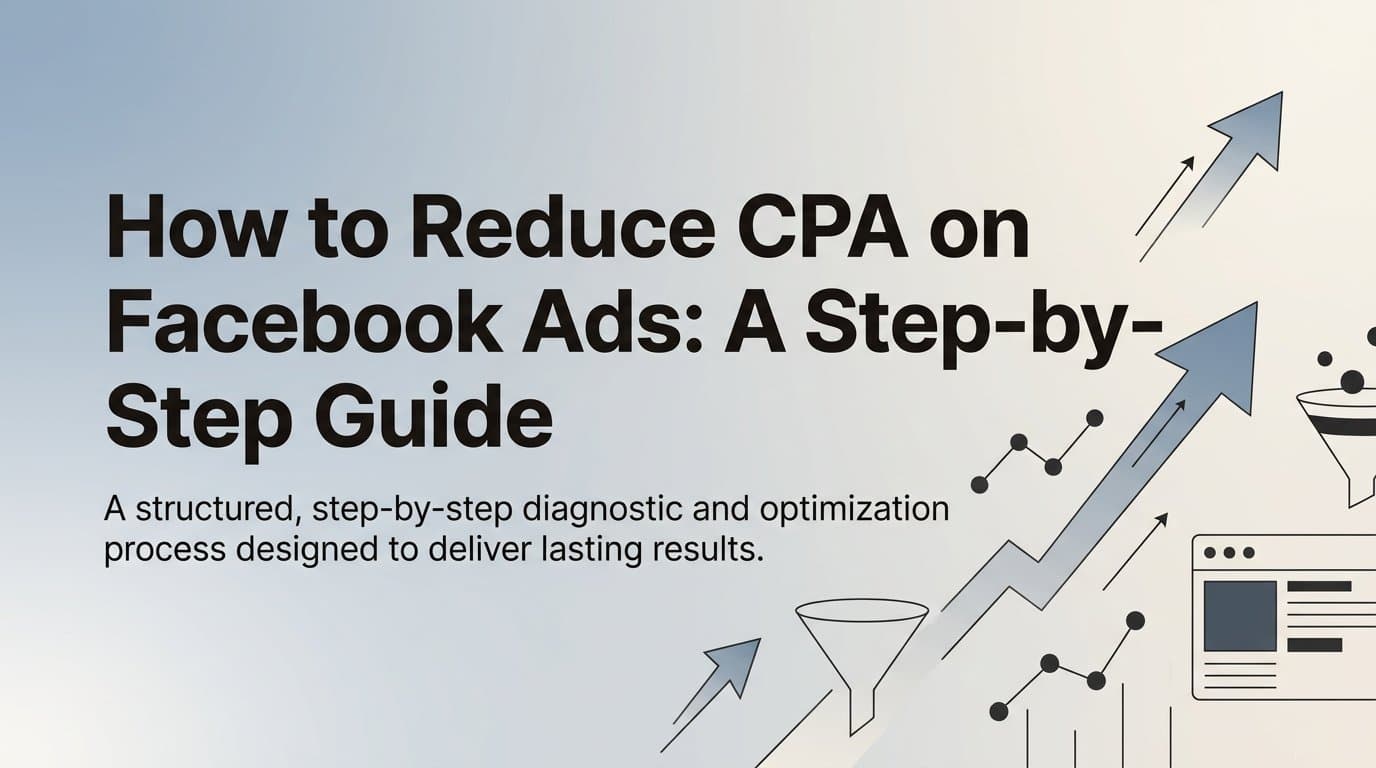
The good news is that CPA is one of the most controllable metrics in your account once you have a structured process for diagnosing and addressing it. This guide gives you exactly that. Each step builds on the previous one, moving from diagnosis through audience targeting, creative strategy, bidding structure, post-click experience, and finally a systematic testing process that locks in lasting improvements.
Whether you are managing a lean budget for a single product or running a multi-campaign account with significant monthly spend, these steps apply. The goal is not to find one quick win and call it done. It is to build an optimization discipline that compounds over time, so your CPA trends down consistently rather than bouncing around unpredictably.
Let us get into it.
Step 1: Diagnose Your CPA Before Touching Anything
The single most common mistake in CPA optimization is skipping the diagnosis entirely. A marketer sees a high CPA, assumes the creative is the problem, swaps it out, and watches CPA stay flat or climb higher. That is because the creative was not the problem. The audience was. Or the landing page. Or the bidding strategy. You cannot fix what you have not identified.
Start by pulling a breakdown report in Meta Ads Manager segmented by campaign, ad set, and ad level. You are looking for where CPA is highest relative to your target. Not all high-CPA ad sets are equal problems. An ad set spending ten dollars a day with a high CPA is a different priority than one spending five hundred dollars a day with the same issue.
Once you have your breakdown, layer in frequency data. Frequency is one of the clearest leading indicators of creative fatigue. When the same audience sees your ad repeatedly, engagement drops, click-through rate falls, and CPA rises. If you see high frequency alongside rising CPA in the same ad sets, creative fatigue is likely a primary driver and creative refresh should be your first action.
Next, trace the conversion funnel. Pull your click-through rate, landing page view rate, and conversion rate for each ad set. This tells you exactly where in the funnel you are losing people. If CTR is healthy but conversion rate is low, the problem lives on your landing page, not in the ad. If CTR is low, the creative or the offer is the issue. Knowing the difference saves you from optimizing the wrong layer.
Establish your baseline CPA target and flag any ad sets running more than thirty percent above it as priority fixes. These are the ones that need immediate attention before you touch anything performing near target.
Where AdStellar helps here: The AI Insights feature gives you leaderboards that rank every creative, headline, audience, and landing page by real metrics including CPA and ROAS, scored against the benchmarks you set. Instead of manually cross-referencing breakdown reports, you can see at a glance which elements are dragging your CPA up and which are driving it down.
Key pitfall to avoid: Jumping straight to budget cuts before completing this diagnosis often kills campaigns that could be fixed with a simple creative swap or audience adjustment. Diagnose first, then act.
Step 2: Sharpen Your Audience Targeting
Audience quality has a direct relationship with CPA. When your ads are reaching people who are unlikely to convert, you are paying for impressions and clicks that will never produce results. Tightening your targeting is one of the highest-leverage moves you can make once your diagnosis points to audience issues.
For top-of-funnel campaigns running to broad interest-based audiences, add behavioral or interest signals to narrow the pool. You are not trying to over-restrict delivery, but you do want Meta's algorithm working with a more qualified starting point. Think about what your best customers actually do, what they read, what they buy, and what problems they are solving, then layer those signals in.
Custom Audiences built from your highest-value customer segments are often your most efficient targeting option. Past purchasers, email subscribers who have shown intent, and high-engagement website visitors all make strong Custom Audience seeds. These people already have some relationship with your brand, which typically translates to lower CPA when you re-engage them with the right offer.
Lookalike Audiences work best when the seed list is built from your best customers, not just all website visitors. If you seed a Lookalike from everyone who ever landed on your homepage, you get a broad mix of intent levels. If you seed it from customers who purchased twice or spent above a certain threshold, Meta has a much cleaner signal to work from. The quality of the seed directly shapes who gets targeted.
Exclusions are equally important and frequently overlooked. Make sure recent purchasers and existing customers are excluded from your acquisition campaigns. Paying to convert someone who already converted is pure waste. Similarly, exclude audiences that have consistently shown high CPA and low conversion volume over a meaningful spend period.
Review placement performance as well. Some placements deliver strong CPA for certain products and audiences; others consistently underperform. Pull placement breakdowns and exclude the ones that are draining budget without producing conversions.
Key pitfall to avoid: Over-segmenting your audiences into very small buckets prevents Meta's algorithm from gathering enough data to optimize effectively. Audience sizes that are too small create delivery instability, which keeps CPA artificially elevated. Find the balance between qualification and scale.
Step 3: Overhaul Your Ad Creative Strategy
Creative is often the fastest lever for CPA improvement. A single strong creative can outperform a weak one by a wide margin, and the gap tends to widen over time as the algorithm routes more budget toward what is converting.
Start by identifying your lowest-performing creatives by CPA and pausing them. Do not let them continue draining budget while you test replacements. This alone can produce a meaningful CPA improvement before you have launched a single new ad.
When building new creative, test multiple formats in the same ad set. Static images, short-form video, and UGC-style content do not perform uniformly across all audiences and products. Format preference varies based on what the audience responds to and how complex the product or offer is. Running multiple formats simultaneously lets Meta's algorithm route spend toward what is working rather than forcing you to guess upfront.
On copy, lead with the outcome the customer gets, not the features of the product. Benefit-led copy consistently outperforms feature-led copy in direct response advertising. "Cut your ad spend in half" lands differently than "Advanced bidding algorithm." The first speaks to what the customer wants. The second describes what you built. Know the difference and write accordingly.
Before building new creative from scratch, look at what has already worked. Your highest-performing headlines, hooks, and copy structures from past campaigns are your best starting point for new ads. Recycling proven elements into fresh creative is more efficient and often more effective than starting with a blank page every time.
Keep an eye on frequency as a signal for when to refresh. When frequency approaches 3.0 on a given ad set, CPA typically starts to rise as the audience becomes fatigued with the same creative. Refreshing before you hit that threshold keeps performance more stable.
Where AdStellar helps here: AdStellar's AI Ad Creative feature lets you generate image ads, video ads, and UGC-style avatar content directly from a product URL. You can also clone competitor ads from the Meta Ad Library for creative inspiration, then refine any ad through chat-based editing. No designer, no video editor, no back-and-forth briefing process. When you find a winning creative, the Winners Hub stores it alongside its real performance data so you can pull it into your next campaign rather than starting from scratch.
Key pitfall to avoid: Refreshing creative without changing the hook or core message often produces minimal improvement. The visual and the opening line carry the most weight. If those stay the same, the audience will recognize the ad quickly regardless of other changes.
Step 4: Restructure Your Bidding and Budget Allocation
Getting your bidding strategy and budget structure right is one of the less glamorous parts of CPA optimization, but it has an outsized impact on results. Poor budget allocation means your best ad sets are often underfunded while weaker ones continue spending.
Start with an audit. Look at which ad sets are underspending relative to their CPA performance and which are overspending on high-CPA delivery. This mismatch is common in accounts that have grown organically without a deliberate structure review.
For campaigns where you have a firm CPA ceiling, consider switching from lowest cost bidding to cost cap bidding. Lowest cost bidding prioritizes volume and will chase conversions at any price once budget allows. Cost cap tells Meta not to exceed a specific cost per result, which gives you more predictability. The tradeoff is that cost cap campaigns can underspend if the cap is set too aggressively, so set it at a level that is achievable based on your historical data.
Advantage Campaign Budget, formerly known as CBO, is worth using if you are running multiple ad sets within a campaign. It lets Meta automatically shift spend toward the best-performing ad sets in real time, which reduces the manual reallocation work and often improves overall campaign CPA. The caveat is that without minimum spend limits at the ad set level, CBO can starve smaller audiences that have strong potential but need time to gather data. Set minimum spend floors to protect those ad sets while still allowing Meta to optimize allocation.
When scaling budgets on performing campaigns, increase in increments of fifteen to twenty percent every forty-eight to seventy-two hours rather than making large jumps. Budget increases above that threshold tend to reset the learning phase, which temporarily destabilizes CPA as the algorithm recalibrates.
Key pitfall to avoid: Running too many ad sets with small individual budgets is one of the most common structural problems in Meta accounts. When each ad set has insufficient budget to generate enough optimization events per week, none of them exit the learning phase. CPA stays high and unstable across the board. Consolidate where you can and put meaningful budget behind your best-performing ad sets rather than spreading spend thin.
Step 5: Fix the Post-Click Experience
This is the step that gets skipped most often, and it is frequently the reason CPA stays high even after everything else has been optimized. Your ad can be perfectly targeted with a compelling creative and a strong click-through rate, but if the landing page does not convert, your CPA will remain elevated regardless of what you do in Ads Manager.
Start with load speed on mobile. A significant portion of Meta ad traffic comes from mobile devices, and slow load times directly increase bounce rates. Users who click an ad and wait more than a few seconds for a page to load often abandon before the page fully renders. That click still costs you money. Check your mobile load speed using Google's PageSpeed Insights or a similar tool and address any issues flagged as high-impact.
Next, check message continuity between your ad and your landing page. The headline and offer on your landing page should align directly with what the ad promised. If your ad promotes a specific discount and the landing page opens on a generic homepage, you create a continuity gap that drives confusion and drop-off. Every click should feel like a seamless continuation of the ad experience, not a jarring transition.
Simplify your conversion flow. Every additional field in a form or step in a checkout process is a potential drop-off point. Audit what you are actually asking users to do and remove anything that is not essential to completing the conversion. Friction reduction at the bottom of the funnel can have a significant impact on CPA without requiring any change to your ads.
Add social proof near your primary call to action. Reviews, customer counts, trust badges, and testimonials reduce hesitation at the moment of decision. People are more likely to convert when they see evidence that others have already done so successfully.
Finally, verify that your Meta Pixel and Conversions API are both firing correctly on all conversion events. Tracking gaps mean Meta's algorithm is optimizing based on incomplete data, which leads to poor targeting decisions and higher CPA. The Conversions API is particularly important in environments where browser-based tracking is limited by ad blockers or privacy restrictions. Better signal quality means better optimization.
Key pitfall to avoid: Optimizing your ads without addressing landing page issues means you are plugging a leak at the top of the funnel while the bottom continues to drain. Both ends need attention for CPA to move meaningfully.
Step 6: Build a Systematic Testing Process to Lock In Gains
Everything covered in the previous steps produces better results when it is part of a structured testing process rather than a series of one-off changes. Systematic testing is what separates accounts that improve consistently from those that see temporary wins followed by regression.
The core principle is simple: test one variable at a time. When you change the creative, the audience, the landing page, and the offer simultaneously, you cannot attribute any CPA change to a specific element. You end up with a result but no understanding of what caused it, which means you cannot replicate it reliably. Isolate variables and you build genuine knowledge about what works in your specific account.
Before drawing conclusions from any test, set a minimum spend threshold. Results based on a small number of conversions are statistically unreliable and can lead you to scale a winner that was actually just lucky noise. Determine in advance how much spend or how many conversions you need before making a decision, and stick to it.
Document every test. Keep a running log that captures the hypothesis you were testing, the specific variable changed, the result, and the action taken. Over time this log becomes one of your most valuable assets. It prevents your team from repeating experiments that have already been run, builds institutional knowledge that survives team changes, and gives you a clear picture of what levers actually move CPA in your account.
Apply a Winners Hub approach to your best performers. When a creative, headline, audience, or copy combination consistently delivers strong CPA, save it with its performance data attached. When building new campaigns, start from your proven winners rather than from a blank slate. This compounds your learning and reduces the time it takes to find a performing combination in each new campaign.
When scaling winners, increase budgets gradually. The fifteen to twenty percent every forty-eight to seventy-two hours rule applies here as well. Aggressive scaling disrupts algorithm stability and can turn a strong performer into an inconsistent one quickly.
Where AdStellar helps here: The Bulk Ad Launch feature lets you create hundreds of ad variations by mixing multiple creatives, headlines, audiences, and copy combinations, then launch every variation to Meta at once. Instead of manually building and launching tests one by one, you can run comprehensive tests across your entire creative and audience matrix in a fraction of the time. AI Insights then ranks every element by ROAS, CPA, and CTR against your specific targets, so you know exactly what to scale and what to cut without manually digging through data. The Winners Hub stores your top performers with their real performance data attached, ready to pull into your next campaign.
Your CPA Reduction Action Plan
Reducing CPA on Facebook ads is not a one-time project. It is an ongoing discipline built on diagnosis, structured testing, and the willingness to act on what the data shows rather than what you assumed would work.
Here is the checklist to work through in order. First, audit your CPA by campaign, ad set, and ad level before making any changes. Second, tighten your audience targeting with better Custom Audiences, stronger Lookalike seeds, and proper exclusions. Third, pause your lowest-performing creatives and refresh with multiple formats and benefit-led copy. Fourth, restructure your bidding and budget allocation to match spend with performance. Fifth, fix post-click friction on your landing page and verify your tracking setup. Sixth, build a repeatable testing process with documented results and a Winners Hub for your top performers.
Each of these steps compounds on the others. Fixing creative without fixing targeting still leaves money on the table. Fixing targeting without fixing the landing page does the same. The accounts that consistently lower CPA over time are the ones that work through all of these layers systematically rather than chasing one fix at a time.
If you want to move through this process faster, AdStellar handles the most time-consuming parts automatically. It generates creatives, builds campaigns, launches hundreds of variations at once, and surfaces your winners with real performance data so you always know what to scale next. Start Free Trial With AdStellar and see how much faster your CPA optimization moves when the platform is doing the heavy lifting.