If you manage Instagram advertising at any meaningful scale, you already know the feeling: your campaigns need fresh creative, your budget is ready to spend, but production is the wall you keep running into. A designer is backed up. A video shoot fell through. The approval chain stalled. Meanwhile, ad fatigue is setting in and your cost per result is climbing.
The Instagram ad creative production bottleneck is one of the most common and costly problems facing performance marketers today. It is not just a workflow inconvenience. When creative output cannot keep pace with testing demand, your entire advertising strategy suffers. You cannot rotate fresh angles, you cannot run meaningful split tests, and you cannot scale what is working because there is nothing new to push.
This article breaks down seven actionable strategies to remove that bottleneck for good. Whether you are a solo marketer, a lean in-house team, or an agency managing multiple clients, these approaches will help you produce more ad creative faster without sacrificing quality or burning out your team. Some strategies focus on process and workflow. Others focus on technology and automation. The most powerful results come from combining both.
By the end, you will have a clear picture of where your biggest production drag is coming from and exactly what to do about it.
1. Build a Modular Creative System Instead of Starting from Scratch
The Challenge It Solves
Every time your team starts a new ad from a blank brief, you are burning time that compounds across every campaign. The real cost is not one slow ad. It is the cumulative drag of recreating the same structural decisions over and over, from choosing a hook format to writing a CTA, when those decisions could already be made and stored.
The Strategy Explained
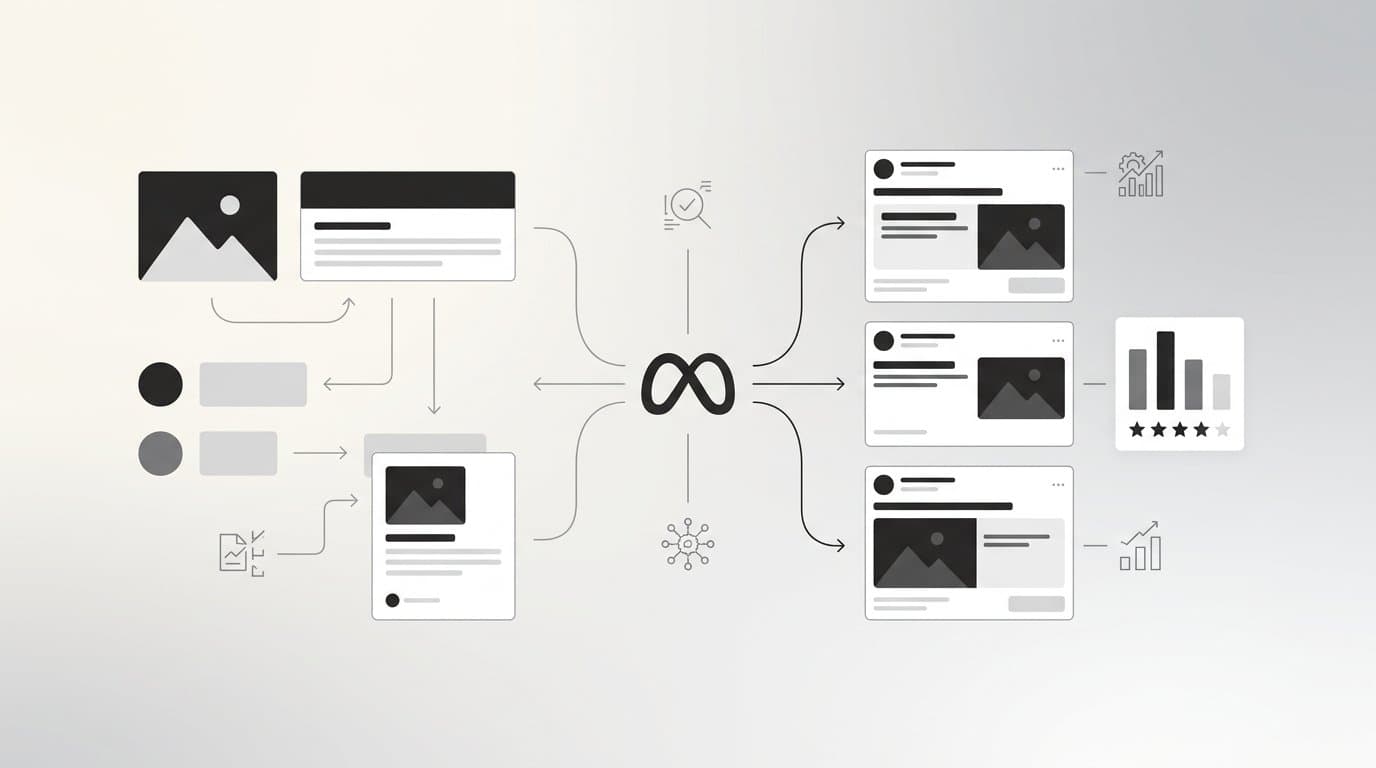
A modular creative system breaks your ads down into independent, reusable components: hooks, background visuals, text overlays, product shots, CTAs, and copy blocks. Each component lives in a library. When you need a new ad, you are mixing and matching from proven parts rather than building from zero.
Think of it like a kitchen with a well-stocked pantry. You are not growing ingredients from seed every time you cook. You are combining what you already have into something new. The result is faster production, more consistent brand execution, and a natural foundation for bulk variation testing.
This system also makes briefing faster. Instead of describing a concept from scratch, you point to existing components and specify what changes. Designers, copywriters, and AI tools all work faster when the brief is structured around components rather than open-ended descriptions.
Implementation Steps
1. Audit your existing ads and identify recurring elements: hook formats, visual styles, CTA phrases, and copy structures that have appeared across multiple campaigns.
2. Organize these elements into a shared library with clear labels, performance notes where available, and version history so your team knows what has been tested.
3. Create a brief template that maps to your component library, so every new ad brief references specific existing parts or clearly flags which components need to be created fresh.
4. Establish a regular cadence for adding new components to the library based on what is performing well, so the system grows smarter over time.
Pro Tips
Start with hooks. The opening two seconds of any Instagram ad does more work than any other element. Building a library of five to ten proven hook formats gives you an immediate production shortcut. Label each hook by the psychological trigger it uses, such as curiosity, urgency, or social proof, so your team can match the right hook to the right campaign objective without deliberating.
2. Use AI to Generate Ad Creatives Directly from Your Product
The Challenge It Solves
Designer dependency is one of the most fragile points in any creative production workflow. When one person controls output, their bandwidth becomes your ceiling. Briefing cycles, revision rounds, and competing priorities all create delays that compound quickly, especially when you need to test multiple creative angles simultaneously.
The Strategy Explained
AI creative generation has moved well beyond novelty. Tools like AdStellar's AI Creative Hub let you generate image ads, video ads, and UGC-style avatar content directly from a product URL. No designer briefing. No revision email chains. No waiting for assets to come back from production.
The process is direct: point the AI at your product, specify your format and objective, and receive ready-to-test creatives. Chat-based refinement replaces the traditional briefing and revision cycle. Instead of writing a brief, waiting, reviewing, and sending feedback, you iterate in real time through conversation. The speed difference is significant, and the creative quality is production-ready.
This approach is particularly powerful for teams that need to test multiple creative angles quickly. You can generate a static image ad, a short video variation, and a UGC-style piece in the time it would previously take to brief a single asset. That volume is what enables real creative testing at scale.
Implementation Steps
1. Identify the three to five creative angles you want to test for your next campaign, such as product benefit, social proof, problem-solution, or lifestyle context.
2. Use an AI creative tool to generate at least one ad per angle, specifying format, dimensions, and any brand guidelines the tool supports.
3. Use chat-based refinement to adjust messaging, visual emphasis, or CTA until each creative is ready for testing, without involving a designer for rounds of revision.
4. Batch your generation sessions so you are producing a week or two of creative inventory at once rather than generating one ad at a time as campaigns demand it.
Pro Tips
Do not treat AI generation as a replacement for creative strategy. The AI handles production. You still need to define the angle, the audience insight, and the message hierarchy. The marketers who get the most from AI creative tools for Instagram are the ones who come in with a clear point of view and use the tool to execute it fast, not the ones who expect the tool to do the strategic thinking.
3. Clone and Adapt Competitor Ads to Accelerate Ideation
The Challenge It Solves
Blank brief syndrome is real. When your team sits down to ideate new creative concepts, the absence of a starting point often creates more delay than the production itself. Ideation sessions run long, consensus is hard to reach, and the resulting brief is frequently too vague to produce quickly. The fix is not more brainstorming. It is better inputs.
The Strategy Explained
Meta's Ad Library is a free, publicly available resource that shows you active ads running across Meta platforms right now. Your competitors are running ads. Your category leaders are running ads. The formats, hooks, and creative structures that are worth studying are already visible, and you do not need a research budget to access them.
The strategy is straightforward: use the Ad Library to identify creative formats that are working in your niche, then adapt those frameworks for your brand. You are not copying ads. You are studying proven structures and applying your own product, messaging, and brand voice to a format that the market has already validated.
AdStellar takes this a step further by letting you clone competitor ads directly from the Meta Ad Library and use AI to adapt them for your brand. This compresses the gap between competitive research and production-ready creative. Instead of manually deconstructing an ad and briefing a designer to recreate the structure, the AI handles the adaptation.
Implementation Steps
1. Search the Meta Ad Library for your top three to five competitors and filter by active ads to see what is currently running.
2. Identify recurring creative formats, hook structures, and visual approaches. When multiple brands in your category are using a similar format, that is a signal worth paying attention to.
3. Document the frameworks you want to test, noting the hook type, visual approach, copy structure, and CTA format for each.
4. Use AI cloning tools to adapt these frameworks for your brand, then test them alongside your original concepts to compare performance.
Pro Tips
Pay attention to how long ads have been running. An ad that has been active for several weeks or months is almost certainly performing well enough to justify continued spend. Longevity in the Ad Library is one of the strongest signals you have that a creative format is working.
4. Separate Creative Approval from Creative Production
The Challenge It Solves
In many teams and agencies, approval is where production goes to stall. A creative is finished, but it sits in someone's inbox waiting for sign-off. Feedback arrives late, is subjective, or opens the door to scope creep. One stakeholder's preference overrides another's, and suddenly a finished ad requires three more rounds of revision. The creative was never the bottleneck. The process was.
The Strategy Explained
The solution is to redesign approval so that subjective opinion is not the gate. When decisions are based on personal preference rather than performance data, every approval becomes a negotiation. When decisions are based on data, the conversation changes entirely.
This means two things in practice. First, separate the production workflow from the approval workflow. Creative should move through production on its own track and only enter an approval queue when it is fully finished, not when it is 80% done and needs direction. Second, introduce performance-based scoring to replace opinion-based review. When AI tools score every ad element against your campaign goals, you have an objective reference point that reduces the room for subjective debate.
AdStellar's AI Insights feature ranks creatives, headlines, copy, and audiences by real metrics like ROAS, CPA, and CTR, and scores everything against your target benchmarks. When your approval process references this kind of data, sign-off becomes faster and more defensible. Teams struggling with creative testing challenges often find that data-driven approval is the single biggest process improvement they can make.
Implementation Steps
1. Map your current approval workflow and identify every point where a creative waits for human input. Note who is involved, what they are reviewing, and how long each stage typically takes.
2. Separate structural approval, such as brand guidelines and messaging strategy, from performance approval. Structural decisions should happen at the brief stage, not after production is complete.
3. Introduce AI scoring or performance benchmarks as the primary reference point for creative review, so feedback is anchored to data rather than preference.
4. Set a maximum revision round limit for any creative that has already passed structural review. If a finished ad meets brand guidelines and the data supports testing it, it should go live.
Pro Tips
The fastest approval processes are the ones where most decisions are made before production starts. If your brief is specific enough, your creative should come back ready to approve on the first pass. Invest more time in the brief and less time in revision rounds.
5. Launch Hundreds of Variations with Bulk Ad Creation
The Challenge It Solves
Testing one or two creatives at a time is not a testing strategy. It is a guessing strategy. When you launch a small number of ads, you are not gathering enough signal to make confident optimization decisions. You are waiting longer for results, spending more on inconclusive tests, and leaving a significant amount of performance data on the table.
The Strategy Explained
Bulk ad creation changes the math entirely. Instead of building individual ads one at a time, you define your creative components, headlines, audiences, and copy variations, and let the system generate every possible combination. What used to take days of manual setup can be done in minutes.
This approach aligns with how Meta's own algorithm works. The more variation you give it to test, the faster it can identify what resonates with your audience. AdStellar's Bulk Ad Launch lets you mix multiple creatives, headlines, audiences, and copy at both the ad set and ad level, generating every combination and launching them to Meta in clicks rather than hours.
The downstream benefit is better data, faster. When you are running dozens of variations simultaneously, you learn quickly what is working across creative format, messaging angle, audience segment, and copy style. That intelligence feeds directly back into your next production cycle, making every round of creative smarter than the last. For a deeper look at how to structure this process, bulk Instagram ad creation covers the full approach in detail.
Implementation Steps
1. Define your variation matrix before production. Decide how many creative formats, headline variations, copy versions, and audience segments you want to test in this cycle.
2. Produce your creative components with the variation matrix in mind. If you plan to test three hooks with two visual styles, you need six creative assets, not one.
3. Use a bulk ad creation tool to generate every combination and review the full set before launching. Check for any combinations that do not make sense together before they go live.
4. Set clear success metrics before launch so you know exactly what you are looking for when results start coming in, and how long you will run each variation before making optimization decisions.
Pro Tips
Resist the urge to launch everything at once with equal budget. Structure your bulk launch so that your strongest hypotheses, based on historical data or proven frameworks, get a slightly higher initial allocation. Use early performance signals to reallocate budget toward winners before the test period ends.
6. Build a Winners Hub to Recycle What Already Works
The Challenge It Solves
Most teams have won before. They have run ads that performed well, found audiences that converted efficiently, and written headlines that drove strong click-through rates. But without a systematic way to capture and organize those wins, they get lost. The next campaign brief starts from scratch, and the team spends time recreating what they already know works.
The Strategy Explained
A Winners Hub is a centralized, organized repository of your best-performing creative assets, audiences, headlines, and copy, each tagged with real performance data. It is not a creative archive. It is a performance library. The distinction matters because an archive stores everything. A Winners Hub stores only what has proven its value in the market.
When every new campaign starts from a position of proven strength, your production cycle shortens dramatically. You are not ideating from zero. You are iterating from a known baseline. You are asking, "How do we build on what already works?" rather than "What should we try?"
AdStellar's Winners Hub does exactly this, organizing top-performing creatives, headlines, and audiences with real performance data attached. When you are ready to build your next campaign, you can pull directly from proven winners and combine them with new variations to test. That combination of proven and new is where the most efficient testing happens.
This connects directly to understanding your creative management system and performance analytics. When you know which assets have historically driven the best returns, you make faster, more confident decisions about what to scale.
Implementation Steps
1. Define your performance threshold for what qualifies as a winner in your account. This should be based on your specific goals, whether that is ROAS, CPA, CTR, or another metric that matters to your business.
2. After each campaign cycle, identify the assets that cleared your threshold and add them to your Winners Hub with performance data attached.
3. Tag each winner by format, creative type, audience segment, and campaign objective so you can filter quickly when building a new campaign.
4. Review your Winners Hub at the start of every campaign brief to identify which proven elements you want to carry forward and which new variables you want to test against them.
Pro Tips
Do not let your Winners Hub become a static archive. Set a review cadence, quarterly works well for most teams, to retire winners that are no longer relevant due to seasonal shifts, product changes, or audience fatigue. A Winners Hub that is regularly curated stays useful. One that never gets pruned becomes noise.
7. Automate the Path from Creative to Live Campaign
The Challenge It Solves
Even when creative production is running smoothly, there is often a significant delay between a finished creative asset and a live campaign. Campaign setup is manual, time-consuming, and requires someone with enough platform knowledge to configure audiences, bidding, placements, and ad structure correctly. That handoff is its own bottleneck, and it is one that most teams do not think to address until it is already slowing them down.
The Strategy Explained
Automating the path from finished creative to live campaign removes the manual setup layer entirely. Instead of a marketer spending hours configuring a campaign in Ads Manager, an AI campaign builder analyzes your historical data, selects the highest-performing creative and audience combinations, and builds a complete campaign structure ready to launch.
AdStellar's AI Campaign Builder works this way. It analyzes your past campaigns, ranks every creative, headline, and audience by performance, and builds complete Meta Ad campaigns in minutes. Every decision comes with full transparency so you understand the rationale, not just the output. The AI gets smarter with each campaign cycle, incorporating new performance data into its recommendations.
This is where the integration between creative generation, bulk launching, and campaign automation creates a genuinely compounding advantage. You are not just saving time on individual tasks. You are removing entire stages from your production-to-launch workflow. The result is a faster feedback loop, more campaigns tested per month, and a continuous improvement cycle that accelerates over time. Teams looking for the right tools to power this workflow will find a thorough breakdown in this guide to Instagram advertising automation tools.
Implementation Steps
1. Audit your current campaign setup process and document every manual step from finished creative to live ad. Identify which steps require specialized knowledge and which are repetitive configuration tasks.
2. Ensure your historical campaign data is clean and accessible. AI campaign builders perform best when they have reliable performance data to analyze. Inconsistent naming conventions or incomplete tracking will limit the quality of recommendations.
3. Run your first AI-built campaign in parallel with a manually built campaign using the same creative assets. Compare the setup time and early performance to build confidence in the automated approach.
4. Use the transparency features in your AI campaign builder to review and understand every decision it makes. This keeps your team sharp and ensures the AI's logic aligns with your strategic goals.
Pro Tips
Attribution quality directly affects the quality of AI campaign recommendations. If your tracking is incomplete, the AI is working with partial information. Connecting your campaigns to a reliable attribution tool, AdStellar integrates with Cometly for this purpose, gives the AI the full picture it needs to make better decisions and surface accurate winners.
Your Implementation Roadmap
The seven strategies above cover every layer of the creative production bottleneck, from ideation and generation to approval, testing, and launch. The question is where to start.
Start with the strategy that addresses your biggest current constraint. If ideation is slow and your team spends too much time staring at blank briefs, begin with competitor research and AI creative generation. If approval is the wall that stops finished work from going live, tackle the process layer first before investing in more production capacity. If you are already producing creative but not testing enough variations to generate meaningful signal, bulk launching and the Winners Hub are your most immediate leverage points.
The compounding effect of combining all seven strategies is where the real acceleration happens. A modular system feeds AI generation. AI generation feeds bulk launching. Bulk launching feeds your insights engine. Your insights engine feeds the Winners Hub. And the Winners Hub feeds your next campaign brief. That is a creative production loop that never stalls.
Each strategy reinforces the others. You do not need to implement all seven at once. But each one you add makes the rest more effective. Teams that build toward the full system find that their creative output scales without a proportional increase in headcount or budget.
AdStellar is built to power exactly this kind of end-to-end workflow. From generating your first AI creative to launching hundreds of variations and surfacing your top performers, it replaces the fragmented stack of tools and freelancers that creates bottlenecks in the first place. One platform handles creative generation, campaign building, bulk launching, performance scoring, and winner organization so nothing falls through the gaps between tools.
Start Free Trial With AdStellar and see how fast your creative output can scale when every stage of the production workflow is connected, automated, and continuously improving based on real performance data.