There is a specific kind of frustration that every Meta advertiser eventually encounters. A campaign that was delivering strong results last month is now quietly bleeding budget, with CPMs climbing, click-through rates sliding, and ROAS heading in the wrong direction. Nothing structural has changed. The targeting is the same. The budget is the same. The only thing that has changed is that your audience has seen your ad too many times.
This is ad fatigue, and on Instagram it happens faster than most advertisers expect. It is not a vague concept or an excuse for underperformance. It is a measurable, documented phenomenon built into how Meta's algorithm works, and it is one of the most common reasons that campaigns that once performed well quietly fall apart without any obvious explanation.
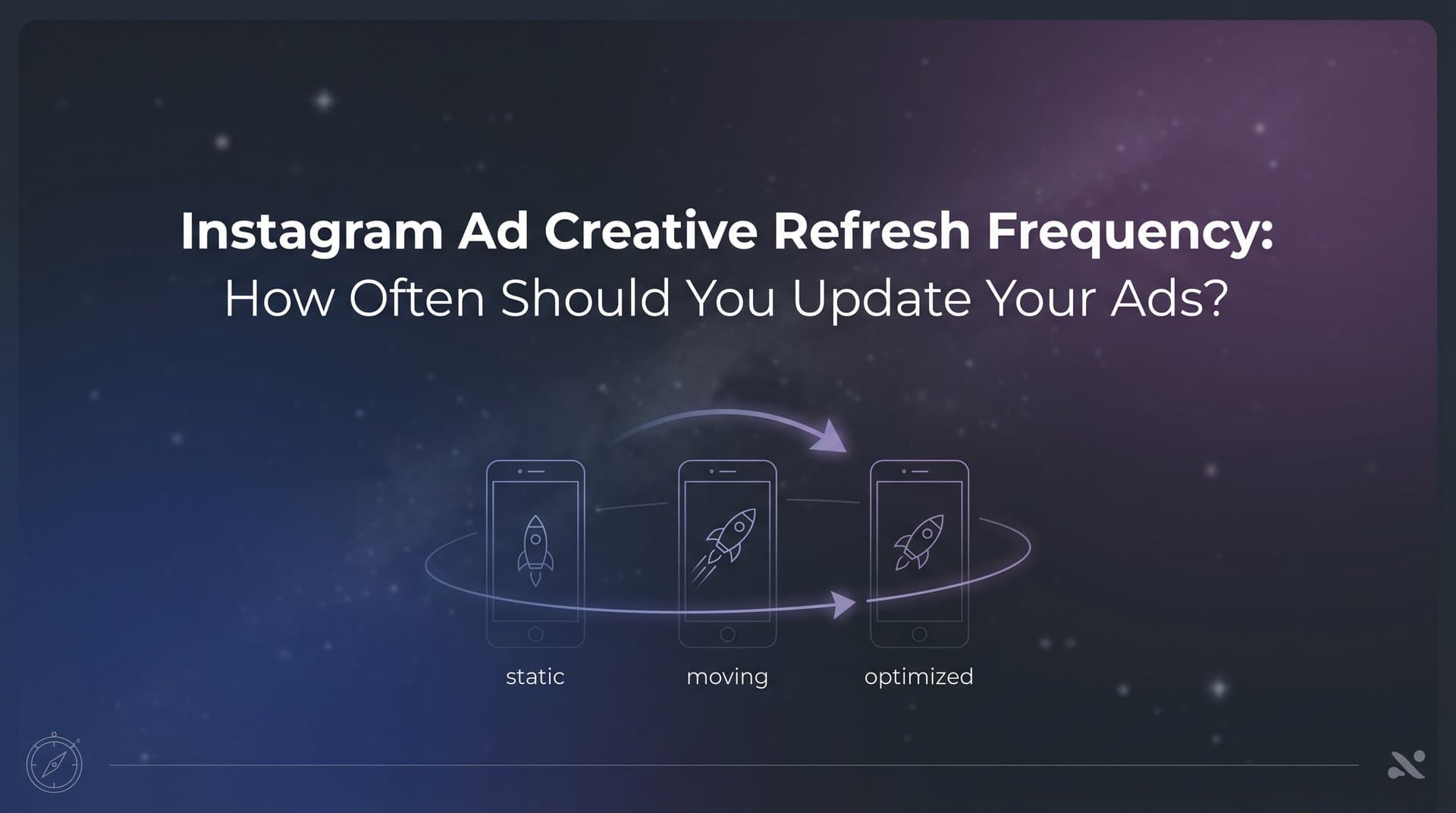
The lever that controls this problem is creative refresh frequency: how often you update, iterate, or replace the ad creatives in your campaigns. Most advertisers treat this reactively, swapping creatives only after performance has already collapsed. The smarter approach is to treat refresh frequency as a proactive system with clear signals, defined timelines, and a repeatable process that keeps campaigns healthy before fatigue takes hold.
This article breaks down exactly how to do that. You will learn why Instagram burns through creatives faster than other platforms, which metrics tell you a creative has peaked, how to set refresh timelines based on your actual audience size and budget, and how to iterate on winners without starting from scratch every time. More importantly, you will see how to build a system that handles much of this without constant manual effort, so your campaigns stay competitive without consuming your entire week.
Why Instagram Eats Creatives Faster Than Any Other Platform
Instagram is a visually dense, high-velocity environment. Users scroll through hundreds of pieces of content in a single session, and they are exceptionally good at pattern recognition. The moment something feels familiar, whether it is a visual style, a hook they have seen before, or an ad format they recognize, their thumb is already moving. This is not a conscious decision. It is a conditioned reflex built from years of heavy platform use.
This environment creates a shorter creative lifespan than most other ad channels. What works on a slower-paced platform, or even in a less visually competitive feed, gets worn out faster on Instagram simply because the volume of competing content is higher and users are more sensitized to advertising patterns. Creatives that feel fresh on day one can feel stale by week two if they are being served to the same audience repeatedly.
Meta's auction system compounds this problem in a specific way. The platform does not distribute your creative evenly across a broad population and then move on. It serves the same creative to the same audience segments repeatedly, especially in tighter audience configurations. This means that a subset of your audience is seeing your ad multiple times before a new user ever encounters it. Exposure accumulates quickly at the impression level, and recognition fatigue sets in well before your frequency score reflects it in aggregate numbers.
Here is where ad fatigue becomes more than just a performance annoyance. When engagement rates drop because users are ignoring or hiding an ad they have seen too many times, Meta's algorithm interprets that signal as a relevance problem. A creative with declining engagement becomes less competitive in the auction. To maintain delivery, the platform has to spend more per impression, which is why CPMs rise as a creative ages. You are not just getting worse results. You are paying more for those worse results.
The practical implication is straightforward: on Instagram, creative refresh frequency is not a nice-to-have. It is a core part of campaign maintenance. Treating it as optional means accepting a predictable degradation curve that will eventually make even a well-structured campaign uncompetitive.
Reading the Signals Before Performance Collapses
The goal is to catch fatigue early, before it has already done significant damage to your campaign efficiency. There are specific metrics worth monitoring on a rolling basis, and knowing which combination of signals indicates genuine creative fatigue versus other campaign problems is what separates a strategic refresh decision from a reactive one.
Frequency: This is the most direct fatigue indicator available in Meta Ads Manager. It measures how many times, on average, each person in your audience has seen your ad. Many experienced practitioners treat a frequency above three to four as a signal to investigate further, though the relevant threshold varies by audience size and campaign objective. A rising frequency score alone does not require immediate action, but it should prompt you to look at what else is happening.
CTR trend: A declining click-through rate over a rolling seven to fourteen day window, when paired with stable or rising frequency, is a strong indicator that your creative is losing its ability to generate interest. Look at the trend rather than a single day's number, since daily CTR can fluctuate for reasons unrelated to fatigue.
CPM movement: Rising CPM without a corresponding increase in competition or budget changes often indicates that Meta's algorithm is deprioritizing your creative in the auction due to declining engagement signals. This is a downstream consequence of fatigue, and it means you are paying more for less.
ROAS or CPA degradation: If your cost per acquisition is trending upward or your return on ad spend is declining over the same window where frequency is rising and CTR is falling, you have a clear pattern that points to creative fatigue rather than a targeting or budget issue.
The important distinction here is between a fatigued creative and a campaign with structural problems. If CPM is rising but frequency is low and CTR is stable, the issue is more likely audience-side or competitive pressure, not creative fatigue. If ROAS is declining but engagement metrics are holding, look at your landing page or offer before pulling the creative. Refreshing a creative prematurely means losing the algorithm's learning phase data and resetting a campaign that may have had more runway left. Use the full diagnostic picture before making the call.
A simple checklist approach works well here: review frequency, CTR trend, CPM trend, and ROAS together on a weekly basis. When two or more of these metrics are moving in the wrong direction simultaneously, that is your signal to prepare a refresh rather than wait for complete performance collapse. Understanding Instagram ad performance tracking in depth will help you interpret these signals more accurately across campaigns.
Refresh Timelines That Match Your Audience and Budget
There is no single correct answer to how often you should refresh Instagram ad creatives. The right cadence depends on a combination of factors specific to your account, and applying a generic rule without accounting for these variables will either leave you refreshing too early and wasting production effort, or too late and paying the price in degraded performance.
Audience size is the most significant variable. A tightly defined, narrow audience, such as a custom audience of past purchasers or a small retargeting pool, saturates much faster than a broad interest-based or lookalike audience. When the same creative is being served to a limited pool of users, individual frequency accumulates quickly. Many practitioners working with smaller, defined audiences find that creatives need rotation every two to three weeks to stay effective. Broad audiences and top-of-funnel campaigns targeting large lookalike segments can often sustain the same creative for four to six weeks or longer before fatigue becomes a measurable problem.
Daily spend and impression volume interact directly with audience size to determine saturation speed. A high-spend account pushing significant daily impressions against a defined audience will exhaust creative novelty far faster than a modest-spend account reaching a fraction of that audience each day. If you are spending heavily, weekly creative reviews and more frequent refreshes are a practical necessity, not a luxury. If your daily budget is more modest, you have more room to extend timelines while still monitoring the diagnostic signals described above.
Campaign type also shapes the appropriate rhythm. Always-on evergreen campaigns, which run continuously to a stable audience with a consistent offer, need a different approach than time-bound promotional campaigns. A campaign tied to a product launch, a seasonal sale, or a trending moment has a built-in time horizon that naturally limits creative lifespan. For these campaigns, the refresh question is less about fatigue and more about keeping creative aligned with the campaign's evolving narrative as the event progresses. Advertisers running Instagram ad campaigns for direct-to-consumer brands often face this challenge acutely given the volume of always-on activity required.
A practical starting framework: audit your creative performance weekly, plan for a refresh review at the two-week mark for tighter audiences, and use the four-week mark as a default checkpoint for broader campaigns. Adjust from there based on what the metrics are actually showing you rather than applying the calendar rigidly.
What to Change and What to Keep
When a creative does need refreshing, the instinct to start from scratch is almost always the wrong move. A full creative overhaul discards the algorithm's accumulated learning about which users respond to your ads, resets performance history, and wastes the insight embedded in what was already working. The more effective approach is deliberate iteration: changing specific elements to inject novelty while preserving the structural foundation that made the creative perform in the first place.
Think of it as the difference between renovating a room and demolishing the building. You want to change what the audience has already seen and tuned out, not everything that was making the campaign work.
The most impactful single element to change in a video ad is typically the opening hook. The first two to three seconds determine whether a user stops scrolling, and a fatigued audience that recognizes your opening frame will skip before the message lands. Swapping the hook while keeping the rest of the ad intact is often enough to reset perceived novelty without losing the creative's proven structure. Applying structured Instagram ad creative testing methods can help you identify which specific elements are driving performance before you decide what to change.
For static image ads, changing the visual color treatment, background, or primary image while keeping the headline and offer consistent can produce a meaningfully different-feeling ad that still carries the same message. Headline and primary text swaps are another low-effort, high-impact lever, particularly when the underlying offer and visual remain strong.
The concept of a modular creative library makes this kind of rapid iteration practical. Instead of treating each ad as a standalone production, build a bank of interchangeable components: proven hooks, headline variants, product shots in different contexts, CTA overlays, and copy angles. When a creative needs refreshing, you are recombining existing assets into new configurations rather than commissioning new production from scratch. This dramatically reduces the time and cost of each refresh cycle while keeping the output grounded in elements that have already demonstrated some level of performance.
This is exactly the kind of workflow that tools like AdStellar's AI Creative Hub are built to support. The ability to generate new image ads, video ads, and UGC-style creatives from a product URL, or to refine existing ads through chat-based editing, means that refreshing a creative no longer requires briefing a designer or waiting on a production cycle. An Instagram ad creative generator can produce new variations of a proven format in minutes and have them ready to launch before fatigue has a chance to compound.
Building a Refresh System That Runs Without Constant Manual Work
The biggest operational problem with creative refresh is not knowing what to do. Most advertisers understand the concept. The problem is that monitoring fatigue signals, briefing new creative, reviewing variations, and launching replacements across multiple campaigns is genuinely time-consuming, especially for agencies managing several accounts simultaneously. When the process is entirely manual, refreshes happen reactively, after performance has already degraded, because there is simply no bandwidth to be proactive.
A proactive refresh calendar changes this dynamic. Scheduling fixed creative review intervals, weekly for high-spend accounts, biweekly for moderate-spend accounts, means that fatigue is caught early as part of a routine rather than discovered after a campaign has already bled budget. The calendar does not replace metric monitoring; it structures it so that the monitoring actually happens consistently instead of falling through the cracks during busy periods.
Beyond the calendar, the operational leverage comes from reducing the friction in each step of the refresh process. This is where AI-powered platforms create a meaningful advantage. Rather than manually identifying which creatives are fatiguing, briefing a designer, waiting for production, and then setting up new ad sets, a platform like AdStellar compresses that entire workflow. Leveraging AI for Instagram advertising campaigns is increasingly what separates advertisers who stay ahead of fatigue from those who are always catching up.
AdStellar's AI Campaign Builder analyzes historical performance data, ranks creatives, headlines, and audiences by actual results, and builds new campaign structures in minutes. Every decision comes with a transparent rationale, so you understand why the AI is recommending specific elements rather than just accepting opaque output. The Bulk Ad Launch feature lets you generate hundreds of ad variations from multiple creatives, headlines, and copy combinations and push them to Meta in a fraction of the time it would take to set each one up manually.
The Winners Hub adds another layer of efficiency to the refresh system. Instead of starting each refresh cycle from a blank slate, you have a curated library of your top-performing creatives, headlines, audiences, and copy variants, all with real performance data attached. When it is time to refresh, you are selecting from proven components and building new combinations rather than guessing what might work. Each refresh cycle becomes faster and better-informed than the one before it.
AI Insights leaderboards surface which elements are performing against your specific goals, whether that is ROAS, CPA, or CTR, so the refresh decision is driven by data rather than intuition. Set your benchmarks, and the platform scores everything against them automatically, flagging what needs attention before it becomes a problem.
Turning Creative Refresh Into a Competitive Advantage
Most advertisers treat creative refresh as a maintenance task: something you do when things break down. The advertisers who consistently outperform treat it as a strategic system that compounds over time.
Every refresh cycle generates new performance data. A new hook variant that outperforms the original tells you something specific about what your audience responds to. A headline swap that fails to move the needle tells you something equally valuable. Over multiple cycles, this data accumulates into a detailed picture of what works for your specific audience, offer, and creative style. Future refreshes become progressively more efficient because they are informed by a growing body of real performance evidence rather than starting fresh each time.
Competitive intelligence adds another dimension to this system. Meta's Ad Library is publicly available, and analyzing how competitors are rotating their creative formats, which angles they are testing, and how their ad inventory changes over time is a legitimate and widely practiced research method. Advertisers who monitor competitor creative patterns can identify emerging formats before they become saturated and incorporate successful structural approaches into their own iterations. Understanding Facebook ad creative testing challenges gives useful context for why systematic competitor analysis matters as part of a broader refresh strategy.
AdStellar's ability to clone competitor ads directly from the Meta Ad Library makes this workflow significantly faster. Rather than manually recreating a format that caught your attention, you can pull it into the platform and use it as a starting point for your own variation, adapted to your offer and brand. This keeps your creative strategy responsive to what is actually working in the market without requiring you to invent every approach from scratch.
The compounding effect of a well-run refresh system is real. Advertisers who maintain fresher creative inventories stay more competitive in Meta's auction, sustain lower CPMs over time, and build a progressively stronger creative library with each cycle. The gap between advertisers who treat refresh as reactive maintenance and those who treat it as a proactive system widens with every campaign that runs.
Putting It All Together
Creative refresh frequency on Instagram is not a single decision. It is an ongoing system built on three foundations: the right signals, the right timing, and the right process for generating replacements quickly.
Watch frequency, CTR trends, CPM movement, and ROAS together on a rolling basis. When multiple signals move in the wrong direction simultaneously, that is your prompt to refresh, not a collapse in performance. Set a proactive review calendar calibrated to your audience size and daily spend, with tighter audiences and higher budgets requiring more frequent attention. When you do refresh, iterate on specific elements rather than replacing everything, and build a modular creative library that makes each new variation faster to produce than the last.
The operational reality is that doing all of this manually across multiple campaigns is genuinely difficult. The platforms that make creative generation, performance scoring, and bulk launching fast and accessible are the ones that make a proactive refresh system practical rather than theoretical.
AdStellar is built for exactly this workflow. Generate scroll-stopping image ads, video ads, and UGC-style creatives from a product URL. Clone competitor formats from the Meta Ad Library. Let AI analyze your historical performance and build complete campaigns around your proven winners. Launch hundreds of variations in minutes. Surface what is working with leaderboards scored against your actual goals. All of it in one platform, without designers, video editors, or manual setup.
If your current approach to creative refresh is reactive, there is a better way. Start Free Trial With AdStellar and build the kind of creative system that keeps your campaigns performing before fatigue has a chance to take hold.