The budget is approved. The audience targeting is dialed in. The campaign structure is mapped out. And then everything stops, because the creative isn't ready.
If you've managed Meta campaigns for any length of time, that scenario is painfully familiar. The strategy isn't the problem. The media buying isn't the problem. The problem is the gap between what you know needs to happen and how long it takes to produce the assets that make it happen. That gap has a name: the Instagram ad design bottleneck.
It's one of the most common and quietly costly friction points in paid social, and it affects teams of every size. Solo marketers waiting on a freelancer. In-house teams routing requests through an overloaded design department. Agencies juggling creative production across a dozen clients with a small shared team. The constraint looks different depending on where you sit, but the impact is the same: slower launches, fewer variations tested, and campaigns that underperform not because the strategy was wrong, but because the creative pipeline couldn't keep up.
This article breaks down exactly what the Instagram ad design bottleneck is, where it forms, what it costs beyond the obvious delay, and how modern performance teams are restructuring their workflows to eliminate it. By the end, you'll have a clear picture of the systems problem underneath the surface frustration, and the practical approaches that actually solve it.
What the Design Bottleneck Actually Looks Like Day-to-Day
The Instagram ad design bottleneck isn't just about slow designers or unclear briefs. It's a structural gap between how fast a team can strategize and how fast they can produce ready-to-launch creatives. The full pipeline runs from initial brief through concept development, design, revision, format adaptation, approval, and final export. Every one of those stages is a potential delay point, and they compound.
The symptoms are recognizable to anyone who's managed paid social at scale. Campaigns sit in a "waiting on creative" status for days before launch. The number of ad variations being tested at any given time is limited not by budget or strategy, but by how many assets the design team could turn around. One designer, or one agency relationship, becomes the single chokepoint that every campaign must pass through. And revision cycles that should take an afternoon stretch into a week when feedback gets batched, interpreted differently than intended, and revised again.
Instagram amplifies this problem more than almost any other advertising channel, and the reason comes down to format requirements. A single campaign concept doesn't produce one creative. It produces several. You need a square (1:1) version for the feed, a portrait (4:5) version for feed optimization, and a vertical (9:16) version for Stories and Reels. That's three to four format variations before you've even started A/B testing different headlines, hooks, or visual approaches.
Think about what that means in practice. If you want to test three different creative concepts with two copy variations each, you're looking at 18 to 24 individual assets just to run a meaningful test. For a team producing creatives through a traditional design workflow, that's not a quick ask. That's a project.
The visual-first nature of Instagram also raises the stakes on every asset. Unlike search ads where a strong headline can carry mediocre creative, or email where copy drives most of the engagement, Instagram stops the scroll with imagery and motion first. Creative quality and variety have a direct, measurable impact on performance in a way that's more acute here than on text-heavy platforms. So the bottleneck doesn't just slow things down: it directly limits how well your campaigns can perform.
For agencies, the constraint multiplies with each client added. A single creative team that's manageable for three clients becomes severely strained at eight. The same designer or small team becomes a shared resource across campaigns with different brand guidelines, different audiences, and different launch timelines. The bottleneck doesn't scale, but the client roster does. Teams managing this challenge at scale often turn to Instagram advertising tools for agencies specifically designed to handle multi-client creative demands.
The Hidden Costs That Go Beyond Slow Turnaround
The most visible cost of a creative bottleneck is the delay itself. A campaign launches a week late, you lose some potential revenue, you move on. But the downstream effects are more significant and harder to see in a single reporting period.
The first hidden cost is the testing gap. Meaningful creative testing requires volume. When you're limited to two or three variations per campaign because that's all production could turn around, you're not running a real test. You're picking between a small sample of options and calling the winner a "winning ad" when it may just be the least bad option from an insufficient set. The campaign optimizes toward a local maximum rather than finding the creative approach that would genuinely outperform. Performance looks acceptable, which means the bottleneck stays invisible while quietly capping your results.
The second hidden cost is ROAS erosion from creative fatigue. Ad fatigue is a well-documented reality in paid social. Audiences on Instagram see the same ads repeatedly, and engagement metrics decline as familiarity sets in. Frequency increases, click-through rates drop, and cost per result climbs. The solution is straightforward: refresh your creative regularly. The problem is that teams stuck in a production bottleneck can't rotate assets quickly enough to stay ahead of fatigue. By the time new creative is approved and ready to swap in, the existing ads have already been running too long. ROAS erodes gradually, the decline gets attributed to audience saturation or market conditions, and the real cause, a creative pipeline that can't keep pace, goes unaddressed.
The third hidden cost is what it does to the performance marketer's actual job. Media buyers and campaign managers are supposed to be acting on data: scaling what's working, cutting what isn't, testing new hypotheses. When creative production is the limiting factor, those decisions get delayed or diluted. You see a winning audience segment but can't test new creative angles against it because the assets aren't ready. You want to scale a campaign but hesitate because you know the creative will fatigue before new assets arrive. The bottleneck doesn't just slow down production. It forces performance marketers into a reactive, wait-and-see posture when they should be operating proactively.
Taken together, these costs mean the true impact of an Instagram ad design bottleneck is rarely captured in a simple "days delayed" metric. It shows up in missed testing opportunities, in campaigns that plateau prematurely, and in media buyers who are underutilizing their expertise because they're waiting on assets rather than acting on insights. Tracking these effects accurately requires solid Instagram ad performance tracking practices that surface the real cost of creative delays.
Where the Bottleneck Forms: The Four Pressure Points
Understanding where the constraint actually lives makes it possible to address it systematically rather than just pushing harder on the same broken process. There are four distinct pressure points where most Instagram ad design bottlenecks originate.
The Brief-to-Design Handoff: This is where strategic intent gets lost in translation. The performance marketer knows the audience, the offer, the angle that's been working in copy, and the competitive context. The designer knows how to build a visually compelling asset. The problem is that the brief is the bridge between those two knowledge sets, and it's almost always incomplete. Designers build what they can infer from the brief. Marketers review what comes back and realize it didn't capture what they actually meant. The first revision round begins before the creative has even been tested. This handoff friction isn't a people problem; it's a process problem. The information needed to produce a strong first draft often lives in the marketer's head and never fully makes it onto the page.
Revision Loops: Revision cycles are where production time goes to die. In a traditional workflow, feedback goes from stakeholder to marketer to designer, gets interpreted, gets implemented, and comes back for review. A single round of revisions can take two to three days when you factor in response times, calendar availability, and the reality that feedback is often given in batches rather than in real time. Multiple revision rounds, which are common when the brief-to-design handoff was unclear, can consume the majority of total production time without meaningfully improving the final creative. The asset that launches after three revision rounds often isn't dramatically better than what would have launched after one clear, specific brief.
Format Fragmentation: A single creative concept doesn't stay a single asset. It needs to be adapted across feed square, feed portrait, Stories vertical, and Reels. Text placement changes. Focal points shift. What works in a 1:1 crop doesn't always translate to a 9:16 frame. Each adaptation requires design time, and each adaptation can trigger its own mini-revision loop. For a team producing five to ten concepts per campaign, the format multiplication effect turns a manageable workload into a backlog quickly. Understanding the precise size of Instagram Stories and other placement specs is essential to getting these adaptations right the first time.
Approval and Compliance Delays: Especially in agency environments, the final gate before launch can be as slow as any earlier stage. Legal review, brand guideline checks, client approval workflows, and internal sign-off processes all sit between "creative is done" and "creative is live." These delays are particularly frustrating because they happen after the creative work is complete, meaning the team has done everything right and is still waiting. In agencies managing multiple clients, these approval queues stack on top of each other, and a delay on one account can push back timelines across the board.
Each of these pressure points is a real constraint on its own. Together, they create a pipeline where the brief-to-launch timeline regularly stretches to one to two weeks for what should be a two-day process.
How High-Performing Teams Restructure Creative Production
The teams that have broken through the Instagram ad design bottleneck aren't necessarily the ones with the biggest design budgets or the most headcount. They've restructured how creative production works at a process level.
The most impactful shift is moving from a request-based model to a self-serve creative model. In a request-based model, every creative need routes through the design team. Performance marketers write briefs, designers produce assets, feedback loops happen, and the designer's calendar becomes the campaign's calendar. In a self-serve model, performance marketers can generate and iterate on creatives directly, without routing every request through a design bottleneck. Designers are freed up for the work that genuinely requires their expertise: brand identity work, high-production campaigns, complex visual storytelling. Routine ad creative production moves to the people who understand the performance context best. This is exactly the kind of workflow that automated ad creation for Instagram is designed to enable.
The second structural shift is building around proven winners rather than starting from scratch each cycle. Teams that catalog their top-performing ad elements, specific hooks that drove strong CTR, color and layout combinations that perform well with particular audiences, CTA styles that convert, create a foundation for new creative that's grounded in real performance data rather than intuition. New variations become iterations on what's already working rather than blank-slate exercises. This compresses both production time and the testing cycle needed to find a winner.
The third shift is parallel production. In a sequential workflow, campaign strategy is finalized, then audience building begins, then creative is briefed, then assets are produced. Each stage waits for the previous one to complete. In a parallel workflow, strategy, audience building, and creative generation happen simultaneously. The campaign is ready to launch when all three streams converge, rather than when the last sequential step finishes. This alone can cut the brief-to-launch timeline significantly without adding any resources.
These structural changes don't require a complete overhaul of how a team operates. They require a clear-eyed look at where the sequential dependencies are and a deliberate decision to remove them.
How AI Creative Tools Change the Equation
The structural shifts above describe the workflow changes. AI creative tools are what make those shifts practically achievable at scale.
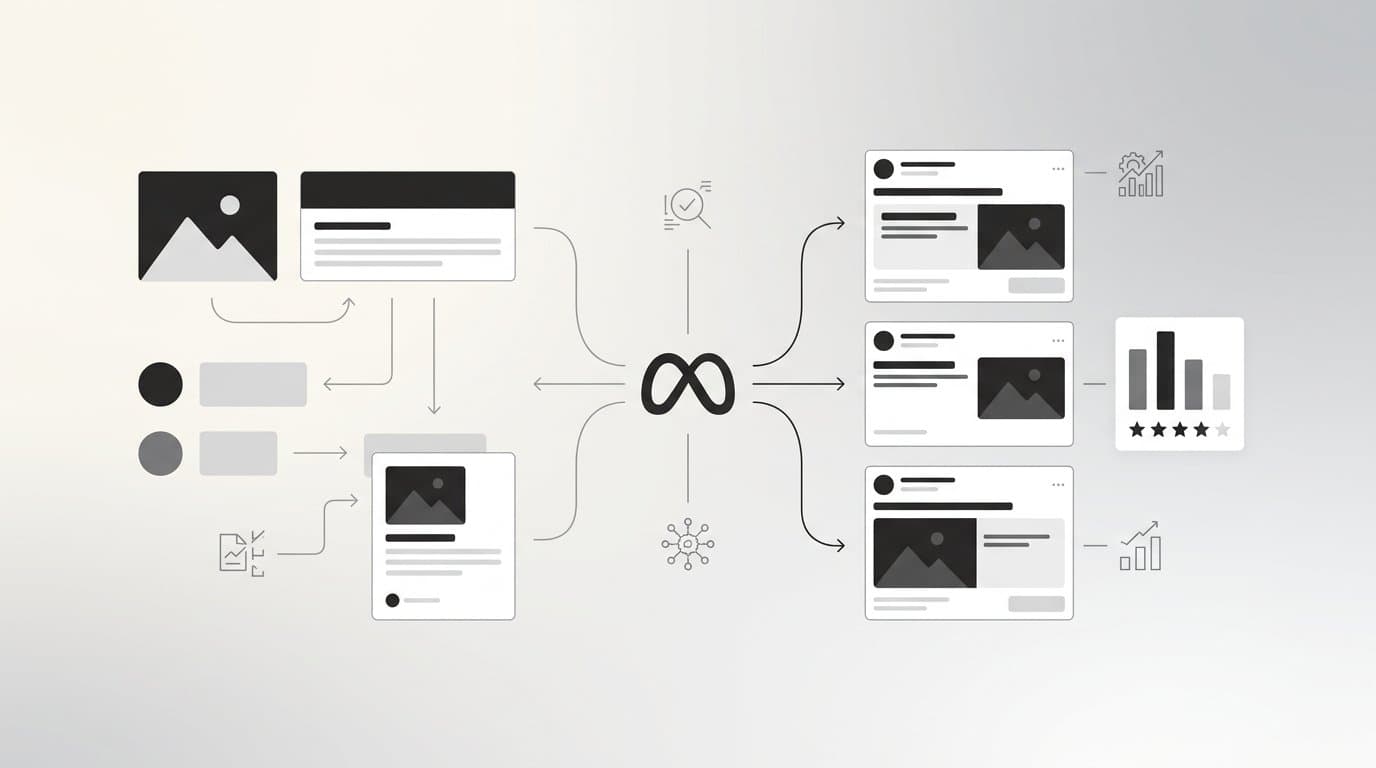
At a practical level, AI ad creative generation works by taking a product URL or a short brief and producing image ads, video ads, and UGC-style creatives without requiring a designer, video editor, or actor. The marketer inputs the context, the AI generates assets, and the output is a set of ready-to-refine creatives that can move directly into a review and launch workflow. For performance marketers, this means the creative production step no longer requires scheduling a designer or waiting for a freelancer to become available. The bottleneck between strategy and execution shrinks substantially.
Platforms like AdStellar take this further with a competitive intelligence layer. The ability to clone competitor ads directly from the Meta Ad Library gives teams a starting point that's grounded in what's already working in their market. Rather than guessing at formats, hooks, or visual styles that might resonate with a particular audience, you can analyze what competitors are running and use that as a creative foundation. This doesn't mean copying; it means starting from market-validated creative signals rather than assumptions, which compresses the testing cycle needed to find a winning approach.
The revision loop problem, one of the four pressure points described earlier, is addressed through chat-based creative refinement. Instead of writing a brief, waiting for a designer to interpret it, reviewing the output, writing feedback, and waiting again, marketers can refine an asset conversationally in real time. "Make the headline larger." "Try a darker background." "Add a stronger CTA in the bottom third." Each instruction produces an immediate iteration. The feedback loop that used to take two days now takes two minutes. This isn't just faster; it's a fundamentally different working model that keeps the creative decision-making with the person who understands the performance context.
For format fragmentation, AI tools that automatically adapt a single concept across all required Instagram placement specs eliminate one of the most time-consuming parts of production. One concept becomes four format variations without four separate design requests. The multiplier effect that drove the bottleneck gets inverted: more formats from less effort.
The net result is that performance marketers can operate more independently on creative production without sacrificing quality, while designers retain ownership of the work that genuinely requires their expertise.
From Bottleneck to Scale: Launching at Volume Without Adding Headcount
Solving the Instagram ad design bottleneck isn't just about producing creatives faster. It's about producing enough creative volume to run the kind of testing that actually surfaces winners, and then scaling those winners efficiently.
Bulk ad launching is the structural answer to the volume problem. Instead of building ad variations manually, one by one, bulk creation tools let you mix multiple creatives, headlines, audiences, and copy combinations and generate every permutation automatically. A set of five creatives, three headlines, and two audience segments produces 30 ad variations. That entire set can be built and launched to Meta in minutes rather than hours of manual ad set construction. The creative volume needed for meaningful A/B testing becomes achievable without a proportional increase in production time or team size.
AdStellar's AI Campaign Builder takes this a step further by analyzing historical performance data to select the strongest creative elements before the campaign even launches. Rather than testing everything equally and waiting for the data to sort itself out, the AI ranks previous creatives, headlines, and audiences by real performance metrics and builds the new campaign around what has already proven to work. Every decision comes with a clear rationale, so performance marketers understand the strategy behind the campaign structure, not just the output.
The continuous learning loop is what makes this approach compound over time. The AI scores every ad element against real metrics: ROAS, CPA, CTR, and whatever goal benchmarks you've set. Those scores feed back into future campaign decisions. Winners get surfaced in the Winners Hub, where top-performing creatives, headlines, and audiences are organized with their actual performance data attached. When you're building the next campaign, you're not starting from intuition or last quarter's memory. You're starting from a ranked inventory of what's already worked.
This is the difference between solving the bottleneck once and building a creative system that improves with every campaign. The first time you use a bulk launch workflow, you save hours of manual setup. The tenth time, the AI has enough historical data to make genuinely informed decisions about which combinations are worth prioritizing. The system gets smarter as it scales, which is the opposite of what happens when you try to solve a volume problem by adding headcount.
AdStellar's AI Insights leaderboards make the performance picture visible at every level: creative, headline, copy, audience, and landing page, all ranked against your actual goals. Spotting what's working and reusing it becomes a built-in part of the workflow rather than a manual analysis exercise.
Putting It All Together
The Instagram ad design bottleneck is a systems problem, not a talent problem. The designers aren't too slow. The marketers aren't writing bad briefs. The constraint is structural: a sequential, dependency-heavy production workflow that can't keep pace with the creative volume Instagram campaigns actually require.
The solution isn't hiring more designers or increasing agency retainers. It's rebuilding the workflow around parallel production, self-serve creative generation, and AI tools that compress the brief-to-launch timeline from weeks to hours. When performance marketers can generate creatives directly, iterate conversationally, launch hundreds of variations in minutes, and let AI surface the winners automatically, the bottleneck stops being the limiting factor on campaign performance.
The shift is from sequential and manual to parallel and AI-assisted. From waiting on assets to acting on data. From testing too few variations to running the creative volume that actually reveals what works.
AdStellar is built for exactly this workflow. It handles creative generation, campaign building, bulk launching, and performance surfacing in one platform, from a product URL to a live, optimized Meta campaign without needing designers, video editors, or separate tools. If you're ready to stop letting creative production be the ceiling on your campaign performance, Start Free Trial With AdStellar and see what your campaigns look like when the bottleneck is gone. The 7-day free trial gives you full access to find out.