Your Instagram ad is crushing it at $100 per day. A clean 4.2x ROAS. Cost per acquisition sitting at $18. You're watching the dashboard like it's the final minutes of a championship game, and every refresh brings good news.
So you do what any rational advertiser would do: you triple the budget overnight.
Within 48 hours, your CPA has ballooned to $47. Your ROAS has collapsed to 1.8x. The ad that was printing money is now barely breaking even. You've just experienced what we call the "scaling death spiral"—and you're not alone.
Here's the uncomfortable truth: roughly 73% of advertisers see performance degradation within the first week of scaling attempts. The average cost per acquisition increases by 40-60% during failed scaling efforts. And only about 27% of campaigns maintain their original performance when scaling beyond 3x the initial budget.
The scaling paradox is real. More budget should mean more results, but instead it often means worse performance. Why? Because Instagram's algorithm isn't just a money-printing machine you can feed unlimited cash. It's a sophisticated system that optimizes delivery based on audience quality, creative performance, and dozens of other signals that shift dramatically when you suddenly demand 5x the conversion volume.
Think of it like this: at $100 per day, your ad reaches the most responsive 1% of your target audience. These people were already primed to convert. When you scale to $500 per day, the algorithm has to find 5x more converters—which means reaching less responsive audience segments. The math simply doesn't scale linearly.
But here's what most advertisers miss: scaling isn't about throwing more money at winning ads. It's a systematic process that requires methodical creative expansion, strategic audience development, intelligent budget management, and increasingly, AI-powered automation to handle the complexity.
The opportunity cost of not scaling properly is massive. If you've found a winning ad, you're sitting on potential revenue that's being left on the table every single day you can't scale it profitably. Meanwhile, your competitors who've mastered systematic scaling are capturing that market share.
This guide walks you through the exact four-step framework that prevents the scaling death spiral. You'll learn how to multiply your creative assets without losing what makes them work, expand your audiences without cannibalizing performance, increase budgets without triggering algorithm chaos, and leverage AI automation to manage the complexity that manual scaling simply can't handle at scale.
By the end, you'll have a systematic approach to take your Instagram ads from $100 per day to $10,000 per day—or whatever your growth target is—without the performance cliff that kills most scaling attempts. Let's walk through how to do this step-by-step.
Step 1: Creative Asset Multiplication Without Losing the Magic
Here's the scaling trap most advertisers fall into: they find a winning creative, then either copy it exactly (limiting reach) or change everything (killing performance). Both approaches fail.
The reality? Your winning ad works because of specific elements—not the entire package. Maybe it's the hook in the first three seconds. Maybe it's the color scheme that stops the scroll. Maybe it's how the offer is framed. Your job is to identify these winning elements, then systematically vary everything else.
Think of it like a recipe. If you're making the world's best chocolate chip cookies, you don't change the chocolate chips, butter ratio, and baking temperature all at once. You keep the core ingredients that make it work, then test variations on secondary elements.
Deconstructing Your Winning Creative
Start by analyzing your best performer frame by frame. Open the video or image and identify three critical components:
The Hook (First 3 Seconds): What stops the scroll? Is it a bold text overlay, a surprising visual, a relatable scenario, or a pattern interrupt? Write down the exact hook mechanism—not just "it's engaging," but specifically what makes someone pause.
Visual Elements: Break down the composition. What colors dominate? Are there faces or products? What's the visual hierarchy? Is there movement or static imagery? Document every visual choice that could influence performance.
The Offer and CTA: How is the value proposition presented? What specific words are used? Where does the call-to-action appear? Is it direct ("Shop Now") or softer ("Learn More")? The framing matters as much as the offer itself.
This analysis reveals your "untouchable elements"—the 20% of your creative that drives 80% of performance. Everything else becomes a testing variable.
The Systematic Variation Framework
Now you create variations that test new angles while preserving your winners. Here's the methodology that maintains performance while expanding reach:
Hook Variations with Constant Visuals: Keep your winning imagery identical but test 5-7 different hooks. If your original hook was "Tired of expensive ads?", test variations like "Your competitors are outspending you," or "What if you could cut ad costs in half?" Same visual foundation, different scroll-stoppers.
Visual Variations with Constant Hook: Lock in your winning hook, then test different visual executions. Change the color palette, swap product angles, test with and without faces, or adjust the composition. Each variation reaches different audience segments while maintaining the proven hook.
Offer Framing Variations: Test how you present the same core offer. "50% off" versus "Buy one, get one free" versus "Save $50 today." Different frames appeal to different psychological triggers, expanding your converting audience without changing your actual offer.
The goal? Create 10-15 variations from one winner, each testing a single variable while keeping proven elements constant. This approach maintains your baseline performance while discovering new converting combinations.
Creative Asset Organization for Scale
When you're managing dozens of creative variations, organization prevents chaos. Set up a system using bulk ad creation tools to track which elements you've tested and which combinations are performing. Modern ad creation software allows you to systematically generate variations while maintaining your winning elements, ensuring you never lose track of what's working.
Step 2: Audience Expansion Without Cannibalization
You've multiplied your creatives. Now you need more people to show them to. But here's where most scaling attempts collapse: advertisers either duplicate audiences (causing self-competition) or jump to completely cold audiences (tanking performance).
The solution? Progressive audience expansion that maintains conversion quality while increasing volume. Think of it as concentric circles radiating out from your core converters.
The Lookalike Ladder Strategy
Start with your best converters and systematically expand outward. If your 1% lookalike is performing well, don't jump straight to a 10% lookalike. That's like going from dating someone to proposing marriage on the second date.
Instead, test 2% lookalikes while your 1% continues running. Once the 2% stabilizes with acceptable performance, layer in 3-4% lookalikes. This progressive expansion maintains conversion quality while scaling reach. Each step validates that the algorithm can find similar converters at the next tier before you commit significant budget.
The key is exclusions. Your 2% lookalike campaign should exclude your 1% audience. Your 3-4% should exclude both. This prevents audience overlap and self-competition that drives up costs.
Interest Stacking for Cold Audience Scaling
Lookalikes eventually hit ceiling limits. When that happens, you need interest-based targeting that doesn't feel like a shot in the dark.
Interest stacking works by combining 3-5 related interests that narrow your audience to highly qualified prospects. Instead of targeting "fitness enthusiasts" (too broad), stack "CrossFit" + "Paleo Diet" + "Fitness Trackers" to reach people with demonstrated commitment to fitness lifestyle.
Test interest stacks in small batches with your proven creatives. The creative variations you built in Step 1 give you multiple shots at connecting with these new audiences. Some combinations will resonate; others won't. The systematic testing approach identifies winners without burning budget on losers.
Retargeting Layers for Maximum Efficiency
While you're expanding to new audiences, don't neglect the gold mine of people who've already engaged. Retargeting typically delivers 2-3x better ROAS than cold traffic, making it essential for profitable scaling.
Set up progressive retargeting layers based on engagement depth. Website visitors who didn't convert get one message. People who added to cart but didn't purchase get a different angle. Past customers get offers for complementary products. Each layer receives creatives tailored to their awareness level, maximizing conversion rates while you scale cold traffic.
Step 3: Budget Increases That Don't Break the Algorithm
You've got multiple creatives running across expanded audiences. Now comes the moment most advertisers screw up: the budget increase. Remember that opening story about tripling overnight? Here's how to avoid that disaster.
Instagram's algorithm needs time to reoptimize delivery when budgets change. Sudden increases force it to find converters faster than it can identify quality prospects, leading to wasted spend on low-quality traffic.
The 20% Daily Increase Rule
The safest scaling approach: increase budgets by no more than 20% every 3-4 days. This gives the algorithm time to adjust delivery, find new converting pockets, and maintain performance quality.
If you're at $100 per day, go to $120. Wait 3-4 days and monitor performance. If metrics hold steady (CPA within 15% of baseline, ROAS above your threshold), increase to $144. Then $173. Then $208. This methodical approach feels slow, but it prevents the performance cliff that forces you to start over.
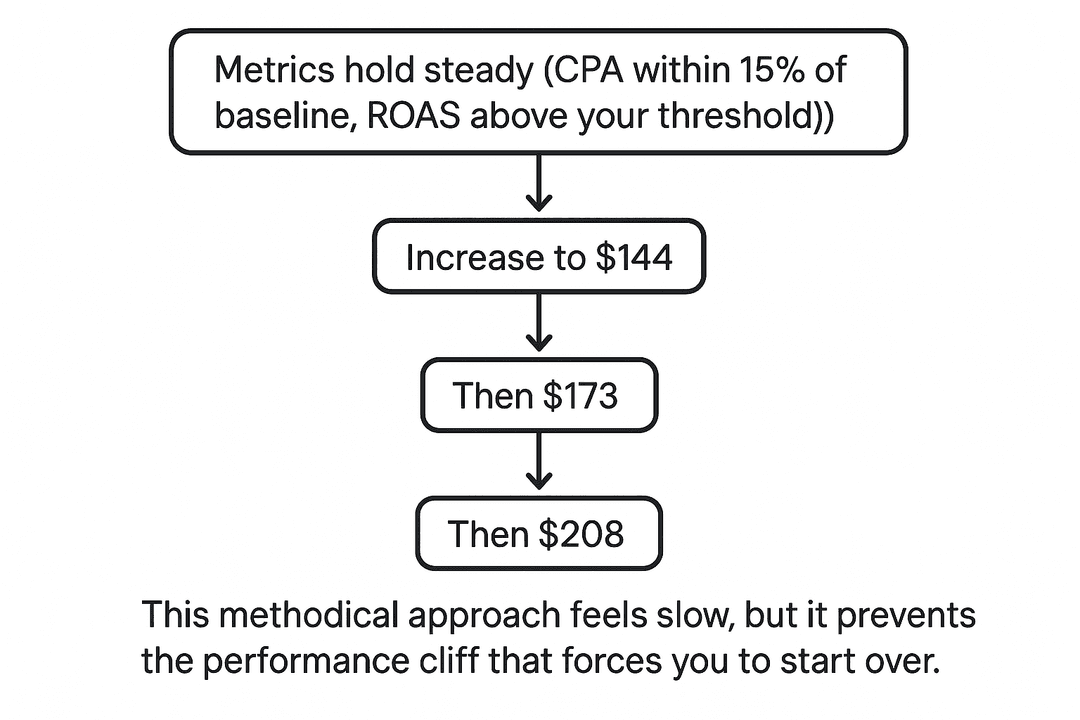
The math works in your favor. A 20% increase every 4 days means you're at $619 per day after 30 days—a 6x scale without the death spiral. Compare that to the advertiser who tripled to $300, crashed, rolled back to $100, and is still trying to recover.
Performance Thresholds and Rollback Triggers
Set clear thresholds before you scale. Define your acceptable CPA ceiling and minimum ROAS. When performance crosses these lines, you have two options: pause the increase and let the algorithm stabilize, or roll back to the previous budget level.
Most successful scalers use a "two-strike" rule. If performance degrades after a budget increase, they pause further scaling but maintain the current budget for 5-7 days. If performance doesn't recover, they roll back 20-30%. If it stabilizes, they resume the scaling schedule.
This approach requires daily monitoring during scaling phases. You can't set it and forget it. The algorithm is constantly reoptimizing, and you need to catch performance shifts before they become expensive problems.
Campaign Budget Optimization vs. Ad Set Budgets
When scaling, Campaign Budget Optimization (CBO) often outperforms ad set budgets because it lets Instagram's algorithm distribute spend to the best-performing combinations. However, CBO requires sufficient budget to test all ad sets effectively.
The rule of thumb: use CBO when your total campaign budget is at least 3x your target CPA multiplied by the number of ad sets. Below that threshold, the algorithm doesn't have enough budget to properly test all combinations, leading to premature optimization that might miss winners.
For early-stage scaling, ad set budgets give you more control. As you scale past $500-1000 per day, transitioning to CBO often improves efficiency by letting the algorithm do what it does best: find the optimal delivery mix.
Step 4: AI Automation for Complexity Management
Here's the reality check: everything you've learned so far works, but it's brutally time-intensive. Managing 15 creative variations across 8 audience segments with progressive budget increases means monitoring 120+ ad combinations daily. Making optimization decisions on that volume manually is where most advertisers hit their scaling ceiling.
This is where ai ad creation and automation become non-negotiable. The framework works, but human execution can't keep pace with the decision volume required for true scale.
What AI Automation Actually Does
Modern facebook ads automation tools handle the three most time-consuming scaling tasks: creative variation generation, performance monitoring, and optimization decisions.
AdStellar AI functions as an end-to-end Instagram ad scaling system that handles the execution complexity we've discussed throughout this framework. Instead of manually creating dozens of creative variations, monitoring performance across multiple campaigns, and making daily optimization decisions, the platform automates these processes while maintaining the strategic principles that drive successful scaling.
The platform starts with creative intelligence. When you connect your ad account, AdStellar AI analyzes your existing campaigns to identify which elements are driving performance. It examines hooks, visual components, offer framing, and engagement patterns to understand what's working. From there, it generates systematic variations that preserve your winning elements while testing new angles—executing the creative multiplication strategy from Step 1 automatically.
For audience management, the system implements progressive expansion strategies without requiring manual campaign setup. It creates lookalike audiences at incremental percentages, manages exclusions to prevent overlap, and tests interest combinations based on your target market. As campaigns gather data, AdStellar AI identifies which audience segments are delivering profitable conversions and allocates budget accordingly.
The budget scaling component follows rule-based protocols you define. You set your performance thresholds—maximum acceptable CPA, minimum ROAS requirements, and scaling pace preferences. The platform then implements gradual budget increases when campaigns meet your criteria, automatically pausing or rolling back when performance degrades. This removes the need for constant dashboard monitoring while preventing the sudden budget jumps that typically crater performance.
Campaign monitoring happens continuously. AdStellar AI tracks performance across all active campaigns, comparing real-time metrics against your baseline performance and defined thresholds. When an ad set's CPA increases beyond acceptable levels or ROAS drops below your minimum, the system either reduces its budget allocation or pauses it entirely, reallocating spend to better performers.
The platform also handles the operational tasks that consume hours of manual work: campaign structure setup, ad set organization, naming conventions, and tracking parameter implementation. When you want to test a new product or offer, you define the strategy and creative direction while AdStellar AI handles the technical execution across multiple audience segments and creative variations.
What makes this approach effective for scaling is the combination of strategic frameworks with execution consistency. The methodology we've covered—creative testing, audience expansion, progressive budget increases—works when executed properly. The challenge has always been maintaining that execution quality as campaign volume increases. Automation systems handle the repetitive optimization decisions that bog down manual management, letting you focus on higher-level strategy while the platform manages the operational complexity of running dozens or hundreds of ad combinations simultaneously.
Creative generation tools analyze your winning ads, identify the core elements, and systematically produce variations that maintain your winners while testing new angles. What takes you hours of manual work happens in minutes, letting you test more combinations faster.
Performance monitoring systems track every metric across all campaigns, flagging degradation before it becomes expensive. Instead of manually checking dashboards multiple times daily, you get alerts when performance crosses your thresholds, letting you focus on strategic decisions rather than data babysitting.
Optimization automation makes the budget and audience decisions you've learned about, but at scale. It implements the 20% increase rule, manages audience exclusions, and reallocates budget to top performers—all based on the frameworks that work, executed with consistency humans can't match.
The Human-AI Collaboration Model
Automation doesn't replace strategic thinking. It amplifies it. You still define the strategy: which products to promote, what offers to test, which audiences to target, and what performance thresholds matter for your business.
The AI handles execution: generating the creative variations, launching the campaigns, monitoring performance, making optimization adjustments, and scaling budgets according to your rules. This division of labor lets you manage 10x more campaigns than manual execution allows.
Think of it like having a team of media buyers who never sleep, never miss a data point, and execute your strategy with perfect consistency. That's what automated instagram ads systems deliver when properly configured.
Implementation Priorities for AI Scaling
Start with creative automation. Use ai tools for campaign management to generate variations of your winning ads. This immediately multiplies your testing capacity without proportionally increasing your workload.
Next, implement performance monitoring and alerting. Set up systems that track your key metrics and notify you when intervention is needed. This prevents the "check the dashboard every hour" trap that kills productivity.
Finally, layer in optimization automation. Once you've validated that your creative and monitoring systems work, let AI handle the routine optimization decisions—budget adjustments, audience expansions, and underperformer pausing. You focus on strategy and creative direction while automation handles execution.
Putting It All Together
You now have the complete framework that separates successful scalers from those stuck at $100 per day. The four-step system—creative multiplication, audience expansion, smart budget increases, and AI automation—isn't theory. It's the exact methodology that prevents the scaling death spiral we opened with.
Here's your scaling readiness checklist:
Foundation Check: Verify 7+ days of stable performance data and proper campaign structure before attempting any scaling.
Creative System: Deconstruct your winner, create systematic variations that preserve core elements, and organize assets for rapid testing.
Audience Strategy: Map your progressive lookalike expansion path, identify interest stacks, and set up exclusions to prevent cannibalization.
Budget Protocol: Follow the 20% daily increase rule, monitor performance thresholds religiously, and have rollback triggers ready.
The reality? Manual execution of this framework becomes overwhelming fast. When you're managing 50+ creative variations across multiple audience segments with daily budget decisions, you need automation that thinks like an expert media buyer.
That's exactly what AdStellar AI does. It analyzes your top performers, generates systematic variations, launches new campaigns, and makes real-time optimization decisions—all while you focus on strategy instead of spreadsheets. The entire scaling framework you just learned? AdStellar AI executes it automatically.
Start by analyzing your best-performing ad using the creative deconstruction method from Step 1. Identify what's working, then decide: manual execution or automated scaling. Get Started With AdStellar AI to see how AI handles the complexity while you capture the growth opportunity.